WTF?? Excuse me, but Kris Johnson from Chico, CA (and someone I worked with in Fairbanks, AK) pointed out in a comment to my last post that the real Extreme Makeover is looking for a "cancer survivor or a librarian."
Understand this. The two categories are bundled together on one line, as if there was some kind of affinity or equivalence. How weird. What could there possibly be related in these two "conditions"? The other categories are hokey perhaps but not oddly bundled. Rescue workers stand alone unbundled from divorcees. Even though some rescue workers are, no doubt divorcees, just as some librarians are cancer survivors--and I'll bet some people can fit in all four categories.
Anyone care to speculate what the connection is?
Wednesday, December 14, 2005


Extreme Makeover: OCLC Sympoisum at ALA
It's not the Symposium that is being extremely made over but it is the topic of the afternoon's talks at ALA Midwinter. Unfortunately we are not offering makeovers for audience members--or OCLC staff, for that matter, although on the mornings I look at myself and think, "good grief, it's my mother!" I would be most grateful for an extreme makeover.
No, this makeover refers to our collective community, our industry, Libraryland, and is related to the report we just issued called Perceptions of Libraries and Information Resources . Respondents to the survey that the report is based on generally like libraries, generally hold the information they get from librarians with reasonably high regard, and even use libraries with some regularity. But, there are some service gaps that need to be discussed, at the very least. Many respondents do not think much of the environments of the libraries they use--cold, dirty, no comfortable chairs, surly staff, confusing layouts and poor signage, inconvenient hours and locations--and most respondents associate libraries with books.
Now, this association with books is perhaps not one we want to discard or change as it is so very clearly important to people and is also important to people who work in libraries. But, what "industry", be that a clothing store, a church, a restaurant, or a car maker, wants to be associated with bad service and unpleasant surroundings? And beyond this, what "industry" wants to be known predominently for "products" that represent only a fraction of their offerings--and the oldest product line, at that? Libraries spend a bazillion dollars on electronic resources for their communities and as far as we can tell, they may as well have donated all that money to Oxfam or Doctors Without Borders and few people would have been the wiser.
Many librarians see Google and other search engines as competitors to libraries that must be beaten at their own game….many librarians still want people to begin searching at library websites because that’s where the “good” information is. This won’t ever happen, but a lot of energy and time is being spent on speaking and writing about the library as an alternative to search engines.
We’ve (well, I have, for sure) started to dig a little deeper into the published literature on peoples’ perceptions and use of libraries over decades (mostly in the US) and have discovered that it’s likely that only a minority of the population has ever used libraries which suggests that attempts to increase use do not provide the simple answer to increased support of libraries. Likewise, marketing of content to people isn’t likely the simple answer either as content is no longer the differentiator it used to be.
One differentiator of the library is in its role in the community in supporting the educational, recreational and leisure interests of all people, and in supporting citizenship and democracy but expression of this role has been muted lately in the library profession as attention is focused on providing content and services virtually, and on the encroachments of the Amazons and Googles.
So, we asked some clever and thoughtful people to come to San Antonio and talk to Symposium attendees about the issues suggested by the report. Hosted by Cathy De Rosa, mine and Alice's boss and OCLC Vice President of Marketing and Library Services, the panelists are: Antony Brewerton, Subject Team Leader at Oxford Brookes University; Patricia Martin, President and Founder of LitLamp Communications Group, Inc.; Jennifer Rice, President of Mantra Brand Communications; and Omar Wasow, Executive Director of BlackPlanet.com and Internet Analyst for NBC.
I'll provide details about them, including links, in my next post.
No, this makeover refers to our collective community, our industry, Libraryland, and is related to the report we just issued called Perceptions of Libraries and Information Resources . Respondents to the survey that the report is based on generally like libraries, generally hold the information they get from librarians with reasonably high regard, and even use libraries with some regularity. But, there are some service gaps that need to be discussed, at the very least. Many respondents do not think much of the environments of the libraries they use--cold, dirty, no comfortable chairs, surly staff, confusing layouts and poor signage, inconvenient hours and locations--and most respondents associate libraries with books.
Now, this association with books is perhaps not one we want to discard or change as it is so very clearly important to people and is also important to people who work in libraries. But, what "industry", be that a clothing store, a church, a restaurant, or a car maker, wants to be associated with bad service and unpleasant surroundings? And beyond this, what "industry" wants to be known predominently for "products" that represent only a fraction of their offerings--and the oldest product line, at that? Libraries spend a bazillion dollars on electronic resources for their communities and as far as we can tell, they may as well have donated all that money to Oxfam or Doctors Without Borders and few people would have been the wiser.
Many librarians see Google and other search engines as competitors to libraries that must be beaten at their own game….many librarians still want people to begin searching at library websites because that’s where the “good” information is. This won’t ever happen, but a lot of energy and time is being spent on speaking and writing about the library as an alternative to search engines.
We’ve (well, I have, for sure) started to dig a little deeper into the published literature on peoples’ perceptions and use of libraries over decades (mostly in the US) and have discovered that it’s likely that only a minority of the population has ever used libraries which suggests that attempts to increase use do not provide the simple answer to increased support of libraries. Likewise, marketing of content to people isn’t likely the simple answer either as content is no longer the differentiator it used to be.
One differentiator of the library is in its role in the community in supporting the educational, recreational and leisure interests of all people, and in supporting citizenship and democracy but expression of this role has been muted lately in the library profession as attention is focused on providing content and services virtually, and on the encroachments of the Amazons and Googles.
So, we asked some clever and thoughtful people to come to San Antonio and talk to Symposium attendees about the issues suggested by the report. Hosted by Cathy De Rosa, mine and Alice's boss and OCLC Vice President of Marketing and Library Services, the panelists are: Antony Brewerton, Subject Team Leader at Oxford Brookes University; Patricia Martin, President and Founder of LitLamp Communications Group, Inc.; Jennifer Rice, President of Mantra Brand Communications; and Omar Wasow, Executive Director of BlackPlanet.com and Internet Analyst for NBC.
I'll provide details about them, including links, in my next post.
Tuesday, December 13, 2005
Arrows Wanted
“Me and my Arrow,
Straighter than narrow.”
– from Harry Nilsson’s song, “Me and My Arrow”
This delightful song has been playing in my head ever since I bought Nilsson’s Greatest Hits album. I also adore the animated movie, The Point about a land where everything must have a Point. The made-for-TV movie featured “Me and My Arrow” and other songs by Nilsson who is also credited with The Point’s story.
So let’s talk about pointing. Among the genteel it’s considered impolite, but on the web one can – indeed, ideally, will -- point (i.e. link) to other resources, or, frequently, to descriptions of those resources. In this blog entry so far, I’ve linked to entries in the All Music Guide, Internet Movie Database, and Open WorldCat, and these have all been references to information about the “thing,” but not the thing itself. Indirection of this sort can be powerful, sometimes annoying -- and for items that can’t transit over the web, a necessity -- but done well, it’s also a superb means of adding value to a reader/user’s experience. The information I’ve linked to provides background and context, and, for the album and movie, provides adequate information to help you get to a copy if you wish.
Referring is something libraries have done forever. Certainly through our catalogs (e.g., search the catalog, discover resources, find the call number, retrieve the item), but also through carefully-crafted pathfinders (i.e. selected bibliographies of library resources). And library reference work is, well, mostly about query-refinement, recommending, and referring. We’ve raised pointing to a high art. Heck, if you simply counted the number of times reference librarians have pointed to where the library washrooms could be found, surely librarians have claim to a new category in the Guinness Book of World Records.
But back to the point -- if the recent past gave us “Rip, Mix, Burn,” (a la Apple’s iTunes ad campaign) and the current thinking emphasizes “Remix” (for more see a conversation with and presentation by Rael Dorfest of O’Reilly Media), I’d like to add another verb, “Refer.” It might just be the Next Big Thing. Indeed, maybe it’s a candidate as a central feature of Library 2.0. Authoritative pointers to reliable descriptions -- and a quick means (intermediated by the library) to get to the referenced resources – is a durable, powerful role for libraries. The next phase is arguably about re-platforming these basic services, and adding in a robust content contribution role for users. Maybe the Library 2.0 campaign slogan should be “Reconnoiter, Refer, Retrieve, Reuse, Reward?”
OK so I got slightly off-point again. Sorry. Let’s return to the pointers themselves. As you’ll see by looking at the various URLs used so far in this blog entry, many lack an elegance of syntax. And we know far too many URLs lack persistence. A lack of elegance isn’t necessarily fatal, but a predictable syntax that lets you remix well-known identifiers into persistent, actionable URLs is certainly far more useful – it makes pointing a lot more predictable, and the pointers far easier for third parties to construct without actually having to do a lot of preliminary searching to figure out what the URL will be. As a new blogger (welcome!) recently noted, there is now a very nice feature in Open WorldCat that allows anyone to cite resources by using a simple URL syntax and the appropriate ISBN/ISSN/OCLC-record-number to point to the corresponding Open WorldCat record (official instructions here).
And use these Open WorldCat links I have. I’ll find the ISBN of an item I’m interested in through various sources, then use the Open WorldCat ISBN URL link method to bring up the appropriate record, click on the editions tab (if one’s present) to look for other editions (e.g., audiobook, e-book, etc.). It’s easy to see if my local public library (for personal reading) or the OCLC Library & Information Center (for professional reading) has the item. And for the professional materials I want, I’ll just email the Open WorldCat link to the OCLC library staff as a circulation/material purchase/ILL request (which is really handy – when they get the item they automatically check it out to me, and ship it to me by interoffice mail. In fact it’s possibly too easy – OCLC staff get indefinite check-out for most items so I now have a very sizable collection of library materials at my desk. And yes, we’re a little spoiled by our marvelous library staff. The blame falls partially on George though – he encourages this sort of user-centered behavior).
If I cite a book, DVD, CD, etc. in a document, blog entry, or create a bibliography that’s going to be made available on the web, I’m now favoring embedding links in the citations to their respective Open WorldCat records – it just makes life so much easier for anyone who actually wants to follow through on the citation and get a copy. Presumably routinely embedding Open WorldCat links would make library pathfinders a bit easier to maintain (as opposed to linking to a number of alternative bibliographic sources) since the links should prove very durable. And in any case the Open WorldCat links in pathfinders could be used with greater ease by users who aren’t the primary service population – all the easier to find the copy in their local library.
One tip, gentle readers – Open WorldCat has a corresponding record for every record in WorldCat, but the search engines only index a subset of all of WorldCat’s records. A big subset, true, but not all. Which means the URL-with-ISBN/ISSN/OCLC record-number link will retrieve records that don’t show up when you search Open WorldCat via the search engines (BTW did I mention that there are some great Open WorldCat tools/search plug-ins are available?)
Which all leads to the final point: I may “heart” Harry Nilsson, but now I “arrow” Open WorldCat frequently and often. And I hope others will too.
Straighter than narrow.”
– from Harry Nilsson’s song, “Me and My Arrow”
This delightful song has been playing in my head ever since I bought Nilsson’s Greatest Hits album. I also adore the animated movie, The Point about a land where everything must have a Point. The made-for-TV movie featured “Me and My Arrow” and other songs by Nilsson who is also credited with The Point’s story.
So let’s talk about pointing. Among the genteel it’s considered impolite, but on the web one can – indeed, ideally, will -- point (i.e. link) to other resources, or, frequently, to descriptions of those resources. In this blog entry so far, I’ve linked to entries in the All Music Guide, Internet Movie Database, and Open WorldCat, and these have all been references to information about the “thing,” but not the thing itself. Indirection of this sort can be powerful, sometimes annoying -- and for items that can’t transit over the web, a necessity -- but done well, it’s also a superb means of adding value to a reader/user’s experience. The information I’ve linked to provides background and context, and, for the album and movie, provides adequate information to help you get to a copy if you wish.
Referring is something libraries have done forever. Certainly through our catalogs (e.g., search the catalog, discover resources, find the call number, retrieve the item), but also through carefully-crafted pathfinders (i.e. selected bibliographies of library resources). And library reference work is, well, mostly about query-refinement, recommending, and referring. We’ve raised pointing to a high art. Heck, if you simply counted the number of times reference librarians have pointed to where the library washrooms could be found, surely librarians have claim to a new category in the Guinness Book of World Records.
But back to the point -- if the recent past gave us “Rip, Mix, Burn,” (a la Apple’s iTunes ad campaign) and the current thinking emphasizes “Remix” (for more see a conversation with and presentation by Rael Dorfest of O’Reilly Media), I’d like to add another verb, “Refer.” It might just be the Next Big Thing. Indeed, maybe it’s a candidate as a central feature of Library 2.0. Authoritative pointers to reliable descriptions -- and a quick means (intermediated by the library) to get to the referenced resources – is a durable, powerful role for libraries. The next phase is arguably about re-platforming these basic services, and adding in a robust content contribution role for users. Maybe the Library 2.0 campaign slogan should be “Reconnoiter, Refer, Retrieve, Reuse, Reward?”
OK so I got slightly off-point again. Sorry. Let’s return to the pointers themselves. As you’ll see by looking at the various URLs used so far in this blog entry, many lack an elegance of syntax. And we know far too many URLs lack persistence. A lack of elegance isn’t necessarily fatal, but a predictable syntax that lets you remix well-known identifiers into persistent, actionable URLs is certainly far more useful – it makes pointing a lot more predictable, and the pointers far easier for third parties to construct without actually having to do a lot of preliminary searching to figure out what the URL will be. As a new blogger (welcome!) recently noted, there is now a very nice feature in Open WorldCat that allows anyone to cite resources by using a simple URL syntax and the appropriate ISBN/ISSN/OCLC-record-number to point to the corresponding Open WorldCat record (official instructions here).
And use these Open WorldCat links I have. I’ll find the ISBN of an item I’m interested in through various sources, then use the Open WorldCat ISBN URL link method to bring up the appropriate record, click on the editions tab (if one’s present) to look for other editions (e.g., audiobook, e-book, etc.). It’s easy to see if my local public library (for personal reading) or the OCLC Library & Information Center (for professional reading) has the item. And for the professional materials I want, I’ll just email the Open WorldCat link to the OCLC library staff as a circulation/material purchase/ILL request (which is really handy – when they get the item they automatically check it out to me, and ship it to me by interoffice mail. In fact it’s possibly too easy – OCLC staff get indefinite check-out for most items so I now have a very sizable collection of library materials at my desk. And yes, we’re a little spoiled by our marvelous library staff. The blame falls partially on George though – he encourages this sort of user-centered behavior).
If I cite a book, DVD, CD, etc. in a document, blog entry, or create a bibliography that’s going to be made available on the web, I’m now favoring embedding links in the citations to their respective Open WorldCat records – it just makes life so much easier for anyone who actually wants to follow through on the citation and get a copy. Presumably routinely embedding Open WorldCat links would make library pathfinders a bit easier to maintain (as opposed to linking to a number of alternative bibliographic sources) since the links should prove very durable. And in any case the Open WorldCat links in pathfinders could be used with greater ease by users who aren’t the primary service population – all the easier to find the copy in their local library.
One tip, gentle readers – Open WorldCat has a corresponding record for every record in WorldCat, but the search engines only index a subset of all of WorldCat’s records. A big subset, true, but not all. Which means the URL-with-ISBN/ISSN/OCLC record-number link will retrieve records that don’t show up when you search Open WorldCat via the search engines (BTW did I mention that there are some great Open WorldCat tools/search plug-ins are available?)
Which all leads to the final point: I may “heart” Harry Nilsson, but now I “arrow” Open WorldCat frequently and often. And I hope others will too.
Tuesday news roundup
Just because I haven't seen it elsewhere (but truth be told, I have not exactly looked everywhere--so no offense if someone posted it days ago...) I thought I'd give some news round up for the posse:
1. Yahoo! bought delicious. Quite cool and it makes total sense to me, that the same brilliant minds working on Flickr will fold in del.icio.us. I always read that and think of delis in the US and wish for veggie pastrami. Don't ask me. What I didn't realize or had forgotten--is that Amazon.com was one of Del.icio.us's venture capital funders. Huh! And Upcoming.org is Yahoo's answer for evite, look like.
2. HarperCollins plans to do something with their digital content. Digitize its catalog of 20,000 books and scan about 3,500 new titles every year. A Publish article here, Chronicle blog post there...but interestingly enough, HarperCollins has happily been a NetLibrary Publisher Partner for years. Or so I thought...(Freakonomics was the June 2005 NetLibrary eBook of the month!)
3. eWeek.com did a special report on "Libraries Go Online" (as if they're breaking new journalistic ground or something? Whatevah...)
4. A back issue of Talk of the Nation from Nov. 2, 2005 features Chris Anderson of ALA Annual 2005 OCLC Symposium fame (oh okay, he's also the editor-in-chief of Wired),Jimmy Wales, founder of Wikimedia Foundation and Nicholas Carr, writer with creds, all chime in with Neal for a rousing (and differing) exchange of opinions on Wikipedia, the Open Source and the Future of the Web.
5. Most of us are sick of talking about Web 2.0. Library 2.0...but of course most people (including me) are just now sorting out what meanings everyone packs into these quasi-ambiguous terms. See Lorcan's post for reflections on buzzwords.
Now, what news have I forgotten, oh my IAG readers?
1. Yahoo! bought delicious. Quite cool and it makes total sense to me, that the same brilliant minds working on Flickr will fold in del.icio.us. I always read that and think of delis in the US and wish for veggie pastrami. Don't ask me. What I didn't realize or had forgotten--is that Amazon.com was one of Del.icio.us's venture capital funders. Huh! And Upcoming.org is Yahoo's answer for evite, look like.
2. HarperCollins plans to do something with their digital content. Digitize its catalog of 20,000 books and scan about 3,500 new titles every year. A Publish article here, Chronicle blog post there...but interestingly enough, HarperCollins has happily been a NetLibrary Publisher Partner for years. Or so I thought...(Freakonomics was the June 2005 NetLibrary eBook of the month!)
3. eWeek.com did a special report on "Libraries Go Online" (as if they're breaking new journalistic ground or something? Whatevah...)
4. A back issue of Talk of the Nation from Nov. 2, 2005 features Chris Anderson of ALA Annual 2005 OCLC Symposium fame (oh okay, he's also the editor-in-chief of Wired),Jimmy Wales, founder of Wikimedia Foundation and Nicholas Carr, writer with creds, all chime in with Neal for a rousing (and differing) exchange of opinions on Wikipedia, the Open Source and the Future of the Web.
5. Most of us are sick of talking about Web 2.0. Library 2.0...but of course most people (including me) are just now sorting out what meanings everyone packs into these quasi-ambiguous terms. See Lorcan's post for reflections on buzzwords.
Now, what news have I forgotten, oh my IAG readers?
Monday, December 12, 2005
Blog Salon is on, now at 6:00 pm
Still Sunday, Jan. 22.
Still OCLC Blue Suite.
Now at 6:00pm (ish)!
In honor of Texas and especially of the Guadalupe river that managed to miss my Dad's house by mere inches, we will be having chips and salsa instead of pretzels this time.
Come one, come all, come blogger, come soon-to-be blogger, come I've-run-out-of-ideas-blogger, come I-just-want-my-photo-with-Steven-Cohen-blogger...
Still OCLC Blue Suite.
Now at 6:00pm (ish)!
In honor of Texas and especially of the Guadalupe river that managed to miss my Dad's house by mere inches, we will be having chips and salsa instead of pretzels this time.
Come one, come all, come blogger, come soon-to-be blogger, come I've-run-out-of-ideas-blogger, come I-just-want-my-photo-with-Steven-Cohen-blogger...
Thursday, December 08, 2005
All I got is a photograph...
“But all I got is a photograph,
And I realise you're not coming back anymore.”
from the song, “Photograph,” by Richard Starkey and George Harrison
I just returned from an OCLC Distinguished Seminar Series presentation by Cathy Marshall (Microsoft) entitled “A Personal Digital Dark Ages: Assessing the Fate of Our Digital Belongings.” Cathy has an easy-going presentation style, and the content was a very approachable mix of the fruits of professional inquiry and her own experiences with her personal archive.
Some highlights of her talk:
• The popular impression that modern life yields significant quantities of personal digital stuff is accurate. Many of us accumulate material in a sort of endless storage room fashion – pile it in, sort it out later. But we generally do a poor job of sorting it out later...
• Digital stores are different from physical ones in many ways – for example with respect to the “geography” of the store (we may remember the grey box on the top shelf has family photos – on our computer we don’t usually get a comparable experience).
• Personal strategies for coping with one’s digital attic and even interest in having access to one’s digital history vary widely by what it is and whose it is. Some people are content to keep a few items and let the rest get lost, trashed, or otherwise pass into oblivion. Others really want to keep everything, but most have vague strategies at best for archiving; strategies which are rarely systematically acted upon (e.g., We know we can burn our documents to CD, but we either don’t, or don’t do it systematically).
• The plethora of platforms, systems, applications, email accounts, etc. most of us use definitely contributes to the problem – from format obsolescence to forgotten passwords and many more issues. With shared computers, loaned PDAs and cast-offs of old equipment, it’s easy to have our digital store in many hands, many places. The net result for most people is a poorly managed and highly vulnerable personal archive.
• Even if you manage to store your content on single machine/server/etc., finding, retrieving, sorting, labeling, and otherwise usefully managing the content is a burden that various desktop tools like Google Desktop address only partially at best.
A great take-away for me was the term, “re-encountering,” that flash of memories experience one has when re-encountering a forgotten keepsake. Cathy’s point was that we typically loose the serendipity of these memory re-encounters we tend to experience with physical archives when we search a digital store – with a digital file, it’s possible to deep search for a desired item; in a physical archive, we usually have to browse through “irrelevant” materials during our search.
Cathy cited Terry Kuny’s “A Digital Dark Ages? Challenges in the Preservation of Electronic Information” among the resources she’s found valuable on the topic. It’s definitely a worthwhile read.
And with that, here’s the close of one more piece of digital content to be put at risk. Hmm...maybe I should print this out and put it in the blue box at the back of my closet...
(BTW: I’m delighted to be a guest blogger on It’s All Good. I’ve been a regular reader from the start, and have even been tapped now and again to do some presentations on the OCLC Environmental Scan. So I follow my heroes, Alice, Alane, George, once more into the breach!)
And I realise you're not coming back anymore.”
from the song, “Photograph,” by Richard Starkey and George Harrison
I just returned from an OCLC Distinguished Seminar Series presentation by Cathy Marshall (Microsoft) entitled “A Personal Digital Dark Ages: Assessing the Fate of Our Digital Belongings.” Cathy has an easy-going presentation style, and the content was a very approachable mix of the fruits of professional inquiry and her own experiences with her personal archive.
Some highlights of her talk:
• The popular impression that modern life yields significant quantities of personal digital stuff is accurate. Many of us accumulate material in a sort of endless storage room fashion – pile it in, sort it out later. But we generally do a poor job of sorting it out later...
• Digital stores are different from physical ones in many ways – for example with respect to the “geography” of the store (we may remember the grey box on the top shelf has family photos – on our computer we don’t usually get a comparable experience).
• Personal strategies for coping with one’s digital attic and even interest in having access to one’s digital history vary widely by what it is and whose it is. Some people are content to keep a few items and let the rest get lost, trashed, or otherwise pass into oblivion. Others really want to keep everything, but most have vague strategies at best for archiving; strategies which are rarely systematically acted upon (e.g., We know we can burn our documents to CD, but we either don’t, or don’t do it systematically).
• The plethora of platforms, systems, applications, email accounts, etc. most of us use definitely contributes to the problem – from format obsolescence to forgotten passwords and many more issues. With shared computers, loaned PDAs and cast-offs of old equipment, it’s easy to have our digital store in many hands, many places. The net result for most people is a poorly managed and highly vulnerable personal archive.
• Even if you manage to store your content on single machine/server/etc., finding, retrieving, sorting, labeling, and otherwise usefully managing the content is a burden that various desktop tools like Google Desktop address only partially at best.
A great take-away for me was the term, “re-encountering,” that flash of memories experience one has when re-encountering a forgotten keepsake. Cathy’s point was that we typically loose the serendipity of these memory re-encounters we tend to experience with physical archives when we search a digital store – with a digital file, it’s possible to deep search for a desired item; in a physical archive, we usually have to browse through “irrelevant” materials during our search.
Cathy cited Terry Kuny’s “A Digital Dark Ages? Challenges in the Preservation of Electronic Information” among the resources she’s found valuable on the topic. It’s definitely a worthwhile read.
And with that, here’s the close of one more piece of digital content to be put at risk. Hmm...maybe I should print this out and put it in the blue box at the back of my closet...
(BTW: I’m delighted to be a guest blogger on It’s All Good. I’ve been a regular reader from the start, and have even been tapped now and again to do some presentations on the OCLC Environmental Scan. So I follow my heroes, Alice, Alane, George, once more into the breach!)
I'll post something tomorrow...
A light-hearted-yet-serious article from the Chronicle, with insights into procrastination. Not that anyone out there in blogland is a procrastinator. We watch our bloglines like hawks!
An interesting personal note to this effect: I posted a message to a Google Groups, to see if there were any sports teams in the area who needed players. Less than 8 hours later, one of my colleagues says, "hey I saw your post for soccer..."
It's a crazy, linked-in world where you snooze (or procrastinate), you are soooo behind.
An interesting personal note to this effect: I posted a message to a Google Groups, to see if there were any sports teams in the area who needed players. Less than 8 hours later, one of my colleagues says, "hey I saw your post for soccer..."
It's a crazy, linked-in world where you snooze (or procrastinate), you are soooo behind.
Blatant Puffery
Several weeks ago, Paul Miller and I recorded a podcast for the Talis website. (Talis provides library management systems in the UK and Ireland.) It's now available, and I invite you to listen.
Wednesday, December 07, 2005
It’s time to rejuvenate the ‘Library’ brand
A direct quotation from the recent news release about the new Perceptions report.
Monday, December 05, 2005
Blog Salon at ALA Midwinter
And speaking of Blog salon, I know you've all been hanging on the edge of your seats, and now you can jump to your feet in euphoria: The Blog Salon is On!
So gear up, get your flickr tabs shined and your Blog People t-shirts ordered, because we'll be hosting Blog Salon II in San Antonio.
Plan on Sunday, January 22 late afternoon around 4.
More details as we have them!
So gear up, get your flickr tabs shined and your Blog People t-shirts ordered, because we'll be hosting Blog Salon II in San Antonio.
Plan on Sunday, January 22 late afternoon around 4.
More details as we have them!
Alane writes as we introduce Eric
Speaking of Alane, she is taking a mini-sabbatical for a couple of weeks, to do some deep thinking, reading and writing on the next report. She has even offered to share the fun--so I have a stack of books (!) on my desk that I can't wait to dig into, too, over the holidays.
side note: the exclamation point is really in reference to the Perceptions report...and the idea that someone would do research in books instead of entirely in online journals, blogs, sites, eContent...
Meanwhile, back at the ranch
Alane will still pop in occasionally, but in the spirit of holiday gift-giving, IAG will also host a guest blogger, Eric Childress of OCLC Research during this time. Eric always feeds us good stuff from the back-end, and veteran IAG readers may recognize him from the Blog Salon at ALA in June...
side note: the exclamation point is really in reference to the Perceptions report...and the idea that someone would do research in books instead of entirely in online journals, blogs, sites, eContent...
Meanwhile, back at the ranch
Alane will still pop in occasionally, but in the spirit of holiday gift-giving, IAG will also host a guest blogger, Eric Childress of OCLC Research during this time. Eric always feeds us good stuff from the back-end, and veteran IAG readers may recognize him from the Blog Salon at ALA in June...
Predictions to Innovations to a Sea Change (or maybe just a wave or two)
All this talk of future Scan predictions becoming reality is way exciting, a little daunting and a little "duh, it was old news by the time it was published on paper." My reactions, anyway.
Innovations need translation into tangible actions
But it led me to thinking about innovations, innovative thinking and how hard it is to know what to DO about trends and predictions--as far as daily life and behavior, tactics, operations is concerned. We won't even get into strategic vision.
Sometimes, two skill sets
Of course, you have to have both (strategy AND tactics). But very often, an organization (a library) may need leaders with different skill sets to accomplish the big picture. It reminds me of the old saying that Winston Churchill would have failed miserably as a peacetime leader, but that he was the right person in the right situation for the WWII setting in the UK.
That brings me back around to libraries. How do we embrace the innovations/changes we hear about (encouraging *risk*) while maintaining enough structure to provide an optimum environment for innovation? And I guess I was thinking about it from the staff development point of view--but it could apply to the library's physical and online environment, as well.
Possibilities for innovation: create a space for it
Is there someone on your staff always complaining about the way things are? Empower that person to present options for change in a recognized kind of way. Are there "sparkspaces" online for patrons/students to meet up on topics of interest, through your library? Perhaps the ship has already sailed on community-forming social software. Of course, we all thought that about Search 3 years ago, too. There are plenty of places to do quick wins on the way to the big Innovations--no matter what your leadership strengths are, for your organization.
A quick read
Food for the day on innovation culture and how to manage through it, from HBS, from the Director-level's vantage point. (Because we all fancy ourselves Directors someday, if we've not already become one at age 26, like George!)
Innovations need translation into tangible actions
But it led me to thinking about innovations, innovative thinking and how hard it is to know what to DO about trends and predictions--as far as daily life and behavior, tactics, operations is concerned. We won't even get into strategic vision.
Sometimes, two skill sets
Of course, you have to have both (strategy AND tactics). But very often, an organization (a library) may need leaders with different skill sets to accomplish the big picture. It reminds me of the old saying that Winston Churchill would have failed miserably as a peacetime leader, but that he was the right person in the right situation for the WWII setting in the UK.
That brings me back around to libraries. How do we embrace the innovations/changes we hear about (encouraging *risk*) while maintaining enough structure to provide an optimum environment for innovation? And I guess I was thinking about it from the staff development point of view--but it could apply to the library's physical and online environment, as well.
Possibilities for innovation: create a space for it
Is there someone on your staff always complaining about the way things are? Empower that person to present options for change in a recognized kind of way. Are there "sparkspaces" online for patrons/students to meet up on topics of interest, through your library? Perhaps the ship has already sailed on community-forming social software. Of course, we all thought that about Search 3 years ago, too. There are plenty of places to do quick wins on the way to the big Innovations--no matter what your leadership strengths are, for your organization.
A quick read
Food for the day on innovation culture and how to manage through it, from HBS, from the Director-level's vantage point. (Because we all fancy ourselves Directors someday, if we've not already become one at age 26, like George!)
Microcontent
Once again, life is imitating the Scan!
Andy Havens of OCLC's Marketing Department passed along an interesting new (at least to me) web site for a company called Encryptanet. Encryptanet allows providers of content to put small charges on access to their content (say, 25 cents for 24 hours of access), to allow impulse purchase of online material. The payments are handled through PayPal, and the transactions would be pretty much invisible to the user, at least according to Encryptanet's publicity.
What isn't clear to me from reading this site is how the individual reader signs up. If it's going to be truly invisible to me as a user, it needs to be set up in advance, like a deposit account. I put $50 in my microcontent account, and Encryptanet tells me when I'm down to my last $5, or something to that effect. Neither I nor my bank wants my checking account charged 25 cents everytime I impulsively purchase a new article about the Marx Brothers or Riders in the Sky.
The implications for something like this for libraries are pretty profound. You could set aside part of your acquisitions budget for content on demand. People could actually get the articles they need immediately. You could drop expensive subscriptions to titles that are rarely used. Nahhh...
For aggregators like us, oy... Publishers of all ilks, from major newspapers to small mom-and-pop blogs like "It's All Good" could hang out their shingles with their rates and let the search engines be their indexes. (Actually, we have no mothers and only one stepfather among the regular contributors to "It's All Good.")
No, I don't believe this is the end of the world as we know it, but I do think that this is yet another shot across the bow in the ongoing process of disaggregation of the bigger packages of information.
Andy Havens of OCLC's Marketing Department passed along an interesting new (at least to me) web site for a company called Encryptanet. Encryptanet allows providers of content to put small charges on access to their content (say, 25 cents for 24 hours of access), to allow impulse purchase of online material. The payments are handled through PayPal, and the transactions would be pretty much invisible to the user, at least according to Encryptanet's publicity.
What isn't clear to me from reading this site is how the individual reader signs up. If it's going to be truly invisible to me as a user, it needs to be set up in advance, like a deposit account. I put $50 in my microcontent account, and Encryptanet tells me when I'm down to my last $5, or something to that effect. Neither I nor my bank wants my checking account charged 25 cents everytime I impulsively purchase a new article about the Marx Brothers or Riders in the Sky.
The implications for something like this for libraries are pretty profound. You could set aside part of your acquisitions budget for content on demand. People could actually get the articles they need immediately. You could drop expensive subscriptions to titles that are rarely used. Nahhh...
For aggregators like us, oy... Publishers of all ilks, from major newspapers to small mom-and-pop blogs like "It's All Good" could hang out their shingles with their rates and let the search engines be their indexes. (Actually, we have no mothers and only one stepfather among the regular contributors to "It's All Good.")
No, I don't believe this is the end of the world as we know it, but I do think that this is yet another shot across the bow in the ongoing process of disaggregation of the bigger packages of information.
Sunday, December 04, 2005
"Gaming, Learning and Libraries"
Tomorrow (Monday) I'm off to Chicago for a program organized by Jenny Levine called "Gaming, Learning and Libraries." Unfortunately, I'm going to miss the first day of this two day conference because of a previous commitment at OCLC, but there should be plenty of food for thought on Tuesday. I hope I provide a little during my own talk.
One of the things I'll be discussing that I didn't even have time to include in the PowerPoint version of my talk is a survey that was released late last month by the BBC. The "Beeb" asked an undisclosed number of UK residents about their gaming habits, and the results are very interesting. 59% of those surveyed (between the ages of 6 and 65) are gamers. Incidentally, for the purposes of this survey, "A gamer is defined as someone who has played video games in the last six months on any platform, including interactive TV (iTV)." 100% of the youngest people surveyed are gamers. Consoles were the most commonly used, followed by PC games and handhelds. My colleague David Leslie from the QuestionPoint team, who pointed me to this study, warned me that their are major differences in the ways people in different countries approach gaming, but this is still a good snapshot and adds more fuel to the discussion.
One of the things I'll be discussing that I didn't even have time to include in the PowerPoint version of my talk is a survey that was released late last month by the BBC. The "Beeb" asked an undisclosed number of UK residents about their gaming habits, and the results are very interesting. 59% of those surveyed (between the ages of 6 and 65) are gamers. Incidentally, for the purposes of this survey, "A gamer is defined as someone who has played video games in the last six months on any platform, including interactive TV (iTV)." 100% of the youngest people surveyed are gamers. Consoles were the most commonly used, followed by PC games and handhelds. My colleague David Leslie from the QuestionPoint team, who pointed me to this study, warned me that their are major differences in the ways people in different countries approach gaming, but this is still a good snapshot and adds more fuel to the discussion.
Thursday, December 01, 2005
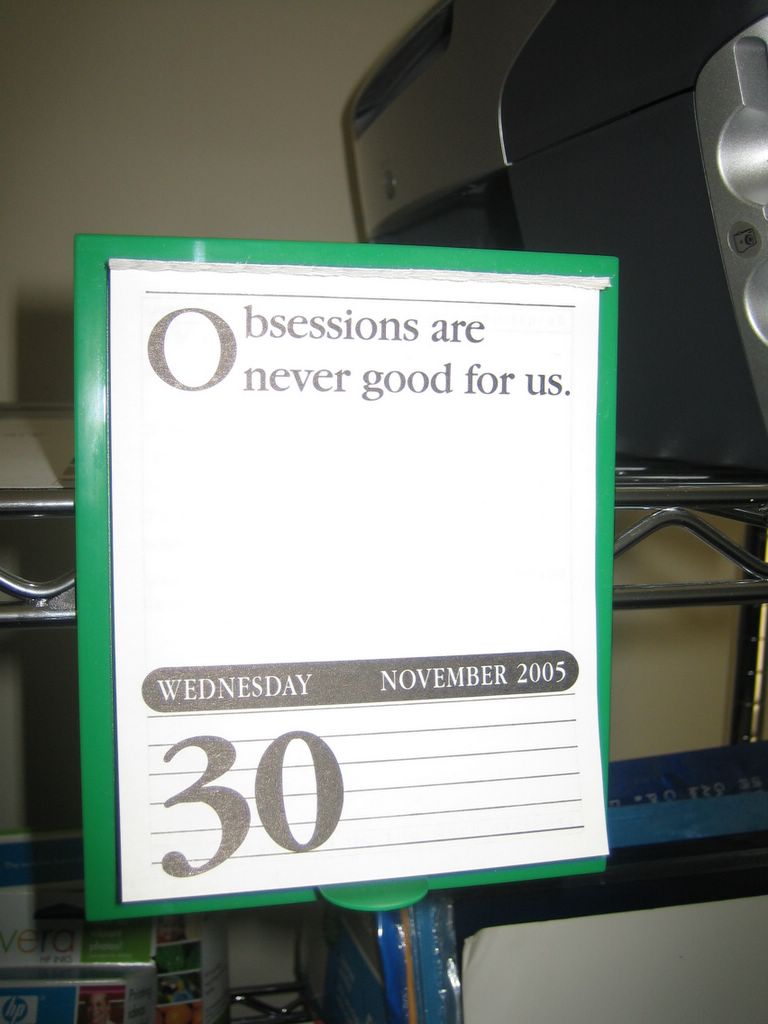

"Obsessions are never good for us"
I'm taking a poll:
Who agreeswith this advice?
And who disagrees?
(The photo says "Obsessions are never good for us.)
I tend to think a healthy fascination--okay, obsession--be it books, authors, quality customer service, a great online experience, absolutely spotless MARC records, ratings, the best recipe for carrot cake, the quickest route to the grocery store, the exact right paint shade for the living room, checking for new podcasts...can be an acceptable vice.
Any reflections, IAG readers?
Who agreeswith this advice?
And who disagrees?
(The photo says "Obsessions are never good for us.)
I tend to think a healthy fascination--okay, obsession--be it books, authors, quality customer service, a great online experience, absolutely spotless MARC records, ratings, the best recipe for carrot cake, the quickest route to the grocery store, the exact right paint shade for the living room, checking for new podcasts...can be an acceptable vice.
Any reflections, IAG readers?
Wednesday, November 30, 2005
WebJunction Wiki
A shout-out to my colleagues at Webjunction who have unveiled their "perpetual beta" wiki.
In his post, Joe Anderson says: "Where we’re headed in our thinking is to use wiki technology as an information management *tool* that is part of a *practice* that includes both free information and more-or-less canonical information. This latter is necessary for us in large part because of our partnerships with state library and other organizations that do not want their content available for editing, but also because some of our content is more authorative in nature (individually authored opinions about specific practices–like wikis, for example). But free information, within that bounded context, is also important component of what we do (and do already, to a certain degree, on our message boards)."
This is good...addressing the need for authority and free information.
In his post, Joe Anderson says: "Where we’re headed in our thinking is to use wiki technology as an information management *tool* that is part of a *practice* that includes both free information and more-or-less canonical information. This latter is necessary for us in large part because of our partnerships with state library and other organizations that do not want their content available for editing, but also because some of our content is more authorative in nature (individually authored opinions about specific practices–like wikis, for example). But free information, within that bounded context, is also important component of what we do (and do already, to a certain degree, on our message boards)."
This is good...addressing the need for authority and free information.
Monday, November 28, 2005
Digitization report from the UK
From the press release issuedNovember 24, 2005.
Although around £130m of public money has been spent on the creation of digital content since the mid-1990s, public sector digitisation programmes have been unstructured, piecemeal and fragmented. In contrast, Google’s Print Library Project, which aims to digitise huge quantities of books from some of the world’s leading libraries, “portends a revolution” in the world of information provision in which the public sector risks being left behind...The report, commissioned on behalf of JISC (Joint Information Systems Committee) and CURL (Consortium of Research Libraries in the British Isles) and based on research undertaken at Loughborough University, also recommends the creation of a UK-wide strategy to avoid the duplication, gaps in provision and lack of coordination that have hampered public sector efforts in this area.
Full report pdf here.
Spotted on Stephen's Web.
Although around £130m of public money has been spent on the creation of digital content since the mid-1990s, public sector digitisation programmes have been unstructured, piecemeal and fragmented. In contrast, Google’s Print Library Project, which aims to digitise huge quantities of books from some of the world’s leading libraries, “portends a revolution” in the world of information provision in which the public sector risks being left behind...The report, commissioned on behalf of JISC (Joint Information Systems Committee) and CURL (Consortium of Research Libraries in the British Isles) and based on research undertaken at Loughborough University, also recommends the creation of a UK-wide strategy to avoid the duplication, gaps in provision and lack of coordination that have hampered public sector efforts in this area.
Full report pdf here.
Spotted on Stephen's Web.
From Information Society to Interaction Society?
"We are moving from the information society to the interaction society, and Lunarstorm is leading the trend," said Ola Ahlvarsson, chairman of Result, a Stockholm-based technology consulting company. "Young people here no longer accept a flow of information from above. They trust what they hear from friends on their network."
This quote is from The International Herald Tribune, from a story about Lunarstorm (Swedish link, and UK link) a Swedish internet service that 90% of high school students in Sweden belong to. This is, according to the story, "a youth audience three times larger than MTV in Sweden, two times larger than the entire readership of all of the Swedish evening newspapers combined and more members logging on daily than the total number of young Swedes watching almost every television show..."
Story link from paidContent.org
I found this interesting...well, because it's interesting anyway, but particularly so because of two recent blog posts, one from Jenny Levine's Shifted Librarian and the other from my colleague Lorcan Dempsey's eponymous blog.
Jenny's November 27 post said, in part: I had heard that one of the reasons our grant application to create a mobile gaming package for MLS libraries was turned down was because some reviewers didn’t understand how you then transition these kids to “traditional library services.”
And Lorcan wrote about libraries and their communities, using the Ann Arbor District Library as an admirable example (which Jenny has too) of a library making an effort to be part of the interaction society by blogging (not many posts but lots of comments) and making a space for people to submit digital/digitized photos and documents of and about Ann Arbor.
Note to the reviewers of Jenny's grant application: provision of information is so last century. But support of community interaction? Good. And seeing we have no working crystal balls here at IAG, what sort of interaction is best for making libraries part of the community--gaming, blogging, picture-sharing, social networks--is a guess so do all of it. Do anything that raises the profile of the library in an interaction society and do it very soon.
This quote is from The International Herald Tribune, from a story about Lunarstorm (Swedish link, and UK link) a Swedish internet service that 90% of high school students in Sweden belong to. This is, according to the story, "a youth audience three times larger than MTV in Sweden, two times larger than the entire readership of all of the Swedish evening newspapers combined and more members logging on daily than the total number of young Swedes watching almost every television show..."
Story link from paidContent.org
I found this interesting...well, because it's interesting anyway, but particularly so because of two recent blog posts, one from Jenny Levine's Shifted Librarian and the other from my colleague Lorcan Dempsey's eponymous blog.
Jenny's November 27 post said, in part: I had heard that one of the reasons our grant application to create a mobile gaming package for MLS libraries was turned down was because some reviewers didn’t understand how you then transition these kids to “traditional library services.”
And Lorcan wrote about libraries and their communities, using the Ann Arbor District Library as an admirable example (which Jenny has too) of a library making an effort to be part of the interaction society by blogging (not many posts but lots of comments) and making a space for people to submit digital/digitized photos and documents of and about Ann Arbor.
Note to the reviewers of Jenny's grant application: provision of information is so last century. But support of community interaction? Good. And seeing we have no working crystal balls here at IAG, what sort of interaction is best for making libraries part of the community--gaming, blogging, picture-sharing, social networks--is a guess so do all of it. Do anything that raises the profile of the library in an interaction society and do it very soon.
Wednesday, November 23, 2005
Convenience, or, What you Will
I am a sucker for holidays, Diwali now included. All good Americans today are checking their cupboards for one more frantic trip to the grocery store before the day of all food days: Thanksgiving.
So my friend Sue (who is a self-confessed Foodie--take the foodie quiz), knowing that I enjoy news-of-the-bizarre, remarked to me, "You know I saw a butter turkey in the store the other day."
"What???" was my unenlightened response.
"Yes, and people were willing to pay $4.00 for it, too!"
And so here you have it. The ultimate convenience, holiday, festival-ness wrapped in cellophane: turkey-shaped butter. (And lamb-shaped, and Christmas-tree shaped...)
So what does this have to do with libraries? It's all about timing, packaging the experience of an event and the idea that we'll pay for novelty and convenience.
Will people pay for the bookmobile to come to their house and deliver? Possibly, especially if it came with a free 5-minute clown visit for the kids. The clown rides shotgun with the bookmobile driver. Parents sign up online for books delivered via clown. Reading is fun becomes the underlying message.
Anyway, wacky idea #476028.
Back to turkey-shaped butter. I did some additional sleuthing to find out there is a food sculptor, Jim Victor, who has done a bang-up job at ol' Tom himself. Having butter sculpted to your likeness, alongside the clown, would be even more entertaining with the bookmobile...
This year I decided to break with tradition and eat something celebratory but not staid. Here's my holiday menu:
Harvest Pumpkin Bisque (a creamy pumpkin soup with red chile pepper accents)
Crusty bread (possibly served with a $4 turkey-shaped butter on the side)
Crisp spinach salad with arugula, almonds and goat cheese
Fresh cranberry relish with oranges and pecans (G'ma's receipe)
Pecan pie with homemade vanilla bean ice cream (pecan pie recipe from How to Cook Everything)
Happy Thanksgiving everyone. And happy shopping .
So my friend Sue (who is a self-confessed Foodie--take the foodie quiz), knowing that I enjoy news-of-the-bizarre, remarked to me, "You know I saw a butter turkey in the store the other day."
"What???" was my unenlightened response.
"Yes, and people were willing to pay $4.00 for it, too!"
And so here you have it. The ultimate convenience, holiday, festival-ness wrapped in cellophane: turkey-shaped butter. (And lamb-shaped, and Christmas-tree shaped...)
So what does this have to do with libraries? It's all about timing, packaging the experience of an event and the idea that we'll pay for novelty and convenience.
Will people pay for the bookmobile to come to their house and deliver? Possibly, especially if it came with a free 5-minute clown visit for the kids. The clown rides shotgun with the bookmobile driver. Parents sign up online for books delivered via clown. Reading is fun becomes the underlying message.
Anyway, wacky idea #476028.
Back to turkey-shaped butter. I did some additional sleuthing to find out there is a food sculptor, Jim Victor, who has done a bang-up job at ol' Tom himself. Having butter sculpted to your likeness, alongside the clown, would be even more entertaining with the bookmobile...
This year I decided to break with tradition and eat something celebratory but not staid. Here's my holiday menu:
Harvest Pumpkin Bisque (a creamy pumpkin soup with red chile pepper accents)
Crusty bread (possibly served with a $4 turkey-shaped butter on the side)
Crisp spinach salad with arugula, almonds and goat cheese
Fresh cranberry relish with oranges and pecans (G'ma's receipe)
Pecan pie with homemade vanilla bean ice cream (pecan pie recipe from How to Cook Everything)
Happy Thanksgiving everyone. And happy shopping .
Subscribe to:
Posts (Atom)


