As our readers know, It's All Good describes itself as "A blog from 3 OCLC Online Computer Library Center staff...purely...personal reflections..."
None of the three of us are in the least bit naive or ingenuous so we know that our "OCLCness" is part of everything we write. Not surprising also, because most of what we write is about things related to our jobs at OCLC.
At the moment, however, there is no official policy at OCLC regarding participation in blogs, either almost official ones like IAG or personal ones of people who happen to work for OCLC (there are two I know of). OCLC does have policies on participating in electronic discussions but as far as I know they are division-specific, not company-wide.
And I am also not aware of any policies about being interviewed, public speaking, letters to the editor, being photographed wearing official OCLC clothes in funny situations and so on. I do think if The New York Times called an OCLC staff member up and said, "tell me what you think about Google Scholar" any of us would be savvy enough to refer the caller to our PR people--who have facts as well as opinions handy.
I am guessing most of you readers do not have policies for blogs, even if you have started one for your institution. I am going to share with you some of the resources I am gathering for our own internal discussion about blogging--and if you have ones to share please send them on! And if you have nothing but ideas to share on the topic of institutional blogging, we're all ears and eyes.
- CorporateBlogging.info is maintained by Fredrik Wackå, from Malmö, Sweden. It's written in English. He says, "Blogging can play an important role in both external and internal communications of your organization. But to find out exactly how, you need an overview. You need a place where many different questions on participatory business communication can be answered. That's what this is. You will find basic facts, examples and testimonials, and an eye on the current discussion."
And right at the top of the CorporateBlogging page is a free 16 page document available for download called "Beginners' Guide to Corporate Blogging."
- The Gilbane Report v.12 no.10 is called Blogs and Wikis: Technologies for Enterprise Applications. The introduction says: "But, being dismissive of blogs and wikis because of how they are most often used, and talked about, today is a mistake (PCs and web browsers weren't considered as serious enterprise tools at first either)." A completely irrelevant but interesting piece of info: the author of the report is Lauren Wood who happens to be married to Tim Bray.
- "Corporate Blogging" is a short article by Frederik Wackå published in July 2004, on what I think is a Danish web site called Kommunikations forum. The article and links are in English, but all the other links are in the native language of the web site. "But most of all, blogging challenges the organisational hierarchy. The blogger becomes a very visible individual. The blog can give this person a position in the eyes of important target groups that don’t necessarily match the organisation scheme. And that requires an open corporate culture."
- Harvard Business Review has published this year's "HBR List: Breakthrough Ideas for 2005" and the business implications of blogging is number 10. This 29 page special report is available for purchase...I bought a PDF version for $6USD and it was available immediately. Steve Rubel, a PR guy with a blog, has a nice summary here if you'd rather not find the whole thing. And the blog bit is a small part of the total, so unless you care to read about all 20 ideas, I wouldn't suggest you purchase the report.
Finally, any comments you'd care to leave about the value to you (or not!) of this blog or any other blog affiliated with a business/institution would be much appreciated.
Monday, March 07, 2005
Library audiobook programs - part 2
Our local daily paper, The Columbus Dispatch, had a long article this morning on the front page of the Connect technology section on digital books available for download from 9 area public libraries. This article was preceded by a spiffy ad in Thursday paper announcing the program, called the Mid-Ohio Library Digital Initiative.
Of course, many libraries have had e-books in their collections for some time but e-audiobooks are newer and people who don't regularly visit libraries may not hear about. What I particularly liked about the Mid-Ohio initiative is the advertisment in the paper...all kinds of companies advertise in newspapers, why not libraries?
Of course, many libraries have had e-books in their collections for some time but e-audiobooks are newer and people who don't regularly visit libraries may not hear about. What I particularly liked about the Mid-Ohio initiative is the advertisment in the paper...all kinds of companies advertise in newspapers, why not libraries?
Wired magazine notes library audiobook program
The ever-astute Wendy McGinnis, Director of PR for OCLC, sent me this clip from Wired magazine: Library Shuffles Its Collection.
It's a program from the South Huntington Public Library on Long Island, New York.
This program is cool for so many reasons. South Huntington Public has been able to:
1. Attract the attention of national technology media outlet. Awesome.
2. Make creative use of existing commerical resources. The library saw what they wanted in the consumer marketplace and adapted it for library use. Score two for creativity. What's that old saying? Improvise, adapt and overcome.
3. Put devices in people's hands. So there's only 10 devices. So what? It gives people a chance to experiment with new technology, new devices with no risk. No risk significantly lowers the barriers to community adoption.
So kudos to the library director who said, "Hey, let's try it. What's the worst that can happen? We have 10 iPod Shuffles that don't circulate. Big deal, I'll take the risk."
***
NB. I'm not even going to shamelessly toot our own horn about our Downloadable Audiobooks program. Nope. No tooting here! :)
Friday, March 04, 2005
Whose News? Media, Technology and the Common Good
"Whose News? Media, Technology and the Common Good" is a conference going on right now (March 3-5) at Harvard, and there is loads of really interesting stuff being said (lots of video clips available), as well as links to interesting content, made accessible through morph, the Media Center of the American Press Institute's blog. Journalists and bloggers are participating and the bloggers are commenting on their blogs, here, here, here, here and here, providing a fascinating commentary on the formal events.
I've said this before--maybe not here, but whenever I do presentations--the best way to get a grip on the trends that will be/are rocking our world is to pay attention to what's happening and being said in the media arenas. Music and news are two I think are particularly apropros. You don't have to be an Arthur C. Clarke to make some leaps from the predictions about journalism or music consumption to the future of the relationship between libraries and their communities of users.
And here's part of the road map. The aforementioned Media Center has a "Thinking Paper" available called We Media: How Audiences are Shaping the Future of Media and Information that I would say is a "must read". From the introduction:
"There are three ways to look at how society is informed.The first is that people are gullible and will read, listen to, or watch just about anything. The second is that most people require an informed intermediary to tell them what is good, important or meaningful. The third is that people are pretty smart; given the means, they can sort things out for themselves, find their own version of the truth. The means have arrived. The truth is out there."
Librarians, journalists, DJs, film makers...we're all "informed intermediaries" and our professional worlds are all being impacted by the arrival of the third way of society informing itself. None of us own "the means" anymore.
Thanks to Rafat at paidcontent.org for the original link.
Thursday, March 03, 2005
Codex Redux
Thanks to all the people who have left comments here on the Scanblog, and to the many more sent me e-mail directly, about my little piece "Revenge of the Codex People." What a blast I've had reading what you've had to say!
All of these comments explain why blogs are not only fun, they're important. They allow us to have a dialogue with people with whom we might never have a chance to interact in person. We actually do learn things, skeptics notwithstanding, and learn more about our colleagues. I loved learning that there really was an abbot who repsonded to Gutenburg; I've frequently said that the first time I saw a Macintosh, in February 1984 in Columbia, SC, I felt like a monk seeing a printing press for the first time. (Incidentally, at least as of 5:00 Eastern today, if you enter "In Praise of Scribes" in a Yahoo search box, the top return is a WorldCat entry. Thanks, "pbinkley!")
My main concern is that I see the world being polarized in yet another way, among those who think electronic resources are a panacea and those who think they are a plague. We need to create and inhabit an "and" world, not an "or" world. It doesn't have to be print or digital, it can be print and digital. It's not Encyclopaedia Britannica or wikipedia, it's EB and wiki. And it doesn't have to be fountain pens on vellum or e-mail and blogs; I would be as hard pressed to live without my fountain pens as I would be without my laptop.
Wednesday, March 02, 2005
Boulder visits
We have a visitor to our creative group this week, Sean Gallagher. Between the two of us, he and I write much of the NetLibrary marketing content. (He does the lion's share!)
His being here has reminded me once again: there is a tangible benefit to getting people in the same room once in awhile. Everything goes smoother.
His being here has reminded me once again: there is a tangible benefit to getting people in the same room once in awhile. Everything goes smoother.
Tuesday, March 01, 2005
Odd Opportunities
I went to have periodontic work done this afternoon (translation: rotor-rooter work done on my gums) and the hygenist is relatively new so we made the usual small talk. She says (in a politically correct way, seeing it was mid-day) "Do you work outside the home?" and I said, yes, I work at OCLC. She perked up..."how do I get into OCLC's database?" Now, this is not the usual yakkety-yak one has with people.
Even here in Dublin, OH (and I know you'll be shocked) most citizens have not one clue as to what OCLC does and even if they have the vaguest, the details escape them. So, to be asked about access to the Real Thing is always surprising. But this woman's spouse is a chemist and she and he do lots of research, related to lipids. For her, the Holy Grail is WorldCat. It was odd for me to be doing a pitch for Open WorldCat through Google and Yahoo! Search while I was tilted back in the chair. I relish, though, any opportunity to spread this particular good word.
Even here in Dublin, OH (and I know you'll be shocked) most citizens have not one clue as to what OCLC does and even if they have the vaguest, the details escape them. So, to be asked about access to the Real Thing is always surprising. But this woman's spouse is a chemist and she and he do lots of research, related to lipids. For her, the Holy Grail is WorldCat. It was odd for me to be doing a pitch for Open WorldCat through Google and Yahoo! Search while I was tilted back in the chair. I relish, though, any opportunity to spread this particular good word.
Monday, February 28, 2005
Wall Street Journal on Blogs
Not new, but newly relevant in light of the past few days sturm und drang about blogs and a national association's president-elect. Peggy Noonan wrote, in the February 17 online edition of The Wall Street Journal's editorial pages, an article called "The Blogs Must Be Crazy." She writes comparing bloggers to the "MSM" (mainstream media) and remarks on the, um, tensions between the status quo and the new frontier. "When you hear name-calling like what we've been hearing from the elite media this week, you know someone must be doing something right. The hysterical edge makes you wonder if writers for newspapers and magazines and professors in J-schools don't have a serious case of freedom envy."
She concludes: "I have seen friends savaged by blogs and winced for them--but, well, too bad. I've been attacked. Too bad. If you can't take it, you shouldn't be thinking aloud for a living. The blogosphere is tough. But are personal attacks worth it if what we get in return is a whole new media form that can add to the true-information flow while correcting the biases and lapses of the mainstream media? Yes. Of course."
And isn't that one of the foundations of librarianship, the "true-information flow"? Yes, I thought so. Keep thinking out loud, my blog people brethren.
Info Today: blogging from the NFAIS conference
Thanks to Marydee Ojala and Dick Kaser for blogging live from the NFAIS conference in Philadelphia. I would have liked to be there but their posts make this a good second best. I'll be looking forward to their coverage of the annual Miles Conrad lecture later today. This lecture has, in the past, been uniformly thought-provoking and interesting, and I expect this one will be too.
Jim McGinty, Vice-Chairman, Cambridge Information Group, is the lecturer and his title is What It Takes to Gain "MindShare" From the Perspective of the Academic Librarian. The full text of the lecture will be posted to the NFAIS web site along with past lectures. Material from last year's lecture by John Regazzi of Elsevier has made its way into many of our Scan presentations.
Jim McGinty, Vice-Chairman, Cambridge Information Group, is the lecturer and his title is What It Takes to Gain "MindShare" From the Perspective of the Academic Librarian. The full text of the lecture will be posted to the NFAIS web site along with past lectures. Material from last year's lecture by John Regazzi of Elsevier has made its way into many of our Scan presentations.
Friday, February 25, 2005
Revenge of the Codex People
Bibliotheca Ephemeris was honoured to obtain an interview with Abbot Michael upon his return from Mainz, where he visited Johannes Gutenberg.
BE: Abbot Michael, can you please tell us what you discovered?
AM: This upstart Gutenberg claims he has created a device to allow ink to be directly applied to paper, without the intervention of a scribe! He has adopted a wine press, of all things, and places tiny pieces of wood on the face of the press, slathers ink all over the wood, and then presses the letters to the paper. He claims he can turn out dozens of pages a day this way.
BE: But you do not seem to be impressed.
AM: It is the most ridiculous thing I’ve ever seen. This is not a dignified scriptorium, where monks illuminate manuscripts with leaf and ink. No, this is brute force work, simply dedicated to speedily turning out books. Can you tell me what civilized person would want this?
BE: What do you see as problems with this method?
AM: Problems? Why it is nothing BUT problems! For one thing, the so-called type is notoriously inefficient. Unlike a scribe, the type can break and introduce mischief into the text. And I saw one document that was nothing but words---no engravings, no marginalia, just words. How can we expect people to reflect upon the glories of the heavens when all we are giving them is words? And, of course, people can form their own ideas if all they see are words.
BE: How do the words get on the paper if there is no scribe?
AM: This is the worst part. ANYONE can set this type. Words can be changed by the typesetter, and who would be able to tell the difference? Do the typesetters require years of seminary training, an understanding of Greek, Latin, and Aramaic, and proper supervision by the hierarchy? No! And anything at all can be distributed like this. Where is the imprimatur, the nihil obstat? This will require the establishment of new institutions to prevent heresy from being introduced, to prevent the children and the feeble-minded from being misled.
BE: Do you feel threatened by this new device?
AM (laughing): Don’t be silly, my son. Why would anyone want hundreds of unbound pages when we can provide beauty and grace? The educated elite--the only people who can or should use these tomes---want to come to the sanctuary, receive the permission of the cleric, and use the text as it is chained to the altar, do they not? Is this not how they have always obtained their use of our books?
View from Mountain View
Thanks to our colleague from OCLC Research, Eric Childress, pointing us to Chris DiBona's comments to Michael Gorman, on Chris's blog Ego Food. Chris works at Google and takes issue with Gorman's characterisation of Google as a "notoriously inefficient search engine." He ends by inviting Gorman to visit Google. Mighty fine idea.
Content/Access Preferences
"A national segmentation study conducted by washingtonpost.com in partnership with Nielsen/NetRatings and Scarborough has found that a rapidly growing number of Americans are increasing their use of online sources for news and information at the expense of other media."
This is the first paragraph of a press release on Yahoo! Finance (thanks to the Shore people for pointing to it). The rest of it is well worth reading and there's a link to a presentation on the full findings.
The study supports the trends we highlighted in both the Scan and the Information Format trends report: peoples' preferences for information consumption are leaning more and more towards web-accessible content.
Another item the Shore site points to is interesting as well. Written by a fellow who heads up a company called "Useability by Design" he makes this comment in his short piece: "It would seem that the general user population are starting to look more and more towards the search functionality rather than formal navigation structures in order to find information."
Boy, haven't I been jumping up and down about this for ages? Formal navigation structures are fabulous as long as they're invisible to people who don't belong to the priestesshood that invented the structures, and the lovely structures lurk in the background assisting the uninitiated. MARC records are terrific descriptions of our inventories but why show the specs for all the nuts, bolts and screws in our stores? And in my opinion, expecting people to "learn" subject headings as a navigation and discovery tool is not dissimilar to snobby garden catalogues that only refer to plants by their Latin names.
To quote Tom Peters (caps and all) the number one question should be (changed, of course, into appropriate library-speak) "HOW WILL THIS PROJECT ENHANCE THE CUSTOMER EXPERIENCE IN A WAY THAT WILL IMPLEMENT 'DRAMATIC DIFFERENCES' FROM OUR COMPETITORS SO THAT WE CAN CAPTURE NEW CUSTOMERS, RETAIN OLD CUSTOMERS & GROW THEIR BUSINESS, BUILD OUR BRAND INTO A LOVEMARK ... AND KICK-START THE 'TOP LINE'?" Not a bad question to ask ourselves, and by ourselves I mean we at OCLC, as well as all the "we" out there in Libraryland.
And, no. I am not going to comment on the Library Journal article of the President-Elect of the American Library Association, Michael Gorman. Lots has been said by others. I was motivated though to muse on satire and found this Gore Vidal quote:
"Laughing at someone else is an excellent way of learning how to laugh at oneself; and questioning what seem to be the absurd beliefs of another group is a good way of recognizing the potential absurdity of many of one’s own cherished beliefs."
Wednesday, February 23, 2005
Care of Feeding of the Blogger
I can't speak for Alane and George, but I can say for myself, my inbox is littered with "cool stuff" that people send me from around the company as potential fodder for the blog.
Of course, a lot of it doesn't make it. Some does. Here are two are the cooler links I got today:
Keep those stories coming.
Of course, a lot of it doesn't make it. Some does. Here are two are the cooler links I got today:
A story about Paul Topping, the pronunciation researcher for Recorded Books. And I would be remiss if I did not fully disclose that yes yes yes, Recorded Books and OCLC have partnered to bring Downloadable Audiobooks to the NetLibrary platform. I'm sure there will be additional audiobook publishers down the road--but this story goes a long way toward explaining why Recorded Books was our initial partner.
A story about the new library at PS 105 in Far Rockaway, Queens and the magic the kids feel in it. Kids love libraries. And who doesn't get nostalgic about their childhood memories of the wonderful place called the library? I get goosebumps (chickenskin if you're in Hawaii) just thinking about it. And apparently the Robin Hood Foundation makes it happen.
Keep those stories coming.
Google web cast
On February 9, Google held its first "analyst day" and the event was webcast in its entirety (even the breaks!) which makes for long listening. I listened yesterday and I found it most interesting--not all of it but a lot of it. Mind you, I am not a Wall Street analyst so did not register that the CFO acted as MC but did not make a financial report.
Those of you watching what Google is doing because you think it will steamroller over the Librarian Ship or because you see Google as a partner in delivering information to people will find snippets to support both views.
As Walt Whitman wrote (not about Google though)
Do I contradict myself?
Very well then I contradict myself,
(I am large, I contain multitudes.)
And here are some glosses on the event, including a roundup from Gary Price at SearchEngineWatch (unlike me, he blogged about this the day after if happened...I just seem to be a week out of step right now...not enough sunlight here in central Ohio).
Random House and MoCo
Another item I was slow to pick up on. Last week, Random House announced it had bought a minority interest in a company called Vocel that offers educational content to subscribers to their cell phones. Richard Sarnoff from Random House had this to say: "Mobile phones have already integrated themselves into people's lives as an everyday appliance. You're also going to see them become an everyday information appliance. As the world's largest consumer publisher, we want to get out in front of this." Links here, and here and here
The kind of content that Vocel currently offers, and RH will offer, via cell phones is informational in nature (language guides, video game playing tips and test taking help) rather than recreational...fiction, eg.
Mobile content is not really a trend anymore...it's way too well established as a distribution channel now, especially outside the US. "Cell phone texts have already caught on in Germany, South Korea and Japan, where a cell-novel became so popular that it was turned into a feature film, 'Deep Love.'"
Monday, February 21, 2005

Red Herring's "Top 100 Innovative Companies"
I am way behind on this. I used to subscribe to the print version of Red Herring. Then it ceased publication, then it came back but I haven't resubscribed, and for some reason I've not been checking the web site. Consequently, I only just caught their annual "Top 100" list here even though it came out in December 2004.
Think of the list as a heads' up...even if you've never heard of most of the companies (although I am sure you've heard of Hewlett-Packard, Google and IBM) the businesses they're in and the work they are being noted for are guideposts to possible futures and to technologies that stand a good chance of being important in our world.
Also, the article has a link to Red Herring's 10 trends they see dominating the tech industry in the year ahead....but right now the link isn't working.
Fear and Loathing on the Funeral Procession
From Colorado this morning comes the sad (but somehow not unexpected) news of the suicide of Hunter S. Thompson, the world's premiere "Gonzo" journalist.
Everyone who blogs should be in mourning today. Thompson's style of free-flowing, truth-light reporting, which owed much to the pioneering work of Jack Keoruac, was a pattern many bloggers seem to emulate. His early works, especially "Fear and Loathing in Las Vegas" and "Fear and Loathing on the Campaign Trail," had a huge impact on me back when I had a full head of hair and a full ration of innocence.
It makes me wonder how Gary Trudeau will mark this passing. Uncle Duke always struck me as being a nearly direct steal from Thompson's persona.
And I can't even bear to discuss the passing of John Raitt and Sandra Dee...how much can one nation stand?
Sunday, February 20, 2005
Hawaii
My friend Jennifer just let me know she was going (for work, no less) to Honolulu for 2 weeks. And of course she asked me where to go, being a sometime local myself. (It was a great year and a half I lived there!) I put together a list for her and it's so good, I decided to share it with you. Think of this as a Reader's Advisory Service for Honolulu newbies:
Eats in Honolulu:
1. Roy's in Hawaii Kai. My fav. Restaurant. Expensive but worth it. Dress up a bit--aloha wear is fine.
2. Indigo in Nu'uanu. Chic but mellow. Like all of Hawaii, I guess...
(there's also an Irish pub called Murphy's down there around the block if you're feeling nostalgic for UK life...
3. Val loves Sam Choy's Breakfast Lunch and Crab. Be ready--lotsa food.
4. Yummy Korean BBQ is all over the place. It is so ono (means delicious) and get vege plate with 2 scoops rice.
5. There's a hole in the wall pizza place by the airport called the Big Kahuna and no lie the cheese balls are worth the cholesteral-clogging potential.
6. Gotta get Malasadas from Leonards. They're portuguese donuts but oh so much better. Best place is around the bend from Haunauma Bay and the light house--but there's also a stand on Kapi'olani I think. Down from Kapiolani Park--near a running room shop and like across from Pyramids middle eastern food and belly dancing.
7. For Mexican (sometimes you need a break from all the mango, guava jelly, yeah?)There's a place called Compadres across from Ala Moana Beach in the strip mall/mega mall there. Granted I have not been back in a couple of years. Last time I was there, they'd plopped a huge movie Mega plex right where it used to be kinda sleepy...
8. Dukes on Sunday. This is the only time I will advise you to go to Waikiki. Dukes has a good menu and on Sundays they have Henry Kapono and you drinnk and dance on the patio. If your hotel is down there, well, so sorry for you. The Sheraton Moana Surfrider is my favorite--of course it is sooooo british imperialism but there we are. They even serve a proper cream tea for $50. Or they used to.
Beaches
For diving--well, we never went past 40-50 feet I don't think. Frankly, the coral is pretty dead but it's fun to swim with the fishes. We went to Electric Beach over Wainai side (pretty far drive from downtown) and I think North Shore once.
For snorkeling and a locals-only beach, go to Kahala. Again, takes some asking around but worth it. Lots of coral--but there is a good cut in the coral in the middle of the beach strip that gives good access.
North Shore: plan to spend the better part of a day driving around the north shore. This time of year, you'll want to watch some medium waves at north shore, get some shave ice from Matsumotos in Haleiwa (the azuki beans are good) and generally stop at all the white shrimp truck, local papaya stands...probably if you leave at 10 in the morning, you'll be home in time to clean up for dinner and you've probably still laid on the beach for an hour or 2 along the way. Pack your bag for anything...
The Bishop Museum and anything Kamehameha Schools would be super cool.
Chinatown is fine--go get a lot of leis from Cindy's on Maunakea. The white ginger is pricy but smells divine. They usually have $1 leis in the bins that are getting old...treat yourself to a new lei every day for your hotel room. It's only $1.
Hikes
Okay. Hikes, there is a KILLER hike up Koliolio Pass, I think it's called. You totally hike up in the morning and it is a haul. But rewards great views..unless it's cloudy, in which case be careful because you won't see the edge of the mountain until it's quite close.
The lighthouse hike is very tame--over by Haunama Bay. Haunama Bay is another place I would avoid if I were you. Very touristy and all coral is dead. Fish will nibble on you, though.
I loved to hike around back behind our house in Nu'uana/Pali Highway but of course I can't tell you much beyond get off the Pali at the last exist before you go over the Highway. Veer off right and find some jungly looking ditch/chain-link fence-type area. That is the trailhead.
Manoa Valley has UH and there is some hiking back there, too--but it is always so rainy and not nearly as hip and happenin as you'd expect for college kids.
Random
A word to the wise: traffic is hell on H1. Definitely avoid H1 during commuter times. Nimitz is much better to get around over on that side of the island.
Roundtop Drive/Tantalus is cool at night.
What else can I tell you? Relax and enjoy Hawaii. Take deep breaths. I miss that island smell in my nose.
Have fun! Can't wait to hear all about it! You are just barely missing the Great Aloha Run--it's tomorrow.
Much aloha
Alice
Friday, February 18, 2005
Laser Foundation/Futures Group Report on PLs
Here's a report that readers of this blog shouldn't miss: "Libraries: A Vision. The Public Library Service in 2015." The report is, as the introduction states, "the result of a two-day seminar for librarians held at Bedford (UK) in 2004. It was organised by the Laser Foundation...Those who attended were mainly young middle managers (The Futures Group)."
The summary of conclusions should get your motor running. They include following the "customer-led" model (George's note: Someday I am going to do a fan letter to Charles Robinson on this site); RFID will lead to revolutionary ways of allocating staff; library staff should follow a dress code, maybe even wear uniforms (George again: I'm at OCLC today in jeans, sneakers and a polo shirt, so this one really concerns me); library school syllabi are out of touch with today's needs; and my personal favorite: "In the future there will be no 'one size fits all' library."
This is in some ways a follow up to last year's scathing report "Who's in Charge? Responsibility for the Public Library Service," by Tim Coates on public libraries in the UK, but it seems more upbeat. After all, the authors/editors quote the environmental scan, so we know they display impeccable taste!
To get to the report, click on The Futures Group, then follow the links to "Publications." You might also want to participate in the forum the Group launched today about "Libraries in a Changing Network Environment."
More mergers: NYT buys About.com
For a cool $410 million, reportedly.
Primedia was the previous publisher/owner. Sources say About.com attracts 22 million unique users per month, and half its revenues are keyed to its use of lucrative cost-per-click text advertising, while The New York Times' Web properties rely mostly on display advertising.
I'm sure about.com answers a lot of generic reference questions that used to go to the library. Which is a good thing--because now we get to work on more interesting questions!
Learn more about the deal. What do you think this acquisition signals about the Times' plans for future growth?
Alberta Libraries Do RSS!
Now this really is All Good. Noted from Steven Cohen's blog Library Stuff--although he got the info slightly wrong because contrary to his posting, the RSS feeds are from much more than the University of Alberta Libraries (which would be significant anyway because U of A has a very big library system). UAL are part of the NEOS consortium.
All the NEOS libraries in Alberta now have RSS feeds from the shared catalog for new books at each of the dozens of libraries in the group. NEOS is a consortium of government, health, college and university libraries in Alberta that cooperate to share library resources, technology, collections and people. Many of the libraries in NEOS use a shared Sirsi Unicorn system.
Kudos to NEOS! And, how come all my old pals at U of A and other Alberta locales didn't give It's All Good an exclusive scoop on this, hmm?
Addendum @ 2pm EDT. I emailed Peter "Amazing" Binkley at U of A to ask him if he was the wizard of this RSS project, and he replied that he couldn't take the credit, that it was the work of Kenton Good (aptly named) and Jeremy Hennig. Kenton has just posted a description of the "how" of the project to his blog here. Thanks!
Thursday, February 17, 2005
More on Mobile Content
This article from Howard Rheingold spells out why it is so vital that libraries work hard at making content mobile. "Farmers, Phones and Markets: Mobile Technology In Rural Development." This should speak to the heart of why many of us wanted to become librarians: equality of access to information.
A quote from Howard: Worldchanging.com blogger Jamais Cascio has written about the part that rural wireless infrastructure can play in a broader economic development effort: "Rather than following the already-developed nations in the same course of 'progress,' leapfrogging means that developing regions can experiment with emerging tools, models and ideas for building their societies."
A quote from Howard: Worldchanging.com blogger Jamais Cascio has written about the part that rural wireless infrastructure can play in a broader economic development effort: "Rather than following the already-developed nations in the same course of 'progress,' leapfrogging means that developing regions can experiment with emerging tools, models and ideas for building their societies."
Newspapers with RSS feeds
Two enterprising people, Jackie Rejfek and Kevin Reynen, have created a wiki-style web site that lists newspapers with RSS feeds. "When Tom created his list, there were 45 daily newspapers with RSS feeds (we're not counting business journals, weeklies, and college papers). Today there are 73." How many libraries are using RSS to push library info to people?
Noted first from paidcontent.org but also noted on Susan Mernit's blog.
Noted first from paidcontent.org but also noted on Susan Mernit's blog.
Wednesday, February 16, 2005
Owning Content...Obsolete?
Several days old but Outsell Now has an interesting musing on the nature of content and owning it. An excerpt: "Content is like the municipal water supply: we all own the water we buy from the city, but that doesn't mean we want to store it in barrels around the house. What we want is reliable and instant access to water, not possession [...]We've concluded that all parts of the content industry are lined up along a "rent vs. buy" spectrum, but that the concept of owning content is slowly losing ground to other models of access."
And from Moco.News, some info about how that content is going to move to portable/handheld devices "Nokia confidently predicted there will be 70 million 3G handsets in use by the end of 2005, up from 16 million at the end of last year (but still a drop in the mobile handset ocean)." 3G handsets are third generation cell phones--although the term cell phone is increasingly antiquated for what 3G devices can do with regard to sending and receiving mobile content. So, these cell phones thatt aren't cell phones make me think of Rene Magritte's painting of a tobacco pipe that includes the words (in French) "This is not a pipe."
And from Moco.News, some info about how that content is going to move to portable/handheld devices "Nokia confidently predicted there will be 70 million 3G handsets in use by the end of 2005, up from 16 million at the end of last year (but still a drop in the mobile handset ocean)." 3G handsets are third generation cell phones--although the term cell phone is increasingly antiquated for what 3G devices can do with regard to sending and receiving mobile content. So, these cell phones thatt aren't cell phones make me think of Rene Magritte's painting of a tobacco pipe that includes the words (in French) "This is not a pipe."
Monday, February 14, 2005
Library Daydreams....
...is the name of a post to a blog called "iBeth: everyday reflections of an academic mom." It's a longish post about internet features she'd like to see added to her library's environment. Worth reading for the non-librarian's view of what's useful--and also because Beth is an engaging writer from a world close to ours (and if you have small kids, the same world!)
And there have been lively discussions in several places (also on the Web4Lib listserv) about the value of RSS, and peoples' perceived preferences for getting updates (RSS or email?). Beth offers her view in the post linked to above: "Anyway, what I've been daydreaming about is the ability to export a list of books I've checked out so that it could be put on my university website and automatically be updated--sort of like Bloglines maintains my blogroll. A "currently reading" list on my university website would help communicate my current research interests. I guess I can do this via allconsuming.net (still need to check out that site, recommended by Mel earlier), but it would be neat to do it through my own library."
Which I think is what Peter Rukavina did back in August for himself and which we blogged.
There's been a fair bit of "regular" press about Answers.com which bills itself as "The best definitions and explanations for over 1 million topics." And certainly the author of this Forbes article thinks it is the "best internet innovation in years." For fact-based searching, this may be the case. Did you notice the tagline in the top right corner? "The New Standard in Reference." How interesting. And so is this.
AskJeeves bought Bloglines
I am shocked, shocked I tell you. I had written AskJeeves off years ago (sorry to all the AskJeeves fans out there)...and now it seems that they have bought Bloglines, my RSS blogreader freeware!
Just when I think that Google is the only game in town, a scrappy underdog says there is still plenty of searchers out there for all of us.
Anyone else surprised by this move?
Just when I think that Google is the only game in town, a scrappy underdog says there is still plenty of searchers out there for all of us.
Anyone else surprised by this move?
Blogger culture
Did you guys hear about the bloggers who have now taken down a second prominent journalist figure?
Read the story in today's NYT.
I'm just back in from 2 days in Bridgewater, New Jersey with our new friends at Baker & Taylor, YBP and Majors. If you haven't heard, OCLC has entered into an agreement to make it easier than ever to get your eContent alongside your pContent. The very same selector/acquisitions/collection development librarian will soon be able to select cloth, paper or electronic formats--at the same time.
As one Baker & Taylor/YBP staffer put it, "What this means is that e is now normal. eBooks are as normal as print books."
Which was pretty cool to hear, I must admit.
Thursday, February 10, 2005
Help OCLC with its Terminologies pilot project!
I am posting this on behalf on our colleague Susan Westberg. Maybe in the spirit of Google we should call this Terminologies Beta.
Does your institution use thesauri other than LCSH or LC Names when adding access points to your bibliographic records?
Are you a Connexion browser user?
Have you upgraded to Microsoft Office 2003 with MS Internet Explorer 6.x?
If so, consider joining the OCLC Terminologies pilot.
What is the pilot? Its goal is to explore a service offering additional terminologies/thesauri/vocabularies for libraries, museums and archives. The pilot is to test functionality of current technology as well as which thesauri OCLC might offer. While the targeted thesauri will be searchable and use a copy and paste methodology from thesaurus to bibliographic record, authority control of these headings will not be available. However, you can be assured that the headings are both accurate (i.e., no typos) and valid terms.
The pilot requires using OCLC Connexion browser (MARC text area), MS Office 2003, and MS Internet Explorer 6.x. MS Office and IE offer a Research Pane that allows you to add services that you can access in Microsoft applications, in this case, URLs that provide access to available thesauri. While the pilot offers only a few thesauri, and for some, limited subsets, another purpose of the pilot is to find out if this presentation method is feasible and desirable. The pilot should last 3-4 months and begin in early March.
The intention of the pilot is to provide a means to access and search thesauri you currently use (be it in paper or web formats) in one place in an online environment. During the pilot, you would search, copy and paste terms from a variety of thesauri into the bibliographic records you are creating or updating,using the Connexion browser and the Research pane available with MS Office 2003. This allows you to expedite adding valid access points to bibliographic records rather than keying them in. Pasting the text into the MARC text area does include the correct tags and subfields.
The list of potential thesauri is:
- gsafd – Guidelines on subject access to individual works of fiction, drama, etc. (ALA)
- gmgpc lctgm – Thesaurus of graphic materials, TGM I & II (LC)
- radfg – Radio form / genre terms guide (LC)
- mim – Moving image materials: genre terms (LC)
- ngl – Newspaper Genre List (University of Washington)
- aat, tgn, ULAN – Getty vocabularies (subsets only): AAT (Art & Architecture Thesaurus), TGN (Thesaurus of Geographic Names), and ULAN (Union List of Artists’ Names)
- mesh – Medical Subject Headings (NLM)
We plan on a phased approach, adding thesauri during the pilot, beginning with GSAFD. If you are interested in participating in the pilot or would like more information, please let me know by February 18.
Thanks,
Susan Westberg
OCLC
Digital Collection Services
Toll-free phone: 800-848-5878 (USA and Canada only)
Direct phone: 614-761-5079
Email: susan_westberg@oclc.org; westbers@oclc.org
BBC program on libraries
I haven't listened yet but the Board Chair of the Edmonton (Alberta) Public Library posted this note to an Alberta-focused library listserv, Jerome-L: "An excellent program, aired February 8, on public libraries, including interviews with the director of The British Library, the European rep for Google, and the director of libraries for Tower Hamlets, a multicultural/working class suburb of London which has moved to the concept of "Idea Stores". Listen in Real Audio. Click on libraries and then Listen Again."
The BBC site says: "If you can get the information that you want, wherever you happen to be, why would you visit a library? And if you don't, what use will all that public space be put to?"
And I haven't listened because I don't have RealPlayer loaded on my work laptop...this broadcast requires RealPlayer.
Wednesday, February 09, 2005
Prolific
Prolific is the word for your bloggers, my friends! Too bad we're not getting paid by the word.
Just a quick note: Was catching up on my Chronicle of Higher Education reading, and I ran across the latest "Balancing Act" column that made me laugh out loud.
[It's page C3 in the Jan. 28, 2005 print issue--not online unfortunately.]
In the article, a tenure-track professor realizes that a rural, small-town campus is no place to be single. So she eventually leaves the academy and finds a job in industry. She still does history, finds success, etc. Happier with the numerous book groups that she now belongs to, and how much she appreciates the socialization aspects of a larger metropolitan area...
At the end of the article, she mentions her friend Emily, who had pursued a PhD but then dropped out. Emily is "bright, funny and well-read...now working as a librarian."
And so of course our professor cannot understand why anyone would decline a professorship to become *a librarian* --so she finally asks Emily what gives.
And Emily's response is classic: "Early on, I realized that academe has no office culture...but I realized that as a single person, I was going to need some interaction at work. Academe couldn't offer me that—but a library could."
How cool is that. A former tenure-track professor admits that librarians are the socially outgoing species at our universities. (Duhhhhh is probably our collective librarian response...)
It brings to mind that Hepburn film Desk Set where she is the sharp-tongued, quick-witted information specialist...
Tuesday, February 08, 2005
Gaming for Librarians
Rochelle at Tinfoil+Raccoon (and also a PLA blogger at ALA MW) points us to the most recent issue of the VOYA (Voice of Youth Advocates) magazine which features gaming. There's a really good article called "Gaming for Librarians: An Introduction." written by Heather Wilson (which also happens to be the name of my youngest sister) who, according to the blurb at the end of the article works at the Bunker Hill Community College Library in Charlestown, MA. So, readers, if you are looking for speakers on this topic in the northeast part of the US, perhaps Heather can share her expertise. She has a web site here
And it's amazing the things I don't know...I am completely unfamiliar with VOYA which is "a bimonthly journal addressing librarians, educators, and other professionals who work with young adults. The only magazine devoted exclusively to the informational needs of teenagers, it was founded in 1978 by librarians and renowned intellectual freedom advocates Dorothy M. Broderick and Mary K. Chelton 'to identify the social myths that keep us from serving young people and replace them with knowledge.'"
Well, that's a mission that I can support.
Addendum, February 10: Too funny! An astute reader points out the misplaced modifier in the last sentence of the quote above. "Them" is intended to refer to social myths but instead makes it sound like young people will be replaced with knowledge! Of course, parents of teenagers might be willing to swap.
Discover, locate, request, deliver
I offer up a few loosely connected things that caught my attention in the last few days.
1. On Sunday night (Feb 6), as Alice has posted, Richard Madaus spoke to Members Council delegates about gizmos, and storage (this presentation will be available on the OCLC web site). He noted that portable computing will allow us to carry massive amounts of content around with us--as we've told you here, Thom Hickey of OCLC Research loaded all the WorldCat records on a 40G iPod and had space left over. Not the indexes or a search interface--just the records. Now, why any of us might want to carry Worldcat in our pockets escapes me just yet--although perhaps the very romance of carrying a goodly amount of documentary heritage in your pocket might be reason enough.
I can imagine that one reason I don't know why it would be All Good to have more bib records in my pocket than any library on the planet has is...because I am not under 30. In fact, amazingly (to me) I turn 50 in 2006. As I don't have children, I can only survey the real digital divide from afar but I am pretty sure that John "Got Game" Beck and others are correct...that the "digital natives" (as Richard Madeus called them) are fundamentally different from we (older) "digital immigrants", even those of us who are gizmo-savvy.
2. Just before I went to Montana, Cathy De Rosa (my boss, and VP of Marketing and Library Services), Chip Nilges (among other things, the guy in charge of the Open Worldcat project) and Lorcan Dempsey (VP, OCLC Research and blogger) had a meeting--the sort where lots of things get drawn on white boards. As we wrestled with some meaty topics Lorcan wrote the four words that are in the title (discover, locate, request, deliver) on the whiteboard as a list: search at the top and deliver at the bottom. Basically, and really generally, these are the main activities of a library and Lorcan suggests the task becomes more difficult and more expensive the further down the list one goes. We agreed that the first activity, "Discover" (or search) has in large part been taken away from the library community as its exclusive domain by search engines, and that perhaps we should all stop spending a lot of resources on this. More on this as we mull this over.
3. Here's another thing I'd like to leave behind: librarians talking about Google as "the competition". If that is so, Google has won and the implication that libraries lost is one I cannot agree with. Outsell Now comments on this in a posting about the SIAA Information Industry Summit:
"Google as the Devil" is no more. What is new is the event’s – and the traditional information industry’s – apparent new attitude toward Google (and by association, the rest of the open Internet as a force in the industry). No longer are businesses describing how they are protecting their turf from Google. Most are actively working with Google on some level, and more importantly, many are going way beyond that, working with other sites and channels that do not involve Google.
4. From the ZDNet blog, "Google as Mental Prosthetic." "Google may actually be nurturing a very different attitude toward life-long learning, and in so doing may be creating a fundamentally new kind of person--someone who's less patient, more inquisitive, less willing to take "No" for an answer and more certain of his or her facts." This echoes back to Richard Madeus asking if kids using handheld devices to find answers among themselves during tests is cheating or collaboration. Banning cell phones in libraries is not going to stop the merry-go-round, folks.
5. From the UK. CIE (Common Information Environment Group) is an interesting collaboration among what we called "libraries and allied organizations" in the Environmental Scan. There are 14 sponsoring or participating organizations ranging from The British Library, to the BBC, to JISC. Too bad we don't have a similar organization here in the US.
Last week, a CEI-commissioned report on trends on UK web use was released. From the press release: "A new MORI survey published today is the first to take a wide-ranging look at the issues of reliability of information found on the Internet, and the extent to which users feel they can trust the information they find there. The reputation of an organisation and the trustworthiness of the content of websites are important factors in people's attitudes, the survey found. Information provided via the websites of more established organisations such as museums, libraries and archives are most likely to gain a great deal or fair amount of trust from people. This is particularly the case in comparison to more commercial websites such as utility companies, travel agencies and Internet-only retail companies." The whole report is available as PDF.
OCLC Symposium "Gaming and the Significance for Information Literacy"
The web cast of the symposium is available now here! Kudos to our clever all things visual guy, Rich Skopin, and the web guys, Chris Galvin and Anson Chan.
Monday, February 07, 2005
Demonstrating Value
From the Members Council's Public and State Libraries Group: We were just talking about the fact that this is the legislative season in many states. OCLC just released a set of advocacy ads that are very useful, and Cynthia Cobb from Florida talked about how she is going to use those, "How Libraries Stack Up," and other materials to make the case at Florida's Legislative Day next month.
If you need to make the case for your library---to the legislature, to the city council, to a business group, or (God forbid) even to your board---don't forget to check out WebJunction. In January, Joe Anderson posted a ton of terrific new information on Demonstrating Impact 2005. This was a follow up to last year's compilation, which turned out to be one of the year's most popular topics.
If you need to make the case for your library---to the legislature, to the city council, to a business group, or (God forbid) even to your board---don't forget to check out WebJunction. In January, Joe Anderson posted a ton of terrific new information on Demonstrating Impact 2005. This was a follow up to last year's compilation, which turned out to be one of the year's most popular topics.
Recognition
Speaking of Members Council, the wonderful Bruce Newell, the director of the Montana Library Network who also represents OCLC Western on Council, was talking to Alane Wilson, Alice Sneary, and me at the reception last night. All of a sudden he blurted out, "You're Alice of the Blog!"
If Bruce ever starts a blog, make sure you read it. He has more ideas before lunch than most of us have in a week!
If Bruce ever starts a blog, make sure you read it. He has more ideas before lunch than most of us have in a week!
Cadavers: A New Use for Metadata?
Maybe it's just because I'm so tired at the moment, but the story that broke this weekend about using barcodes or RFID to track cadavers at the University of California really interested me. The school was involved in a big scandal a while back about the disposition of corpses that had been donated for medical research. Hence, they want to be able to track the cadavers more efficiently.
Maybe they just need better metadata. I've known catalogers who could describe an object in a way that would make an FBI agent envious. A fully complete MARC record for each body could go a long way to helping them with collection analysis and control. And talk about the ultimate authority file...
Maybe they just need better metadata. I've known catalogers who could describe an object in a way that would make an FBI agent envious. A fully complete MARC record for each body could go a long way to helping them with collection analysis and control. And talk about the ultimate authority file...
What goes around...
Comes around.
It turns out that today, oddly enough, is my 5 year anniversary at OCLC.
And what a crazy 5 years it has been! I've often remarked that I never expected to be here so long. Each time I've thought to explore "life after OCLC," something or someone new comes along and shakes up the status quo. A little curiousity goes a long way. A lot of curiosity goes more than 5 years, as it turns out...
I was hired by Debbie Hysell into the Documentation Department as a Web intern in 2000. Lance Osborne and Lisa Plymale were my office mates--they kept me out of trouble and taught me HTML, Dreamweaver and Photoshop as fast as I could absorb it.
It was back in the heydey of Webmania. Let's see if I can find a wayback machine view of the site: Feb. 29, 2000. Can anyone else say UGLY? And we knew it was ugly--but the rush to publish daily, get the news out, watch the stats go up, fix the broken links (by hand...)--it was all heady stuff. We loved it.
There's nothing I can quite compare to those first months. I would look up from being totally absorbed in a task--only to realize it was 4 pm and I was still drinking my morning coffee...
Then in July 2000, I moved into the then-Communications group headed by Phil Schieber. Under Phil and crew, I learned the print world. Back then, we proofed bluelines and prepped CMYK ad negs for publishers. PDFs did not exist! I learned to write ad copy, dig for facts from product managers and do conference signage in spades.
As luck would have it, Cathy De Rosa came on board as our new Vice-President for Corporate Marketing in November 2001. And she brought in our then-outside branding consultant Jenny Johnson in March 2002. Jenny became our Creative Director and jumped into the OCLC fray with both feet. From Cathy I learned strategic vision and action. From Jenny I learned branding and creative execution skills. And OCLC got a revised brand architecture, new WorldCat brand, expanded color palette, new Web site, a Web store, the "Librarians make the difference" campaign and much more...
Sometime around August 2002, Gregor Gilliom joined the team as our Information Designer and manager for our creative group. Gregor was instrumental in making me a better writer and visual information designer. Now I find myself recommending his edits to my own (and others') copy. He and Phil are my two writing pillars of OCLC.
So here we are at 5 years.
Of course, there have been plenty of additional influential people along the way, who've since gone on to explore life after OCLC: Kerri Allen, Susan Berntson, George Promenshenkel, Diana DiPaolo, Linda Shepard...to name a few.
Thanks for the memories. Onward and Upward!
Sunday, February 06, 2005
Members Council Opening Session, part 2
We did some house-cleaning tonight, such as the introduction of new OCLC Board Members: Vickey Johnson, Elizabeth Niggerman, Dave Roselle and Bob Seal.
Turns out that 4 of the 12 library representatives selected to go to Shanghai this spring are closely associated with OCLC.
We had some considerations about OCLC membership, such as:
1. Should we revise the criteria for being a governing member, with the WorldCat-PICA databases finally being fully linked?
2. What OCLC activities should be included in the member delegate algorithm? Brand new services may or may not "count"...
3. Next steps for globalization after May 2007?
Globalization was a hot topic.
And then we had a delightful keynote speaker--Dr. J. Richard Madaus of the College Center for Library Automation in Florida.
Dr. Madaus's presentation was on the future direction of technology in libraries: the "hurrieder" we go, the "behinder" we get.
He talked about technology trends and gave us a few recommendations and laughs along the way:
1. Realize the "gizmos" (technology) will change every year
2. Realize it's not about the technology--it's about the PEOPLE
3. Time to move beyond site-bound (physical collections as inventory) librarianship
Amd we had some "whoah" moments--like when he showed us the Ngage (Nokia) phone, or the 80 gig iPod.
Company to watch (in addition to Apple) is Creative. They've won the CES best-of-show for the past 2 years running.
We're all meant to request the Gutenburg DVD for free and check out the Research button in Microsoft Word 2003.
Then we talked about the Webspace lifestyle. For "native digital" people--those kids under 21--they ONLY know a world with a corresponding digital life on the Web. Here was an interesting corollary: is classroom-wide text-messaging the answers to a test considered cheating or collaborative problem-solving?
Shout out to one of our biggest fans, Bruce Newell.
You future OCLC Members Council delegates, I'll keep you posted on tomorrow's events...
Members Council
Hosted by Members Council President Charles Kratz, tonight was the opening session and dinner for the February 2005 OCLC Members Council meeting.
The theme this meeting is "Pattern Recognition: Moving Beyond Our Comfort Zones." And I for one would like to move us beyond our comfort zones with ages, too. I looked around the room and realized, even in my relative old age, I was one of the youngest people in the room. And I think this situation could change. Of course, this idea may or may not reflect the wishes of OCLC or OCLC Members Council delegates...but I'd love to hear what we'd be talking about with a good mix of ages in Members Council.
Of course the challenge is, the issues that face a Library Director can be quite different from the issues facing a day-to-day e-resource, reference, cataloging, acquisition or children's librarian. And I agree, Members Council is not a place to solve day-to-day problems--but it is a chance to step back and look at our libraries together as a massive body of unified force.
We're a force to be reckoned with, that's for sure. A force that knows no age barriers. So support your up-and-coming someday-Directors! We Gen Xers and Millenials are up to the task, with your Baby Boomer guidance and direction.
Side note: Check out the Boomer Project data: only $US50.
Homer Simpson (on after the Super Bowl) just quoted that "the Internet wasn't made for entertainment. The Internet was made for academic universities to share large data sets." --Sound familiar?
Patriots won
New England just won the Super Bowl of American Football.
(And I would like to say, my Sunday night soccer team also won our what-the-rest-of-the-world-calls-football game tonight, as well.)
Buy your memorabilia now.
And watch the ads you missed. (Most of them are car companies and telecom that I can tell...) I was at Members Council, so I didn't get to see all of them. I did see that Blockbuster just announced a Netflix equivalent...and that Napster announced subscription music. We've all been waiting for both of those announcements to come out.
On to Members Council...
Thursday, February 03, 2005
Common Purpose
As I was catching up on my blog reading I spotted the comment below on the Demos site. And interestingly, the Amazon UK site (which the British author of the comment understandably linked to) has more positive reviews than does the US Amazon site here.
"I am currently reading an extremely inspiring and interesting book called Common Purpose by the Harvard scholar Lisbeth Schorr. Using a multitude of examples and wide-ranging evidence she talks about why successful community initiatives and programmes in social care and education in the US have found it so difficult to 'scale-up' and how the 'system' can be transformed to allow effective grassroot interventions to reach the lives of millions rather than hundreds."
I haven't read the book yet, but the subject would seem to be closely tied to the discussion in the Scan about the receding public interest in funding the "public good" as is so clearly evidenced by numerous stories of libraries at risk. Mind you, to balance this a little, is the Library Journal story of the wonderful community support that the Haines Borough Public Library in Haines, Alaska, receives. This little community (and it really is...I've been there) is made up of people "who tax themselves to the tune of $113 per capita for library service." How amazing and heartening. HBPL deserves its "Best Small Town Library in America" award.
The topic of funding the public good was on my mind anyway as one of the Montana State Library Commissioners brought this up during my day with the Commission on Tuesday. He asked (and I am paraphrasing) why a psychology of scarcity has pervaded what is by any standards a wealthy country. And the question was rhetorical only because none of the 9 people in the room had answers as to why people seem to be perfectly willing to take on a lot of debt to increase their house size and their vehicle size, and to spend a lot of money on gadgets and adult toys, but be mostly unwilling to support increasing public funds to libraries. And in some cases, perfectly willing to see their local libraries close or severely reduce access.
So, perhaps there are lessons to be learned from Haines and the book, Common Purpose.
Audiobooks won't drown you
I am back from Montana--you know, there is no snow west of Minneapolis. It was clear yesterday as we flew into morning, east from Helena, and all across Montana and North Dakota--no snow at all. This is not good.
On January 27, I blogged about my husband's audio reading habits and suggested it's time we all stop saying digital books won't replace print ones because you can't read them in the bathtub. One of our OCLC corporate librarians emailed me a funny close to this thought. Ginny wrote "A friend of ours writes very long, heavy books and he says he has a recurring dream that some woman gets into the tub with one of his books and dips it in the water without realizing it. The book soaks up the water until eventually it weighs her down and she drowns. And the family sues him!!"
On January 27, I blogged about my husband's audio reading habits and suggested it's time we all stop saying digital books won't replace print ones because you can't read them in the bathtub. One of our OCLC corporate librarians emailed me a funny close to this thought. Ginny wrote "A friend of ours writes very long, heavy books and he says he has a recurring dream that some woman gets into the tub with one of his books and dips it in the water without realizing it. The book soaks up the water until eventually it weighs her down and she drowns. And the family sues him!!"
Tuesday, February 01, 2005
Members Council this weekend
We're gearing up for Members Council here in Dublin.
You think it's any coincidence that it falls on Mardi Gras weekend?
Maybe we can scrounge some beads for the delegates. I can hear it now...
The G-rated version of library Mardi Gras
"Hey Mister, throw me some eContent!"
(and the response comes back...)
"Show us your Metadata!"
Okay, so maybe that's a stretch...but maybe we can get some King Cake in, at least! (Note to George: Gambino's is my favorite bakery.)
Monday, January 31, 2005
Merger mania and brand bravado
So Procter & Gamble merges with Gillette.
SBC buys AT&T.
What next?
In other news, Apple edges Google as the hottest brand of 2005.
(Along with Al Jazeera...how crazy is that?)
*It's a free registration on washingtonpost.com*
SBC buys AT&T.
What next?
In other news, Apple edges Google as the hottest brand of 2005.
(Along with Al Jazeera...how crazy is that?)
*It's a free registration on washingtonpost.com*
Saturday, January 29, 2005
Helena, Montana
Helena is where I am until Wednesday. I am here to do some work with the Montana Library Network, Networking Task Force, as well as the Montana State Library Commission members. "Futuring" sort of stuff, using the Environmental Scan as a model for thinking "outside in" in terms of what library services might be like in the near future.
I am staying at Sanders B&B in the "Teddy Buckaroo" guestroom. Wilbur Fisk Sanders was Montana's first State Senator elected in 1890, and he lived in Akron, Ohio as a young adult. The house was built in 1889 and he lived here with his wife Harriet and their children. It's a large house and was considered a mansion when it was built. Many of the furnishings are original, including the big claw-footed bathtubs. Mining funded many of the mansions in Helena, but Sanders was a lawyer.
Another interesting historical connection is through Rock Ringling, one of the owners. Yes, that's a well-known last name, and Rock is a great grandson of one of the six Ringling Bothers who began their circus in the late 19th century. In 1907, Ringling Brothers purchased their biggest competitor, Barnum and Bailey Circus. The combined company Ringling Brothers Barnum and Bailey Circus is still in business, although the Ringling family is not involved anymore.
My breakfast companions were Rock, his dad Paul, Dennis, a colleague of Paul's and Allen, a boyhood friend of Rock's who'd stopped by for one of Rock's good breakfasts. Dennis and Paul are ranchers--and despite Paul being in his 80s, he still works the ranch. I like being back out west where regular workwear includes cowboy boots, big silver belt buckles and cowboy hats, because people here still ride horses as part of their workday. And I like being able to see the horizon--when I first moved to Ohio in the late 90s, I found all the trees stifling which many found downright weird, but when you've lived for a time in places where the sky is big and you can see for miles, you get used to that long view.
So there you go...not much about libraries today and a couple of historical anecdotes.
Thursday, January 27, 2005
Real People Using Audiobooks
Make that "real person." My husband is an avid audiobooks listener. He has been borrowing at least one audiobook a week from our local library for several years. He listens to the same kind of books he reads...books that have submarines or fighter jets or bullseyes on the cover. Airport books. He listens to them while he cuts our grass. We have seven acres and perhaps 1.5 of that is grass. Way too much, I think, but he gets on his beloved Kubota tractor and zips around mowing. It's a big enough space that frequently he'll have to come inside and change CDs. He also listens to audiobooks in his car and on plane trips.
He likes reading historical fiction and non-fiction and is working his way through the audiobooks of the Master and Commander series.....do you know how many CDs make up one of these books? A lot!
A few months ago he bought himself an MP3 player and has been building a music collection (his musical tastes ended with Blood, Sweat and Tears), downloading music. But he's also downloading audiobooks which means he won't be borrowing these titles from the library...it's not that he really wants to own and pay for the content. What he does want to own is convenience. He won't have to change CDs and the titles he's looking for are always "in".
Often, when we baby boomers talk/write about digital content, somewhere is this, "you can't read an ebook in the bathtub". Sure, but you can't read a print book while you're driving a car or a tractor. Time to stop this meaningless observation and time to realize that there are many many ways to consume content. The more libraries embrace all methods of consumption equally, the more visits people like my husband will make to use the collection.
Ride This Wave!
Alice beat me in blogging about the NPR story on audio books this morning...and there's a few things I want to add. I too was disappointed that Lynn Neary didn't mention libraries and their place in the distribution channel, but the Audio Publishers Association mentioned in the story does recognize the role librarians play...they have a section of their web site for librarians. "The Audio Publishers Association (APA) is grateful to the library community for its support of the audiobook market."
And there's something interesting there for retailers that I think should be extended to libraries. This would be a great way for librarians to become more familiar with a method of content delivery that appeals to "Information Consumers."
As the NPR story reported audiobook sales are increasing at double digit rates in the US with a 14% increase in sales between 2001 and 2003. This info was based on an APA survey: "The Audio Publishers Association (APA) released the results of its sales survey today, showing significant growth in retail, wholesale and library sales. APA’s publisher members participated in the sales survey that looked at sales data from 2001- 2003, with 76% of the respondents providing data from 2002 - 2003. According to the survey, retail and wholesale sales increased 14 percent and library sales increased by 7 percent."
And the Open ebook Forum, the organization representing the ebook community recently published the top selling titles for 2004. Library Journal reported on this on January 17, and listed the top 10 titles for 2004. The full list of 30 best selling titles can be found here.
PaidContent.org also reports online subscriptions are up for newspapers: the Wall Street Journal and those in the Knight Ridder group.
And what's the message here? I suggest that it's a very clear one. People will buy digital content if it's on topics of interest to them. And people will borrow digital content if it's on topics of interest to them. I will be so bold as to predict that audiobooks will become a hugely successful way of lending popular titles, both adult and juvenile titles...way more so than ebooks and perhaps even more than print eventually.
And there's something interesting there for retailers that I think should be extended to libraries. This would be a great way for librarians to become more familiar with a method of content delivery that appeals to "Information Consumers."
Retail Store Staff Listening Copies Program
Store Staff can’t handsell what they don’t know firsthand. To help retailers encourage staff recommendations of audiobooks and to further educate store staff about audiobook content, the APA is sending participating stores a lending library of staff listening copies (5-10 audiobooks per store). Booksellers will be able to sample and listen to an assortment of titles to get better acquainted with audiobooks in time for Audiobook month.
As the NPR story reported audiobook sales are increasing at double digit rates in the US with a 14% increase in sales between 2001 and 2003. This info was based on an APA survey: "The Audio Publishers Association (APA) released the results of its sales survey today, showing significant growth in retail, wholesale and library sales. APA’s publisher members participated in the sales survey that looked at sales data from 2001- 2003, with 76% of the respondents providing data from 2002 - 2003. According to the survey, retail and wholesale sales increased 14 percent and library sales increased by 7 percent."
And the Open ebook Forum, the organization representing the ebook community recently published the top selling titles for 2004. Library Journal reported on this on January 17, and listed the top 10 titles for 2004. The full list of 30 best selling titles can be found here.
PaidContent.org also reports online subscriptions are up for newspapers: the Wall Street Journal and those in the Knight Ridder group.
And what's the message here? I suggest that it's a very clear one. People will buy digital content if it's on topics of interest to them. And people will borrow digital content if it's on topics of interest to them. I will be so bold as to predict that audiobooks will become a hugely successful way of lending popular titles, both adult and juvenile titles...way more so than ebooks and perhaps even more than print eventually.
NPR and Audiobooks
Anyone else cheered but disappointed to hear Lynn Neary's story this morning for audiobooks?
The library is mentioned--but only as a place for printed materials! So I thought the loyal, public-access-minded listeners of NPR would also appreciate know that Downloadable Audiobooks are soon to be available in their public library. And I fired off a message to the NPR ombudsman.
Feel free to send in your comments, as well. I'm sure it was an oversight--but to me it's vital to keep the library (and by extension, the library's Web services) positioned in the general public's mind as technology-hub/community gathering place/hip-with-the-times/movin' and shakin' space.
Wednesday, January 26, 2005
Keeping Up with Search News
Here are two blogs from outside Libraryland that cover happenings in search technologies--which means a lot of coverage on Google.
One is older, John Batelle's Searchblog. Batelle is one of the co-founders of Wired magazine, a professor at UC Berkeley's School of Journalism, and a columnist for Business 2.0. He has a handy list of search companies in the right margin of his blog.
And a much newer blog, Steve Green's Weblog, was recommended by Tim Bray from his ongoing blog. Green is the principal investigator for the Advanced Search Technologies project at Sun Systems, the same place Tim now works.
Johnny Carson's Legacy --- and the Scan?
The other night I watched Jay Leno’s hour-long tribute to Johnny Carson on The Tonight Show. About ¾ of the way through the show, Drew Carey leaned over to Leno and said, “Y’know, when you die, they aren’t going to do this for you.” Leno and the audience roared. But Drew was right.* And the reason he was right actually has something to do with the Scan.
Johnny Carson was one of the last stars of old-fashioned, network-driven broadcast television. His show was a triumph of mass entertainment in an era when popular culture was largely driven by NBC, CBS, and ABC. He came on the air before videotape replaced live broadcasting, and he left the air just before the Mosaic browser was introduced. In the years since he retired, the number of choices people have for late night entertainment has mushroomed, with everything from cable networks to pay-per-view to surfing the web to massively multiplayer online games available. The successful options are the ones that find a target audience and do a good job serving them.
Libraries have tried for many years to be all things to all people. We were loath to aim at target audiences or create niche services (although frequently what we thought of as a service that was open to all was used by only a few). We were slow to recognize the various competitors we faced. In the Scan we talk about the need to look at nontraditional content, to accommodate our users, to address new audiences with new staff, all things that the commercial broadcast networks have had to learn to do in order to compete in their new environment.
The major networks have all made real changes to try to stay viable in this environment. The Scan is about how we can do that in the library world.
_______________________________________________
* For some reason, I’ve always felt a kinship with Drew Carey. Fat guy, glasses (then Lasik), bad hair, class clown, got his start in a library…don't know why I'd feel a kinship with him!
Tuesday, January 25, 2005
The Library as Community Gathering Place
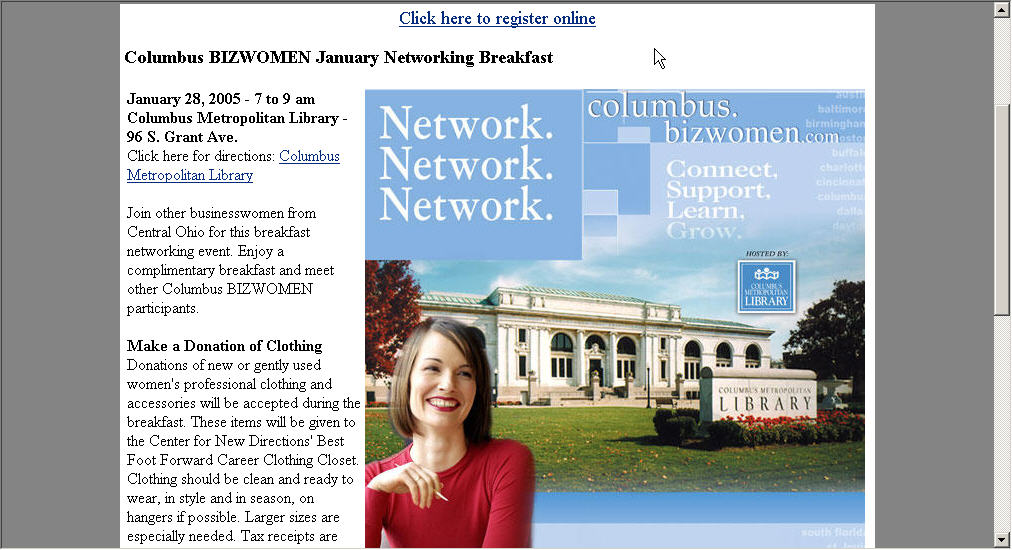
Late-breaking news from an OCLC staffer on the move, Carrie Benseler. The Columbus Metropolitan Library will host the January meeting of the Columbus Businesswomen's networking breakfast.

Information is a Conversation, not a Lecture
I stole the title from Karen's Free Range Librarian post from yesterday "Pensees from WebCred" in which she muses "out loud" on things informational in a most effective and elegant way. Jenny Levine also clipped a sentence or two for The Shifted Librarian. Go read Karen's whole (longish) post. Karen mused in an earlier post that she feels she has regained her (writing) groove and I agree. Lots to chew on.
And I do like to know Karen relishes red sweaters!
Two pensees particularly resonated. One on metadata and one on what Jenny called being part of information seekers' "trusted circles" when I interviewed her for the Scan.
"Metadata should be firmly lashed to information at the beginning of its journey and if possible added to along the way, over the Donner Pass and through cordones sanitaire, so that information becomes less "lossy" and in fact richer in meaning."
"Anne Lipow, a great librarian, innovator, educator, and publisher, often said that the user is not remote from the librarian, the librarian is remote from the user. This is true for all information communities. Our users (readers, patrons) are right there, where they should be; we are the ones who need to close the distance."
There was another Blog conference going on almost the same time as WebCred in Boston...Blog Business Summit happened on the opposite coast--Seattle. Tom Peters' blog has several posts on this.
And in other news....hardly worth commenting on due to the vast coverage but Google Video has debuted as a beta--just as was predicted a few short weeks ago, and which we faithfully reported. I tested it by searching "Donald Trump" although given the vast coverage of that non-event (although I am sure it was a meaningful event to The Donald and Melania) perhaps that was too easy. And it's the 'in' thing to do. Blinkx and Yahoo also released video search engines.
Another interesting Pew study was released, also commented on in many places: Search Engine Users "Users paint a very rosy picture of their online search experiences. They feel in control as searchers; nearly all express confidence in their searching skills. They are happy with the results they find; again, nearly all report that they are usually successful in finding what they’re looking for. And searchers are very trusting of search engines, the vast majority declaring that search engines are a fair and unbiased source of information. " This is, of course, an extension of the research we reported on in the Environmental Scan--that people are generally satisfied looking for things on their own. A must-read for librarians.
And noted in Wired News, "Information Wants to Be Liquid." "Frode Hegland, a researcher at University College London, wants to change the basic structure of information on the net." There's a demo. And no mention of the Semantic Web.
And that's just a few of the information conversations happening "out there".
Monday, January 24, 2005
Habbo Hotel
Alane sent me this link, as a possible safe, fun game. Go ahead, stick your toe in the Habbo Hotel.
And check out their disclaimer:
Sounds familiar, eh?
And check out their disclaimer:
In Habbo Hotel, real people use virtual characters to have authentic conversations, play games, enter competitions, and develop new friendships. It is a fun and nonviolent game environment where the benefits are great, but care must be taken.
Sounds familiar, eh?
Friday, January 21, 2005
Gaming in the Toledo Library
Is the library community on to something or what?
The Toledo-Lucas County Public Library is offering Madden Madness 2005 tomorrow (Saturday, January 22). This is a video game competition with the winner, according to the article in today's Toledo Blade, receiving "an all-expense-paid trip to the Bahamas and a 2006 version of the game."
And to think---I used to get in trouble for showing non-educational 16mm films in the Buffalo and Erie County Public Library branch I worked in as a student!
How Games are Reshaping Business & Learning
This is a link to an article from the Wisconsin Technology Network ("the region's leading source for news, commentary and analysis for technology and life science") that reports on a program held at U Wisconsin-Madison on gaming yesterday. I found the link in a Slashdot post.
And yes, "our" panelists from the OCLC Symposium, Kurt Squire and Constance Steinkuehler, were two of the three speakers. Their colleague James Gee (a professor of reading) was the third, and are all members of Academic Advanced Distributed Learning (ADL) Co-Lab. All three are described by the authors as "among the top researchers in learning through game-playing."
You'll see some familiar facts in the article and there is active commenting going on--last time I checked there were 29, some lengthy.
But the really cool thing is that this program "How Games are Reshaping Business & Learning" was simulcast via the Web so if you go here, you can click on the red title and the program will open up in a new window and begin. The program is just over 95 minutes long.
If you attended the Symposium, you'll see that Constance picked up a good intro from John "Got Game" Beck who began his presentation with "Name That Tune". And the ideas presented by Kurt and Constance at the Symposium are amplified and reinforced through this program. There's also a link to a paper called "Good Video Games Reinforce Good Learning" coauthored by Kurt and Jim Gee, and others.
Thursday, January 20, 2005
Bits and Pieces
Our fellow OCLC blogger, Lorcan Dempsey, notes some things over on his blog that are interesting.
"Worldcat in your pocket" talks about "how far we have come in being able to manipulate and move large amounts of data." WorldCat on your iPod and a 24-node (48-cpu) Beowulf cluster with 96 Gigabytes of memory--whatever this is! Whatever it is, it's hardware that puts data manipulation at warp speed.
And in this posting, Lorcan comments on Stanley Wilder's recent article in the Chronicle of Higher Education (subscription required for online, if you have access to the print, it's the January 7 issue) titled "Information Literacy Makes All the Wrong Assumptions." As someone who did a lot of bibliographic instruction once, I have long thought that something is wrong with the whole approach to information literacy, and while I don't entirely agree with Wilder's proposed solutions, I do agree with his articulation of the problems and issues.
Along with this article, I read Brenda Bailey-Hainer's Library Journal article "Virtual Reference: Alive and Well" and Stephen Abrams article on Google...which, dang it all, I can't lay my hands on right this minute and I only had it in paper. I'll cite when I find it. But, reading these three articles one after another (I was waiting for my car to get a new battery--all the cold weather has been hard on aging parts, automotive and other) was interesting--refreshing, in a way. All three authors are, in essence, asking readers to have another look, another think about topics, we either don't think about or that we think we know everything about, and twisting the issues slightly. All worth reading.
Noted on the Worthwhile blog, an article called Your Third Place Workspace? Given our interest in libraries as a third place, I was happy to see two comments identifying libraries as readers' fav 3rd places.
Addendum: 9pm EST. Here's the Stephen Abram article citation. "Google Scholar: Thin End of the Wedge?" Information Outlook, January 2005, v.9 (1): 44-46. I think this is not on the open web because I got stopped...so, any SLA member want to tell us why this good library content is not available to general readership? I can guarantee "protecting" this content is not going to win SLA more members.


The Paradox of Choice
I subscribe to a great blog called "Good Experience," and it's all about getting companies (and marketing people within companies) to remember that the reason they are in business is the customer. And as such, they should focus their business on the customer experience.
Today's installment had a nice interview with Barry Schwartz, the author of The Paradox of Choice.
Read the interview about the paradox of choice and how it affects the customer experience.
The gist of Schwartz's theory says that the less choices we're faced with in a purchasing decision, the more likely we are to actually make a purchase. With 200 choices, we are overwhelmed and walked away. With 12, we might actually pick something and buy it.
I wonder what happens when we apply the choice-paradox theory to our concept of the library. It's our library-sacred cow that more choice of materials is always better. Right? I want every iteration of The Tempest that is available and I want it at my fingertips--FRBRized, no less.
But what happens when we apply Schwartz's theory to information-shopping? If we remove the price tag (library materials are "free" to the consumer) then the choice rules don't apply? Or is the idea of weeding through information choices applying, while purchasing choices are not?
Food for thought, my friends.
Wednesday, January 19, 2005
The Guardian's Gamesblog
Just came across this blog as I wandered from link to link. What a handy thing to add to My Yahoo! The blog began in mid 2004 and the bloggers are 2 males, 1 female.
"Welcome to Gamesblog, the new computer games weblog from the Guardian. Our aim here is to talk about games in an entertaining, adult way, and help enjoy playing games on whatever gadget you own - PC, games console, handheld device or mobile phone."
This looks like it would be a good way to keep up not only with what's happening with games (they promise no lengthy geeky reviews) but also with game culture. Aleks Krotoski, the female blogger, speaks and writes about women and gaming, something I know Constance Steinkeuhler and at least two symposium attendees were avidly discussing after the program.
And for you librarians interested in this topic but not sure what's what? Remember that blogs are designed to be two way...if you leave a comment or a question for bloggers, you'll get a reply.
Tuesday, January 18, 2005
The Seattle Public Library:Shattering Stereotypes
One of the side benefits of being an old greybeard like myself is that occasionally you get asked to serve on a cool committee. Deb Robertson, the director of ALA's Public Programs Office, nominated me for a spot on the first advisory committee for the office. Deborah Jacobs, the director of the Seattle Public Library, chairs the committee, and we had our first official meetings at this Midwinter conference. One of the things we spent a lot of time talking about (and I swear I didn't introduce the topic) was the idea of creating some public programs for libraries to host about gaming. But that's not what I'm blogging about here.
Rather, I'm afraid I've made some rather intemperate remarks recently about the new downtown Seattle Public Library (different link). I understand that I am utterly in the minority here, that everyone but your humbled correspondent seems to be unreservedly enamored of this building. Of course, word of my remarks got back to Deb Jacobs, as these things will do in our very small field. (And, that, young librarians, is one lesson to take home from today's blog!)
Deb was quite forgiving of my remarks (which you can be when you are dealing with the only oddball in a crowd), but she also told me about an event that sounds fascinating. She's hosting a conference sponsored by the Public Libraries International Network and the Library called "The Seattle Public Library: Shattering Stereotypes." The conference will be held April 27 through 29, with a postconference tour of three new SPL branches on April 30. This conference will showcase not only the new library, but best practices in leading public libraries from around the world. Because space is limited, and only two representatives from any organization will be able to register, you might want to act fast on this one. Deb also tells me that, in keeping with European tradition, the conference will feature a dance!
Home again, Home again, jiggedy jig
Now that almost everyone is back home again...back to eating steamed vegetables instead of cream chowder, milk instead of martinis, I challenge all the ALA MW 2005 attendees to ponder for a minute:
*What did I learn at this conference?
*What new information has challenged my thinking?
*What positive changes can I make in my library because of what I've experienced?
*How can I translate my experience for the staff members who did not attend?
When I was a camp counselor--back in the day--we designated time for the kids to process their "mountaintop experience" on the lasy day of camp, before they went back to the "real world." It's hard to spend 5 days being fed knowledge from all directions, and then find yourself returned to an uncomfortable realization that everyone else not at camp has been living their regular old humdrum life.
And now you, too, have returned to the humdrum...except that that's the wonderful part that happens when we get together as an industry: the formerly mundane becomes exciting again, and lively staff discussion ensues.
Welcome home.
Subscribe to:
Posts (Atom)


