Monday, April 25, 2005

"Last One Out Turn off the Lights..."

This is the main title of a recently published book. The full title is Last One Out Turn Off The Lights: Is This the Future of American and Canadian Libraries? It is a collection of essays by Canadian and US librarians, many of them known to me (people often express surprise about how many Canadian librarians I know...don't forget though, there's 10 times less of them than US librarians). The introduction "Change the Lightbulb or Flip the Switch--Our Choice!" is written by the two editors Susan Cleyle and Louise McGillis and starts off:
Feeling good about being a librarian in the twenty-first century? Think you have a handle on the technology and the many different information choices available today? Let's face it, libraries and librarians are perfectly situated to shine in the information age; after all our business is the acquisition, organization, and dissemination of information. If we are feeling so confident about the future, why is the literature filled with articles trying to find a place for us to fit, and why are we in a state of collective amazement that we may not be the information resource of choice for many of the technologically savvy users of today? We are no longer in the forefront--we are losing our users, and as a result, librarians are being challenged to shape up or be permanently relegated to the sidelines.

The essays in the book address five main topics: libraries and the web, library as place, getting services to the desktop, certification of librarians, and the future of library associations.

I enjoyed many of the articles and found useful things in them, but my favourite was actually the epilogue, written by Waynn Pearson, the Library Director at the Cerritos Library which won awards for its design. Waynn begins his essay by linking the redesign of the library to his reading The Experience Economy: Work is Theatre and Every Business a Stage, a book I've read, liked and thought more librarians should read (along with The Dream Society: How the Coming Shift from Information to Imagination Will Transform your Business and Brand Lands, Hot Spots and Cool Spaces: Welcome to the Third Place and the Total Marketing Experience)

Here's what Waynn's advice is on creating a vibrant library (but read the book for all the details)
* Design for the common user
* Look outside the library for ideas
* Develop a story line
* Don't limit yourself to providing information
* Communicate with more than words
* Get out from behind the desk
* Create gathering places
* Romance your users
* Play your part
* Make it fun

Not much wailing and gnashing of teeth in this collection of essays, just a lot of energetic, dedicated librarians, experienced and not so experienced, looking to "resole our comfortable shoes and [go] where users want to take us."

You all go!

Google shifts advertising strategy

So is Google selling out?
From today's New York Times article, it sounds like they're ready to trade contextual, sensible advertising for profits.

If you own Google stock, perhaps you don't mind.

For the rest of us, it signals some final death-knell of Google's claim to be different. Now they'll allow graphical ads (only on partner sites--not on "mamma" Google) and more shockingly, they'll allow advertisers to buy placement.

Before today, an advertiser had to be contextually related. Now if I'm a monster truck engine-maker, and I want to go after laptop purchasers, I can have my monster truck engine ad appear next to laptop search results--regardless of whether it "makes sense."

What happened to "don't be evil?"

Friday, April 22, 2005

Earth Day celebration

Happy Earth Day, everyone. Just remember, when you hug a book, you're hugging a tree in evolved form.

Environmental question of the day: Has anyone ever explored the idea of an outdoor library?

I can imagine all kind of issues...what about the computers when it rains? How do I keep the DVDs from walking off? Mold growing in the stacks...

Right. My question is geared to more of an architectural/conceptual idea. Anyone have photos, ideas for an outdoor library?

A few: New York, Umatac in Guam, and Vietnam.
Also: Paper about cataloging.

Thursday, April 21, 2005

The Star Shone on Alabama

On Wednesday, I spoke at the Birmingham Public Library Lunch at the Alabama Library Association conference.

I have a bit of advice for you: it you ever get invited to the Alabama Library Association conference, go. I was there way too briefly, but what I saw, I enjoyed thoroughly. (Incidentally, the fried chicken at the lunch was almost as good as the best I’ve eaten, and I lived in South Carolina for seven years.)

I was met at the airport by Renee Blalock, the Associate Director of the Birmingham Public Library, who had invited me to the conference. Michele Norris, the host of NPR’s All Things Considered, was also on the flight—she was the keynote speaker for the conference. Another word of advice: if Michele Norris ever speaks within 100 miles of where you are, drop everything and go hear her. Her keynote speech was exactly what every meeting organizer hopes for: a relevant, incredibly well-delivered speech from the heart that gets discussion going for the rest of the event. Now don’t get me wrong, I didn’t agree with everything she said, but the way she said it was SO GOOD! Before she became the host of ATC, Michele’s beat was education and she still cares passionately about kids (including her own two toddlers) and how they learn.

My only gripe with Michele’s talk is that I have a hang-up about the library as nostalgia. She talked a lot about how libraries used to be. She expressed concern about “point and click” journalism, and about whether information, as it becomes more common, will become less valuable.

But she was fully engaged with the audience. At one point, she said she would love to spend time shadowing the librarian at NPR, just to learn more about what she does. At that point, Elizabeth Aversa of the College of Communication and Information Services, School of Library and Information Studies at the University of Alabama (yes, this all fits on her card) offered to have her shadow LIS students as they learn about the next generation of information provision, and Michele accepted.

Michele’s talk wasn’t all nostalgia…she was firmly grounded in the current environment. She talked about a dinner party she’d attended with a number of journalists. As the evening progressed, they started talking about stories they’d each pursued based on internet research that either turned out to be totally bogus or that took them off in the wrong direction. As it turns out, there was one librarian at this party, and after everyone had related his or her horror story, she said, “You each could have saved yourself a ton of time and embarrassment just by picking up the phone and calling your librarian.” KUH-ching!

She said that librarians need to be right at the table when the editorial meetings are being held every day. By extension, librarians need to be at every meeting of the city council, school board, deans and provosts, student senate, and wherever else decisions are being made. That’s how we make the leap from gatekeeper to player!

OK, so sign me up for Michele’s fan club. The icing on the cake? She said her favorite children’s book is Curious George. (OK, this is a shameless plug for WebJunction. You can get your price of admission refunded at the door!)

Trading Spaces (Library Edition)

So last week, I was in New Jersey doing a scan presentation for the library association conference there. One of the people at the program, Kathy Schalk-Greene, gave me her card and suggested that I check out the web site on the card.

What a find! If you’ve read the scan or attended one of the presentations we’ve done, you’ll know that one of our themes is the importance of the library as place. Thirteen months ago, the Mount Laurel Public Library hosted a conference called “Trading Spaces: Reinventing the Library Environment” and this site is an absolute treasure trove of information about how to re-make your library into a more inviting place for your community. And the kicker is that the emphasis is how to do this on a skimpy budget. Mount Laurel Public Library and South Jersey Regional Library Cooperative each kicked in $15,000 to renovate the library, and the results are phenomenal.

But this was more than just an isolated success story. Instead, the idea was to use Mount Laurel as a showcase, and when you check out the photos and the testimonials on these pages, you’ll see why this has worked. Kathy won the New Jersey Library Association’s Librarian of the Year Award at the close of their conference last week. Just another reason to listen, eh?

In the interest of full disclosure, I should note that Karen Hyman (the director of the South Jersey Regional Library Cooperative) and I are on the dais together in Chicago for a PLA preconference called “Creating a Library Sales Force: It’s Easier than You Think,” on Friday, June 24 at the Sheraton Chicago Hotel and Towers. We also have the absolutely wonderful team of Peggy Barber and Linda Wallace, with whom I worked back in my ALA days, and Gail Griffith from Carroll County Maryland, PL, on the program. (Google Gail’s name and you’ll find a wealth of programs with which she’s been involved!)

Wednesday, April 20, 2005

Games, Learning and Society Conference

Here's a conference for librarians who want to learn more about the role of games in learning. The Games, Learning & Society Conference (GLS) will be held June 23-24, 2005 in Madison, Wisconsin, and "will explore issues of how videogames and digital media are impacting learning and society. Speakers, discussion groups, and interactive workshops and exhibits will focus on game design, game culture, and games' potential for learning and society more broadly." (from the conference web site)

It's going to be a small two-day conference (capped at 250, according to the conference FAQ) which often means a more meaningful experience for attendees. More exposure to speakers and other attendees, and less sessions to pick from.

The conference is sponsored by the University of Wisconsin-Madison (home to Constance Steinkuehler and Kirt Squire*, panelists at the OCLC Gaming Symposium at ALA Midwinter 2004) and the Academic Advanced Distributed Learning Co-Lab.


* Kurt and Constance had just had a great article published in Library Journal, called "Meet the Gamers." "They research, teach, learn, and collaborate. So far, without libraries."

Report on Massive Multiplayer Online Gaming

Noted on Stephen Downes always informative newsletter OLDaily.

From the ADL site: The The Advanced Distributed Learning (ADL) Initiative released a report in March, examining multiplayer online games as a future focus area for ADL. The report, "Massive Multiplayer Online Gaming: A Research Framework for Military Training and Education." reviews relative online gaming research literature and proposes 15 primary experiments pertaining to massive multiplayer online gaming (MMOG), first popularized in the entertainment world and now finding growing interest in education and training environments.

The report is available for downloading here.

Stephen's comment: "this report is a good and in-depth study of the relation between online role-playing games such as MUDs and educational achievement. There is some discussion of how players of such games self-organize and some lighter discussion of the psychological impact of play in such environments."

And while some of us may not be entirely comfortable with the military connection, it's good to remember that the Internet itself began life as ARPANET, a military research project.

Monday, April 18, 2005

Adobe buys Macromedia

This is BIG news in the creative/design world. And for anyone who publishes a combination of print, electronic, Web.
My two favorite software makers have now joined forces. The people who brought you Dreamweaver will now be the same people who brought you Photoshop. It's a beautiful thing. I'm so excited. Go hug your Webmaster/graphic designer/communications person. He or she probably won't believe you at first. Read more from the CNET story >>

Welcome to the containerless future

A great hunk of writing came across my desk this morning from one of the information-space e-newsletters I get.

The short piece lamented the fact that Intel offered $10,000 for an archival copy original of Electronics magazine that tipped Moore's law into existence. The writer ackowledged that there are photo- and digital copies everywhere, but few originals to be found. So Intel turned to the library community--who subsequently now have to protect their originals from poachers.

The writer then explored the idea of "what is an original?" of an object when the original object is in fact digital. Here's a snippet:
It makes us wonder once again how future generations will view our obsession with content containers and packages. When someone 50 years from now wants to document the rise of blogs, they'll likely point to the original posts on the Powerline and FreeRepublic blogs about the CBS documents about President Bush's military service that proved to be false and led to the downfall of Dan Rather. But what will they put in their museum? Where will the originals of those posts be? They don't exist outside the ones and zeroes on somebody's computer, and that will be true of all kinds of important documents we are creating today. What's an original when there never was a print version?

The clincher was at the end: "Welcome to the containerless future."

Friday, April 15, 2005

University of Alberta's Bike Library

A good post for a lovely Friday afternoon. This came to me via Jerome-L, an Alberta-based library list. The newspaper article referred to appeared in today's edition of The Edmonton Journal (subscription required) on page B4.

In response to calls and numerous e-mails, please allow me to advise you that the [Edmonton] Journal headline with regard to Item #4 below is misleading. The University of Alberta Library System, while providing exemplary service to campus in a variety of ways and making information resources available also in a variety of ways, is NOT engaged in loaning bicyles. The "bike library" intiative seems to be centred in the Environmental Co-ordination Office of Students. We 'peddle' books, not bikes.

4. U OF A LIBRARY SYSTEM NOW INCLUDES LOANER BICYCLES
U of A students can rent bikes, painted university colors of green and gold, for $20 a month. Bike Library saves students time and money where before had to walk 45 minutes or take bus, one student has only a 10 minute bike ride to campus. Program run by student environment office and volunteer bike mechanics fix donated bikes. Environment office hopes to expand program. Page B4; by Jodie Sinnema

Rupert Murdoch is a "digital immigrant"

Rupert Murdoch heads up News Corporation, one of the largest media corporations in the world. On Wednesday he gave a speech to US newspaper editors at a conference in Washington. The text of the speech is here.

Murdoch has adopted the terms "digital immigrants" and "digital natives" that George, Cathy and I now use when talking about generational differences in our presentations. We got the terms and definitions from John Beck who co-wrote Got Game. Perhaps Mr. Murdoch has read this book too. Or perhaps he read Marc Prensky who seems to have been the guy who first published something using the terms.

Murdoch had this to say:
"Scarcely a day goes by without some claim that new technologies are fast writing newsprint’s obituary. Yet, as an industry, many of us have been remarkably, unaccountably complacent. [...] I come to this discussion not as an expert with all the answers, but as someone searching for answers to an emerging medium that is not my native language. Like many of you in this room, I’m a digital immigrant. I wasn’t weaned on the web, nor coddled on a computer. Instead, I grew up in a highly centralized world where news and information were tightly controlled by a few editors, who deemed to tell us what we could and should know. My two young daughters, on the other hand, will be digital natives. They’ll never know a world without ubiquitous broadband internet access.

The peculiar challenge then, is for us digital immigrants – many of whom are in positions to determine how news is assembled and disseminated -- to apply a digital mindset to a new set of challenges.

We need to realize that the next generation of people accessing news and information, whether from newspapers or any other source, have a different set of expectations about the kind of news they will get, including when and how they will get it, where they will get it from, and who they will get it from."

Could be a librarian talking about challenges in our world, couldn't it?

More coverage of the speech here and here and here

The last link was to commentary by Jeff Jarvis, an experienced journalist and media watcher. Read the comments too to this post and read 1. Find sand. 2. Dig hole. 3. Insert head and the comments. Read A New Model for LOCAL NEWSPAPERS and read those comments too.Substitute the word "editors" with "librarians", and "newspaper" for "library" and see if any of this sounds familiar.

Good stuff. Food for thought. Somebody invite Mr. Jarvis to speak to librarians.

Is Encarta Becoming Wikipedia?

In a post on the AP, quoted in the excellent newsletter/blog Resource Shelf, Microsoft is looking for volunteers to help keep Encarta up to date. Microsoft is saying that it will continue to have editors verify the information, and it's asking for citations to the changes.

It sounds a little like Wikipedia, doesn't it?

Form a government: the House of Commons

George's post inspired me to chime in: I first moved to the UK in 1997, about 3 weeks after the new Labour Government was formed. I had arranged, you see, to work for a Tory MP in Parliament--thinking that there was no way "new Labour" was going to win.

But of course they did and suddenly I found myself in the middle of the Opposition party, meeting William Hague (such a bright hope at the time...), picking up the daily Hansard and forming loud-mouthed opinions on Alistair Campbell and Peter Mandelson...

Curiously enough, I spent the summer doing public policy research on Internet filtering. (Our best recommendation at the time was self-policing.) The MP I worked for as a research assistant was really keen on the Web.

Much has changed since that bright summer in London!

Parliamentary Elections

Lorcan Dempsey brought to my attention a blog log that the BBC is offering on its web site for comment on the upcoming elections in the UK. One of the guest bloggers is a friend of Lorcan, and he's managed to bring the concept of networked libraries into the electoral discussion. Go to http://www.bbc.co.uk/radio4/today/election/weblog_john.shtml, then scroll down to the 14 April entry.

ALA always tries to get the presidential candidates on the record about libraries, but John has managed to get some pretty candid reactions from his candidates. "When I spoke to the candidates of three parties for the last Scottish Parliament election, I asked them about their position on networked libraries and e-library developments. Two seemed amazed or baffled at the concept; one said that he thought that libraries still depended on paper cards to store details of where a book might be. "

Tuesday, April 12, 2005

"Does the non-dynamic library have a future?"

Yesterday I did a scan presentation for the New Jersey Library Association in a preconference called "Information Services in the Larger Context."

This was an excellent audience, full of questions, comments, and well-considered opinion. But one question stopped me in my tracks. One public library director explained his frustration in seeing the slow pace of change in libraries, and asked, "Does the non-dynamic library have a future?"

After some hemming and hawing, sort of like Elmer Fudd attempting to speak Aramaic, I finally said, "Maybe not." How's that for forceful opinion leadership?

During the rest of the program, the ride back to Newark Airport, and the flight home, I had time to think about this. It seems to me that libraries have a responsibility, not just an opportunity, to change.

Determining the nature of that change, though, is a combination of marketing and leadership. The type of marketing I'm referring to here is not about sales, but rather it's about knowing your clients thoroughly, what they need and want. Pat Wagner of Pattern Research led the group through some excellent exercises in this direction as the other part of the preconference, and she made some important points about how a library director can start to understand their communities more effectively.

But it's not just about giving people what they want. Leadership is about creating a vision that you can share with the board, with elected officials and business people, with the library's clients, and most of all, with the library staff. (One of our side discussions during this meeting was about the importance of not blaming the staff for not being willing to change. If the leaders cannot explain the change and provide a reason for it, the problem lies not with the staff, but with their leaders.)

Also, the clients can't know everything about what libraries could offer---they only know what they've experienced. Library leaders need to have contagious enthusiasm, not only for what the library is today but for what it can be tomorrow and beyond. And then they need to spread that contagion far and wide.

If we could do this, we wouldn't have to worry about non-dynamic libraries!

Buying and Selling eContent Conference

The BSEC conference is wrapping up today in Scottsdale, Arizona. This is the 6th annual conference that is aimed at "thought leaders, executives, and global content buyers". A look at the list of companies and organizations attending past conferences is an interesting one, a combination of technology companies, business analysts, content aggregators, publishers...and as far as I could tell, only two librarians. Which is too bad. Here's why the conference organizers think people should attend this conference:

Buying & Selling eContent covers issues and challenges faced by top-level executives who are responsible for buying and selling electronic content, including:
- Industry outlook and analysis from analysts who study the trends
- Content licensing, contracts, pricing, and usage
- Copyright, rights management, and intellectual property
- New paradigms and technology for content creation, delivery, and use
- Business threats and opportunities, and how to deal with them successfully
- Insights into successful business models and why they work
- PLUS roundtable discussions where you can talk with peers about issues of common concern and interest.

Aren't library directors top-level executives who are responsible, ultimately, for buying content?

Dave Weinberger (Mr. Cluetrain Manifesto) was a keynote speaker and his presentation, Everything Is Miscellaneous: Uprooting the Old Information Order is available as an MP3 feed here (courtesy of Rafat Ali, from PaidContent.com). The entire thing is about the organization of knowledge. "As we digitize the world's information, we're discovering that the fundamental principles by which we've organized the real world don't apply very well. These principles have a long history, going back to Aristotle, and have determined the traditional shape of knowledge as a tree of categories or concepts." Some of the key ideas in the audio are also available here in Weinberger's e-zine Journal of the Hyperlinked Organization, including the whole tree/leaf idea of taxonomies.

The first mention of Dewey is at about minute 8 of a 55 minute presentation.

Friday, April 08, 2005

Print-on-Demand Getting Interesting

On April 4th, Amazon announced that it had acquired BookSurge, a South Carolina-based company, providing print-on-demand services to publishers, authors, retailers and libraries as noted in many places. This January 2005 report notes that BookSurge was founded in 1999 (although the company web site says 2000), and "is the global leader in inventory-free book distribution and fulfillment with print and sales facilities in the United States, Canada, Mexico, the United Kingdom, Spain, the Netherlands, Poland, Australia, Greece and Panama."

It looks like books are available in eighteen languages, including Croatian, Welsh, Esperanto and Persian. And one of their latest releases is The Da Vinci Code in Arabic.

Most interesting. I'll bet there's some behind-the-scenes stories related to this acquisition. BookSurge would be considered a smaller player in the POD world, which is dominated by Lightning Source, a division of Ingram Industries, of which Ingram Book Group will be the most familiar to librarians (I had no idea that another part of Ingram is a shipping company). Ingram Book Group is also Amazon's major conduit to print books. Salon magazine has an October 18, 2001 story, "The Instant Book That Wasn't" that involves all three of the players: Amazon, Ingram Book Group and BookSurge. Here's the link but if you don't subscribe to Salon you'll need a (free) day pass to read it.

In the story, the CEO of BookSurge, Bob Holt, is quoted: "Ingram will be disintermediated, maybe in 10 years, maybe 20. The model where you put a bunch of books in a warehouse and distribute them, that's a dying horse. It's still valuable for bestsellers--but what percentage of titles are bestsellers? Less than 1 percent of titles each year." Hmm, perhaps disintermediation is closer than 10 years?

But this isn't the only interesting BookSurge news--this is older but somehow I missed it entirely. Our colleague Eric Childress (a very good "spotter" for IAG) passed it along to me. Back in January 2005, BookSurge and ebrary announced a partnership for the "joint development of a print-on-demand offering, initially focused on the library market. The initiative will enable libraries throughout the world to purchase authoritative content in print from leading publishers, without astronomical shipping costs or lengthy waits for delivery."

An analysis of the ebrary/Booksurge partnering can be found in The Seybold Report for Feb. 9, 2005.

The internetnews.com article linked to above ends with this: "Although the battle over e-book sales continues -- Internet portal Yahoo also has e-book sales deal with four major publishing houses -- e-books are still a small part of the current online book market, but both publishing companies and online retailers clearly are expecting significant growth. When that might happen is the open question."

It might be an open question but librarians should keep an eye on this because the answers are likely to have a big impact on the supply chain for books.

Addendum (April 12): The choice of quote above from internetnews.com, about e-book sales makes it sound like the author conflates Print-on-Demand books with e-books. This wasn't the case...and I should have put the quote in content.

Thursday, April 07, 2005

Duke's iPod program reduced

Sorry to hear that Duke has put restrictions on next year's iPod program. I'll have to cancel my plans for how I could do a second undergraduate degree...all for the love of a green iPod mini.

What Do Women Want Online?

Find out in the article: What Do Women Want Online? Ten Tips for E-tailers.
A lot of these principles pertain to library/Web OPAC use, as well!

Fight over eReserves at UC

Heard about a potential legal battle about electronic reserves at UC? It was in this morning's Chronicle, electronic edition. (password required)
(Whispered aside) Are we talking about the California Digital Library? Or something else entirely?

Here's the thing: publishers (in my admittedly very limited view) seem to be burying their heads in the sand, struggling to preserve that last iota of revenue stream. I say, look up! This is an opportunity!

Technology changes, so libraries change, so students' habits change, so information search/sort out/soak up abilities of students change...so it seems inevitable that copyright law will change, too. It's just a matter of time. So why not contribute to the change in a way that is helpful to you, as a publisher?

I read a great analogy to this phenomenon that makes a lot of sense, from Jim Wallis's latest book. People keep licking their finger and putting it in the air, to see which way the wind is blowing. And then they go in that direction. And they've been so busying going in that direction, that they don't realize the underlying truth: the wind has changed.

I'd say the wind has changed for eResources and convenience on our campuses. And the law will catch up. But how long will it take? A year? Two? Four?

Wednesday, April 06, 2005

Being Necessary

George may be the last person to hear about del.icio.us tags. I may be the third last. I know what they are, read about them, but haven't test driven them...I approve in principal. Not good enough. I need to use them so I understand what it means when someone on the LITA-L mailing list says they are trying out such tags added to the OPAC. I have a sense this is terrific.

But that's not what I want to comment on.

I hear the same concerns about patron confidentiality that George remarks on in his post. I hear you, I am one with you, I have a library degree too. BUT, I wonder who appointed us spokespeople for the masses? I am not aware that any library has some kind of check box on a library card application that says: "would you be willing to give up some amount of personal data so that we may send you personalized information about our collection?"

We're collectively all fired up about protecting patron confidentiality but my guess is we've not asked patrons about their wishes. Let's not design services for mythical people. Let's ask real people. It may turn out that Community A prefers that no personal information inform an OPAC search. It's all good...you asked your community. But perhaps Community B is comfortable providing a little more information in order to get personalized recommendations. Or perhaps it depends on the individual and you can't make a blanket policy that fits everyone in your community. But let's be very clear who informs our policies. It would be good if it wasn't a bunch of belly button lint collecting professionals.

del.icio.us

Just a few minutes ago, I posted a piece on "StoryCode." StoryCode is social software, defined in the Wikipedia as "applications which facilitate virtual connection and collaboration between people on a network. It is sometimes described succinctly as 'connection comes before content.'"

Bob Harriman, a former colleague here at OCLC after his tenure as the coordinator of LC's Newspaper Program, and now the Director of Preservation Programs for Preservation Technologies, brought "del.icio.us" to my attention. OK, maybe I'm the last person to hear about this, but I find it fascinating. From its home page, here's a description of what del.icio.us is all about:

» del.icio.us is a social bookmarks manager. It allows you to easily add web pages you like to your personal collection of links, to categorize those sites with keywords, and to share your collection not only among your own browsers and machines, but also with others.
» Once you've registered for the service, you add a simple bookmarklet to your browser. When you find a web page you'd like to add to your list, you simply select the del.icio.us bookmarklet, and you'll be asked for information about the page. You can add descriptive terms to group similar links together and add notes for yourself or for others.
» You can access your list of links from any web browser. Your links are shown to you with those you've added most recently at the top. In addition to viewing by date, you can also view all links with a specific keywords (you define your own keywords as you add the links), or search your links for keywords.
» What makes del.icio.us a social system is its ability to let you see the links that others have collected, as well as showing you who else has bookmarked a specific site. You can also view the links collected by others, and subscribe to the links of people whose lists you find interesting.

Ed Kiecyzkowski, now the County Librarian in San Bernardino, California, was the director of the Mansfield-Richland County Public Library in Ohio when I ran the Fairfield County District Library. He did a survey of how public libraries used clerical, paraprofessional, and professional staff. He told me that the only job all the libraries in his survey reserved for librarians was collection development and selection. Of course, this was at least 15 years ago, but this kind of cooperative, user-managed development of sources and tools changes the playing field, doesn't it?

I think the growth of sites like del.icio.us also shows that privacy is less of a concern for users of this type of site than it is for many librarians. Am I saying that we should throw our traditional defense of the privacy of library use records out the window? No, I am not. But do I think we should be doing a better job in mining our circ data to help people find more things that might interest them or be useful to them in their research? Yes.

My feelings on this led to a very heated discussion in the Library Automation class I discussed earlier on this blog. Several of the students in the class were quite passionate (and articulate) in their belief that library records should not be used for this purpose, especially if there was any chance whatsoever they could fall into the clutches of Big Brother. I couldn't agree with those students more. But I do feel that there must be ways to aggregate this sort of data, maybe even using the records of a number of libraries, to protect user confidentiality but still allow us to use what we know.

21st Century Reader's Advisory

One of the things we occasionally get to talk about in our Blog presentations is the growth in cooperative creation of content. Here's an interesting example that just came over the transom.

This morning's e-mail brought a note from a gentleman named Paul Youlten, who is working on a new site called StoryCode. This is a cooperative site that allows librarians, teachers, book sellers, and other "passionate readers" to "score" fiction in a variety of categories, resulting in links from one book to another. For example, if you liked Life of Pi (as I did), you would find a number of titles that have a score correlation of 77% or better. I rated my all time favorite novel, The Adventures of Huckleberry Finn, and there were about a dozen novels that had roughly 66% correlation, some surprising (Seventh Son by Orson Scott Card? I, Robot by Isaac Asimov?) and some intriguing (The Color Purple by Alice Walker and To Kill a Mockingbird by Harper Lee). Your rating of the book could change the books that come up in the rating scale, since I was the first one to score Huck.

There are several limitations to the system now. It's in Beta, and the database is pretty small (about 600 titles) at the moment. But they're adding to it rapidly, and invite all of us passionate readers to join.

If you haven't seen it, you might also want to check out FictionFinder, which is a project of the OCLC Research to act as a reader advisory service based on the MARC record. The web site describes this by saying, "...summaries, subject headings, genre terms, etc. are extracted from individual bibliographic records, filtered," (through the FRBR algorithm, not a CIPA filter --- blogger's note) "and presented at the work level." This is another one of the wonderful tools available free from the OCLC Research Works site. Check it out!

Google on TV

Got this juicy tidbit on Monday...now ready to pass it on.

Al Gore (the former Vice-President) and Joel Hyatt (an entrepreneur) are teaming up to create a new national TV network--Current.tv--created by, for and with and 18-34 year-old audience. It pulls in Google for it's news updates each half-hour...except it's not traditional "news," the way we think of it now--it's news like Google Zeitgeist. In other words, rather than trying to tell you what's important in the world, it flips the question: What does the world seek to learn right now?

"We're pleased to collaborate with the entire Current team to help this network make the world's information more accessible," said Sergey Brin, Google's co-founder and president of Technology. "Current is an exciting new direction for TV programming that enables any viewer to have the opportunity to broadcast their video to the world," said Larry Page, Google's co-founder and president of Products.


I am all jazzed to think of tv as active collaboration--as a platform where GenX, GenY voices can be heard. MTV or VH1 might have done that, been that in the 80's...but who watches Pimp my Ride and thinks there is any collaborative activity?

Check out the full story abotu Current.tv on CNET.

Sunday, April 03, 2005

Being Relevant

I just hopped onto Amazon to have a look and see if an old book was available (it is), and if I could "look inside" at the index (I could). There on the first page I saw were items honoring Pope John Paul II titled In Memoriam: The Millennium Pope. The Pope died only about 24 hours ago and yet Amazon has already gathered together a series of links to books by him, books about the pope and his papacy, about papal elections, the Roman Catholic Church, and to nine DVDs. The list of books by the Pope had been viewed over 5000 times.

Golly, I wonder if the Amazon staff had to work outside of their regularly scheduled hours?

How many libraries have done something similar already? Any? Not likely. And unfortunately, topical lists of content available to libraries' communities are always outside of the discovery and delivery systems that would connect interested people to that relevant content.

Why?

Saturday, April 02, 2005

Thank you, Waco!

Rowland Nethaway, the senior editor of the Waco (Texas) Tribune Herald, wrote a column that was syndicated in a number of newspapers over the weekend. In the Columbus Dispatch, the column was headlined, "Libraries could use a multimedia overhaul," but I prefer the headline that appeared in its original incarnation in the Waco paper: "Let's Meet at the Library."

Mr. Nethaway makes a strong case, from the user's point of view, for the library as the third place (although he doesn't use that phrase). After decrying the decline in use of schools and other public facilities for social organizations, he says, "I think part of the old-fashioned spirit of community and ownership can be recaptured by building multipurpose public facilities. My idea is to turn public libraries from quiet repositories of the printed word into modern gathering places for all sorts of activities."

Mr. Nethaway has a pretty 1980s idea of what public libraries currently offer, in a lot of ways. But his solution is right up our alley. We are in a perfect place to build on this support. It's also nice to see this kind of idea coming from outside the profession.

Friday, April 01, 2005

Google Gulp

No idea how long this will stay around but this is pretty funny. Make sure to read the FAQs.

At Google our mission is to organize the world's information and make it useful and accessible to our users. But any piece of information's usefulness derives, to a depressing degree, from the cognitive ability of the user who's using it. That's why we're pleased to announce Google Gulp (BETA)™ with Auto-Drink™ (LIMITED RELEASE), a line of "smart drinks" designed to maximize your surfing efficiency by making you more intelligent, and less thirsty.

Of the four Beta flavors, this was my fav:
Sero-Tonic Water – Just try to stay down once your synapses get a blast of this bubbly concoction whose refreshing blend of selective serotonin reuptake inhibitors is perfect for those moments when all your other beverage options just seem soooo depressing.


And you have to admit the tag line is great: "Quench your thirst for knowledge."

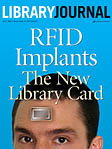
The April Fool's Day cover spoof from Library Journal is"RFID Implants: The New Library Card." Posted by Hello

Library Journal fooling

There's some funny stuff on the LJ Web site today. I was all excited to scoop you that Michael Gorman decided to step down...until I realized it was an April Fool's Day joke.
Had to chuckle at the headlines...especially the "Bar Opens in Library, Circulation Triples!"

Spring Break at the office

It has been spring break week here, back at the ranch.

Everyone it seems is either out sick with the flu, out sick with spring fever or off traveling somewhere interesting. Perhaps we should just declare it spring break for everyone.

Oh wait, I know what's coming...
APRIL FOOL!

Thursday, March 31, 2005

Houston

So on Wednesday, I was in Houston, doing a scan report for the Houston Area Research Library Consortium (HARLiC---sorry, no current URL that I could uncover). HARLiC has been around since 1978, and has, like many library consortia, worn many hats during its existence. Part of this meeting was to consider the creation of some new special interest groups to focus on issues on the library horizon. Bonnie Juergens, the executive director of Amigos Library Services, facilitated the event. She did a terrific job keeping the meeting focused and rolling. Somehow, she was tougher on time than the people who produce the Oscars, but she did it in such a charming way that no one objected!

The audience was, in some ways, the mirror image of the students I described in my previous post. These Texans were experienced librarians working in some of the biggest, most comprehensive institutions in the Southwest. But they had the same excited (and exciting) drive to find new ways to serve. The discussion was effervescent, full of exploring for possibilities, and refreshingly free of the kvetching about how we're all victims. No pity parties for these Tall Texans!

The prize for the best line of the day definitely went to Nita Schriver from
Houston Public Library. She was appointed to report on her group's discussions, and when Bonnie handed her the microphone, she said, "We were the virtual reference group, so if you want to know what we talked about, send me an e-mail."

And if you happen to be in Houston, make sure to check out the
M. D. Anderson Library at the University of Houston. Their major building project is nearly complete, but even in its not-quite-finished state, it's nothing short of magnificent. We had the HARLiC program in a gorgeous conference room with a splendid view of the heart of the campus. Kudos to Dana Rooks, the indefatigible dean of the library!

LIS Students and the Scan

On Monday evening, I spoke to a Library Automation class in the Kent State University LIS program offered here in Columbus. Nancy Lensenmayer, the Program Officer for Education and Professional Development in the OCLC Member Services team, teaches the class and invited me to speak about the scan.

This was a fun, feisty group. We had several delightful detours into areas I hadn't planned, such as the pros and cons of self-service (the verdict: occasionally overrated, but getting integrated in our lives in surprising ways), the role of libraries in easing the digital divide, weighing the possibility of misusing ILS data by government agencies and private industry against the ability to mine data to improve overall service, and the dependability of wikis as a source of information.

The best thing about this class was that they were ready to think about library automation beyond the integrated library system. They were looking for ways to expand the possibilities. They were deeply inculcated with the best library values of service and preservation, but they didn't seem to be as hidebound as some other groups that I've worked with. They were also more than willing to challenge my preconceptions, making me think more deeply about what I was saying.

If you're one of those library directors who wrings your hands over the state of library education, relax. I've seen the future, and to quote Arthur, it doesn't suck!

Wednesday, March 30, 2005

"Laying the Newspaper Gently Down to Die"

A very good essay by Jay Rosen at the very good PressThink on the state of newspapers (at least as a print medium) and journalism. Lots of links to other interesting material. I kept thinking about libraries and possible parallels as I read...well, not possible parallels. There are clear parallels.

I liked this comment, from a journalist working at a small town newspaper because I am finding more and more that what gets printed in the newspaper delivered to my house is news I have already read in a web-based news source--except for the local news that isn't of much interest outside our community:

The discussion on whether newspapers are dead always seems to focus on the bigger papers, while smaller papers that focus on community news, community events, and community people, seem to thrive. You can't get the information anywhere else, and very few people in the global market want to read about how Billy Smith hit for the cycle in a local Little League game. And, as much as people like our local news, they also like the lists of names we run ... birth announcements, who got convicted of drunken driving, who got divorced, our sports agate, etc...

So, it seems to me that there's a niche to fill there, a product that local papers can offer that's unique from the bigger dailies.

Will we eventually go the way of the dinosaur? I'm not so closed minded to think that we won't, but I'll bet that your small, local dailies will live longer than the big ones that offer news product you can get almost anywhere.

Thom Hickey's Blog

Another OCLC staffer has a blog. Another Blog Person.

Our Chief Scientist and all-round nice guy, Thom Hickey, has started Outgoing. Thom says, "I expect to write about some of the projects we have going in OCLC Research, the techniques we use, and the occasional post about some trend that looks important to libraries."

Welcome Thom!

Tuesday, March 29, 2005

Todd Lockwood and The Brautigan Library

I dangled this story in front of you some days ago, after my husband and I got back from a few days at The Point. I needed to get permission from Todd to tell the story because it's his story.

The Point is close to Lake Placid, and a reasonable drive from Burlington, Vermount. There are only ten rooms in winter, and eleven in summer when the fabulous unheated room over the boathouse can be used. If you're checking out the website, we stayed in Mohawk.

With only a few number of guests even at capacity, meals are served "en famille" so the atmosphere is like a country house weekend. Or at least, to this solidly middle class person, what I imagine a country estate weekend would be like. I got my education in this from such impeccable sources as Agatha Christie, John Galsworthy, and P.G. Wodehouse.

One of our dinner companions was Todd Lockwood, a very interesting guy, although there was a tableful of interesting people that evening. But Todd told a story that I thought was of interest to the library world. I asked him if I could share the story and he kindly sent me the version below. I've added links. Thanks to Todd for being an honorary librarian.

Todd's story.

Here is a piece I wrote for the first issue of the Brautigan Library
newsletter, The 23, which basically tells the story I told you at
dinner...

------------------------------

The Brautigan Library got started, in spirit, about twenty years ago
when Richard Brautigan wrote his fourth novel, The Abortion: An
Historical Romance 1966. Among other things, this book helped redefine
romance for the sixties counterculture-- breaking away from simplistic
gender roles, and offering up the possibility of relationships founded
on mutual respect and communication, not just passion alone. It was a
book that tended to have a profound effect on those who read it,
evidenced by the "this book will change your life" inscriptions one
often finds scrawled in old copies of the novel.

And, of course, Brautigan's book described a library-- a weird little
library where unknown, unpublished writing could find a home. As
Brautigan put it, "This library came into being because of an
overwhelming need and desire for such a place. There just simply had
to be a library like this." When I first read those words in the
mid-seventies, I couldn't have agreed more. Such a library seemed like
a splendid idea. It seemed perfectly plausible to me that someone,
somewhere would one day open such a library, using Brautigan's story as
a model.

Well, life nearly began imitating art shortly after the novel was
released: Brautigan had given his readers an actual library street
address in The Abortion, right down to the zip code. As it turned out,
the address was indeed the address of a library -- the Presidio Branch
of the San Francisco Public Library. They were subsequently flooded
with inquiries from all across America, wondering if they indeed
accepted unpublished manuscripts. Sadly, the answer was "no."

Years ticked by as I pursued a career in photo-portraiture, and in 1980
started a music recording studio in Vermont. The Abortion continued
to own a space on my bookshelf, and it got a rereading every year or
so. With every reading, I would be reminded of the library idea. By
the mid-eighties, I really began thinking of the library as "something
I was going to do." It was simply a matter of when.

Brautigan's suicide in 1984 was a terrific blow to thousands of readers
whose ideals survived the cynical seventies with the help of
Brautigan's insights and humor. Coming to grips with the reality of
his troubled life-- a life perceived as fun-loving and well- founded--
has not been easy. His death made the library idea seem a bit trivial,
so it stayed on the back burner for another five years.

In August 1989, I happened to go to the film Field of Dreams with my
wife. I had no idea what the movie was about, but before long it
became clear that, for me, the movie was about building the Brautigan
Library. Somehow, I knew the time had come to get things rolling. The
very next day I called Brautigan's literary agent, and off we went.

The Brautigan Library idea has not been greeted with universal praise.
A number of published authors have declined invitations to be advisory
trustees to the library. In fact, one poet had her lawyer send us a
cease & desist letter, to insure that her name wouldn't be associated
with the library. The fact is, even when Brautigan was at the peak of
his career, his own work was not held in high esteem by the literary
community. He was an outsider. Academics thought his writing was
trivial, yet his popularity was undeniable. He was writing for
readers-- not for writers.

Perhaps it was Brautigan's unpretentious approach to writing that made
him such an inspiration to new writers. Probably no other American
author since the sixties has inspired so many people to write down
their story for the first time. Brautigan shows us that ideas need not
be wrapped in layers of grammar and vocabulary to be relevant; that
vision is the seed that makes for a moving piece of writing.

A few months ago, we received a two-page manuscript from a woman who
drives a school bus. It was filled with spelling errors and incomplete
sentences. While trying to decide whether or not to send it back for
corrections, I finally just read it, as it was written. The short
story tells of sunlight beaming through a snowstorm "like a diamond
patch." So beautiful was this moment that she pulled the school bus
off the side of the road so her passengers could enjoy it. I learned
something in reading her story: Ideas with vision will usually survive
a less-than-perfect presentation. But the most elaborate presentation
in the world is no substitute for vision. In an era when technique is
the most discernible asset one finds in most art and literature, this
is indeed a concept worth pondering.

We already have all kinds of writing in the Brautigan Library, but the
vast majority is writing which shares a personal vision. Many of our
books are written in first person, which is, to me, a signal that we
are already building an archive that will distinguish us from other
libraries; that will be of use to historians; that will offer a unique,
grass-roots view of America.

-- Todd Lockwood, November 1990

---------------------------------

And here's a link to a story from the Boston Globe about the disposition of the collection which is being kept safe at the Fletcher Free Library in Burlington until it can be moved to the Presidio branch of the San Francisco Public Library. I did tell Todd that if this didn't work out that OCLC would welcome the Brautigan Library. Even though OCLC and its members focus on published material for the most part, almost all libraries have special collections of unique material, and I think it would be really fine to have the Brautigan Library at OCLC should it need a home--not that I have one zot of authority of make this so. But George does!

Funny old world, eh?

Friday, March 25, 2005

Oxford, et al.

I love cowboy music, and the old Gene Autry song "I'm Back in the Saddle Again" keeps running through my mind today. I've been away from the office, my e-mail, and this blog for about 10 days. I'll be back in the office on Monday, but I decided to jump in to do some work on my e-mail before then. Thanks to my wonderful assistant Susan, most of my listservs, CNN updates, daily New York Times, broadcast e-mail jokes, and other materials had been excised, but I still had about 300 items to go through. *sigh*

Last week, I gave a scan presentation at the Staff Conference 2005 for the Oxford University Libraries. I was on the agenda early in the day, and then was invited to participate in the rest of the conference. Oxford, like most other universities on this planet, is going through a number of convulsions. Funding and purpose seem to be huge challenges. The vice chancellor of the University, Dr John Hood, gave the opening address. He talked about the difference between being a"great university" and being one of the "best universities." His take on this was that being a great university is about history, what the institution has done in the past. On the other hand, being one of the best universities in the world is about performance, what the institution is doing now and in the future. He gave a pretty fearless talk and he truly set the tone for much of the rest of the day, for good or ill. (Dr Hood has been at Oxford for about six months, and spent many years of his career in the private sector. I got the sense that his ideas are, to be generous, controversial, such as can be seen in this article: "Mutiny at Oxford?")

The theme for the day was "Are They Being Served? Supporting Our User Base: Changes, Challenges and Champions." After ensuring with my host that this title was truly cribbed from the old BBC sitcom "Are You Being Served?" I used a Grace Brothers Department Store theme as my intro. Audience members over 45 chuckled charitably at my comments. But the discussions throughout the rest of the day were what really fascinated me. Electronic versus traditional materials, the definition of service, distribution of resources, conservation versus access, difficult users---all of these were topics for the day. These are some of the brightest people in our field and they are struggling with change, so that should be either reassuring or terrifying for the rest of us.

Incidentally, the speaker just before lunch was one of the best speakers on library marketing I've ever heard. His name is Antony Brewerton, and he's at Oxford Brookes University. I was scribbling notes like an undergraduate in a survey course during his remarks. One might not think of Oxford as a hotbed of library marketing, but Mr. Brewerton gives the lie to that. I even learned something during his introduction! He's also hysterically funny in a sort of Graham Norton way. If I could figure out some way to bring him to the States to do a series of programs on library marketing, I'd do it in a New York minute.

The rest of my time in England was vacation. Three plays in five days, Stonehenge, the changing of the guard, the Tower, the British Museum (which, despite Ira Gershwin's contention, has most definitely NOT lost its charm), the new Globe Theatre, the Tate Modern---I never wanted to leave. OK, I could have afforded maybe three more days there before taking out a second mortgage on my house, but it would have been worth it!

Yahoo! debuts Creative Commons search engine

Most cool! On Wednesday, Yahoo! released a beta search tool called Creative Commons search that allows the searcher to scope a search by "content I can use for commercial purposes" and "content I can modify, adapt, or build on." Yet another positive development from one of the majors in helping people locate relevant material. Thanks to The Long Tail for the news, and also to linking to Larry Lessig's comments on this.

Thursday, March 24, 2005

No News is...News?

Over the past year or so of blogging, I have discovered 2 main reasons I am slow to post to IAG. Either there's no news, or there's way too much of it. Isn't that a brilliant insight?

I agree with you, it's not.

This week seems to be one of way too much going on and so I suffer paralysis. I find myself mildly envious of the librarians I encounter when I give presentations who have never heard the term "RSS" or who ask, "what's an iPod?" How come I got blessed with a major curiosity gene that kept me restless and often frustrated as a real, working librarian? And as you readers know, I don't work as a real librarian anymore although of course my education and work experience are very important to my current position.

So, I was interested to read at Library Dust, (one of George's favorite blogs) Michael McGrorty's post about Jessamyn West. Michael began by writing:
In an old house in the wilds of Vermont lives a woman who may hold the keys to the future of the American Library—the one with the capital ‘L.’ There, far from the epicenter of library affairs, she ekes out a marginal existence working part-time for a local library, awaiting a call to greater service. You have probably heard of her; she is Jessamyn West and her story tells a lot about the pace and nature of progress in the institution with and without the capital ‘L.’

He goes on to write about the nature of hiring in librarianship and why it is, in our profession, the restless, the square pegs in round holes, are very often not heading up major libraries.
Jessamyn asks the hard questions, the ones with the answers nobody wants to hear. You don’t get a long way in the library world by inquiring whether the library, as found, is a good idea; what you get from that is a library that is a good idea, but only after a lot of change. Libraries like to claim they want change. They don’t. Change in the library world comes when it is forced by circumstances: when somebody invents a computer to replace the card catalog, when the Internet comes along to nudge the print world; very few of the crash-bang innovations in the library come from librarians.


So it was appropriate that our colleague Eric Childress forwarded me this link to a piece from a company/resource site called LeaderValues, about innovation called Can Bad Attitudes Lead to Good Business Innovation? It's short and worth reading (and there are other things worth reading there). It ends with this:
So if you want innovators in your team look for people with some particular bad attitudes – the ones with rebellious, contrary and divergent views. These are people who some might label as troublemakers. They are not negative or cynical – on the contrary they are passionate about their ideas. They do not defer to authority, they are dissatisfied with the status quo, they are impatient for change and they are angry about the obstacles put in their way.


Hmm, I know quite a few librarians with "bad attitudes" who no longer work in libraries.

Stopping by blog on a snowy morning

Hello from New England! I'm in this mod hotel called the New England Conference Center and the view is absolutely gorgeous. The rooms are hexagonal--bounded by windows on three sides. It's a bit like being in a tree house. Wish I had the camera to share the view with you.

Robert Frost comes to mind, as I watch the snow fall from my sixth floor perch...

One of the topics at the conference I am not attending is data visualization software. Of course I get all excited, thinking they're talking about things like Antarctica or Thinkmap. But no, they're talking about x,y coordinates and how to turn a lot of numbers into a picture of the ocean floor. Challenges are similar for both industries, though. The presenter talked about the importance of having good metadata and adequate funding. Some things cut across all industries!

Tuesday, March 22, 2005

Kudos to our own Chip Nilges

George is in the UK, Alice is attending a conference as 'spouse of Val' and I have been in and out....these are the excuses anyway, for not noting any earlier that our esteemed OCLC colleague and pal Chip Nilges has been named one of the 50 or so "Movers and Shakers" of 2005 by Library Journal. He is honored as one of the "Change Agents", a title that definitely suits him, and which most recently refers to his efforts bringing library metadata to the web with the Open Worldcat program.

LJ said of Chip and his fellow Change Agents: "Their actions—large and small—have an impact on people. Open a building at seven a.m. and the library becomes a part of commuters’ lives. Challenge library students to think about race and the next generation of librarians will provide better service. Make a deal with Google and library content is suddenly visible."

Chip is quoted as saying: "We must always begin with what the user wants and work backward from there." Amen, Brother Nilges.

The only quibble I have with Chip is that he still hasn't been skiing in western Canada despite my PR work of years about great snow, short lift lines, favourable exchange rate and Canadian beer.

Monday, March 21, 2005

Mobile phone novels

You know the old saying about watching Japanese schoolgirls for technology trends?

See the latest story from CNN's site, A mobile page turner. (Note: Article expires 4/20/2005.)

With this new development, we may have to reconsider the inflight cell phone ban...as long as your phone is silent while you read.

France and cultural patrimony

From this morning's Chronicle Daily Report:

GALLED BY GOOGLE? French cultural officials hope to develop a library-digitization project for European literature. Full story (login required).

Here's my question--> Has OCLC PICA (the European arm of our worldwide library cooperative) had any discussions here?

CIL - final post

There were lots of other presentations and lots of interesting exhibits and conversations in the hallways. At the hotel the place where wireless connections worked best was the lounge/bar off the main lobby, and it was fun to see all these supposedly stuffy librarians in the lounge with their laptops tapping away on keyboards. I spent a lot of time there between presentations, and met a lot of interesting people. There is another blog about this conference with links to even more blogs at http://www.infotodayblog.com/. It was fun and entertaining, and interesting and challenging, and I would LOVE to go back again. I recommend it to all of you.

CIL - Web project management

The presentation on Web Project Management was by Jason Clark, and he's obviously been there and done that! He understands what it is to work in a real library where you can plan your day to get lots of "things done!" and have it demolished by one involved reference question, or more likely a series of involved reference questions! He understands schedules and interruptions and priorities and impossible situations. And he understands how to deal with them constructively. The main secret is documentation: Document every decision, so you won't have to make them again. Document every change so you will remember why you did it, and your team members will know why you did it. The phases of a web project are: discovery, research, design, execution, deployment. You have to determine the critical path and not swerve from it. And most of all be flexible! And we all certainly know about being flexible.

CIL - last morning keynote

The keynote on Friday morning was by Mary Lee Kennedy & Stephen Abram on Personas. They called it delighting the real user. And it was about amazing things. They suggested that we should do in-depth analysis of our users to determine what they want. I'm not sure that is practical in the average library - actually I'm sure it is not practical. But we can all get some idea of who they are by watching them and talking to them, and pooling the knowledge all the staff already have about the people they work with. Mary Lee and Stephen did personas for a corporate library that involved 50,000 employees - and they represented them with 5 personas. The bottom line for this group boiled down to how long the person had been with the company, their age (which correlated to what technologies they were comfortable using), and how mobile they were in their work - where they were located. The focus is on what is valuable to the user - not what the library has available. It's an interesting twist!

Friday, March 18, 2005

"Getting Thousands of Hits" - Ban This Meme

Our colleague Lorcan Dempsey's post to his blog yesterday was about library strategic plans and searching from library web sites. One commenter to Lorcan's posting worries about (my words, not his) dumbing down the library's search interface to the simplicity offered by Google, fearing the result would be "thousands of hits."

I have often heard this sentiment expressed by librarians with regard to ordinary people using generic search engines. Indeed, the president-elect of ALA did that in his piece on Google Print. (abstract only here...spend $$ to see the whole article) The notion is that, because of the size of the web, using simple search terms, or imprecise ones, yields way too much information, undifferentiated and untethered from helpful structures such as LCSH.

I am announcing my official renunciation of this needlessly binary view of searching. It's unhelpful, breeds complacency, and is myopic.

Pretend you've never ever been in a large library. Pretend you know absolutely nothing about taxonomies. Pretend you don't know the difference between a magazine, a journal, an index and a book. Pretend you don't know what you don't know, and don't know how to articulate your unknowingness. Once you've pretended all this, make a pretend visit to a very large library for the first time.

And then tell me why it would be easier to find information in this situation than it would be to find information in a set of Google or Yahoo! search results? If you're pretending to be in a physical large library, maybe you'll ask for help, but there's a good chance you wouldn't. And if you're pretending to visit this large library virtually, chances are you can't see any human presence at all. In both places, the pretend you might wander around a bit, poking this button or looking at that printed object. But in the absence of any knowledge of how the "thousands of hits" in a library may be found, let alone investigated, the ordinary searcher might leave the library with nothing. A scarcity of information.

Yes, people get thousands of hits when they search Google, and they do because it's easy. But, it is a convenient fiction librarians tell themselves that nothing of any use is found this way because of the abundance of information. It just isn't true. I say so in the introduction to The Environmental Scan: almost all of the 250+ references in the bibliography were found using Google, using keywords. So, let's get past this unhelpful "us vs them" mentality and work a lot harder at making the valuable information we curate easy to find.

In November 2004 I blogged about Google Scholar and wrote about a post from a blog called Dog News. I said: "This is how scholarly material is going to come to "the people" rather than the people coming to scholarly material which is the current paradigm at work in libraryland, and one that consistently fails to be attractive to searchers."

Dog News caught my mention and commented on it, saying, in part, this:

"I GET this, why not make a real world example of it, so everyone else, those of us who aren't brilliant librarians, can GET it too. Google Scholar can change the world! and I can help to point the way... knowledge is power, leveraging knowledge to your goals is even more powerful."

Exactly.

Ontology....a 300 year old hack?

According to Clay Shirky, ontology is nearing the end of its useful life. Now, I've only read the program description of a presentation called "Ontology is Overrated: Links, Tags, and Post-hoc Metadata" he made on March 16 at the O'Reilly Emerging Technology Conference. But, I think you'll agree that even the description is packed with more than a few interesting and challenging notions for librarians, including this "the Library of Congress's classification scheme exists not because concepts require consistent hierarchical placement, but because books do."

I'll bet there were either none or very few librarians in the audience at this talk so it's fascinating to me that a talk every librarian should listen to was presented to people outside our field. Wonder if we can find a place for him to talk about his ideas to librarians? I wonder if he's made such a talk at LC...I know he's been doing some consulting to LC.

And when you've read the description of the Shirkey presentation, check out the other speakers at the Etech conference. A rather distinguished set of people. I really wish I'd attended...as a community, we should be present at these kinds of conferences. We talk among ourselves too much.

Thanks to The Long Tail for the link.

I had a lovely 3 day vacation here, and met some very interesting people. I have a story to tell as soon as I get permission from the storyteller.

CIL - LISNews - Collaborative Blogging

The highlight of yesterday for me was a presentation by Blake Carver of LISNews explaining how it got started and how it runs. I knew that there were several authors, but there are dozens! He says it's like a really big dysfunctional family, then adds that it's really a community with mostly common goals and values and very different ways of expressing them. He is a charming speaker and seems surprised that this venture he started very simply has become a force in our world.

Last morning ruminations

This is the last morning - I'm sad to see it end, but eager to get back to my own bed and my own routines. As I always am when I travel. But I want to reflect on some of the reactions I have come across - to my being from OCLC.

In the opening keynote I sat next to a woman who looked at my nametag and said, You're from the MotherShip! She meant it quite positively and went on to talk about what OCLC has meant to her in her professional life. Then I came across a vendor who initially refused to talk to me. He said, You're the competition. I'm not going to tell you about our product! I started to leave the booth because I had come across that attitude at ALA and wasn't going to arguie with him. He called me back, said he was kidding, and gave me a detailed demo of his product, comparing it very knowledgeably to ours. It was a wonderful time.

Those are the two extremes - - awe and disdain (though pretended!) But the attitude I've come across here that surprises me most is ignorance. A number of the vendors who scanned my badge asked what OCLC is! I wanted to tell them to do their homework - instead I said that we're a library membership organization and let it go. Most of the vendors know who we are and were eager to show me their products - one even gave me his card and asked me to pass it along to the right people - he wants to partner with us!

The non-vendor participants I've met are all extremely positive about OCLC. It makes me feel good to be able to represent an organization that is seen as helpful, listening and caring by the wider library community!

Thursday, March 17, 2005

CIL - Social Software

Social software was a new term to me, and the presentation this morning by Matthew Dames introduced me to a lot of new ideas. (He actually prefers the term digital collaboration which makes more sense to me. He defines it as a system of software and social interaction that allows people to work efficiently across distances. It's browsers like Safari and del.icio.us that allow for collaboration and sharing of bookmarks. It's RSS feeds and blogs, Instant Messaging systems and P2P file sharing. It's VoIP, Mp3, gaming consoles and smart phones. It's all those new techie things my grandson understands and patiently explains to me. Matthew believes libraries as places will not be funded in the future - a pretty scary thought to me! - and that librarians will be needed to help create digital communities and to provide context for information that is floating around loose.

I still like to curl up with a physical book, so some of this seems a little extreme to me. But the idea of being to work with someone whose brain I need to pick, no matter where they are, is very attractive!

CIL - Information Innovation

This morning's keynote by Bruce James of the USGPO was fascinating. The USGPO is the largest printing & information processing facility in the world. They employee 2500 people, but that number is going down as they automate and innovate.

Mr. James presented the rich history of the GPO from the 1813 passage of a bill declaring that information belongs to the people to the present. And he made it sound like he was there and was taking us all along for the ride!

Since he started at the GPO in 2003 he has been on a mission to modernize the organization from the core. They now have a strategic vision in place - that is the music. They are working on the words - the new structure, business units, business practices, etc. Great progress has been made.

Last month 50% of the GPO output was born digital and will never be printed by the government. And last year they made $11 Million - after years of losses. 256,000 documents are now available online and 3M will be digitized. The users of GPO data have asked for digital formats rather than paper, and that is what they are now delivering.

He also understands and worries about all our library concerns - preservation and authentication - who will assure that this digitized text is the real thing? - access, indexing and all.

What an exciting time we live in!!

Alice and George talk with Wayne State MLS students about blogging best practices, this blog (It's All Good), and how to set up their own blog! Posted by Hello

Wednesday, March 16, 2005

CIL - the future of the special library

Another presentation I went to was titled "The Future of the Special Library" by R. James King from the Naval Research Library here in Washington. He began by thanking his staff for all their work, a lovely touch! Two of them were in the session and we all applauded for them. And then he quoted Isaac Asimov: No sensible decision can be made any longer without taking into account not only the world as it is, but the world as it will be. And he invoked the often repeated phrase that the only way to deal with the future is to invent it.

An interesting concept that he brought out is that documents are talking things. Before there was writing people sat and learned from the talk of their elders - aristotle & plato come to mind. Manuscripts extend the voice - printing goes further - digital and web dessemination even further. And each time the format changes we require new means for authentication of the content! We get further and further from the original speaker. And as we move forward everything also becomes less durable: vellum to paper to digital.

Fascinating things to think about! Talk at you tomorrow (I hope!)

Today at CIL - Opening keynote

I haven't fallen off the face of the earth - it's been an incredible day. (And I was unable to connect to the internet for several hours, so this is really late!) We learned several things about CIL this morning. The conference was first called "Small Computers in Libraries," with small meaning microcomputers which we now call PCs. How the world and our terminology have changed!. There are over 2100 people here representing all 50 states, 10 other countries including Canada, Egypt, Nepal, the UK, Sweden and Slovakia. There are 139 speakers and 62 companies exhibiting. What a group to be part of.

Clifford Lynch's opening keynote was exciting and inspirational. His purpose was to relect of what's happened in the last 20 years and project into the future. He spoke a little about the big trends he has seen that we all lived through but seldom think about in an organized way.

He talked about arpanet in 1969, the internet emerging in the mid to late 70s and the web in 1994. 1985 was the beginning of the era of online catalogs, ATM began in the early 80s and were many people's introduction to computers. In the mid 90s the Internet burst into the public scene and there was a huge adult education problem that libraries stepped up to address. I never thought about that role for libraries, but I used one in a library before I had one of my own, and I was proud that I could manage the catalog fairly quickly.

The trends he spoke of include moving from scarcity to abundance, from hard-to-find information to more than we can cope with. Moving from surrogates to digital representations that stand by themselves, from bibliographic records to full text.

And he spoke of the long term trend from scriptoriums in monasteries to printing presses that belong to organizations to PCs that belong to individuals. The power has shifted immensely. The web is for authoring as well as consuming - BLOGS, for example.

Information is paradoxical - it is fragile and must be preserved with care. And it is impossible to get rid of when you sent one angry email in 1982 that is still on the web and comes up every time someone Googles your name! EVerything embarrassing will persist!

He talked about security and privacy and the issues we still need to sort out there.

He predicted with certainty that CIL at 30 will be an interesting thing!!

ChangeThis

My wonderful-yet-crazy friend Arthur Smith (who also happens to work for OCLC...he currently helps us be savvy in the Middle East and Arabic countries) sent me this link.

Of course, you guys know I love Manifestos. Pretty much just the word itself makes me want to leap off my chair in a frenzy of impassioned Activity! on behalf of A Good Cause! And you all already know about the Cluetrain Manifesto. Of course.

Here's my current manifesto that I am going to post all around our space, here in the Creative Services area: This I Believe! Even if you're not in a creative role, people will think you're creative if you post manifestos outside your office.

Go ahead, be daring. Be risky! Be bold, in search of adventures!

(just watch the chair you leap off of..mine has rolled out from under me before and it was very un-fun...)

Tuesday, March 15, 2005

Hello from Computers in Libraries

I'm here! Checked into the hotel, snug in my room and ready to sign in at 7:30 in the morning. There are more than 2,000 people registered for this conference which starts at 9:00 with a keynote address by Cliff Lynch. This is the 20th annual Computers in Libraries conference. There are 4 tracks going here: search & collaboration, web design, tools & people, e-resources & learning, and critical issues & planning. I will be moving back and forth between tracks, so you're likely to hear some strange combinations of new ideas as I come across them. I will post when I can - there are several wireless networks sort of available, but I'm new to wireless and not sure how it will work. I feel more secure on the ethernet cable in my room. I'll talk at you soon!!

Monday, March 14, 2005

Wayne State

We had a lovely conversation with the Wayne State library science students this afternoon. It was like George and I were the blogger celebrities or something! Very cool.

Photo will be forthcoming...as soon as they send it to us! (hint, hint...)

Saturday, March 12, 2005

Guest Blogger

It's my pleasure to introduce "It's All Good's" first guest blogger, Ginny Browne. Ginny is OCLC's Knowledge Management librarian. She runs our internal website, called C-Web, and manages internal knowledge transfer. Ginny also is one of the three editors of this nifty little glossary that we have behind our firewall (sorry) that defines library jargon, acronyms, initialisms, and, especially, OCLC-speak. (I just went to check this and realized the glossary needs some serious updating. As one of the three editors, this just makes me shiver...) For her day job, Ginny works in our Library and Information Center, and serves as the recorder for the Members Council's State Academic Libraries group.

Ginny will be attending the Computers in Libraries conference in DC next week, and she'll be bringing us news of what's new and interesting there. If you run into Ginny and you say something profound, you might just end up on this blog.

Friday, March 11, 2005

Visiting Miami

Yesterday I flew to Miami, FL, in the morning and came home at night which made for a very long day...entirely my choice, mind you. I had been invited to speak to library staff of the combined Miami Dade College campuses by Thom Saudargas, a librarian (and funny guy) who is the Campus CIO for the Medical Center Campus. It was the first time I've given a presentation in a real theater...I stood on the little proscenium and delivered my oration although there were times I wished I could tap dance as we had a hard time getting my slides up on the screen so I was holding up the print-out of my presentation, saying, ok, now we are moving to slide 3 that looks like this...

All was good in the end.

And today I got a nice email from an attendee who thanked me and said...not only were you full of thoughts, you filled me with thoughts of what we could do. This kind of feedback is why I spend 20 hours of one day on the road. Not that my thoughts were so marvy but that I could help one person at least think in new ways about doing the job. It's not important to me if my ideas are ones that are used...what is vital to me is that people working in libraries think outside of their usual practices and assumptions.

Off the soapbox now. I am taking a few days vacation so George and Alice are "on". And we're going to have a guest blogger...more on that to come.

Tim Bray's Ten Reasons Why Blogging is Good For Your Career

Go read the 10 reasons here...and recall that Sun (Tim's employer) has a) one of the few blogger CEOs and b) a publically available policy on Public Discourse that includes blogging. And by the by, if Sun's CEO says "Web services may collapse under its own weight" in his blog I am likely to give that opinion some weight.

Wednesday, March 09, 2005

Google-eyed over Google's digitization

Mark Herring, dean of libraries services at Winthrop University, wrote a short piece for the Chronicle's Mar. 11, 2005 Point of View column. [login required]

Best part, IMHO:
Digitization is big news; it's a good idea; and it's inevitable. But let's not get all goggle-eyed over Google right away. Here are five reasons not to tear up your library card quite yet.


Go Mark. I may have some additional ideas about things--but this is valuable dialogue nonetheless.

I'll second the idea that we live in an "AND" world: digitized books (eBooks) and printed books (pBooks) are both valuable formats for information consumers.

Yes, sometimes I snuggle up with my laptop, PDA, iPod. But often I cozy up with my hardback that I can dogear and scribble on. By the same token, when I look for that "Poor Yorick" quotation from Hamlet that CSI made reference to last night, a digitized version gets me there a heck of a lot faster.

And check out Herring's poster. Anyone like to comment?

Tuesday, March 08, 2005

More Than I Know

Welcome to Peter Binkley, to the Blog People. Peter is the Digital Initiatives Technology Librarian, University of Alberta Libraries in Edmonton, Alberta, Canada. And I suspect he's more capable of reading complex texts than most of us...if I recall correctly Peter has a Phd in Medieval History.

As a Canadian librarian, my professional world is smaller than that of US librarians...there's a lot less of us! Peter is one of the luminaries of the Canadian library community, as was his brother Dave, who passed away too young very recently. There's no six degrees of separation for our small community--it's two, maybe three.