While reading an interview with Ajit Balakrishnan, the CEO of Rediff, an Indian company that has 35 million registered users for its portal software, I had a thought. I know the analogy isn't perfect, but work with me, OK?
Perhaps PCs are to mobile communications as the telegraph was to the telephone. They all offered the ability to communicate over long distances quickly. PCs, like the telegraph, had a big head start in the marketplace. They each require a large investment in technology by the user, a corps of intermediaries who keep the system running, and usage rules and customs that are dictated by the dominant service provider. Mobile phones, like the land lines that preceded them, are more democratic (small "d" democratic) in that the need for intermediaries is diminished, the technology is put to all sorts of uses that didn't seem immediately apparent, and while it's all pretty complicated behind the scenes, it's also pretty simple for the end user. (Although my grandmother never did quite get the hang of all numbers in her telephone number; to the end, she thought her number was "MAdison 3-0770.")
There are lots of ways the analogy breaks down; for example, will there ever be a US cellular company with the government monopoly that AT&T enjoyed at its apex? I doubt it. But it does provide a way of thinking about how we need to move library services to mobile communications if we want to be where the users are, doesn't it? We were still using Western Union lines to send interlibrary loan requests from the Charleton County Library to the State Library in Columbia, South Carolina, in the late 1970s, but I'm pretty sure we didn't assume everyone would have a Telex machine at home or in their offices to work with us!
Sunday, July 17, 2005


WaterFire on the Mile
Columbus has a new third place.
Not to take anything away from Columbus Metro Library or any of the other fine libraries in this area, but last night, Columbus introduced WaterFire on the Mile.
The setting was just north of downtown, along a stretch of the Scioto River between two railroad bridges and adjacent to a new city park. The ritual started just at dusk with a procession of torch bearers that felt like the "Night on Bald Mountain" sequence from the original Fantasia. Then, to a wonderfully selected accompaniment of world music, volunteers in gondolas set 50 braziers ablaze in the river and tended them for more than three hours. Thousands of central Ohioans came together to help create an art installation that involved all five senses. In the park and along the street, stiltwalkers and fire jugglers enchanted the crowd. The atmosphere was at once festive and reflective. It had to be the happiest, most diverse, and soberest large crowd I've ever been part of in this city.
The artist, Barnaby Evans, had created a similar work in Providence, Rhode Island. The river there, from what I've seen on TV and the Providence website, is more like the Riverwalk in San Antonio, narrower, more accessible, and winding right through the downtown area. This setting is a trifle more remote from downtown, and the river is wider, but the effect was not lessened.
Even for someone like me, someone who's about as spiritual as a brick, there was a sense of peace, of getting in touch with something so deep in our humanity that it's hard to describe. The aroma of the burning wood, the crackling sounds of the fires, the warmth on the skin that lessened and intensified as one moved closer to or away from the braziers, the way the fire reflected in the water, the music in so many genres and languages, the good fellowship that permeated the air: the combined effect was simultaneously overwhelming and deeply reassuring.
Not to take anything away from Columbus Metro Library or any of the other fine libraries in this area, but last night, Columbus introduced WaterFire on the Mile.
The setting was just north of downtown, along a stretch of the Scioto River between two railroad bridges and adjacent to a new city park. The ritual started just at dusk with a procession of torch bearers that felt like the "Night on Bald Mountain" sequence from the original Fantasia. Then, to a wonderfully selected accompaniment of world music, volunteers in gondolas set 50 braziers ablaze in the river and tended them for more than three hours. Thousands of central Ohioans came together to help create an art installation that involved all five senses. In the park and along the street, stiltwalkers and fire jugglers enchanted the crowd. The atmosphere was at once festive and reflective. It had to be the happiest, most diverse, and soberest large crowd I've ever been part of in this city.
The artist, Barnaby Evans, had created a similar work in Providence, Rhode Island. The river there, from what I've seen on TV and the Providence website, is more like the Riverwalk in San Antonio, narrower, more accessible, and winding right through the downtown area. This setting is a trifle more remote from downtown, and the river is wider, but the effect was not lessened.
Even for someone like me, someone who's about as spiritual as a brick, there was a sense of peace, of getting in touch with something so deep in our humanity that it's hard to describe. The aroma of the burning wood, the crackling sounds of the fires, the warmth on the skin that lessened and intensified as one moved closer to or away from the braziers, the way the fire reflected in the water, the music in so many genres and languages, the good fellowship that permeated the air: the combined effect was simultaneously overwhelming and deeply reassuring.
Friday, July 15, 2005
Iggy Pop on Environmental Scanning
On Thursday, we had the opening session of the "One Book, Five Landscapes, Six Partners, Endless Possibilities" project here at OCLC. Late yesterday, I received the following e-mail, reprinted here with Lisa's permission.
George,
On my way back to the library after your presentation today, I was listening to a Terry Gross Fresh Air interview with Iggy Pop and I had one of those "aha" moments--something he said struck a chord and relates to what we discussed today.
He was talking about how he formed The Stooges and what he was looking to create with the band (saying that he didn't think there was much of a future in "getting a bowl cut, wearing a polyester shirt and imitating the Yardbirds.”).
When Terry said he was ahead of his time, he responded by saying he was actually with the times and everyone else was behind. He said, “If you looked at what was happening socially, culturally, even in the automotive industry, you see that the music we created was music the time was screaming for.” One would never think about Iggy Pop looking to the automotive industry to inform his music—but there you have it—an environmental scan of sorts influencing the birth of punk rock.
Looking forward to learning more and hearing what others have to say.
Lisa Fuller
Community Relations/Development Director
Worthington Libraries
Incidentally, this blog entry is being cross posted to a new open forum at WebJunction about the One Book project. Even though it will focus on the Ohio-based project, the forum will be available for anyone who wants to participate. Lurkers can read the discussion; you'll need to register for WebJunction (free and fast, and anonymous if you'd like) to post. The URL for the new forum will be announced next week.
George,
On my way back to the library after your presentation today, I was listening to a Terry Gross Fresh Air interview with Iggy Pop and I had one of those "aha" moments--something he said struck a chord and relates to what we discussed today.
He was talking about how he formed The Stooges and what he was looking to create with the band (saying that he didn't think there was much of a future in "getting a bowl cut, wearing a polyester shirt and imitating the Yardbirds.”).
When Terry said he was ahead of his time, he responded by saying he was actually with the times and everyone else was behind. He said, “If you looked at what was happening socially, culturally, even in the automotive industry, you see that the music we created was music the time was screaming for.” One would never think about Iggy Pop looking to the automotive industry to inform his music—but there you have it—an environmental scan of sorts influencing the birth of punk rock.
Looking forward to learning more and hearing what others have to say.
Lisa Fuller
Community Relations/Development Director
Worthington Libraries
Incidentally, this blog entry is being cross posted to a new open forum at WebJunction about the One Book project. Even though it will focus on the Ohio-based project, the forum will be available for anyone who wants to participate. Lurkers can read the discussion; you'll need to register for WebJunction (free and fast, and anonymous if you'd like) to post. The URL for the new forum will be announced next week.
Baghdad Library
If you didn't see the article in the July 15th USA Today about what's happening with a public library slowly attempting to provide service again in Baghdad, you owe it to yourself to read it.
Thursday, July 14, 2005
Environmental Scanning, Pt. 3
Part 3 of this series on environmental scanning looks at some of the "how" of the process. As I said in Part 2, there is no template for producing an environmental scan and no one way to do the work. There are, though, some important, must-have basics:
- top-level support
- know why you're doing a scan
- decide how it will be done and who will do it
- decide how the results will be communicated
- must lead to action
Environmental scanning is not a fancy name for crystal-ball gazing--there's no assuption that a scan in anyway foretells the future. A good scan will identify trends not fads but it isn't intended to be The Future. It is meant to identify some issues which are likely to have an impact on your organization. And it isn't a means to an end. A scan should be only one part of a larger strategic planning process--that's the "must lead to action" piece.
We are often asked why we didn't include any/more information on topic X (usually someone's hobby horse!) and the reason is a practical one, for the most part. There are so many trends that may impact an organization that at some point in the scanning process, you just have to decide which ones are included and which ones aren't. But be prepared to defend your decisions.
How you do the scan has to work within your organization but here's the benefit of our hindsight. The best people to do the work of scanning the environment may be anywhere in your organization and they may not be part of the management team. Some of the characteristics you're looking for are curiosity, a "big-picture" ability, a willingness to see beyond the status quo, the ability to synthesize a lot of disparate information, the ability to spot "early warning signs" (the beginnings of a trend), facility with numbers and spreadsheets, and a librarian's dedication to recording the sources.
Now, does all this exist in one person? Could be, but not necessary. Our experience was that a small team is better than a big team and that a lot of what we hold dear in terms of process needed to be jettisoned
Much of the strategic planning work I participated in as an academic librarian was, in a word, painful. Big committees concerned about inclusiveness and collegiality to the point that deciding how to respect differing opinions and reach consensus became the tasks of these committees, not the original purposes.
Think of your scan as being like the slogan about a library's collection: There's something in here to offend everybody. And because that's so, it's a lot better to put together a small team of people that can do the work and then step back and let them work....no peering over their shoulders, or having the entire management team review the scan-in-progress weekly.
Our team here at OCLC was small: Jay Jordan, our CEO, was the sponsor. I reported to Jay for the project, and Cathy De Rosa and Lorcan Dempsey were my co-authors. We were the content owners and complemented one another's backgrounds and skills. Lorcan and I are librarians with different work experiences, neither of us are Americans, and we can both write. Cathy was the business and marketing leg of this stool, and the American non-librarian. She has considerable numeric skills (she won't let me near a spreadsheet) and was the main reason the "voice" of the scan is accessible and clear because she wouldn't let Lorcan or me sink into librarianese.
Our core team was supplemented by two very able art directors who helped turn data into easily apprehended pictures, as well as make a layout that was fresh and interesting. We also were able to use some of the staff in our market research analysis for data identification and analysis. They also conducted the focus groups.
Many OCLC staff did interviews of the over 100 people we talked with...and there's a bit of a tale here. We began researching the Scan in June 2003 and had to have it finished in early September. Not a lot of time and over the summer. Lots of people are away in the summer, so we canvassed OCLC staff: who do you know that you could call up and ask a bunch of questions of? And that's how we came up with the list of interviewees--luckily because OCLC staff have diverse contacts we were able to talk with a wide variety of information professionals. And that's the point: it's important to talk to people outside your main community and your usual supporters.
To actually do the work? Gather information like a sponge and with little regard for where it comes from or in what format....anywhere and anything will do as long as it's relevant to the landscapes you've decided on. Even then, having a bucket for 'really interesting stuff that doesn't fit' is a good idea because as you start to analyze and synthesize, connections may pop out at you.
Start your bibliography the minute you start collecting stuff...this is a lesson learned from leaving the dang bibliography to the end too many times in grad school and having a very hard time getting it put together.
Put material into physical or virtual folders representing your landscapes--even if it means duplicating items--and mark them when you add them to the bibliography. And keep track of the places you look for information--with so much interesting stuff available on the web it's easy to lose something. I spent too many hours trying to reproduce a search so I could locate some exact thing.
Lorcan, Cathy and I divvied up the landscapes and did most of the information gathering and preliminary writing by ourselves, but then we spent a lot of time together hashing over the trends, analyzing them and coming to conclusions about their relative importance. We drew on white boards a lot over the summer.
And then, I got my magic editorial wand out and made one voice for the report.
Next, and the last in this series: what happens when the scan is done.
A Breaking Point for Self-Service
While I was on vacation in Buffalo last week, the local paper ran a story by Stevenson Swanson of the Chicago Tribune under the headline, "A Breaking Point? Service gets lost in the technology of a self-serve American world." The point of the article is that the move toward self-service is causing a backlash, raising questions about whether we are actually saving money or time in the trade off between doing tasks ourselves and having to learn so many new processes. Also, are we truly competent to handle tasks such as home sales, retirement planning, and other complicated issues on our own?
I had an epiphany in Chicago at the ALA conference when I heard the delightful Joan Frye Williams make a very simple, but very powerful, point: Self-service does not mean NO service. It means putting control in the hands of the customer, letting him or her manage the transaction, and providing appropriate and requested assistance 0n the customer's own turf and on his or her own terms. (Joan, if you're reading this and I'm misquoting or misrepresenting you, please jump in here!)
Too often, it seems, retailers (and I'm afraid, some libraries) seem to think that self-service means you turn the customer lose and wish them well. But if you think about it, your best experiences with self-service have probably been when you know there's a safety net, someone on an 800-number or a chat service or even in the little booth at the gas station who can help guide you through the sticky parts.
I had an epiphany in Chicago at the ALA conference when I heard the delightful Joan Frye Williams make a very simple, but very powerful, point: Self-service does not mean NO service. It means putting control in the hands of the customer, letting him or her manage the transaction, and providing appropriate and requested assistance 0n the customer's own turf and on his or her own terms. (Joan, if you're reading this and I'm misquoting or misrepresenting you, please jump in here!)
Too often, it seems, retailers (and I'm afraid, some libraries) seem to think that self-service means you turn the customer lose and wish them well. But if you think about it, your best experiences with self-service have probably been when you know there's a safety net, someone on an 800-number or a chat service or even in the little booth at the gas station who can help guide you through the sticky parts.
Wednesday, July 13, 2005
A Plethora of Bookish Stuff
Why shouldn't you all benefit from the rummaging through the landfill of the Web I've been doing today?
Two pieces from MSNBC's Practical Futurist columnist, Michael Rogers. The first, published June 21/05 is titled "Turning books into bits: Libraries face the digital future." Not a lot of new ideas in this but it was notable (to us at OCLC) because OCLC and Open WorldCat were mentioned, and Cathy De Rosa quoted.
Rogers closes this article by suggesting "that electronics will ultimately break the concept of the book down into much smaller units."
Well, yes, it will, and so we pointed out in the final chapter of the Environmental Scan..."The second pattern to emerge from the twilight is the rapid and widespread reduction of content and institutions to much smaller units of use and interaction than in the past." Disaggregation.
In a July 10/05 article published in Global Politician, Sam Vaknin (who, according to the bio blurb, until recently served as Economic Advisor to the Government of Macedonia...I find this very quirky) writes about "The Future of the Book".
Vaknin references an essay by publisher Joeseph Esposito that was published in the March 2003 issue of firstmonday. The Esposito essay is called "The processed book."
And in "Future Creep: 500 Books in your Gadget Bag" the Gizmodo columnist Sanford May looked (July 28/04) at "what it will take for eBooks to finally compete with dead tree publishing." He concludes by saying, "like iPod, none of the eBook enhancements need be especially novel in concept; true genius will lie in the packaging: content, convenience, and, of course, cool factor. Without a truly compelling alternative to print, the eBook revolution will stall at its own forward-thinking rhetoric."
(The latent grammarian in me has to wonder at the construction of the Esposito and May quotes....very complicated. A semi-colon followed by a colon? The latter construction is correct and I think the former is not)
And then Cory Doctorow at boingboing the next day (July 29/04) ripped May's column apart in "Ebook column gets it all wrong."
And that's it for today. Tomorrow, part 3 of my environmental scanning "series."
Two pieces from MSNBC's Practical Futurist columnist, Michael Rogers. The first, published June 21/05 is titled "Turning books into bits: Libraries face the digital future." Not a lot of new ideas in this but it was notable (to us at OCLC) because OCLC and Open WorldCat were mentioned, and Cathy De Rosa quoted.
The second piece, "Waiting for the iPod of digital books" dated June 28/05 is a follow-up to the first article. Rogers begins with this:"We are going to be able to create a great deal of knowledge,” says Cathy De Rosa, vice president of library services for OCLC. “There are millions of items that exist only one place in the world—the ability to mobilize those resources is extraordinary, so your research can include the book, the map, the sound recording, the journal article, even the original manuscript. The problem is: how do we put it together?"
Of all the Practical Futurist columns I’ve written over the last four years, last week’s piece on “Turning Books into Bits” attracted the very least amount of reader feedback. I’m not sure whether that’s because people aren’t that interested in libraries, or if the enormous transition described in the piece just didn’t provoke many reactions.Hmmm, neither option is terribly good news for libraries, is it?
Rogers closes this article by suggesting "that electronics will ultimately break the concept of the book down into much smaller units."
Well, yes, it will, and so we pointed out in the final chapter of the Environmental Scan..."The second pattern to emerge from the twilight is the rapid and widespread reduction of content and institutions to much smaller units of use and interaction than in the past." Disaggregation.
In a July 10/05 article published in Global Politician, Sam Vaknin (who, according to the bio blurb, until recently served as Economic Advisor to the Government of Macedonia...I find this very quirky) writes about "The Future of the Book".
E-books are only the latest application of age-old principles to new "content-containers". Every such transmutation yields a surge in content creation and dissemination. The incunabula--the first printed books--made knowledge accessible (sometimes in the vernacular) to scholars and laymen alike and liberated books from the tyranny of monastic scriptoria and "libraries". E-books are promising to do the same.
Vaknin references an essay by publisher Joeseph Esposito that was published in the March 2003 issue of firstmonday. The Esposito essay is called "The processed book."
The "processed book" is all about content, not technology, and contrasts with the "primal book"; the latter is the book we all know and revere: written by a single author and viewed as the embodiment of the thought of a single individual. The processed book, on the other hand, is what happens to the book when it is put into a computerized, networked environment.
And in "Future Creep: 500 Books in your Gadget Bag" the Gizmodo columnist Sanford May looked (July 28/04) at "what it will take for eBooks to finally compete with dead tree publishing." He concludes by saying, "like iPod, none of the eBook enhancements need be especially novel in concept; true genius will lie in the packaging: content, convenience, and, of course, cool factor. Without a truly compelling alternative to print, the eBook revolution will stall at its own forward-thinking rhetoric."
(The latent grammarian in me has to wonder at the construction of the Esposito and May quotes....very complicated. A semi-colon followed by a colon? The latter construction is correct and I think the former is not)
And then Cory Doctorow at boingboing the next day (July 29/04) ripped May's column apart in "Ebook column gets it all wrong."
Really, it's as though he sat down and called an ebook startup's PR guy, then reasoned out all of his a priori, without reference to any of the activity in the field. I believe fiercely and passionately in ebooks...but articles like this do nothing to advance the discussion.
Two more Sam Vaknin pieces from Global Politician venture further afield from just ebooks, but they are relevant to the bookish topic. "Digital Object Indentifiers and the Future of Online Content" - Part 1 and Part 2 will resonate with librarians.
The Internet is too rich. Even powerful and sophisticated search engines, such as Google, return a lot of trash, dead ends and Error 404's in response to the most well-defined query...like the legendary blod, the Internet is clearly out of classificatory control.
And that's it for today. Tomorrow, part 3 of my environmental scanning "series."
Librarian for Hire
Thanks to super-blogger Michael McGrorty (Library Dust), here's a link to an interesting way for librarians to find themselves an employer.
http://cgi.ebay.com/ws/eBayISAPI.dll?ViewItem&category=50340&item=5986887620&rd=1
http://cgi.ebay.com/ws/eBayISAPI.dll?ViewItem&category=50340&item=5986887620&rd=1
Tuesday, July 12, 2005
Live and Direct from the Franklin County Courthouse
Hey hey IAG fans. I have not deserted you. I've just been on holiday, as they say in the U.K.
I was off galavanting around the New Hampshire Seacoast area last week...bustling shops, quaint neighborhoods and all in all, a charming place.
This week and next, however, are a whole other story. I am on JURY DUTY. Yes, that fabled existence where you get paid to sit around and listen, then give your one word opinion. No one mentions that you pay for parking ($5-$10), your lunch ($5-$12) and snacks from the vending machine ($3-$5). So that pretty much eats up your $20/day stipend. So much for a lifetime career as a professional juror.
I would like to say, this experience has inspired a renewed sense of civic duty and service to country...but this is day 2 and the big criminal case just settled, moments before we the prospective jury members were meant to enter the courtroom. I feel ridiculously relieved. A press conference happens as all 60 of us wait to descend the elevator in silence, back to the jury pool waiting room.
High drama here at the Courthouse.
In case you get called to your own jury duty, here are a few (ahem!) good excuses...
I was off galavanting around the New Hampshire Seacoast area last week...bustling shops, quaint neighborhoods and all in all, a charming place.
This week and next, however, are a whole other story. I am on JURY DUTY. Yes, that fabled existence where you get paid to sit around and listen, then give your one word opinion. No one mentions that you pay for parking ($5-$10), your lunch ($5-$12) and snacks from the vending machine ($3-$5). So that pretty much eats up your $20/day stipend. So much for a lifetime career as a professional juror.
I would like to say, this experience has inspired a renewed sense of civic duty and service to country...but this is day 2 and the big criminal case just settled, moments before we the prospective jury members were meant to enter the courtroom. I feel ridiculously relieved. A press conference happens as all 60 of us wait to descend the elevator in silence, back to the jury pool waiting room.
High drama here at the Courthouse.
In case you get called to your own jury duty, here are a few (ahem!) good excuses...
Environmental Scanning, Pt. 2.
What is an environmental scan? Here's a definition I like:
In yesterday's post about environmental scanning I said that there wasn't much in the library literature published about environmental scanning....one reason for this is that scans are internal business documents and so may not be published or publically available. Be that as it may, it would be helpful if there were more overview articles available to library staff such as the one I quote from above.
OCLC's Board of Trustees is to be credited for the decision to release OCLC's scan as a public document. The original audience of our environmental scan was the OCLC Board and it was indeed intended to be "internal communication of external information" delivered to the Board as an element of OCLC's regular and ongoing business planning. The purpose of the scan was to inform OCLC's key decision makers to guide them in strategic planning.
The Board members felt that the information we had identified, collected, interpreted and synthesized was of value to the larger library world and so the now well-known OCLC Environmental Scan was released.
There really is no "boiler plate" for producing an environmental scan but if you look at a lot of them you will see common elements. For example, almost all will use the same kind of structure as we did--the division of the environment into certain "landscapes". You'll see various initialisms to describe the landscapes (PEST, STEP...) but there are no rules as to the landscapes covered. Most scans will examine political, economic, social and technological trends and then, depending on the nature of the organization doing the scan others will be added that are particularly relevant to that worldview.
In our scan we decided not to scan political trends per se due to the international scope of our review but we did add Research and Learning, and Library. Other organizations add landscapes such as Legal/Regulatory, Demographics, Transportation, Policing and so on...whatever will adequately expose the issues and trends relevant to a particular group of decision makers.
If you've read our scan, you will know that we approached the scanning from "outside-in". We began a long way away from libraries and looked at the mega-trends that have influences on many sectors and then tried to analyze these through the optic of what these mega-trends might imply for OCLC and libraries. "Outside-in" takes a very broad view of the environment and is intended as a long view of the world. The other way to scan is "inside-out" and it is this approach that I think libraries in general take (as OCLC has also in the past), in that planning is begun with the organization at the center and the landscapes are viewed from that vantage point.
It's my personal opinion that "inside-out" planning is why librarians find themselves at the periphery of the new information universe and why some librarians still believe that our version of the information universe is the correct one, and some seem determined to be missionaries to the heathens.
Inside-out planning allows us, for example, to view circulation statistics rising and gate counts increasing as measures of success and ignore the ever decreasing share of the budget pie vis a vis other parts of the parent funding agency.
And for those of you who've had to sit through one of my scanny presentations, you will know that the need for "outside-in" scanning is one I go on and on about. One of Google's philosophies is "Focus on the user and all else will follow." This is outside-in planning.
In part 3, I'll cover the "how-to" part of environmental scanning.
Environmental scanning is the internal communication of external information about issues that may potentially influence an organization's decision-making process. Environmental scanning focuses on the identification of emerging issues, situations, and potential pitfalls that may affect an organization's future. The information gathered, including the events, trends, and relationships that are external to an organization, is provided to key managers within the organization and is used to guide management in future plans. It is used to evaluate an organization's strengths and weaknesses in response to external threats and opportunities. In essence, environmental scanning is a method for identifying, collecting, and translating information about external influences into useful plans and decisions.(Kendra S. Albright, "Environmental Scanning: Radar for Success", Information Management Journal 38 (3), May/June 2004: p. 38)
`
In yesterday's post about environmental scanning I said that there wasn't much in the library literature published about environmental scanning....one reason for this is that scans are internal business documents and so may not be published or publically available. Be that as it may, it would be helpful if there were more overview articles available to library staff such as the one I quote from above.
OCLC's Board of Trustees is to be credited for the decision to release OCLC's scan as a public document. The original audience of our environmental scan was the OCLC Board and it was indeed intended to be "internal communication of external information" delivered to the Board as an element of OCLC's regular and ongoing business planning. The purpose of the scan was to inform OCLC's key decision makers to guide them in strategic planning.
The Board members felt that the information we had identified, collected, interpreted and synthesized was of value to the larger library world and so the now well-known OCLC Environmental Scan was released.
There really is no "boiler plate" for producing an environmental scan but if you look at a lot of them you will see common elements. For example, almost all will use the same kind of structure as we did--the division of the environment into certain "landscapes". You'll see various initialisms to describe the landscapes (PEST, STEP...) but there are no rules as to the landscapes covered. Most scans will examine political, economic, social and technological trends and then, depending on the nature of the organization doing the scan others will be added that are particularly relevant to that worldview.
In our scan we decided not to scan political trends per se due to the international scope of our review but we did add Research and Learning, and Library. Other organizations add landscapes such as Legal/Regulatory, Demographics, Transportation, Policing and so on...whatever will adequately expose the issues and trends relevant to a particular group of decision makers.
If you've read our scan, you will know that we approached the scanning from "outside-in". We began a long way away from libraries and looked at the mega-trends that have influences on many sectors and then tried to analyze these through the optic of what these mega-trends might imply for OCLC and libraries. "Outside-in" takes a very broad view of the environment and is intended as a long view of the world. The other way to scan is "inside-out" and it is this approach that I think libraries in general take (as OCLC has also in the past), in that planning is begun with the organization at the center and the landscapes are viewed from that vantage point.
It's my personal opinion that "inside-out" planning is why librarians find themselves at the periphery of the new information universe and why some librarians still believe that our version of the information universe is the correct one, and some seem determined to be missionaries to the heathens.
Inside-out planning allows us, for example, to view circulation statistics rising and gate counts increasing as measures of success and ignore the ever decreasing share of the budget pie vis a vis other parts of the parent funding agency.
And for those of you who've had to sit through one of my scanny presentations, you will know that the need for "outside-in" scanning is one I go on and on about. One of Google's philosophies is "Focus on the user and all else will follow." This is outside-in planning.
In part 3, I'll cover the "how-to" part of environmental scanning.
Monday, July 11, 2005
Libraries and the Long Tail
I have been remiss in not pointing to John Blossom's helpful June 27 posting about the OCLC Symposium at ALA in Chicago. He was one of our panelists (he, Chuck Richard, Nancy Davenport and Chris Anderson made the Symposium a very interesting and successful event) and as you'll read, finds much positive for librarians in the application of the Long Tail.
Read the rest here.
Focus on the finite. The good news about "the long tail" is that it is likely to free up librarians to do what they do best - manage finite collections of content with high levels of expertise while leaving to others the managing of massively popular content and specialized collections beyond their focus. Rather than focusing on easily reproduced content available commercially in electronic formats librarians can focus on obtaining and preserving truly rare content that is most important to their local patrons' needs. The rest can be "borrowed" or licensed on a far more global level with lots of contextualization from local librarians and community enthusiasts to enhance its local value.
Read the rest here.
Amazon Acquires Another Niche
Living the Long Tail large. As noted in paidContent.org, July 9 and my italics added:
"Amazon has bought out CustomFlix Labs, a small, Santa Cruz, CA-based company that creates DVDs on demand. Amazon would not disclose terms of the deal, which came three months after the company bought BookSurge, which does the same thing with books. The goal is to expand Amazon's already massive catalog and carry titles that may be requested so infrequently that they don't deserve space in the company's warehouses. Also, the acquistion could give independent filmmakers a broader venue for selling their work. Amazon already sells CustomFlix titles."
"Amazon has bought out CustomFlix Labs, a small, Santa Cruz, CA-based company that creates DVDs on demand. Amazon would not disclose terms of the deal, which came three months after the company bought BookSurge, which does the same thing with books. The goal is to expand Amazon's already massive catalog and carry titles that may be requested so infrequently that they don't deserve space in the company's warehouses. Also, the acquistion could give independent filmmakers a broader venue for selling their work. Amazon already sells CustomFlix titles."
Environmental Scanning, Pt 1.
When we do scanny presentations, we're often asked how we did the environmental scan by people who want to do one for their institutions, or who are just curious. I thought I had posted about this here, but it doesn't appear I have. So, I am going to do a few posts on this topic.
First the background.
Environmental scanning as a definable subject appears to have been around since the late 60s (references coming in a later post) but it doesn't seem to have gained a lot traction until the 80s to refer to the process of gathering and evaluating information from the external environment. But what became glaringly clear to me once I began researching in the summer of 2003 was that librarianship--at least according to the published record--had little awareness of the process and no application of scanning as a tool to drive strategic planning.
Looking for the subject heading "environmental scanning" in Library Literature yields articles on competitive intelligence almost all of which seemed to focus on librarians participating in CI in companies, or as a hot new area to exploit as part of the work of librarianship.
Now, I did find environmental scans issued by libraries and associations [pdf] on the web, but there's no body of literature within librarianship as there is for many other sectors. And it's not because this is work done only by for-profit entities. Lots of interesting organizations do scans.
I thought then and still do that the lack of environmental scanning done in libraryland is not good at all. How can libraries possibly make good plans for services, for populations, for the future without knowing (and I mean knowing in the empirical way....not "informed opinions") what demographic, political, economic, sociocultural, legal, technology trends suggest for our organizations?
At one presentation I gave, a librarian told me she initially wondered why a library organization would be concerned about trees. And however silly that seems, I certainly did not learn anything about strategic planning and the building blocks of the process at library school. I think I would have found that useful--perhaps more useful than the several "type of library" courses I took.
I became an environmental scanning evangelist only through the serendipity of being asked to anchor the project that resulted in our Environmental Scan. As Cathy, Lorcan and I looked at the hugeness of the topics we felt needed to be covered, I did a bit of ferreting around and decided that the structure of an environmental scan was the only way to corral the herd of information.
Next post: what is an environmental scan?
First the background.
Environmental scanning as a definable subject appears to have been around since the late 60s (references coming in a later post) but it doesn't seem to have gained a lot traction until the 80s to refer to the process of gathering and evaluating information from the external environment. But what became glaringly clear to me once I began researching in the summer of 2003 was that librarianship--at least according to the published record--had little awareness of the process and no application of scanning as a tool to drive strategic planning.
Looking for the subject heading "environmental scanning" in Library Literature yields articles on competitive intelligence almost all of which seemed to focus on librarians participating in CI in companies, or as a hot new area to exploit as part of the work of librarianship.
Now, I did find environmental scans issued by libraries and associations [pdf] on the web, but there's no body of literature within librarianship as there is for many other sectors. And it's not because this is work done only by for-profit entities. Lots of interesting organizations do scans.
I thought then and still do that the lack of environmental scanning done in libraryland is not good at all. How can libraries possibly make good plans for services, for populations, for the future without knowing (and I mean knowing in the empirical way....not "informed opinions") what demographic, political, economic, sociocultural, legal, technology trends suggest for our organizations?
At one presentation I gave, a librarian told me she initially wondered why a library organization would be concerned about trees. And however silly that seems, I certainly did not learn anything about strategic planning and the building blocks of the process at library school. I think I would have found that useful--perhaps more useful than the several "type of library" courses I took.
I became an environmental scanning evangelist only through the serendipity of being asked to anchor the project that resulted in our Environmental Scan. As Cathy, Lorcan and I looked at the hugeness of the topics we felt needed to be covered, I did a bit of ferreting around and decided that the structure of an environmental scan was the only way to corral the herd of information.
Next post: what is an environmental scan?
Sunday, July 10, 2005
New Dog is My Excuse
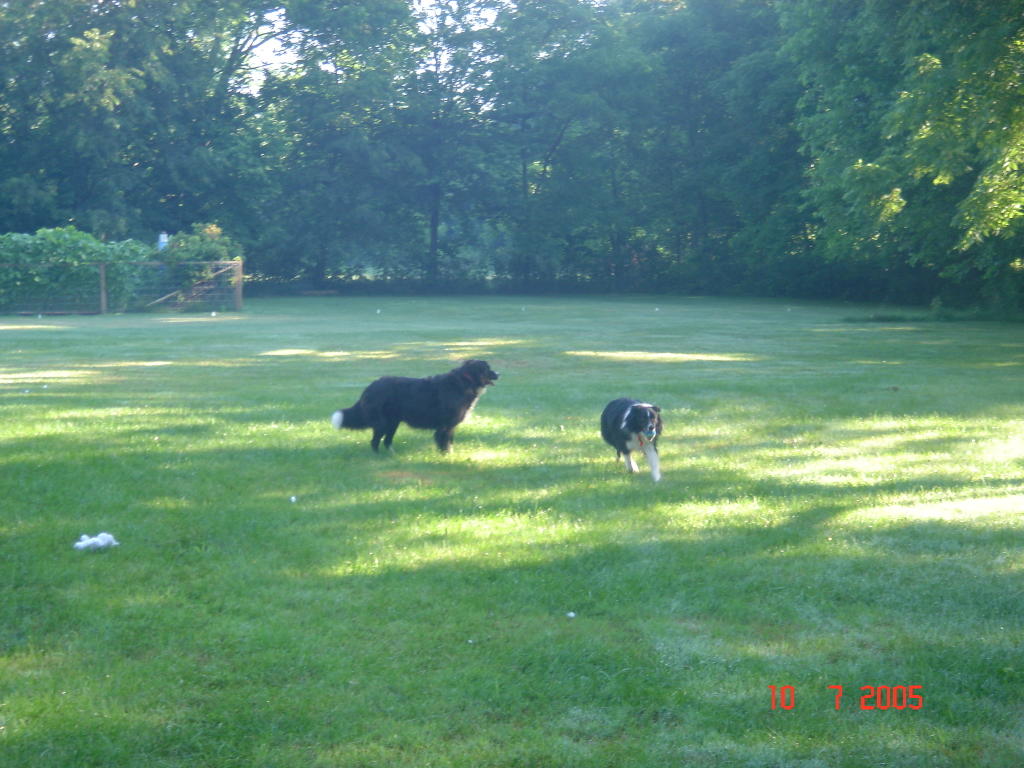
Just because Alice and George are off shouldn't mean nothing happens here, but I am confessing that I hardly ever fire up the work laptop on the weekend (and a choice I find hard to stick to sometimes) and although IAG exists anywhere I am connected, because it's not my personal blog I deliberately don't do much blogging off times (although I had a weird work dream last night and woke up with this phrase in my head, "cost of sale").
My husband and I have two dogs and I got it in my head that we needed a third. Our older dog is somewhere between 8 and 10 and she's big so likely won't get to be a 20 year old dog. She's a rescue border collie/whatever and smarter than many people I know so I wanted her to train any new dogs we got. Our second dog was a pound dog and is a 3 year old mutt with a sweeter disposition than anybody I know.
Cruising around the web looking at dogs that need new homes is dangerous...I know this because yesterday we introduced the 3rd dog to the household (4 cats, 45 fish). Photo is dog 1 (left) and dog 3 (right).
So, there you go. A post that has nothing at all to do with libraries, environmental scans, content consumption habits...nada. Not even any links. This is my real life.
Thursday, July 07, 2005
The Fourth Literacy
If you had time to read the newspaper this morning, you might have seen an Associated Press item reporting on the big kahuna of testing organizations Educational Testing Service work to create a test to evaluate what ETS is calling the "fourth literacy", which is Internet intelligence, measuring whether students can locate and verify reliable online information and whether they know how to properly use and credit the material.
I'd think that any librarian teaching information literacy will want to take a look at the test as it looks like the competencies/literacies being evaluated are among the ones librarians teach. Perhaps the good news is that the efforts of teaching librarians will receive more institutional support as a result.
The ETS announcement references Connected to the Future, a study from the Corporation for Public Broadcasting, that was underwritten by ETS, Bell South, and Kodak (an interesting group of underwriters).
Posts to IAG might be sparse for a week or so because both George and Alice are off with limited access to the Internet.
I'd think that any librarian teaching information literacy will want to take a look at the test as it looks like the competencies/literacies being evaluated are among the ones librarians teach. Perhaps the good news is that the efforts of teaching librarians will receive more institutional support as a result.
The ETS announcement references Connected to the Future, a study from the Corporation for Public Broadcasting, that was underwritten by ETS, Bell South, and Kodak (an interesting group of underwriters).
Posts to IAG might be sparse for a week or so because both George and Alice are off with limited access to the Internet.
Tuesday, July 05, 2005
Dodgy Stuff
I am with Alice.....I did not like Chris Dodge's Utne Reader article at all. I didn't disagree with all his points but I definitely did not like how it was written.
It's all well and good to revere Sandy Berman and the work he did at Hennepin County Library (and continues to do on his own) but to use that as an optic for a supposedly big picture article on the future of public libraries is a bit much--and disingenuous.
Ordinary people do not search subject headings, Berman or LCSH. They search key words. Using Dodge's example of "menstrual cramps" (whaa-aa? Couldn't he think of a better phrase than this?) as a bound phrase in the keyword index of WorldCat, I got 29 records, not the one German-language item Chris's subject search revealed. Using the "libraries" limiters on Yahoo! and Google I still found 10 items (Yahoo!) and 18 (Google) served up through Open WorldCat.
So, I say Chris Dodge should have done his homework instead of indulging in low-level scaremongering. Mind you, Utne lost my respect and my subscription back in the late 90s when they published a booklet on how to survive Y2K that was full of the silliest, most uninformed drivel about the "potentially enormous and unknown global challenge ."
I am much fonder of this vision of the future of libraries which includes "Die Bibliothèque d'amis: an intimate public library for friends, which provides space for a good conversation about literature."
Addendum @8:35pm EDT: My husband--bless his pragmatist soul--pointed out that few ordinary people would be searching for whole books on menstrual cramps. A researcher or scientist would use the formal term and those of us who might suffer would be looking for much more immediate information than could be found in books.
It's all well and good to revere Sandy Berman and the work he did at Hennepin County Library (and continues to do on his own) but to use that as an optic for a supposedly big picture article on the future of public libraries is a bit much--and disingenuous.
Ordinary people do not search subject headings, Berman or LCSH. They search key words. Using Dodge's example of "menstrual cramps" (whaa-aa? Couldn't he think of a better phrase than this?) as a bound phrase in the keyword index of WorldCat, I got 29 records, not the one German-language item Chris's subject search revealed. Using the "libraries" limiters on Yahoo! and Google I still found 10 items (Yahoo!) and 18 (Google) served up through Open WorldCat.
So, I say Chris Dodge should have done his homework instead of indulging in low-level scaremongering. Mind you, Utne lost my respect and my subscription back in the late 90s when they published a booklet on how to survive Y2K that was full of the silliest, most uninformed drivel about the "potentially enormous and unknown global challenge ."
I am much fonder of this vision of the future of libraries which includes "Die Bibliothèque d'amis: an intimate public library for friends, which provides space for a good conversation about literature."
Addendum @8:35pm EDT: My husband--bless his pragmatist soul--pointed out that few ordinary people would be searching for whole books on menstrual cramps. A researcher or scientist would use the formal term and those of us who might suffer would be looking for much more immediate information than could be found in books.
Utne not me
Just was forwarded and read an article from Chris Dodge in the Utne Reader with which I disagree completely. On just about every level.
It appears gilded with half-truths and Nicholson Baker quotes, calculated to make the average American reader think that libraries and librarians should remain firmly rooted in the 1950's. Rrrr.
Whatever. Read the article for yourself and let me know if my nose is out of joint unnecessarily.
Knowledge for Sale?
It appears gilded with half-truths and Nicholson Baker quotes, calculated to make the average American reader think that libraries and librarians should remain firmly rooted in the 1950's. Rrrr.
Whatever. Read the article for yourself and let me know if my nose is out of joint unnecessarily.
Knowledge for Sale?
Friday, July 01, 2005
Hasta la vista, Bloggers!
Like Lili Von Shtupp in Blazing Saddles, I'm tired. Just not for the same reason, unfortunately. (BTW, that link is rated PG-13.)
Therefore, I'm off for a week of R & R, visiting my folks in the neighborhood where I grew up in Buffalo, the Shaw Festival in Niagara on the Lake, Ontario, and Toronto. I'll be back to blogging the week of July 11.
For our Canadian friends, Happy Canada Day! To our US friends, to quote Margo Channing, "Fasten your seatbelts. It's going to be a bumpy night."
Therefore, I'm off for a week of R & R, visiting my folks in the neighborhood where I grew up in Buffalo, the Shaw Festival in Niagara on the Lake, Ontario, and Toronto. I'll be back to blogging the week of July 11.
For our Canadian friends, Happy Canada Day! To our US friends, to quote Margo Channing, "Fasten your seatbelts. It's going to be a bumpy night."
Love your Library license plates

One of the metalibrarians at the OCLC Information Center kindly sent this hunk of fun stuff yesterday. I guess our advocacy message is reaching presidents, provosts, mayors, city councilpeople...and DMV employees.
Here's the clip from Birdie at lisnews.com:
You've gotta love the DMV now that they've issued a sentimental "Love Your Library" license plate. The plate, which features a design consisting of various library resources to the left of the plate number and includes the words "READ - LEARN - EXPLORE," is available to anyone who has a passenger or commercial vehicle registered in New York State (and who can afford an additional $43 over the cost of a regular plate). Here's the press release from Empire Information Services.
The new license plate gives New Yorkers the chance to show their support for libraries by helping to subsidize summer reading programs.
Good stuff.
And P.S. George's birthday is this weekend, so be sure to leave him celebratory comments!
Canada Day
Formerly known as Dominion Day, July 1 is Canada Day. Think you know anything about Canada? You can take a quiz here. Don't feel bad if you don't get the answer to this question correct--only 8% of Canadians taking the quiz were correct.
Who is Canada's head of state?* No it's not him. And it's not her.
Perhaps because I had to study for my citizenship exam 20 years ago, I found myself in the top category for correct answers and as a result I "have qualified for the John A. Macdonald Chair for Advanced Historical Drinking at the Dominion Institute. Please show up at our offices Monday morning for a plate of leftover Haggis and some 138-year-old single malts!"
Happy Canada Day to Canadians everywhere.
* The correct answer is here.
Who is Canada's head of state?* No it's not him. And it's not her.
Perhaps because I had to study for my citizenship exam 20 years ago, I found myself in the top category for correct answers and as a result I "have qualified for the John A. Macdonald Chair for Advanced Historical Drinking at the Dominion Institute. Please show up at our offices Monday morning for a plate of leftover Haggis and some 138-year-old single malts!"
Happy Canada Day to Canadians everywhere.
* The correct answer is here.
Subscribe to:
Posts (Atom)

