Thomas left a comment on the previous post about the results of our survey showing that "books" is what 69% of 3,348 respondents think of when they think of libraries. ("Information" was a distant second at 12%.) I am pulling part of his comment up so I can remark on it.
"If books are the brand of libraries. Maybe we should look at what other things are branded with books. Try Knowledge, Wisdom, Reliability, Information etc. Maybe not so bad brand after all?"
Well, unfortunately, those other good qualities Thomas lists were not mentioned often as being the "top-of-mind" association. If they were indeed co-branded with books, then these works would have been mentioned frequently in the same comments with books as in "A place where you find lots of books and information." They were not.
We did actually probe for those other attributes Thomas mentions, in other questions, and we also took a very close look at the verbatim comments contributed as answers to this question because we wanted to know if books=information, knowledge, learning and so on. Our analyses conclude...no. When respondents said books we are pretty confident they meant the physical thing, not what "book" embodies. The word "smell" showed up a lot, for example, as in "smelly old books. "
You'll be able to have a look at this yourself when we publish the report. We will also be publishing a companion/followup piece called The Library Brand where this is explored more.
When we asked what respondents thought the purpose of the library is, most people said "information" and in response to another question most respondents agreed the library is a place to learn.
It's important to note that the question we asked about the first association people make with "library" was an open-ended one. This means people could say anything they liked. This is different from a question that guides responses by providing a list of choices. The question we asked about the role of the library in the community was a guided response one. Respondents picked from a list of 14 attributes and 85% said the library is a place to learn. This suggests, that when prompted, people do see a role for the library that is beyond the top-of-mind association of books.
If this is confusing to you, try the top-of-mind association game yourself. What is the first thing you think of for "hospital?" What is the first thing you think of for "Mercedes-Benz?" Whatever that word was is the "brand" (for you) of those two things. Now answer the question "what is the role of a hospital/Mercedes-Benz?" Whatever you answered is the "brand promise." They are very different. And neither actually have to be anywhere close to the experience you actually have had of hospitals and Mercedes-Benz.
Here's some of the verbatim comments with the country of the respondent in brackets: A facility that is mostly concerned with books. (Canada); a building with books (Wales); A great collection of books (India); A place to borrow books (US); books and a woman in glasses (Australia); borrowing books (Singapore). And here's one of the very few that included several attributes: A place where expertise, information, knowledge and entertainment are available to the masses.
Wednesday, October 26, 2005


Sunday, October 23, 2005
Read. This. Now.
I've had this post sitting in the draft box for several days waiting for the web site of the magazine Fast Company to reflect the latest print issue so I could point you to the article I talk about below, but it is still showing the October one. So, either find a print copy or you might have to wait until the November issue shows up on the Web site.
********************
Get those library glasses out and read this Fast Company essay with them on. It's a mere two pages long but should have you shifting uneasily in your chair, or bouncing up and down, yelling, "yes! yes!! yess-ss!!" The title is "Back in the Box" and it's by Douglas Rushkoff. [spelling corrected, thanks]
"In their endless rush to embrace the next big thing, too many businesses have forgotten what they are and what they really do. The fashionable compulsion to break with the past has, bizarrely, come to mean abandoning the true value they once offered customers."
And this, for me, resonanted with something I read last week, in a source few of you will be able to lay hands on--nyse magazine (oct/nov 2005) which is published by the New York Stock Exchange. (It was on Jay Jordan's desk and it was, um, borrowed). The article was about McDonald's.
"Back at the turn of the new century...a variety of cost-cutting measures had derailed the company. 'Ultimately,' says CFO Matt Paull, "we think we hurt the brand."
As Alice has noted, we are thinking a lot about brand in our part of OCLC (George probably is not thinking do much about this) because of the survey I tiresomely keep referring to that you can't see yet because we haven't released it (I tell you proofreading umpty dozen tables full of numbers takes a long long time). The survey results show that for the respondents--3300+ in 6 countries--the overwhelming top-of-mind association with "library" is "books". So, "books" is the brand of The Library.
Perhaps you are not surprised. Perhaps you are happy that this strong association exists. But, it is then a bit odd, I think, that for all the e-resources we've added, for all the portals and web sites that have been built, for all the classes academic librarians have held on using non-print resources, for all the computers that people use in public libraries.....that the brand is still books.
So, this is what we have to work with when we promote our libraries and their resources. Like it or not, it is not possible to change peoples' associations with a strong brand by telling them something different. BIG questions: what is the value of The Library and what does it do?
Friday, October 21, 2005
Members Council this weekend
Librarians around the world are packed their bags to gather at Members Council this weekend. Alas, I was not looking at my calendar (I was actually in the airport...oddly enough) when my mother rang me up to ask if she could come see this new house (and its associated boxes) that she has heard so much about.
So without so much as an inkling of common sense, I agreed that she should take advantage of the cheap flight she has procured and come visit.
All of that is to say unfortunately you will have to rely on Alane and George this time, for all the dialogue and conversations that emerge. Or perhaps it is fortunate? Oh--don't answer that!
Tuesday, October 18, 2005

City branding
Speaking of branding and the trend towards branding things you never used to think needed a brand...(libraries, the post office, water, universities) cities now join the ranks.
Oh sure, cities have always had marketing campaigns and bids for tourists. Vegas, Honolulu, New York...but this new effort looks like it has residents--as well as tourists--in its target audience.
The City of Atlanta has an initiative underway, complete with new logo, anthem, newsletter and team. The message is "Opportunity, Optimisim, Openness" and the effort highlights Atlanta's prominence as a major airport hub ATL.
I am beating the branding horse again, I know, but I tell you this: if a major city that hosted the Olympics less than 10 years ago now feels compelled to spend $4.5M on image perception, it makes me think that we (speaking for libraries as a whole) have a lot of catching up to do.
Friday, October 14, 2005
Top 100 brands
We've been doing a lot of talking about the library brand and what that means lately, largely around the report Alane was talking about a few posts ago. So my "brand antennae" has been up, you could say.
Which is what the "Top 100 Global Brands Scorecard" caught my eye. The top 4 brands have not moved in the past 4 years: Coca-Cola, Microsoft, IBM, GE, in that order.
The next 5 have all hung together, although there has been some switching around: Intel, Nokia, Disney, McDonald's, Toyota, Marlboro.
A few surprises for me: Starbucks was way down on the list, as was Apple, Nike, VW--all these brands that I tend to think of as watershed, in terms of great, memorable, visual brands and brand experiences...
Check out the list for yourself.
And then start to think where the mindshare might be for "Your Library" in your library user/patron/customer/information consumer's head. Because this list represents the brands that are your competition for his/her attention!
Thursday, October 13, 2005
Google looks for content
I know, I know...everyone's heard it already. But I can't help but bring it up, as it seems the harbinger of what we all know is true: content, content and more content will rule the roost, soon enough.
Read more about the Google+Comcast deal to buy the content side of AOL, from Reuters.
Of course, it's all rumors and innuendo at this point.
ABC TV on your iPod
And just in case you read my fawning review on the new Nano and rushed out to buy one, (Come now, you know who you are...) I have a reason for buyer's remorse: an even more recently released iPod does video. Story from CNET. More photos. (And it comes in black, too, which my fashionista sense says will match more of my "I hang out with graphic designers" wardrobe.
I hear you can watch Desperate Housewives on it? Ah, but will it play CSI?
Perhaps now Alane will finally want to watch some TV... Speaking of TV and ABC, have you seen ABC's mobilestore, where you can download show clips to your mobile phone? Very interesting...
There are apparently more than 11,000 audiobooks in iTunes, too.
New Card
All this happened today AND I got my new library card with my new address on it today. And guess how easy it was?
A heck of a lot easier (and MUCH more pleasant) than most of the other forms, systems and bureaucracy I encountered today. Foreshadowing for the post tomorrow...
Wednesday, October 12, 2005
Semiotics to the Rescue
I found this article , "More Use RSS Than Have Heard Of It" from ClickZ very interesting, reporting on a survey conducted for Yahoo! by Ipsos Insight. "The number of tech-savvy Internet users who knowingly sign up for RSS syndicated content is only four percent, while another 12 percent are somewhat aware of the term RSS. Twenty-seven percent of adult Internet users access RSS feeds through personalized start pages, though they don't know that's what they're doing on personalized portal pages."
One reason it's interesting to me is that the survey data we're wading through to produce the report (titled The OCLC Report on Perceptions of Libraries and Information Resources...still on for release at the end of the month) shows this same odd relationship between use and familiarity in our data. Even though our survey takers all use the Internet, sometimes they report "never have heard of" for things that make us scratch our heads..."they use the web and x% have never heard of email?" What is up with that!?
Well, this report helps me understand why maybe. Even web-savvy users don't always know what the particular service/feature names are, especially if the functionality provided is known by several names (email, chat, IM), or if the discrete function/service is perceived to be part of a bigger whole. And example of this might be "ask an expert" services. If I've sought help from a Lands' End expert while shopping online I might not separate that bit of the process from the process as a whole. So, on a survey I might answer, "yes, I have shopped online," but answer "no, I have not used an ask-an-expert service."
The converse is true too...a brand name such as Kleenex, Xerox or Google comes to "stand in" for the entire use category, as in: Hand me a kleenex please, I'll just xerox that for you, Did you google her?
This article and the data from our survey suggests to me that there is a lot of thinking and testing that needs to be done to determine what we call resources and services we offer over the Web...or whether in some cases we don't call them anything and embed them seamlessly.
Tuesday, October 11, 2005
Reagan Library workers claim age discrimination
From NPR: Reagan Library volunteers were relieved of their duties, because they were too old. Of course, many of them are younger than the President, when he left the white house.
Monday, October 10, 2005
Open WorldCat Reviews (revised)
Revision added October 12. Ok, ok...sometimes I write/talk before I think/do (I am an ENTJ on the Myers-Briggs scale) and this was one of those times. As several of my esteemed colleagues informed me...I am flat out wrong about linking in the Open WorldCat reviews feature. Lorcan clarifies in the comments to his original post, linked below. Here's what he said:
Thanks to everyone who corrected me.
Finally, Anonymous Commenter? I do know, generally, what "nudnick" means...and like the sound of the word added to the meaning to connote "annoying wind bags who know nothing."
***************************
Original Post: Only so we don't look like complete know nudnicks, I refer you to Lorcan's post about the release of the terrific review feature in Open WorldCat (no bias here!).
S'wonderful, S'marvelous. Can I just say that it would be more marvelous if we could link from within the review? We bloggy types are habituated to the hot link inside and it feels like amputation to have to communicate in flat text. I've forgotten how to point people to things except to provide a link.
My stalwart OCLC Open Worldcat colleagues....it's all about context! Stand alone bib records--even those enhanced by reviews--are entombed little artifacts. When readers can show others that this book has connections to that book, and this web site and these seventeen journal articles and that one really flakey personal blog...then we're really exposing the value of metadata and exploiting in the best sense the value of WorldCat.
Thom Hickey writes a little about how the review functionality is implemented with some links to background information about the underlying technology. Thom points to a review he has started in which there are several links. URL links are now supported. At first there was some concern about links to inappropriate sites. After feedback, it has been decided to allow links and see what happens. The guidelines will be amended to reflect this soon.
Thanks to everyone who corrected me.
Finally, Anonymous Commenter? I do know, generally, what "nudnick" means...and like the sound of the word added to the meaning to connote "annoying wind bags who know nothing."
***************************
Original Post: Only so we don't look like complete know nudnicks, I refer you to Lorcan's post about the release of the terrific review feature in Open WorldCat (no bias here!).
S'wonderful, S'marvelous. Can I just say that it would be more marvelous if we could link from within the review? We bloggy types are habituated to the hot link inside and it feels like amputation to have to communicate in flat text. I've forgotten how to point people to things except to provide a link.
My stalwart OCLC Open Worldcat colleagues....it's all about context! Stand alone bib records--even those enhanced by reviews--are entombed little artifacts. When readers can show others that this book has connections to that book, and this web site and these seventeen journal articles and that one really flakey personal blog...then we're really exposing the value of metadata and exploiting in the best sense the value of WorldCat.
Nice PowerPoints!
At the Ohio Library Council conference last week, Omar Wasow quipped, "Power corrupts. PowerPoint corrupts absolutely."
Despite this sage advice, you might want to check out Eric Childress' PowerPoint presentation on applying the OCLC Environmental Scan in a tech services context. It will be available tomorrow on the Office of Research presentation web site.
If you're attending the Arizona Library Association conference later this week, I hope you'll find time to attend my presentation on Thursday morning, "Google, Gamers and the Gathering Place: Implications of the OCLC Environmental Scan for Arizona Libraries." But if you don't go to my presentation, go see Chrystie Hill, who will be talking about Arizona's WebJunction, or Tim Prather from Amigos Library Services, who will be talking about OCLC's Union List Service. We're all on at 9:00 a.m. Thursday.
Reputation is stronger than truth
A MARC Database Manager and Senior Cataloger at the State Library of North Carolina was on her toes last week. She sent me the story "The Mining of the Invisible Web," and I just about fell on the floor. There is a line in the article,
Maybe I've been on my soapbox again lately, talking about reporters checking facts (or NOT checking facts, as the case may be).
I asked if I could share it with everyone, to which she answered:
And I am pleased to report, there are a number of comments (6 so far) to correct the author. The most colorful, I have to say, is "Sergey Brin was just a gleam in his daddy's eye when OCLC invented WorldCat!"
The other thing it tells me, is that we (OCLC) need to make sure it's very clear who is doing what: librarians and library staff members are building WorldCat. Google is simply indexing it and making it visible/accessible on a much wider scale.
"Meanwhile Google is creating a comprehensive bibliographic database that it calls WorldCat to search for and find information formerly only found in libraries."
Maybe I've been on my soapbox again lately, talking about reporters checking facts (or NOT checking facts, as the case may be).
I asked if I could share it with everyone, to which she answered:
"Please do share it! I'm so glad you enjoyed it. Though I am steamed on behalf of OCLC and thousands of nameless catalogers that one of our major cooperative products is being attributed to Google..."
And I am pleased to report, there are a number of comments (6 so far) to correct the author. The most colorful, I have to say, is "Sergey Brin was just a gleam in his daddy's eye when OCLC invented WorldCat!"
The other thing it tells me, is that we (OCLC) need to make sure it's very clear who is doing what: librarians and library staff members are building WorldCat. Google is simply indexing it and making it visible/accessible on a much wider scale.
Saturday, October 08, 2005
Omar Wasow: Move from "Information to Transformation"
Omar Wasow was the keynoter on Thursday at the Ohio Library Council conference. What a dynamite speaker!
Mr. Wasow is the co-founder of BlackPlanet.com, an online service aimed at African Americans that now has more than 16 million members. He is also a frequent media guest, on CNN, The Tavis Smiley Show, and, perhaps most notably, as the man who taught Oprah how to use computers in a 12-part series on her show.
Mr. Wasow managed to ingratiate himself with me immediately by NOT talking about how much he liked libraries when he was a child. Instead, he related how he had used libraries this spring to wipe out a few incompletes on his college transcript, allowing him to enroll in a Ph.D. program at Harvard which he started last month.
But the bulk of Mr. Wasow's comments were about how libraries must move from a focus on information to one of transformation. He referred several times to the OCLC Environmental Scan, mostly approvingly but occasionally taking us to task for focusing too much on the information role of libraries. (He did note positively our discussion of the library as "third place," but he thought we should have centered on this more.) He applied the concepts laid out in The Experience Economy by Joseph Pine and James Gilmore to libraries, saying that we should pay as much attention to the experience our users have when they use our services as we do to the services themselves. "The experience of being in a library can be as important as the information available," he said. "Part of the magic of libraries is the experience."
Mr. Wasow's last thought was inspired: "Too often, libraries are viewed as a Temple of Books. To succeed, libraries must embrace that they are Temples of Thought!"
Thursday, October 06, 2005
A Nice Pair of Breaches, or Divides, Digital and Other
Today, I'm speaking at the Ohio Library Council conference here in Columbus on the things we as librarians can learn from the gamer generation. And as I was preparing for the talk, I was thinking a lot about a short essay that Alane turned me on to, called "“Digital Natives, Digital Immigrants,"” by Marc Prensky.
Prensky got me thinking about one of the first roles of American public libraries, the key reason Andrew Carnegie was so interested in underwriting library buildings all over North America. Carnegie believed that having public libraries in every city, town, and village would help geographic immigrants acculturate (and yes, even assimilate) in their new home. The public library and the librarians would help immigrants learn the language, the customs, and the other basic material needed to gain citizenship in this strange land.
To me, this is the library's role in the digital divide. We can help digital immigrants acculturate to this strange new land. We can help them learn the language, the customs, and the basic rules of the road. The librarians at the turn of the 19th century did not see it as their roles to lift people out of poverty and make them middle class American citizens. They saw it as their role to provide access to the tools (anachronistic phrasing, I realize) that the immigrants could use to help themselves.
I agree with Alane that libraries and librarians cannot cure poverty or homelessness, we cannot fix the lives of people who make bad choices, and we can't change the economic system. What we can do is help people learn to use all the tools that are available to them, and then, maybe, they can do those things for themselves.
Tuesday, October 04, 2005
Once More, Into the Breach
Over at BlogJunction, our QuestionPoint (goodness, why did I type QuestionPoint??? And why didn't I notice until Chrystie pointed out on 06/05 that she works for...) WebJunction colleague Chrystie Hill has a thought-provoking post revolving around this question: "Is there anything that’s still relevant to me about my library?"
This is a relevant question! And is related to the data I refer to a couple of posts below that we have in-house and are publishing soon about peoples' perceptions and uses of libraries. Chrystie is much younger than I am, and one trend that's very evident among the data gathered is that younger people (14-25) have much less use for and interest in using libraries and their resources, print or otherwise, than older people. Perhaps this was ever so, but I suspect the disinterest is supported now by other technologies and ways of accessing and delivering content.
Chrystie also says: "Is there enough there there to sustain this concept of libraries for the public good? I’m afraid we can’t sustain ourselves serving only the people in our communities who have no money; the benevolence of our government or other benefactors is far from guaranteed."
Now, at the risk of starting another go-round with George about the Digital Divide (actually I thoroughly enjoy these debates!), this issue of sustainability and serving people with no money (and it's these people that are always assumed to be on the "have not" side of the DD) is huge. There are very few organizations that have sufficient funds, out of the public purse, to serve the disadvantaged adequately (welfare? medicare? food stamps?).
And the current sociopolitical climate, at least in the US, has more and more money being removed from funding the public good from government purses, leaving the gap to be filled, in theory, by generous private benefactors. One response from the library community is that we, then, must step up and bridge the divide on behalf of the disenfranchised.
What are the stats on TV ownership in the US? Rheotrical question because TV ownership is very, very high. There are few disenfranchised wannabe TV /owners/viewers. Why is that? Because most people choose to participate in that form of technology and will assume debt to participate. Which suggests that even people with low annual incomes decide to spend scare dollars on something they value.
OK, I'll stop being oblique. The so-called digital divide, in the US, is one driven by values. If people valued access to seek-it-yourself information, to email, to the internet in the same way that they clearly value access to network TV, I doubt there would be a digitial divide. The DD, simplistically, is a clash of values between what librarians think people want and need and what people opt to spend time and dollars on.
Here's a divide for you: my husand and I own a television. we never watch it. I haven't watched TV at home for almost 20 years. Ahhh, you say to yourself, that's what's wrong with her!
Monday, October 03, 2005
Foiling the Spambots
Dear readers and sometime commenters: we've had to turn on the comment verification feature because, for some reason, the volume of blogspam has jumped recently. So, humans now have to type in the word they see in order to leave a comment. I wonder why so much of our spam was about voip services?
Yahoo to digitize library collections
Now that Google is having to duck and cover on the copyright infringement issue--and the authors guild is up-in-arms--Yahoo will quietly step into the breach.
Here's a snippet of what Scott Carlson and Jeffery R. Young of The Chronicle report about the project:
Here's the story as it ran in the Washington Post.
Interestingly enough, the link for Open Content Alliance did not come up on top, for a Google search.
I am a bit irked, though, by headlines such as "Open Content Alliance brings libraries online" (from Macword UK) and wonder if the editor really thinks that libraries just *hadn't thought of it yet* ?
We know the truth, my friends...and I guess this is where we smile as say, "Yes, isn't it wonderful? Great library content, all available online, all the time. A dream come true!"
Here's a snippet of what Scott Carlson and Jeffery R. Young of The Chronicle report about the project:
Yahoo officials say that the project is not a response to Google's partnership with five major research libraries to scan millions of books, and that some planning for the Yahoo project was under way before Google announced its plans last December.
The new archive is called the Open Content Alliance, and it was conceived in part by Brewster Kahle, director of the Internet Archive, a nonprofit digital library. The archive will be doing much of the actual scanning for the project, using a process it has developed in recent years. Libraries involved in the project can have their books scanned by the Internet Archive for 10 cents per page, which leaders of the project say is far below the standard price of scanning.
Other participants in the project are Adobe, the European Archive, the National Archives of England, O'Reilly Media, and Hewlett Packard Labs. The project hopes to attract other libraries and other partners, however, as well as more financial support.
Here's the story as it ran in the Washington Post.
Interestingly enough, the link for Open Content Alliance did not come up on top, for a Google search.
I am a bit irked, though, by headlines such as "Open Content Alliance brings libraries online" (from Macword UK) and wonder if the editor really thinks that libraries just *hadn't thought of it yet* ?
We know the truth, my friends...and I guess this is where we smile as say, "Yes, isn't it wonderful? Great library content, all available online, all the time. A dream come true!"
Thursday, September 29, 2005
Williamsburg, VA
I am in "colonial Williamsburg", at the South Atlantic Regional Conference, which is the annual event for Virginia, North Carolina, South Carolina, Georgia, Florida and Caribbean SLA Chapters.
Tomorrow I will be speaking to attendees about the disaggregation and unbundling of content from its traditional containers, and the changes to the channels in which content is available. This trend was one of the three overarching megatrends we identified in the Environmental Scan, and one we explored in more depth in the "2004 Information Format Trends" report (here).
And (foreshadowing drumroll, please) a trend whose bones we decided to put some flesh on. In the OCLC report (not published yet but soon, really soon) of the survey we commissioned one of the major areas we asked the 3300+ responders was about their familiarity with libaries' e-resources. When the report is released (late October we hope) you will see many questions probing for peoples' awareness and perceptions of, and usage of library-provided e-resources. But, here's a teaser: one question we asked was:
"Why haven’t you ever used the online library website?" (This was a follow-up to a question asking if people had used a library website...which is where most if not all libraries provide access to various e-resources). Here's the answers, by country of respondent....and I apologize that the x and y axes have somehow disappeared. This was grabbed from one of our drafts of the report and I have no idea why the format changed. But, for the purposes of making a point, I don't think the values are necessary--the 4 groups represent the geographic groupings, US, Canada, UK, and Asia, top to bottom. The data will be in the report.
 Oh. My. Good. Grief. Yes, folks.....3348 Internet-savvy people in 6 countries do not know libraries even have web sites, can't find such an animal, or prefer other websites. Hmmm, and here in the United States ALA has been running the @your library campaign for a couple of years. It'll be interesting to see what before and after measurements ALA will use to determine the effectiveness of the campaign.
One of the open-ended questions we asked in the survey was: what is the first thing you think of when you think of the library? 3,785 comments were documented and the answers were varied but more than half (57%) included books in their response. Here's how one 41 year old Canadian responder put it.
"Books, books, books, rows and rows of books, stacks of books, tables filled with books, people holding books, people checking out books. Libraries are all about books. That is what I think and that is what I will always think.”
Tomorrow I will be speaking to attendees about the disaggregation and unbundling of content from its traditional containers, and the changes to the channels in which content is available. This trend was one of the three overarching megatrends we identified in the Environmental Scan, and one we explored in more depth in the "2004 Information Format Trends" report (here).
And (foreshadowing drumroll, please) a trend whose bones we decided to put some flesh on. In the OCLC report (not published yet but soon, really soon) of the survey we commissioned one of the major areas we asked the 3300+ responders was about their familiarity with libaries' e-resources. When the report is released (late October we hope) you will see many questions probing for peoples' awareness and perceptions of, and usage of library-provided e-resources. But, here's a teaser: one question we asked was:
"Why haven’t you ever used the online library website?" (This was a follow-up to a question asking if people had used a library website...which is where most if not all libraries provide access to various e-resources). Here's the answers, by country of respondent....and I apologize that the x and y axes have somehow disappeared. This was grabbed from one of our drafts of the report and I have no idea why the format changed. But, for the purposes of making a point, I don't think the values are necessary--the 4 groups represent the geographic groupings, US, Canada, UK, and Asia, top to bottom. The data will be in the report.
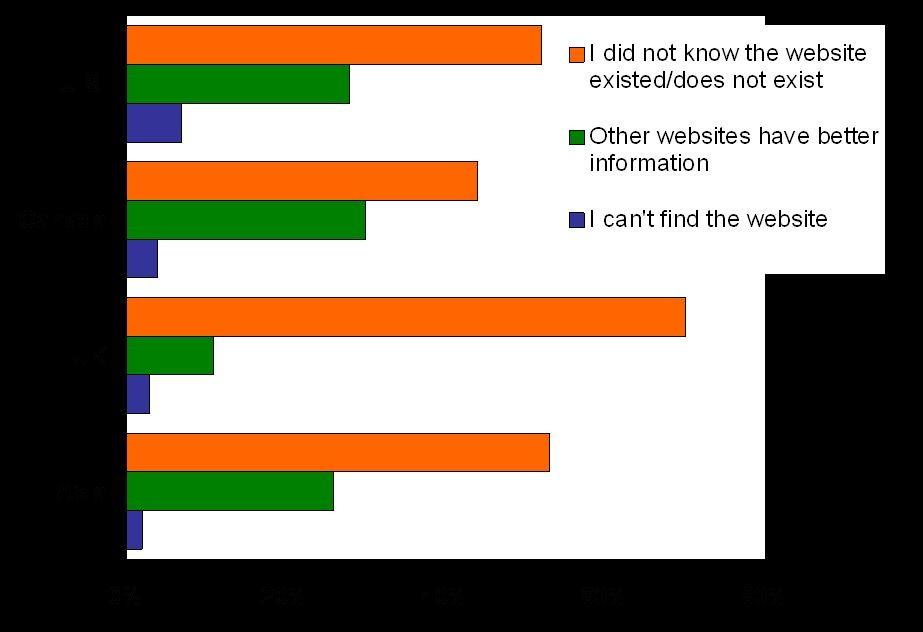 Oh. My. Good. Grief. Yes, folks.....3348 Internet-savvy people in 6 countries do not know libraries even have web sites, can't find such an animal, or prefer other websites. Hmmm, and here in the United States ALA has been running the @your library campaign for a couple of years. It'll be interesting to see what before and after measurements ALA will use to determine the effectiveness of the campaign.
One of the open-ended questions we asked in the survey was: what is the first thing you think of when you think of the library? 3,785 comments were documented and the answers were varied but more than half (57%) included books in their response. Here's how one 41 year old Canadian responder put it.
"Books, books, books, rows and rows of books, stacks of books, tables filled with books, people holding books, people checking out books. Libraries are all about books. That is what I think and that is what I will always think.”
Wednesday, September 28, 2005
Being Included is So Important
As long as it's on the right list.
Lists I am not happy to be included on:
1. Not-yet-included-in-our-service-area
2. Customer-prone-to-return-items
3. Fines for overdue materials
Lists I am happy about:
3. Newest customer for the local plumber (we can now use our gas stove!)
2. Sales of existing homes for September (bubble, schmubble)
1. IAG on Technorati Blog finder under "library" and "libraries" (okay, so I got the metadata wrong, but at least it demonstrates the absolute power of metadata!)
Whoo Hoo!
Plus, 288 links from 100 blogs.
Monday, September 26, 2005
At the NWILL Conference
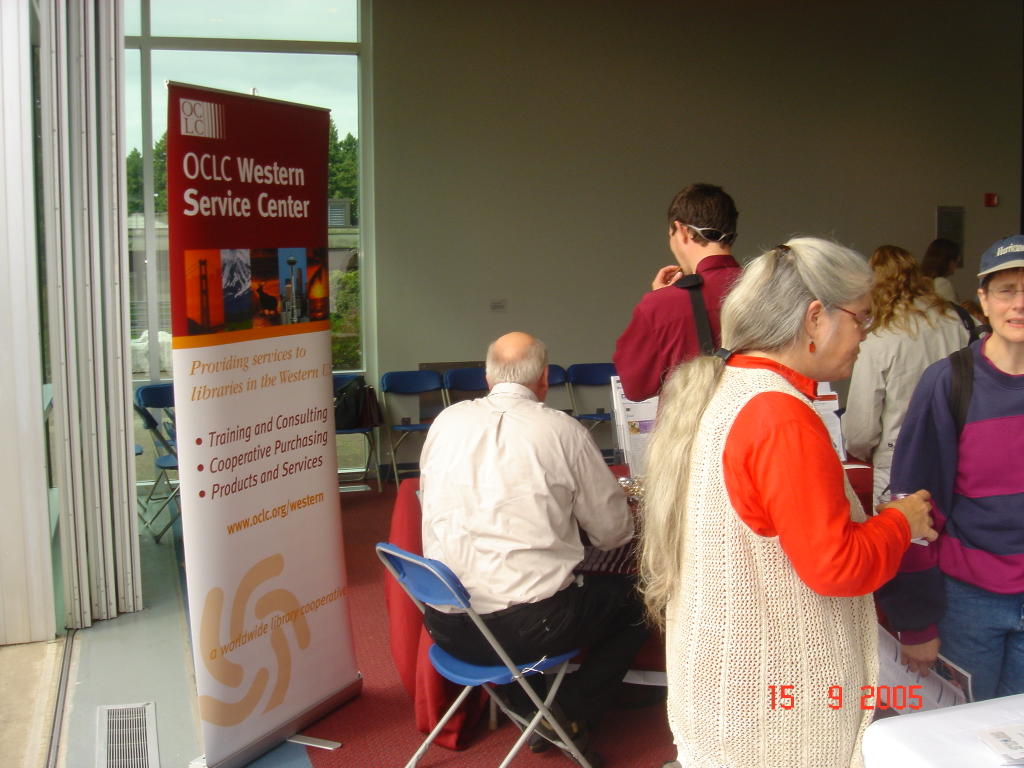
Not a brilliant shot, I admit, but behind me were some floor to ceiling windows that made it impossible to take the picture from the preferred angle. The guy in the white shirt, sitting down, is Sam Sayre of OCLC Western and I hope he was talking to the fellow standing beside him about OCLC ILL services. I'm sure he was.
Subscribe to:
Posts (Atom)

