It's not the Symposium that is being extremely made over but it is the topic of the afternoon's talks at ALA Midwinter. Unfortunately we are not offering makeovers for audience members--or OCLC staff, for that matter, although on the mornings I look at myself and think, "good grief, it's my mother!" I would be most grateful for an extreme makeover.
No, this makeover refers to our collective community, our industry, Libraryland, and is related to the report we just issued called Perceptions of Libraries and Information Resources . Respondents to the survey that the report is based on generally like libraries, generally hold the information they get from librarians with reasonably high regard, and even use libraries with some regularity. But, there are some service gaps that need to be discussed, at the very least. Many respondents do not think much of the environments of the libraries they use--cold, dirty, no comfortable chairs, surly staff, confusing layouts and poor signage, inconvenient hours and locations--and most respondents associate libraries with books.
Now, this association with books is perhaps not one we want to discard or change as it is so very clearly important to people and is also important to people who work in libraries. But, what "industry", be that a clothing store, a church, a restaurant, or a car maker, wants to be associated with bad service and unpleasant surroundings? And beyond this, what "industry" wants to be known predominently for "products" that represent only a fraction of their offerings--and the oldest product line, at that? Libraries spend a bazillion dollars on electronic resources for their communities and as far as we can tell, they may as well have donated all that money to Oxfam or Doctors Without Borders and few people would have been the wiser.
Many librarians see Google and other search engines as competitors to libraries that must be beaten at their own game….many librarians still want people to begin searching at library websites because that’s where the “good” information is. This won’t ever happen, but a lot of energy and time is being spent on speaking and writing about the library as an alternative to search engines.
We’ve (well, I have, for sure) started to dig a little deeper into the published literature on peoples’ perceptions and use of libraries over decades (mostly in the US) and have discovered that it’s likely that only a minority of the population has ever used libraries which suggests that attempts to increase use do not provide the simple answer to increased support of libraries. Likewise, marketing of content to people isn’t likely the simple answer either as content is no longer the differentiator it used to be.
One differentiator of the library is in its role in the community in supporting the educational, recreational and leisure interests of all people, and in supporting citizenship and democracy but expression of this role has been muted lately in the library profession as attention is focused on providing content and services virtually, and on the encroachments of the Amazons and Googles.
So, we asked some clever and thoughtful people to come to San Antonio and talk to Symposium attendees about the issues suggested by the report. Hosted by Cathy De Rosa, mine and Alice's boss and OCLC Vice President of Marketing and Library Services, the panelists are: Antony Brewerton, Subject Team Leader at Oxford Brookes University; Patricia Martin, President and Founder of LitLamp Communications Group, Inc.; Jennifer Rice, President of Mantra Brand Communications; and Omar Wasow, Executive Director of BlackPlanet.com and Internet Analyst for NBC.
I'll provide details about them, including links, in my next post.
Wednesday, December 14, 2005


Tuesday, December 13, 2005
Arrows Wanted
“Me and my Arrow,
Straighter than narrow.”
– from Harry Nilsson’s song, “Me and My Arrow”
This delightful song has been playing in my head ever since I bought Nilsson’s Greatest Hits album. I also adore the animated movie, The Point about a land where everything must have a Point. The made-for-TV movie featured “Me and My Arrow” and other songs by Nilsson who is also credited with The Point’s story.
So let’s talk about pointing. Among the genteel it’s considered impolite, but on the web one can – indeed, ideally, will -- point (i.e. link) to other resources, or, frequently, to descriptions of those resources. In this blog entry so far, I’ve linked to entries in the All Music Guide, Internet Movie Database, and Open WorldCat, and these have all been references to information about the “thing,” but not the thing itself. Indirection of this sort can be powerful, sometimes annoying -- and for items that can’t transit over the web, a necessity -- but done well, it’s also a superb means of adding value to a reader/user’s experience. The information I’ve linked to provides background and context, and, for the album and movie, provides adequate information to help you get to a copy if you wish.
Referring is something libraries have done forever. Certainly through our catalogs (e.g., search the catalog, discover resources, find the call number, retrieve the item), but also through carefully-crafted pathfinders (i.e. selected bibliographies of library resources). And library reference work is, well, mostly about query-refinement, recommending, and referring. We’ve raised pointing to a high art. Heck, if you simply counted the number of times reference librarians have pointed to where the library washrooms could be found, surely librarians have claim to a new category in the Guinness Book of World Records.
But back to the point -- if the recent past gave us “Rip, Mix, Burn,” (a la Apple’s iTunes ad campaign) and the current thinking emphasizes “Remix” (for more see a conversation with and presentation by Rael Dorfest of O’Reilly Media), I’d like to add another verb, “Refer.” It might just be the Next Big Thing. Indeed, maybe it’s a candidate as a central feature of Library 2.0. Authoritative pointers to reliable descriptions -- and a quick means (intermediated by the library) to get to the referenced resources – is a durable, powerful role for libraries. The next phase is arguably about re-platforming these basic services, and adding in a robust content contribution role for users. Maybe the Library 2.0 campaign slogan should be “Reconnoiter, Refer, Retrieve, Reuse, Reward?”
OK so I got slightly off-point again. Sorry. Let’s return to the pointers themselves. As you’ll see by looking at the various URLs used so far in this blog entry, many lack an elegance of syntax. And we know far too many URLs lack persistence. A lack of elegance isn’t necessarily fatal, but a predictable syntax that lets you remix well-known identifiers into persistent, actionable URLs is certainly far more useful – it makes pointing a lot more predictable, and the pointers far easier for third parties to construct without actually having to do a lot of preliminary searching to figure out what the URL will be. As a new blogger (welcome!) recently noted, there is now a very nice feature in Open WorldCat that allows anyone to cite resources by using a simple URL syntax and the appropriate ISBN/ISSN/OCLC-record-number to point to the corresponding Open WorldCat record (official instructions here).
And use these Open WorldCat links I have. I’ll find the ISBN of an item I’m interested in through various sources, then use the Open WorldCat ISBN URL link method to bring up the appropriate record, click on the editions tab (if one’s present) to look for other editions (e.g., audiobook, e-book, etc.). It’s easy to see if my local public library (for personal reading) or the OCLC Library & Information Center (for professional reading) has the item. And for the professional materials I want, I’ll just email the Open WorldCat link to the OCLC library staff as a circulation/material purchase/ILL request (which is really handy – when they get the item they automatically check it out to me, and ship it to me by interoffice mail. In fact it’s possibly too easy – OCLC staff get indefinite check-out for most items so I now have a very sizable collection of library materials at my desk. And yes, we’re a little spoiled by our marvelous library staff. The blame falls partially on George though – he encourages this sort of user-centered behavior).
If I cite a book, DVD, CD, etc. in a document, blog entry, or create a bibliography that’s going to be made available on the web, I’m now favoring embedding links in the citations to their respective Open WorldCat records – it just makes life so much easier for anyone who actually wants to follow through on the citation and get a copy. Presumably routinely embedding Open WorldCat links would make library pathfinders a bit easier to maintain (as opposed to linking to a number of alternative bibliographic sources) since the links should prove very durable. And in any case the Open WorldCat links in pathfinders could be used with greater ease by users who aren’t the primary service population – all the easier to find the copy in their local library.
One tip, gentle readers – Open WorldCat has a corresponding record for every record in WorldCat, but the search engines only index a subset of all of WorldCat’s records. A big subset, true, but not all. Which means the URL-with-ISBN/ISSN/OCLC record-number link will retrieve records that don’t show up when you search Open WorldCat via the search engines (BTW did I mention that there are some great Open WorldCat tools/search plug-ins are available?)
Which all leads to the final point: I may “heart” Harry Nilsson, but now I “arrow” Open WorldCat frequently and often. And I hope others will too.
Tuesday news roundup
Just because I haven't seen it elsewhere (but truth be told, I have not exactly looked everywhere--so no offense if someone posted it days ago...) I thought I'd give some news round up for the posse:
1. Yahoo! bought delicious. Quite cool and it makes total sense to me, that the same brilliant minds working on Flickr will fold in del.icio.us. I always read that and think of delis in the US and wish for veggie pastrami. Don't ask me. What I didn't realize or had forgotten--is that Amazon.com was one of Del.icio.us's venture capital funders. Huh! And Upcoming.org is Yahoo's answer for evite, look like.
2. HarperCollins plans to do something with their digital content. Digitize its catalog of 20,000 books and scan about 3,500 new titles every year. A Publish article here, Chronicle blog post there...but interestingly enough, HarperCollins has happily been a NetLibrary Publisher Partner for years. Or so I thought...(Freakonomics was the June 2005 NetLibrary eBook of the month!)
3. eWeek.com did a special report on "Libraries Go Online" (as if they're breaking new journalistic ground or something? Whatevah...)
4. A back issue of Talk of the Nation from Nov. 2, 2005 features Chris Anderson of ALA Annual 2005 OCLC Symposium fame (oh okay, he's also the editor-in-chief of Wired),Jimmy Wales, founder of Wikimedia Foundation and Nicholas Carr, writer with creds, all chime in with Neal for a rousing (and differing) exchange of opinions on Wikipedia, the Open Source and the Future of the Web.
5. Most of us are sick of talking about Web 2.0. Library 2.0...but of course most people (including me) are just now sorting out what meanings everyone packs into these quasi-ambiguous terms. See Lorcan's post for reflections on buzzwords.
Now, what news have I forgotten, oh my IAG readers?
Monday, December 12, 2005
Blog Salon is on, now at 6:00 pm
Still Sunday, Jan. 22.
Still OCLC Blue Suite.
Now at 6:00pm (ish)!
In honor of Texas and especially of the Guadalupe river that managed to miss my Dad's house by mere inches, we will be having chips and salsa instead of pretzels this time.
Come one, come all, come blogger, come soon-to-be blogger, come I've-run-out-of-ideas-blogger, come I-just-want-my-photo-with-Steven-Cohen-blogger...
Thursday, December 08, 2005
All I got is a photograph...
“But all I got is a photograph,
And I realise you're not coming back anymore.”
from the song, “Photograph,” by Richard Starkey and George Harrison
I just returned from an OCLC Distinguished Seminar Series presentation by Cathy Marshall (Microsoft) entitled “A Personal Digital Dark Ages: Assessing the Fate of Our Digital Belongings.” Cathy has an easy-going presentation style, and the content was a very approachable mix of the fruits of professional inquiry and her own experiences with her personal archive.
Some highlights of her talk:
• The popular impression that modern life yields significant quantities of personal digital stuff is accurate. Many of us accumulate material in a sort of endless storage room fashion – pile it in, sort it out later. But we generally do a poor job of sorting it out later...
• Digital stores are different from physical ones in many ways – for example with respect to the “geography” of the store (we may remember the grey box on the top shelf has family photos – on our computer we don’t usually get a comparable experience).
• Personal strategies for coping with one’s digital attic and even interest in having access to one’s digital history vary widely by what it is and whose it is. Some people are content to keep a few items and let the rest get lost, trashed, or otherwise pass into oblivion. Others really want to keep everything, but most have vague strategies at best for archiving; strategies which are rarely systematically acted upon (e.g., We know we can burn our documents to CD, but we either don’t, or don’t do it systematically).
• The plethora of platforms, systems, applications, email accounts, etc. most of us use definitely contributes to the problem – from format obsolescence to forgotten passwords and many more issues. With shared computers, loaned PDAs and cast-offs of old equipment, it’s easy to have our digital store in many hands, many places. The net result for most people is a poorly managed and highly vulnerable personal archive.
• Even if you manage to store your content on single machine/server/etc., finding, retrieving, sorting, labeling, and otherwise usefully managing the content is a burden that various desktop tools like Google Desktop address only partially at best.
A great take-away for me was the term, “re-encountering,” that flash of memories experience one has when re-encountering a forgotten keepsake. Cathy’s point was that we typically loose the serendipity of these memory re-encounters we tend to experience with physical archives when we search a digital store – with a digital file, it’s possible to deep search for a desired item; in a physical archive, we usually have to browse through “irrelevant” materials during our search.
Cathy cited Terry Kuny’s “A Digital Dark Ages? Challenges in the Preservation of Electronic Information” among the resources she’s found valuable on the topic. It’s definitely a worthwhile read.
And with that, here’s the close of one more piece of digital content to be put at risk. Hmm...maybe I should print this out and put it in the blue box at the back of my closet...
(BTW: I’m delighted to be a guest blogger on It’s All Good. I’ve been a regular reader from the start, and have even been tapped now and again to do some presentations on the OCLC Environmental Scan. So I follow my heroes, Alice, Alane, George, once more into the breach!)
I'll post something tomorrow...
A light-hearted-yet-serious article from the Chronicle, with insights into procrastination. Not that anyone out there in blogland is a procrastinator. We watch our bloglines like hawks!
An interesting personal note to this effect: I posted a message to a Google Groups, to see if there were any sports teams in the area who needed players. Less than 8 hours later, one of my colleagues says, "hey I saw your post for soccer..."
It's a crazy, linked-in world where you snooze (or procrastinate), you are soooo behind.
Blatant Puffery
Several weeks ago, Paul Miller and I recorded a podcast for the Talis website. (Talis provides library management systems in the UK and Ireland.) It's now available, and I invite you to listen.
Wednesday, December 07, 2005
It’s time to rejuvenate the ‘Library’ brand
A direct quotation from the recent news release about the new Perceptions report.
Monday, December 05, 2005
Blog Salon at ALA Midwinter
And speaking of Blog salon, I know you've all been hanging on the edge of your seats, and now you can jump to your feet in euphoria: The Blog Salon is On!
So gear up, get your flickr tabs shined and your Blog People t-shirts ordered, because we'll be hosting Blog Salon II in San Antonio.
Plan on Sunday, January 22 late afternoon around 4.
More details as we have them!
Alane writes as we introduce Eric
Speaking of Alane, she is taking a mini-sabbatical for a couple of weeks, to do some deep thinking, reading and writing on the next report. She has even offered to share the fun--so I have a stack of books (!) on my desk that I can't wait to dig into, too, over the holidays.
side note: the exclamation point is really in reference to the Perceptions report...and the idea that someone would do research in books instead of entirely in online journals, blogs, sites, eContent...
Meanwhile, back at the ranch
Alane will still pop in occasionally, but in the spirit of holiday gift-giving, IAG will also host a guest blogger, Eric Childress of OCLC Research during this time. Eric always feeds us good stuff from the back-end, and veteran IAG readers may recognize him from the Blog Salon at ALA in June...
Predictions to Innovations to a Sea Change (or maybe just a wave or two)
All this talk of future Scan predictions becoming reality is way exciting, a little daunting and a little "duh, it was old news by the time it was published on paper." My reactions, anyway.
Innovations need translation into tangible actions
But it led me to thinking about innovations, innovative thinking and how hard it is to know what to DO about trends and predictions--as far as daily life and behavior, tactics, operations is concerned. We won't even get into strategic vision.
Sometimes, two skill sets
Of course, you have to have both (strategy AND tactics). But very often, an organization (a library) may need leaders with different skill sets to accomplish the big picture. It reminds me of the old saying that Winston Churchill would have failed miserably as a peacetime leader, but that he was the right person in the right situation for the WWII setting in the UK.
That brings me back around to libraries. How do we embrace the innovations/changes we hear about (encouraging *risk*) while maintaining enough structure to provide an optimum environment for innovation? And I guess I was thinking about it from the staff development point of view--but it could apply to the library's physical and online environment, as well.
Possibilities for innovation: create a space for it
Is there someone on your staff always complaining about the way things are? Empower that person to present options for change in a recognized kind of way. Are there "sparkspaces" online for patrons/students to meet up on topics of interest, through your library? Perhaps the ship has already sailed on community-forming social software. Of course, we all thought that about Search 3 years ago, too. There are plenty of places to do quick wins on the way to the big Innovations--no matter what your leadership strengths are, for your organization.
A quick read
Food for the day on innovation culture and how to manage through it, from HBS, from the Director-level's vantage point. (Because we all fancy ourselves Directors someday, if we've not already become one at age 26, like George!)
Microcontent
Once again, life is imitating the Scan!
Andy Havens of OCLC's Marketing Department passed along an interesting new (at least to me) web site for a company called Encryptanet. Encryptanet allows providers of content to put small charges on access to their content (say, 25 cents for 24 hours of access), to allow impulse purchase of online material. The payments are handled through PayPal, and the transactions would be pretty much invisible to the user, at least according to Encryptanet's publicity.
What isn't clear to me from reading this site is how the individual reader signs up. If it's going to be truly invisible to me as a user, it needs to be set up in advance, like a deposit account. I put $50 in my microcontent account, and Encryptanet tells me when I'm down to my last $5, or something to that effect. Neither I nor my bank wants my checking account charged 25 cents everytime I impulsively purchase a new article about the Marx Brothers or Riders in the Sky.
The implications for something like this for libraries are pretty profound. You could set aside part of your acquisitions budget for content on demand. People could actually get the articles they need immediately. You could drop expensive subscriptions to titles that are rarely used. Nahhh...
For aggregators like us, oy... Publishers of all ilks, from major newspapers to small mom-and-pop blogs like "It's All Good" could hang out their shingles with their rates and let the search engines be their indexes. (Actually, we have no mothers and only one stepfather among the regular contributors to "It's All Good.")
No, I don't believe this is the end of the world as we know it, but I do think that this is yet another shot across the bow in the ongoing process of disaggregation of the bigger packages of information.
Sunday, December 04, 2005
"Gaming, Learning and Libraries"
Tomorrow (Monday) I'm off to Chicago for a program organized by Jenny Levine called "Gaming, Learning and Libraries." Unfortunately, I'm going to miss the first day of this two day conference because of a previous commitment at OCLC, but there should be plenty of food for thought on Tuesday. I hope I provide a little during my own talk.
One of the things I'll be discussing that I didn't even have time to include in the PowerPoint version of my talk is a survey that was released late last month by the BBC. The "Beeb" asked an undisclosed number of UK residents about their gaming habits, and the results are very interesting. 59% of those surveyed (between the ages of 6 and 65) are gamers. Incidentally, for the purposes of this survey, "A gamer is defined as someone who has played video games in the last six months on any platform, including interactive TV (iTV)." 100% of the youngest people surveyed are gamers. Consoles were the most commonly used, followed by PC games and handhelds. My colleague David Leslie from the QuestionPoint team, who pointed me to this study, warned me that their are major differences in the ways people in different countries approach gaming, but this is still a good snapshot and adds more fuel to the discussion.
Thursday, December 01, 2005
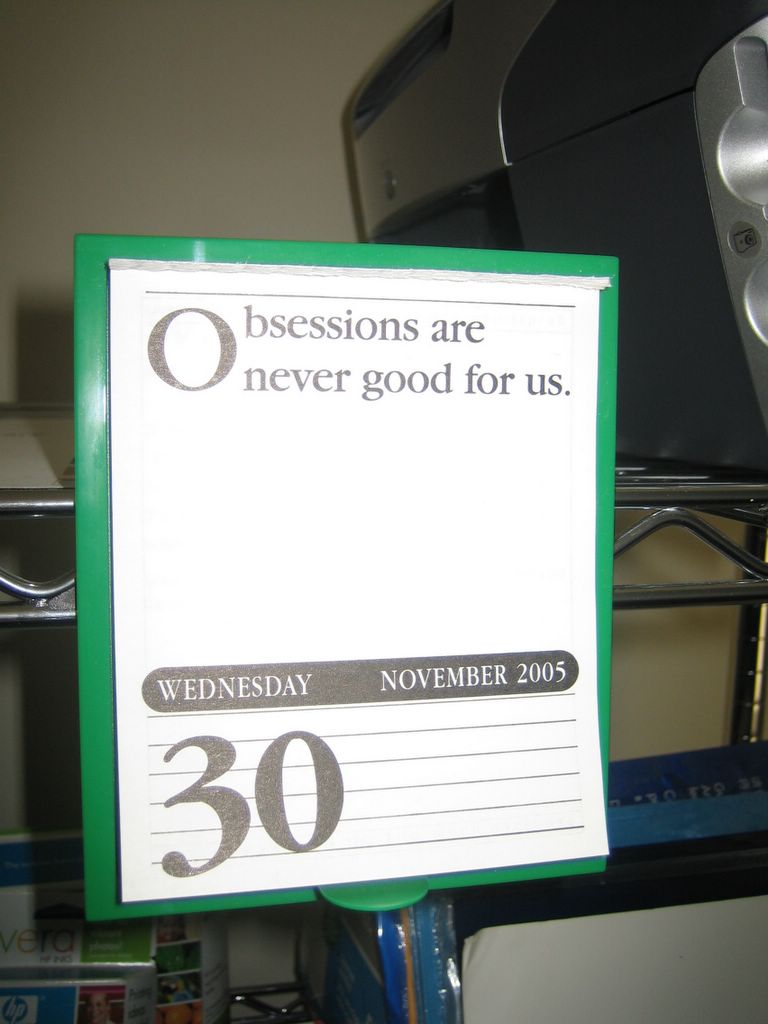

"Obsessions are never good for us"
I'm taking a poll:
Who agreeswith this advice?
And who disagrees?
(The photo says "Obsessions are never good for us.)
I tend to think a healthy fascination--okay, obsession--be it books, authors, quality customer service, a great online experience, absolutely spotless MARC records, ratings, the best recipe for carrot cake, the quickest route to the grocery store, the exact right paint shade for the living room, checking for new podcasts...can be an acceptable vice.
Any reflections, IAG readers?
Wednesday, November 30, 2005
WebJunction Wiki
A shout-out to my colleagues at Webjunction who have unveiled their "perpetual beta" wiki.
In his post, Joe Anderson says: "Where we’re headed in our thinking is to use wiki technology as an information management *tool* that is part of a *practice* that includes both free information and more-or-less canonical information. This latter is necessary for us in large part because of our partnerships with state library and other organizations that do not want their content available for editing, but also because some of our content is more authorative in nature (individually authored opinions about specific practices–like wikis, for example). But free information, within that bounded context, is also important component of what we do (and do already, to a certain degree, on our message boards)."
This is good...addressing the need for authority and free information.
Monday, November 28, 2005
Digitization report from the UK
From the press release issuedNovember 24, 2005.
Although around £130m of public money has been spent on the creation of digital content since the mid-1990s, public sector digitisation programmes have been unstructured, piecemeal and fragmented. In contrast, Google’s Print Library Project, which aims to digitise huge quantities of books from some of the world’s leading libraries, “portends a revolution” in the world of information provision in which the public sector risks being left behind...The report, commissioned on behalf of JISC (Joint Information Systems Committee) and CURL (Consortium of Research Libraries in the British Isles) and based on research undertaken at Loughborough University, also recommends the creation of a UK-wide strategy to avoid the duplication, gaps in provision and lack of coordination that have hampered public sector efforts in this area.
Full report pdf here.
Spotted on Stephen's Web.
From Information Society to Interaction Society?
"We are moving from the information society to the interaction society, and Lunarstorm is leading the trend," said Ola Ahlvarsson, chairman of Result, a Stockholm-based technology consulting company. "Young people here no longer accept a flow of information from above. They trust what they hear from friends on their network."
This quote is from The International Herald Tribune, from a story about Lunarstorm (Swedish link, and UK link) a Swedish internet service that 90% of high school students in Sweden belong to. This is, according to the story, "a youth audience three times larger than MTV in Sweden, two times larger than the entire readership of all of the Swedish evening newspapers combined and more members logging on daily than the total number of young Swedes watching almost every television show..."
Story link from paidContent.org
I found this interesting...well, because it's interesting anyway, but particularly so because of two recent blog posts, one from Jenny Levine's Shifted Librarian and the other from my colleague Lorcan Dempsey's eponymous blog.
Jenny's November 27 post said, in part: I had heard that one of the reasons our grant application to create a mobile gaming package for MLS libraries was turned down was because some reviewers didn’t understand how you then transition these kids to “traditional library services.”
And Lorcan wrote about libraries and their communities, using the Ann Arbor District Library as an admirable example (which Jenny has too) of a library making an effort to be part of the interaction society by blogging (not many posts but lots of comments) and making a space for people to submit digital/digitized photos and documents of and about Ann Arbor.
Note to the reviewers of Jenny's grant application: provision of information is so last century. But support of community interaction? Good. And seeing we have no working crystal balls here at IAG, what sort of interaction is best for making libraries part of the community--gaming, blogging, picture-sharing, social networks--is a guess so do all of it. Do anything that raises the profile of the library in an interaction society and do it very soon.
Wednesday, November 23, 2005
Convenience, or, What you Will
I am a sucker for holidays, Diwali now included. All good Americans today are checking their cupboards for one more frantic trip to the grocery store before the day of all food days: Thanksgiving.
So my friend Sue (who is a self-confessed Foodie--take the foodie quiz), knowing that I enjoy news-of-the-bizarre, remarked to me, "You know I saw a butter turkey in the store the other day."
"What???" was my unenlightened response.
"Yes, and people were willing to pay $4.00 for it, too!"
And so here you have it. The ultimate convenience, holiday, festival-ness wrapped in cellophane: turkey-shaped butter. (And lamb-shaped, and Christmas-tree shaped...)
So what does this have to do with libraries? It's all about timing, packaging the experience of an event and the idea that we'll pay for novelty and convenience.
Will people pay for the bookmobile to come to their house and deliver? Possibly, especially if it came with a free 5-minute clown visit for the kids. The clown rides shotgun with the bookmobile driver. Parents sign up online for books delivered via clown. Reading is fun becomes the underlying message.
Anyway, wacky idea #476028.
Back to turkey-shaped butter. I did some additional sleuthing to find out there is a food sculptor, Jim Victor, who has done a bang-up job at ol' Tom himself. Having butter sculpted to your likeness, alongside the clown, would be even more entertaining with the bookmobile...
This year I decided to break with tradition and eat something celebratory but not staid. Here's my holiday menu:
Harvest Pumpkin Bisque (a creamy pumpkin soup with red chile pepper accents)
Crusty bread (possibly served with a $4 turkey-shaped butter on the side)
Crisp spinach salad with arugula, almonds and goat cheese
Fresh cranberry relish with oranges and pecans (G'ma's receipe)
Pecan pie with homemade vanilla bean ice cream (pecan pie recipe from How to Cook Everything)
Happy Thanksgiving everyone. And happy shopping .
Tuesday, November 22, 2005
Worth Reading
Or is that metareading? Reading about reading? Anyway, a bunch of writing about reading:
These first two noted from TeleRead.
CNET: Randal Picker - Buy the book, get the search service.
"Amazon Upgrade is something else entirely: digital access to books purchased through Amazon. This is a really clever move by Amazon. The company is changing the basic scope of the book business, and this will put even more pressure on independent booksellers and even large operators like Barnes & Noble and Borders. And Amazon has come up with a structure that should put meaningful limits on the sharing of digital texts."
Bill McCoy (he works at Adobe): How Not to Make eBooks "Take Off."
"In order to create a compelling eBook user experience, must we abandon an open ecosystem, where publishers and users have choices of different kinds of rights and different channels for acquiring content?"
But read Bill's other posts as well--he has a couple on the future of reading.
Barbara Quint at Infotoday: Books Online: The Fee versus Free Battle Begins.
"For those of little faith when it comes to Microsoft’s long-term commitment to open access (OA), the company’s strategy for revenue generation may be in a general process of change. On Oct. 30, Ray Ozzie, Microsoft’s CTO, circulated a memo with a cover letter from chairman Bill Gates, that advocated adjusting revenue generation to the Internet Age. Gates stated, “The next sea change is upon us” and Ozzie advised, “In some cases, it may be possible for one to obtain more (software) revenue through the advertising model than through a traditional licensing model.”
Someone always has to pay the tab, but when it’s O.P.M (Other People’s Money), it feels free to the users."
And finally an excellent explication of the most confusing "Google Print Book Search Publisher Partner Library Project Program" from Siva Vaidhyanathan, whom some of you might have heard at ALA in the summer.
World Digital Library
Gary and Danny at SearchEngineWatch provide a good summary of the Library of Congress/Google partnership, the World Digital Library, and note some of the other major book digitization projects.
The seed for this project was sown by James Billington, in a speech to UNESCO in June, according to SEW. (links in the SEW article)
I wonder if Google approached LC or vice versa?
Something many of us fret about is the sustainability of these digitizing projects from several aspects: funding, archiving, and durability, for instance. Clay Shirky recently gave a lecture on the issue of durability in San Francisco as part of The Long Now Foundations seminars on long-term thinking.
The lecture, "Making Digital Durable: What Time Does to Categories" was to address "one of the most intractable problems of the information age: how to preserve digital information and tools in usable condition beyond ten years." I would have loved to be there...I like what Clay writes about social software, and he is apparently a great speaker. The good news is The Long Now does record its seminars and makes them available here. I see Ray Kurzweil's September 2005 lecture is up so the wait shouldn't be too long.
And a couple of attendees blogged about the lecture, including Merrilee from RLG at hangingtogether and More Like This and Paul Miller at Demos Greenhouse.
Monday, November 21, 2005
California Dreamin'
I spent the last week in California, attending the Virtual Reference Desk Conference (VRDC) near San Francisco, and then doing a scan presentation as part of a library futuring program for the Metropolitan Cooperative Library System (MCLS) in Los Angeles.
In the interest of full disclosure, I must note that VRDC is part of my portfolio at OCLC, so my comments here should be seen in the prism of boosterism! That being said, VRDC was a terrific experience. I am a defrocked reference librarian who still loves the concept of being the information guru, despite the fact that I know my skills have atrophied. The enthusiasm of the participants was palpable, except for one person who hung around the registration desk to complain about everything. It was like having Statler and Waldorf wrapped up in one person.
VRDC ended on a somewhat bittersweet note. The Department of Education has pulled its funding for the Virtual Reference Desk program at Syracuse University's Information Institute, and OCLC can't manage this conference alone. So David Lankes, a.k.a. as "Virtual Dave," told the audience, "The future of the conference is in your hands." He asked for volunteers to participate in a telephone call next month about the future of the conference, and more than a dozen people volunteered. We shall see what happens.
I left San Francisco for Los Angeles, and on Wednesday morning, I was on a panel with Susan Hildreth, the state librarian of California, and Joan Frye Williams, the delightful speaker and consultant, discussing the future of libraries. The three of us had done a similar program in San Francisco in September, but we used a different format for the question and answer session. Pam Alger of MCLS gathered the questions from the audience following our morning program, and then she presented the questions to Joan, Susan and me. We were able to be much more direct in our answers, because we didn't know who we might be insulting. One of Joan's points is that part of the reference job I used to love, being the information guru, is about as dead as Elvis.
NYT: Privacy vs Convenience
I am behind on my newspaper reading so I just, this evening, read the Sunday New York Times. The Week In Review section has an article on libraries and data and privacy, "Books for Lending, Data for Taking."
Nothing earthshattering in the article but I was glad to see the mainstream media recognize the "rock and a hard place" position libraries are in with regard to mining data to personalize users' experiences.
That said, as I have suggested many times in presentations, there has to be a way libraries can offer increased personalization to users as a deliberate choice. If my library asked, I would risk my personal data as an exchange for personalized information...Alane, you clearly like Alice Munro...may we send you some recommendations based on this? Readers' advisory for the web.
Blanket policies don't really work anymore. Libraries need to accommodate convenience as well as privacy, but on a sliding scale, not an absolute one.
Seen on Flickr
Out of the
clubs and
//into the
libraries
See the good story on tagging from CNET. Also awesome visual for how Flickr works with Yahoo.
Where's My Train?
I like this...it's an interactive map showing the real locations of the suburban trains in the city of Dublin. The other one, the real one in Ireland. The creator, a Dublin fellow, says he takes the realtime data from Irish Rail, smooshes (my word, not his) it a bit and maps it onto Google Maps.
Most inventive and useful one would think...wonder what it looks like on a handheld? If only libraries still had bookmobiles.....there could be maps with little icons of buses making the rounds. It wouldn't be quite so exciting watching the book you placed on hold wending its way towards you, would it? Or perhaps it would if you were 43rd on the list for a much-wanted book. Or could the location of reference librarians be mapped on a university campus--help is on the way!
It's interesting to watch presence develop on the web. I wish libraries were doing more in this area. Lists of content or services or buildings do not a presence make.
Diwali, or Festival of Light
I went to a Diwali celebration last night--the Festival of Light in India. There was music, singing, dance, a special fashion show, food and friends.
I bring it up because I realized three things about libraries and communities, while I experienced my first Diwali:
1. I had no idea this celebration even existed.
-->Your library may be completely awesome, but if you don't get regular news coverage or generate a visible, tangible presence in people's lives--would-be library supporters may not actually know you exist. Even though you're right downtown! Even though you have a big brick building! Even though there are blue signs everywhere!
2. The room was populated with people from all cultures.
-->People may walk through your door, hit your site, use your database, chat on virtual reference software who are bloodlines library supporters (you know what I mean) and people who know absolutely nothing about an OPAC. But they've shown up and how can you make them feel welcome?
3. It's difficult to articulate your own culture when you're still in it.
-->As a citizen of the library (and you as library staff members/librarians), I get lost in the details. I mean there is so much good stuff (!) and so many intricacies of the way holds and reserves are set, databases are accessed, etc. But in order to get good perspective on what's important to my library culture, I need to leave the building. Go live with another culture (be that the coffee shop, the supermarket, the hospital, the police station, the fitness center, the train station) for a day. And then bring those reflections back with you, when you return to your own.
To sum up, the experience of my first Diwali also made me realize: while I am not Indian myself, I actually have a lot in common with many people who are.
To experience another culture is to recognize your self, within it.
***
Now I am feeling distinct *profound*! Anyone else have a good Diwali story to share?
I bring it up because I realized three things about libraries and communities, while I experienced my first Diwali:
1. I had no idea this celebration even existed.
In my North-American-centered world, this major festival had never registered before. No news coverage. Not even when I lived in the UK. So I didn't know it existed. Of course, if I would have sat down and thought really hard, I probably would have realized that there should be a Christmas-equivalent (in terms of status/societal importance) in India. But the simple fact is, I rarely sit down and think hard about things outside the scope of my experience.
-->Your library may be completely awesome, but if you don't get regular news coverage or generate a visible, tangible presence in people's lives--would-be library supporters may not actually know you exist. Even though you're right downtown! Even though you have a big brick building! Even though there are blue signs everywhere!
2. The room was populated with people from all cultures.
I freely admit (as if you hadn't guessed from this post yet) that I do not have a South Asian/Indian background. I do have a Native American background--but that is as close as I get to India, with bloodlines. But bloodlines don't matter much, in the 21st century. Or do they?
It's easy to assume that only Indians would be interested in an Indian festival, but that was clearly not the case. I went to learn and to experience something new.
-->People may walk through your door, hit your site, use your database, chat on virtual reference software who are bloodlines library supporters (you know what I mean) and people who know absolutely nothing about an OPAC. But they've shown up and how can you make them feel welcome?
3. It's difficult to articulate your own culture when you're still in it.
As I watched the traditional dances and listened to music from Bollywood, I reflected how difficult it would be, had the positions been reversed. If I lived in India, and wanted to encapsulate all American culture into a single evening event for my host country--what would I say? How would I structure it to reflect a true experience? Would we sing country and western ballads? Jazz? Re-enact a baseball game? There is so much to communicate, where would I start?
-->As a citizen of the library (and you as library staff members/librarians), I get lost in the details. I mean there is so much good stuff (!) and so many intricacies of the way holds and reserves are set, databases are accessed, etc. But in order to get good perspective on what's important to my library culture, I need to leave the building. Go live with another culture (be that the coffee shop, the supermarket, the hospital, the police station, the fitness center, the train station) for a day. And then bring those reflections back with you, when you return to your own.
To sum up, the experience of my first Diwali also made me realize: while I am not Indian myself, I actually have a lot in common with many people who are.
To experience another culture is to recognize your self, within it.
***
Now I am feeling distinct *profound*! Anyone else have a good Diwali story to share?
Wednesday, November 16, 2005
Academic blogging
A very good article in Slate on the perils of academics' blogging. The author, Robert Boynton, a non-blogging academic, raises some interesting points about academic antipathy to blogging. This one reminded me of the debate among librarians' about the worth(lessness) of Wikipedia. "The current antipathy toward blogging may have something to do with the fact that universities have no tools for judging blogs."
How People Use Books
There cannot be many of you who have not read or heard of Michael Gorman's latest statements on the foolishness of "reducing scholarly texts to paragraphs" published in the Wall Street Journal on November 1, 2005, in an article about Google Print (I won't provide a link because this content is behind a wall). If you were perhaps in Mongolia with the Bushes, there are summaries here and here. The particular sentence that raised my hackles (again) was this: "The point of a scholarly text is they are written to be read sequentially from beginning to end, making an argument and engaging you in dialogue.” [I wonder if Dr. Gorman actually said this sentence in which there is the grammatical error of lack of agreement..."a scholarly text" and "they are written."]
Gorman has made similar assertions in the past. In "Google and God's Mind," [pdf] Los Angeles Times, December 17, 2004 and then reprised in his now infamous LJ article "Revenge of the Blog People." My very own personal opinion is that this is arrant nonsense. And based on...on...what? Is there any research, any data to support his assertions about how scholars are supposed to read? Or is it how ordinary people are supposed to read scholarly texts? Is there a difference?
Well, as luck has it, I have been spending time rummaging around looking at surveys and reports of surveys and bibliographies of surveys because of our report I keep mentioning as being almost ready to publish. (It really is almost ready to release....we have been rather bogged down in editing by committee) I discovered that in 1985 Gordon Sabine and Patricia Sabine conducted a survey of how people use books and journals, in particular technical and professional material.
I should have already known about this because the study was conducted with the aid of a grant from OCLC, and OCLC founder Fred Kilgour wrote a letter to 50 librarians asking them to nominate people to participate, but we don't have the book here. The resulting report was published as an 18 page book called How People Use Books. This may be hard to find. But, Sabine and Sabine also published a report of the study in Library Quarterly, v56, no.4 1986, pp. 399-408.
As the authors point out themselves, the sample size is small (613) and the participants are not "typical patrons" but are heavy users of scientific-technical volumes. Sixty-nine percent of the interviewees had occupations in the hard sciences and 21 percent were social scientists and "persons in the arts and the professions." So, I'd guess there 'd be a scholarly type or two among the group.
Here's the question asked that is germane to this posting:
"When you use a volume from the library these days, do you generally find yourself using the entire volume or just parts of it?"
The data are presented in the article but here's the summaries for the question.
"These interviewees read very small portions of the books and journals they most recently examined; six out of ten read 10 percent or less."
"Most interviewees--eight out of ten--reported they generally read only small parts of the books and journals they use these days rather than using entire volumes."
"A higher proportion of hard scientists read only 10 percent or less of the cited volume."
Here's some of the verbatim comments the authors report: "I read only what I need"; "I used to be a whole book person, but more and more I'm going for narrower and narrower portions of books"; "If it's completely in my field, I read the whole book. If it's not, I read just the parts in my specialty, be that a chapter or a page or even just one paragraph."
One scientist commented on "a real problem" with searching for the information one needs: "Books still are organized as books [...] These data are not organized necessarily for easy browsing, and one cannot get at just that information one wants. A complicated organization like a knowledge base is going to be required for finding technical information."
Hmmm, a knowledge base like Google Print perhaps?
So, slight as this research is, I can at least point you to empirical evidence that some scholarly people in 1985 did not read scholarly texts from beginning to end.
I can't say this with any certainty, but the way Gorman suggests reader and text should engage one another is reminiscent of the ideas of New Criticism, the literary criticism movement that flourished in the 1930s and 1940s, and whose members included F.R. Leavis, I.A. Richards, William Empson and John Crowe Ransom. It was brilliant stuff in its day but has little to say anymore about the way real people interact with real texts, digital and print.
But lots of people are writing. Check out this, and this and this and this. And no doubt there's articles galore and a few dissertations.
If Gorman is aware of recent research that supports his assertion about how texts are to be read, I'd be most interested in hearing from him, and I'll be happy to point people to data supporting his opinion. Otherwise, he could do the profession a favour, and just not say this ever again.
Monday, November 14, 2005
Change
So a while ago I was doing a presentation for a public library that will remain nameless. Before my 8:30 showtime, I had a breakfast meeting with my hosts, a group of reference librarians and branch staff. We had a very pleasant discussion, and they were telling me about all the changes the city had been going through. The tax base was eroding, the formerly vibrant downtown had decayed and was seen as scary by the suburbanites, the demographics were changing so that the city was rapidly becoming minority majority.
After listening to this for a while, I asked (innocently, I swear), "So with all this change in the city, how has the library changed?" Dead silence. 15, 20 seconds, nothing but crickets. Finally, one of the librarians talked about how they were answering many more questions using electronic resources, and more people were using the website. But absolutely nothing about adding collections in new languages or themes, changing hours to reflect the users' needs, recruitment to diversify the staff, or much of anything else. I felt like a Victorian who had just inquired after the crazy aunt who lives in the attic: I embarrassed both my hosts and myself with an inappropriate question.
A long time ago, I worked in a branch of the Buffalo and Erie County Public Library that was in a neighborhood which had once had a large Polish population. The branch had developed an outstanding collection of Polish literature and English works in translation. The trouble was, by the time I worked there in the 1970s, the Polish population in the neighborhood was gone, moved out of the inner city to the 'burbs. The community was about evenly divided among African-Americans, Puerto Ricans, and Irish-Americans.
Libraries have been respected over the years because they are solid, reliable institutions. As always, though, our greatest strengths can become our most debilitating weaknesses. It's not easy to change the direction of a large institution like an urban public library. There's never enough money to overhaul collections or revamp or retrain staff. There can be political, bureaucratic, or collective bargaining reasons for not making change.
But every time someone looks in a library and doesn't see something or someone that indicates that this library is for him, we've missed another opportunity. And to face the 21st century with a 19th or even 20th century service plan is a tragic waste of scarce public resources.
Stephen's Big Ideas
Stephen Abram is a one-man band...more energy than whole cheerleading squads and more good points than the biggest box of Crayola Crayons. His latest article published at SirsiDynix OneSource is called "Five Big Questions to Drive Strategic Thinking." (All his presentations and OneSource articles are here.)
His five questions are:
1. Have our users changed in a material way? (Yes)
2. Can we relax a bit now that we've adapted to the last few BIG changes? (No)
3. Is there another big environmental or technological change on the way? (Yes)
4. Are we automating for the future? Or are we just automating 19th and 20th century processes? (Sort of)
5. Do we have the energy, resources, flexibility, and the money? (Of course)
Go read the whole article. Thought provoking, as Stephen's stuff always is.
I read this article a couple of hours ago, and question 1 was a timely one for me because I'd been musing over the weekend on the stereotyping I think we are all guilty of now and then, of "senior citizens" (a phrase I am not fond of). I hear from librarians frequently that "seniors" who use their libraries resist new technologies and offer this as reason not to change the status quo.
Well, my dad turned 70 this past June. I think he's probably pretty typical of his age and experience. He knows how to use computers because he's used them as adjuncts to his job in several different careers, and he's been using one for personal reasons for sometime. He is web-savvy because he discovered the web is a good way to find information and stuff (especially now he lives in Panama). And he's also broken most of the records on his Xbox rally driving game. I gave him the Xbox and the game as a 70th birthday present even though he'd never played any kind of video game. I picked the rally game because he used to be a rally driver, and he's driven several of the routes included in the game.
My point is that my dad learned about computers and the web and video because these technologies all had a context for him: part of a job, a way to keep in touch, and as absorbing entertainment. He has a lifelong habit of learning and it is this habit that defines people far more than their age. Older library users are not homogenous anymore than young library users are. But many library staff know very little about their communities of users beyond big broad cliches--a bad basis for designing services.
As Stephen says: "The general "public" just ain't so general anymore" and I'll bet there are quite a few "senior citizens" in your library's community like my dad.
Friday, November 11, 2005
Armistice Day
Alane's post about Remembrance Day reminded me of my beloved grandfater, Joe Duffy. He was 25 years old when World War I began. He was living in Buffalo, New York, but when the war started, he crossed the border into Canada and joined the Canadian Army, fighting for King and Crown. This is very strange, because he was a devout Roman Catholic, and just as devout an Irishman. This was right before the Easter Uprising, and Irish Catholics didn't have a lot of fealty to King and Crown. Family lore says Joe joined the army not so much because he was PO'd at the Kaiser as that he was PO'd at his wife. Whatever.
There are two songs about World War I that I particularly love. The first is Eric Bogle's "And the Band Played Waltzing Matilda," about the disastrous attack by Australian soldiers on the Turkish stronghold at Gallipoli. The second is by John McCutcheon, "Christmas in the Trenches," about the informal Christmas truce of 1914.
I still like the old US name for this holiday, Armistice Day. That's how Joe Duffy always referred to it. He was in trenches on the 11th hour of the 11th day of the 11th month of 1918, and the armistice meant he was free to come home, marry his second wife (my grandmother), and get on with his life. He never spoke of the war.
I promise my next post will have something to do with libraries. I do have a story to tell, but I need a bit more time to digest it.
Podcast feeds on InfoTrac
Now we're talking at least some format integration in library resources. Repeat the mantra: content not container.
Thomson Gale has podcasts loaded into its InfoTrac databases. Check out the press release. Eager to try it out...
Remembrance Day
I should be wearing a little red fuzzy plastic stylized poppy on my sweater today, but I have never seen one here in the US although my husband, the American, says he used to wear poppies as a child. When I was a kid in England, a few weeks before Remembrance Day people with trays of poppies and donation boxes would appear, and my mum, me and whichever siblings were along would put our sixpences in the box and get our own poppies to wear, in remembrance. In the 60s, they were made of thick felt, with a two part center--a green bit and a black bit--held together with a straight pin.
And when we moved to Canada, the poppies were there too, and we learned by heart the poem by Canadian Lt-Gen John McCrae, In Flanders Field. He wrote it on May 3, 1915, during the second Battle of Ypres, the day after a good friend of his had been killed--blown to bits by artillery fire.
At 11:00am on the 11th day of the 11th month in 1918, after more than four years of fighting, fighting ceased on the Western Front as set out in the armistice between Germany and the Allies. In the UK, and the other Allied countries, November 11 is known as Remembrance Day which I think--my own personal opinion--is more inclusive than Veterans' Day of all the people who were and are involved by choice-- or not-- in wars.
My maternal grandfather was in the British Merchant Marine for many years, and sailed the North Atlantic in supplies convoys in WWII. My mother and my grandmother stayed behind in the port city of Plymouth, England which was heavily bombed and nearly destroyed during The Blitz.
Where have all the soldiers gone?
Long time passing
Where have all the soldiers gone?
Long time ago
Where have all the soldiers gone?
Gone to graveyards every one
When will they ever learn?
When will they ever learn?
Pete Seeger
And when we moved to Canada, the poppies were there too, and we learned by heart the poem by Canadian Lt-Gen John McCrae, In Flanders Field. He wrote it on May 3, 1915, during the second Battle of Ypres, the day after a good friend of his had been killed--blown to bits by artillery fire.
In Flanders fields the poppies blow
Between the crosses, row on row,
That mark our place; and in the sky
The larks, still bravely singing, fly
Scarce heard amid the guns below.
We are the Dead. Short days ago
We lived, felt dawn, saw sunset glow,
Loved, and were loved, and now we lie
In Flanders fields.
Take up our quarrel with the foe:
To you from failing hands we throw
The torch; be yours to hold it high.
If ye break faith with us who die
We shall not sleep, though poppies grow
In Flanders fields.
At 11:00am on the 11th day of the 11th month in 1918, after more than four years of fighting, fighting ceased on the Western Front as set out in the armistice between Germany and the Allies. In the UK, and the other Allied countries, November 11 is known as Remembrance Day which I think--my own personal opinion--is more inclusive than Veterans' Day of all the people who were and are involved by choice-- or not-- in wars.
My maternal grandfather was in the British Merchant Marine for many years, and sailed the North Atlantic in supplies convoys in WWII. My mother and my grandmother stayed behind in the port city of Plymouth, England which was heavily bombed and nearly destroyed during The Blitz.
Where have all the soldiers gone?
Long time passing
Where have all the soldiers gone?
Long time ago
Where have all the soldiers gone?
Gone to graveyards every one
When will they ever learn?
When will they ever learn?
Pete Seeger
Wednesday, November 09, 2005
Presentation Zen
My friend Gregor pointed me to this blog by Garr Reynolds, Presentation Zen. I don't know how many powerpoints you do, but there are times when my days and nights seem filled with them. My own or someone else's.
So his site was a breath of fresh air, to see examples of good and not-so-good presentations. He provides easy, "duh" kind of tips that I forget all the time:
There's a bit in there about presenting naked too, but you didn't hear it from me!
So his site was a breath of fresh air, to see examples of good and not-so-good presentations. He provides easy, "duh" kind of tips that I forget all the time:
*Don't put your hand in your pocket
*Don't fold your hands across your chest
*Don't do a very complicated visual and think you've actually communicated anything
There's a bit in there about presenting naked too, but you didn't hear it from me!
Debate on Google Print at NYPL
Now, here's an event I'd love to attend. November 17 at New York Public Library: THE BATTLE OVER BOOKS: Authors & Publishers Take on the Google Print Library Project. The event is cosponsored by Wired magazine and the panelists are luminaries in their worlds: Allan Adler, Association of American Publishers; Chris Anderson, Wired Magazine; David Drummond, Google; Paul LeClerc & David Ferriero, The New York Public Library; Lawrence Lessig, Stanford Law School; Nick Taylor, The Authors Guild . (Hmmm, all guys...) You'll recall that NYPL is one of the "G5".
No indication of the event being podcast, but perhaps an attendee or two could blog it?
(Noted on Dave Winer's Scripting News blog.)
Tuesday, November 08, 2005
Amazon Shorts
I missed this additional content offering from Amazon. Amazon Shorts are short literary works available for purchase--49 cents!--from well-known authors that have never been published anywhere else--and won't be for at least 6 months according to the FAQ. Amazon made a foray into original content a year or so ago when they showed made-for-Amazon short films over a period of weeks. With Amazon Shorts, the line between content seller and publisher just got a lot fuzzier.
In the FAQ:
This will drive collection development librarians nuts...
In the FAQ:
What types of material can I list as an Amazon Short?
Any previously unpublished short-form work (2,000 - 10,000 words, fiction or nonfiction) you've created that your readers would find interesting. An Amazon Short could be a single short story, an update on a well-loved character, a compelling speech, additional material that enriches your published works, or even your commentary on your work or other subjects. Some authors have chosen to treat this as a "laboratory" for experimentation with new genres, themes, etc. We are open to creative ideas for new work.
This will drive collection development librarians nuts...
Monday, November 07, 2005
Books! Books!! Books!!!
As Alice remarked in her post about the recent Amazon announcement about Amazon Pages and Amazon Upgrade, you might have read it in the Scan first. Here's what we wrote in September 2003 "Amazon’s “search inside” ups the ante in this arena, raising consumer expectations that content is searchable and definable at a micro level, and, we predict, payable for—at the micro level. Micropayment for microcontent is the next logical step." And so it is which is why that prediction wasn't really that clever, just a no-brainer extension of Amazon's "search inside the book" capabilities.
Books are the topic de semaine for sure.
I was in South Carolina for the Charleston Conference and on Thursday morning Jerry Kline, CEO of Innovative Interfaces, Inc, gave a speech called Forging the Library's Future in an Electronic World. He had three topics: e-resources, library as place, and books. He asked (I am paraphrasing based on the notes I scribbled on my crossword puzzle) are libraries focusing/spending too much on e-resources? He suggested that provision of materials in this format earns libraries no credit (not visible enough) and that there's evidence that e-resources are underused. He suggested that the physicla library as a gathering place is really important to our communites, and that libraries need to buy more books--physical books. As he said "we [the library community] get credit for each title."
Walt Crawford's Mid-Fall 2005 Cites & Insights has a long essay [pdf] called "Library Futures, Media Futures" in which he draws the threads together of several tossed conversational balls of print versus electronic, place versus virtual, reading versus not-reading from posts and exchanges he has had with others in the blogosphere. This sentence sums up the long piece for me "I don't believe our future (the future of anyone readingthis essay in 2005) is solely digital and I don't see any evidence to support such a massive change."
Chris Anderson has an interesting post on the Long Tail of books and he links to an equally interesting article by Tim O'Reilly on the huge number of books in what he calls the "twilight zone." These are the so-called orphan works...in the public domain or not? Tim makes some interesting points about the Google Print program and the American Association of Publishers lawsuit to prevent Google from scanning any books without permission. One of my favourite points (because I happen to agree!):
"...the AAP is asking us to believe that publishers are willing to unearth the contracts for more than 25 million books, track down the authors (since many of those books surely don't grant electronic rights to the publishers, since those rights weren't even conceived at the time many of those contracts were signed), and get their permission to opt them in, and this despite the fact that those 25 million books didn't sell even one copy in 2004. Try to be serious."
And I noticed that the numbers Tim and Chris are using to determine the number of books in the Long Tail and the twilight zone are based on WorldCat numbers. Yes, Tim links to the article "Anatomy of Aggregate Collections: The Example of Google Print for Libraries" by my OCLC Research colleagues, Brian Lavoie, Lynn Connaway and Lorcan Dempsey, published in D-Lib in September.
And something has been bugging me for a bit. Libraries make much of the fact that circulation stats are way up. Does the format of the borrowed material make a difference? Do DVDs and CDs circulate more often than books? I got to thinking that the "return trip" for AV material is likely much shorter than it is for print as it is most likely consumed quickly. In other words, I may borrow 20 DVDs a month but only 5 books because the books take longer to finish. Does this mean that measuring circ stats absent other data is not really worth much as a success assessment? Gatecount might be related too... I might have to come to the library several times a month to replace the DVDs. Do any public libraries measure cardholder use as a percentage of their total communities and break this out by frequency? I don't think I have seen any stats like this.
Friday, November 04, 2005
Micropayments for microcontent
Remember this bit, from the Environmental Scan?
It's becoming reality--and fast.
Check out the NYT article this morning, "Want 'War and Peace' Online? How About 20 Pages at a Time?"
Of course, nothing in the article about Open WorldCat...but there was a story out of Members Council that was pretty cool:
Apparently a Member was coming in for October 2005 Council from the U.K., and he was stopped by Passport security and queried.
Purrr, purrr. Sometimes micropraise is all that is required.
But I AM wondering if Google and Amazon could present the "Find in a Library" option alongside the microcontent--especially if the searcher's library already owns the eBook?
It's becoming reality--and fast.
Check out the NYT article this morning, "Want 'War and Peace' Online? How About 20 Pages at a Time?"
Of course, nothing in the article about Open WorldCat...but there was a story out of Members Council that was pretty cool:
Apparently a Member was coming in for October 2005 Council from the U.K., and he was stopped by Passport security and queried.
"What is Member's Council? What is OCLC?"
And while this librarian started to explain about what the cooperative is, the security person listened for a minute and then cuts him off,
"Oh, you mean WorldCat? Oh yeah, I use WorldCat all the time on the Web!"
Purrr, purrr. Sometimes micropraise is all that is required.
But I AM wondering if Google and Amazon could present the "Find in a Library" option alongside the microcontent--especially if the searcher's library already owns the eBook?
Thursday, November 03, 2005
eBooks Take the Ivory Tower Webcast
Just saw this Webcast opportunity pop up on my LJ Academic Newswire...setting aside the fact that IAG was not cool enough to get a mention in LJ's cover story on library blogs Oct. 1 issue...
EBOOKS TAKE THE IVORY TOWER: WEBCAST SET FOR NOVEMBER 15
I'm going to sign up. Who's with me?
EBOOKS TAKE THE IVORY TOWER: WEBCAST SET FOR NOVEMBER 15
On November 15, at 2 p.m. EST, join an online interactive discussion about ebooks in the academic library, the first in series of online programs from the editors of LIBRARY JOURNAL under LJ's URLearning Series.
Topics include trends in ebook pricing models, enhancements and usability, acceptance and usage by different groups, managing collections, and the impact of digitization projects.
The webcast will be hosted by LJ editor Francine Fialkoff and facilitated by Tom Peters, consultant, author, and founder of TAP Enterprises. Panelists include Jim Mouw, assistant director of technical and electronic services at the U. of Chicago; Warren Holder, electronic resources coordinator at the U. of Toronto; and Suzanne Weiner, vice provost for strategic initiatives and head of collection management at North Carolina State.
I'm going to sign up. Who's with me?
Monday, October 31, 2005
A Bunker State of Mind
Over at paidContent.org, Rafat Ali has a post about his attendance at the ONA (the Online News Association) conference. I've lifted this post's title from his and it refers to what he thought he observed among the conference attendees.
Have to say, I very quickly began thinking about library conference attendees while I read it. Rafat says, "...what I see is self-doubt, existential crisis, a siege mentality." Why, yes, Rafat, I do think librarians share some of these with journalists. "Audience" interest in what traditional libraries and traditional newspapers offer is waning and neither media outlets have figured out how to successfully offer the new along with the old. Both, in many cases, have employees who hope that interest in new content channels is a fad, a passing fancy.
Not likely. This is from a comment attached to the post that I suspect does reflect the opinions of this young person's peers:
I am 21, and just finished my business degree. I am one of the older members of the Net Generation - a generation that gets most of its information and entertainment through the Internet. The world I grew up in, is vastly different from the one my parents grew up in. We think differently. I even see huge differences in mentality, regarding media consumption, with my friends aged 25-30. I cannot speak for my peers, but I can tell you that there is at least one person excited about this future. I love media, and I am entrepreneurial by nature. The army of people like me, who have grown up in a different world from the people running the traditional media outlets, are only just starting to get into action.So, it seems relevant to point you to an essay our colleague Eric Childress sent along to Alice, George and me called The Future of Libraries: Beginning the Great Transformation, written by a futurist, not a librarian.
Making Visible the Invisible at Seattle Public Library
I don't know how I missed this...a most interesting art installation in that piece of art otherwise known as the Seattle Public Library. It's called Making Visible the Invisible and is by artist/engineer George Legrady. The piece consists of six large LED panels that hang behind one of the main desks at SPL. The screens display visualizations of data generated in real time, based on all checked-out items, using several slices of data, including the Dewey Decimal Classification.
Pictures of the screens here, here (this post sent me to the others I link to) and here. An article from the online version of Seattle Post-Intelligencer is here.
Fascinating. I wonder if the library staff are learning things about use of the collection as they see the flow of content, rather than having that data disappear into the black hole of the OPAC.
Friday, October 28, 2005
More on Members Council
Alice mentioned earlier on the blog that Members Council met here in Dublin this week. What a group! The delegates to Council are among the most interesting, articulate, and creatively challenging people it's been my pleasure to work with. This meeting primarily focused on small and rural libraries, both in North America and around the world. We had some wonderful presentations: Chew Ling Beh (eLPEDIA, Singapore), Ellen Tise (University of Western Cape, South Africa), Ernie Ingles (University of Alberta, a delegate from OCLC Canada, and Council's vice-president/president-elect), and Andrew Wang (OCLC Asia Pacific) comprised a fascinating panel to talk on the state of libraries in various regions on Sunday night.
On Monday morning Jay Jordan gave his state of the cooperative meeting, with a special focus on what we are doing outside the US. Then, Jay Starratt (Southern Illinois University - Edwardsville/ILLINET delegate) led the delegates through a discussion of three questions about globalization that resulted in many insights.
Monday afternoon, Bruce Newell (Montana Library Network/OCLC Western delegate) and Jeff Baskins (William F. Laman Public Library, North Little Rock, Arkansas/Amigos delegate) offered a fascinating program on issues facing small and rural libraries, with the focus on US institutions. (Bruce's excellent white paper, "Montana Libraries: Good Neighbors," is available on WebJunction.)
There were also lots of discussions in interest group and type of library meetings. The minutes, small group meeting notes, and other proceedings will be up on the Members Council website soon.
The Council also passed a resolution asking OCLC's Board and management to approve funding for a Council meeting outside of the usual sanctuary of Dublin, Ohio. We have some spade work to do on identifying sites and costs, benefits and ROI, but more on that later!
The meeting concluded with a presentation by Cathy De Rosa on the new study of public perceptions of library and information services that I mentioned in my previous post. I am sure that Alane Wilson, as one of the principal authors of this report, will post here as soon as the report is available online, but I've been informed that it should be available very soon. Watch this space or the OCLC web site.
Podcast
Paul Miller from the UK's Talis will be interviewing me next month on the scan and the new OCLC report which will be released shortly on public perceptions of library and information services. He's opened his blog for anyone who wants to suggest questions we might discuss, and if you have any ideas, please post your comments there.
And please, be kind...this is my first podcast!
George
Thursday, October 27, 2005
WSJ approves of Google Print
Alan Murray has written a column in the Wall Street Journal on why "Google Library is Great for the World."
He's looking at it from an economist's point of view--rather than the publishers--and of course Google's revenues and earnings are looking really good right now. (Raise your hands now--how many of us bought stock when we should have?)
One line from the article give me a twinge, when I have my library hat on:
Goofy-sounding notion indeed.
The article needs a login (which I don't have) but there is a Video available for free. And the video gives a clear picture of what "normal" people (or at least media/business people) think about Google Print.
Check out the video--there is one point where the commentator says, "What's the difference between this and going to the library?" I soooo wanted to jump into the conversation!!
Of course, there was also one guy who was adamant that "no one is going to read a book on the computer screen."
He's looking at it from an economist's point of view--rather than the publishers--and of course Google's revenues and earnings are looking really good right now. (Raise your hands now--how many of us bought stock when we should have?)
One line from the article give me a twinge, when I have my library hat on:
The Google economy is a kind of high-tech feudal system: The peasants produce the content; Google makes the profits. That's all the more annoying to the content crowd because the lords of this money machine--Sergey Brin and Larry Page--perpetuate the goofy-sounding notion that they do all this to help the world, rather than line their own pockets.
"That's true," Brin said in an interview. "We talked at Stanford for a while about making Google an open-source project. We ultimately decided that would not be an efficient way for us to get the resources we needed to make it run. So we started a company."
As for the Google Print Library Project, Brin says, "We actually dreamed of the ability to do this back before we started Google as a company." It is good for Google's users, good for the business, it's fair, and it's legal, he says. "But more importantly, I think it is really great for the world."
Goofy-sounding notion indeed.
The article needs a login (which I don't have) but there is a Video available for free. And the video gives a clear picture of what "normal" people (or at least media/business people) think about Google Print.
Check out the video--there is one point where the commentator says, "What's the difference between this and going to the library?" I soooo wanted to jump into the conversation!!
Of course, there was also one guy who was adamant that "no one is going to read a book on the computer screen."
Wednesday, October 26, 2005
More on Books as the Brand
Thomas left a comment on the previous post about the results of our survey showing that "books" is what 69% of 3,348 respondents think of when they think of libraries. ("Information" was a distant second at 12%.) I am pulling part of his comment up so I can remark on it.
"If books are the brand of libraries. Maybe we should look at what other things are branded with books. Try Knowledge, Wisdom, Reliability, Information etc. Maybe not so bad brand after all?"
Well, unfortunately, those other good qualities Thomas lists were not mentioned often as being the "top-of-mind" association. If they were indeed co-branded with books, then these works would have been mentioned frequently in the same comments with books as in "A place where you find lots of books and information." They were not.
We did actually probe for those other attributes Thomas mentions, in other questions, and we also took a very close look at the verbatim comments contributed as answers to this question because we wanted to know if books=information, knowledge, learning and so on. Our analyses conclude...no. When respondents said books we are pretty confident they meant the physical thing, not what "book" embodies. The word "smell" showed up a lot, for example, as in "smelly old books. "
You'll be able to have a look at this yourself when we publish the report. We will also be publishing a companion/followup piece called The Library Brand where this is explored more.
When we asked what respondents thought the purpose of the library is, most people said "information" and in response to another question most respondents agreed the library is a place to learn.
It's important to note that the question we asked about the first association people make with "library" was an open-ended one. This means people could say anything they liked. This is different from a question that guides responses by providing a list of choices. The question we asked about the role of the library in the community was a guided response one. Respondents picked from a list of 14 attributes and 85% said the library is a place to learn. This suggests, that when prompted, people do see a role for the library that is beyond the top-of-mind association of books.
If this is confusing to you, try the top-of-mind association game yourself. What is the first thing you think of for "hospital?" What is the first thing you think of for "Mercedes-Benz?" Whatever that word was is the "brand" (for you) of those two things. Now answer the question "what is the role of a hospital/Mercedes-Benz?" Whatever you answered is the "brand promise." They are very different. And neither actually have to be anywhere close to the experience you actually have had of hospitals and Mercedes-Benz.
Here's some of the verbatim comments with the country of the respondent in brackets: A facility that is mostly concerned with books. (Canada); a building with books (Wales); A great collection of books (India); A place to borrow books (US); books and a woman in glasses (Australia); borrowing books (Singapore). And here's one of the very few that included several attributes: A place where expertise, information, knowledge and entertainment are available to the masses.
Sunday, October 23, 2005
Read. This. Now.
I've had this post sitting in the draft box for several days waiting for the web site of the magazine Fast Company to reflect the latest print issue so I could point you to the article I talk about below, but it is still showing the October one. So, either find a print copy or you might have to wait until the November issue shows up on the Web site.
********************
Get those library glasses out and read this Fast Company essay with them on. It's a mere two pages long but should have you shifting uneasily in your chair, or bouncing up and down, yelling, "yes! yes!! yess-ss!!" The title is "Back in the Box" and it's by Douglas Rushkoff. [spelling corrected, thanks]
"In their endless rush to embrace the next big thing, too many businesses have forgotten what they are and what they really do. The fashionable compulsion to break with the past has, bizarrely, come to mean abandoning the true value they once offered customers."
And this, for me, resonanted with something I read last week, in a source few of you will be able to lay hands on--nyse magazine (oct/nov 2005) which is published by the New York Stock Exchange. (It was on Jay Jordan's desk and it was, um, borrowed). The article was about McDonald's.
"Back at the turn of the new century...a variety of cost-cutting measures had derailed the company. 'Ultimately,' says CFO Matt Paull, "we think we hurt the brand."
As Alice has noted, we are thinking a lot about brand in our part of OCLC (George probably is not thinking do much about this) because of the survey I tiresomely keep referring to that you can't see yet because we haven't released it (I tell you proofreading umpty dozen tables full of numbers takes a long long time). The survey results show that for the respondents--3300+ in 6 countries--the overwhelming top-of-mind association with "library" is "books". So, "books" is the brand of The Library.
Perhaps you are not surprised. Perhaps you are happy that this strong association exists. But, it is then a bit odd, I think, that for all the e-resources we've added, for all the portals and web sites that have been built, for all the classes academic librarians have held on using non-print resources, for all the computers that people use in public libraries.....that the brand is still books.
So, this is what we have to work with when we promote our libraries and their resources. Like it or not, it is not possible to change peoples' associations with a strong brand by telling them something different. BIG questions: what is the value of The Library and what does it do?
Friday, October 21, 2005
Members Council this weekend
Librarians around the world are packed their bags to gather at Members Council this weekend. Alas, I was not looking at my calendar (I was actually in the airport...oddly enough) when my mother rang me up to ask if she could come see this new house (and its associated boxes) that she has heard so much about.
So without so much as an inkling of common sense, I agreed that she should take advantage of the cheap flight she has procured and come visit.
All of that is to say unfortunately you will have to rely on Alane and George this time, for all the dialogue and conversations that emerge. Or perhaps it is fortunate? Oh--don't answer that!
Tuesday, October 18, 2005
City branding
Speaking of branding and the trend towards branding things you never used to think needed a brand...(libraries, the post office, water, universities) cities now join the ranks.
Oh sure, cities have always had marketing campaigns and bids for tourists. Vegas, Honolulu, New York...but this new effort looks like it has residents--as well as tourists--in its target audience.
The City of Atlanta has an initiative underway, complete with new logo, anthem, newsletter and team. The message is "Opportunity, Optimisim, Openness" and the effort highlights Atlanta's prominence as a major airport hub ATL.
I am beating the branding horse again, I know, but I tell you this: if a major city that hosted the Olympics less than 10 years ago now feels compelled to spend $4.5M on image perception, it makes me think that we (speaking for libraries as a whole) have a lot of catching up to do.
Friday, October 14, 2005
Top 100 brands
We've been doing a lot of talking about the library brand and what that means lately, largely around the report Alane was talking about a few posts ago. So my "brand antennae" has been up, you could say.
Which is what the "Top 100 Global Brands Scorecard" caught my eye. The top 4 brands have not moved in the past 4 years: Coca-Cola, Microsoft, IBM, GE, in that order.
The next 5 have all hung together, although there has been some switching around: Intel, Nokia, Disney, McDonald's, Toyota, Marlboro.
A few surprises for me: Starbucks was way down on the list, as was Apple, Nike, VW--all these brands that I tend to think of as watershed, in terms of great, memorable, visual brands and brand experiences...
Check out the list for yourself.
And then start to think where the mindshare might be for "Your Library" in your library user/patron/customer/information consumer's head. Because this list represents the brands that are your competition for his/her attention!
Thursday, October 13, 2005
Google looks for content
I know, I know...everyone's heard it already. But I can't help but bring it up, as it seems the harbinger of what we all know is true: content, content and more content will rule the roost, soon enough.
Read more about the Google+Comcast deal to buy the content side of AOL, from Reuters.
Of course, it's all rumors and innuendo at this point.
ABC TV on your iPod
And just in case you read my fawning review on the new Nano and rushed out to buy one, (Come now, you know who you are...) I have a reason for buyer's remorse: an even more recently released iPod does video. Story from CNET. More photos. (And it comes in black, too, which my fashionista sense says will match more of my "I hang out with graphic designers" wardrobe.
I hear you can watch Desperate Housewives on it? Ah, but will it play CSI?
Perhaps now Alane will finally want to watch some TV... Speaking of TV and ABC, have you seen ABC's mobilestore, where you can download show clips to your mobile phone? Very interesting...
There are apparently more than 11,000 audiobooks in iTunes, too.
New Card
All this happened today AND I got my new library card with my new address on it today. And guess how easy it was?
A heck of a lot easier (and MUCH more pleasant) than most of the other forms, systems and bureaucracy I encountered today. Foreshadowing for the post tomorrow...
Wednesday, October 12, 2005
Semiotics to the Rescue
I found this article , "More Use RSS Than Have Heard Of It" from ClickZ very interesting, reporting on a survey conducted for Yahoo! by Ipsos Insight. "The number of tech-savvy Internet users who knowingly sign up for RSS syndicated content is only four percent, while another 12 percent are somewhat aware of the term RSS. Twenty-seven percent of adult Internet users access RSS feeds through personalized start pages, though they don't know that's what they're doing on personalized portal pages."
One reason it's interesting to me is that the survey data we're wading through to produce the report (titled The OCLC Report on Perceptions of Libraries and Information Resources...still on for release at the end of the month) shows this same odd relationship between use and familiarity in our data. Even though our survey takers all use the Internet, sometimes they report "never have heard of" for things that make us scratch our heads..."they use the web and x% have never heard of email?" What is up with that!?
Well, this report helps me understand why maybe. Even web-savvy users don't always know what the particular service/feature names are, especially if the functionality provided is known by several names (email, chat, IM), or if the discrete function/service is perceived to be part of a bigger whole. And example of this might be "ask an expert" services. If I've sought help from a Lands' End expert while shopping online I might not separate that bit of the process from the process as a whole. So, on a survey I might answer, "yes, I have shopped online," but answer "no, I have not used an ask-an-expert service."
The converse is true too...a brand name such as Kleenex, Xerox or Google comes to "stand in" for the entire use category, as in: Hand me a kleenex please, I'll just xerox that for you, Did you google her?
This article and the data from our survey suggests to me that there is a lot of thinking and testing that needs to be done to determine what we call resources and services we offer over the Web...or whether in some cases we don't call them anything and embed them seamlessly.
Tuesday, October 11, 2005
Reagan Library workers claim age discrimination
From NPR: Reagan Library volunteers were relieved of their duties, because they were too old. Of course, many of them are younger than the President, when he left the white house.
Subscribe to:
Posts (Atom)


