Monday, August 29, 2005


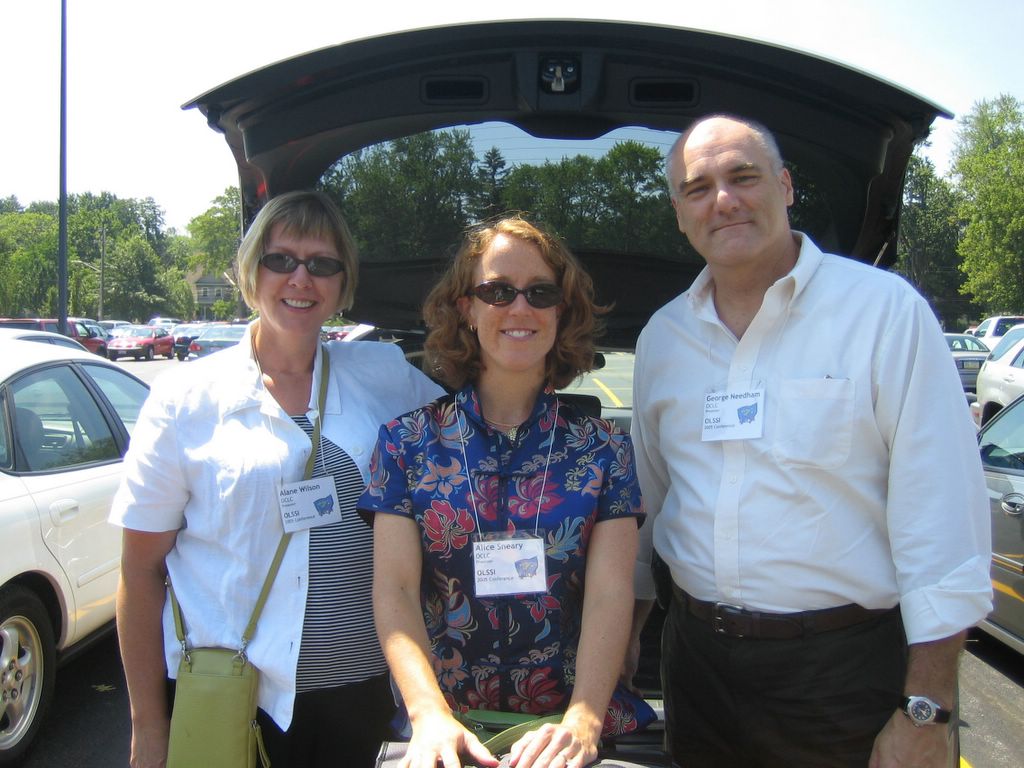
The It's All Good Bloggers, at our recent outing to Cleveland, Ohio. L-R is Alane Wilson, Alice Sneary and George Needham. Posted by Picasa

Entitlement Management Systems

I wasn't familiar with the phrase or the innards of Entitlement Management Systems (perhaps because I am so far removed from the day-to-day backroom operations of libraries) but as a way of bundling a lot of stuff together it's both a useful phrase and what appears to be helpful technology. Digital rights management would be only one part of the whole entitlement process, according to the article I am referring to, from Telephony Online.
Entitlement is the process of authorizing a service (a music or broadcast TV channel, pay per view, etc.) or content (a movie, program, game or special event) to a customer. Entitlement also includes the assignment of rights, which are the rules that govern how services and content can be used.
The article is written from the point of view of for-profit telcos but there's interesting tidbits to be gleaned if you read the article from the point of view of the task of providing disparate content to library patrons.

I found this is in Hot Bytes, a bi-weekly newsletter from the e-Content Institute.

Sunday, August 28, 2005

Evacuation from Hurricane Katrina

To our U.S. colleagues in Louisiana, Mississippi, Alabama and especially New Orleans: I hope you have found safe shelter from the storm.

My husband's parents live right outside New Orleans, so it was a relief to hear that they made it out.

As a librarian/library worker, aren't you glad you've done the hard work of digitizing all your special collections at times like these? And I know SOLINET has preservation programs to assist librarians in the aftermath of natural disasters such as these, to help you know how to dry out your books safely, how to put a disaster plan in place and more. Small solace, I know...

The immediate resource that stands out is "Hurricane: Are You Ready for the Big One? A Primer for Libraries, Museums, and Archives, 1998" By Dr. Michael Trinkley, Director of Chicora Foundation. For $15, you get comprehensive guide to assist libraries, museums and archives in protecting their staff, collections and facilities from the ravage of hurricanes. Covers disaster planning; "storm proofing" your facility (both new construction and retrofitting); recovery efforts; sources for hurricane assistance and consulting; and weather definitions.

For those of us who are land-locked and can't begin to imagine what to do, here are excerpts on:
1. How to prepare for a hurricane
2. What to after it's over

Thanks to SOLINET for making these resources available.

Thursday, August 25, 2005

Public Good on a Small Scale

Thought I'd shoot you guys a Q&A with Chris Maher, a prominent e-mail marketer from Austin, TX. Wanted to share it with you because he's wondering how to connect work with the larger purposes of life, and how he can use his business to promote the Public Good and create a value chain. (His words, not mine.)

Have a look. He had a particular part that caught my attention:

Government has been characterized as the enemy. The enemy. The government that built the highways and bridges; that stepped forward for civil rights (albeit under the flag of interstate commerce); that defends our liberties; that, when all is said and done, can be a voice for the voiceless: This is not my enemy. The question becomes, How do we bring such dead institutions back to life? But, that's not for this discussion.

So, with governments largely irrelevant and with a new breed of public servants who seem conflicted about the role of government to begin with, who can belly up to the bar and look at social problems in new ways? Who can make a useful analogy between core business processes and core civic processes, and start rethinking access to health care, food distribution, provision of shelter, affordable housing, literacy, etc.?

If not business people and other citizens, then who?


Of course, I would substitute "Library staff members" for business people and other citizens there!

Get the whole story through Sept. 2 on MarketingProfs.com.

And once again, the breach wins...

Alane, I hate to burst your bubble, but public libraries have been in the business of teaching for a lot of years.

They've helped immigrants learn the materials they need for a citizenship test, or English as a second (or third, fourth, or fifth in some cases...) language. They've provided space, materials, and often tutors for adults who needed to gain or improve literacy skills. And beyond that, they've offered a wealth of continuing education, personal development, and training courses, from discussions of current events, to awareness of health issues, to how to use a microwave oven. (These are just offerings from public libraries I worked in during the 1970s and 1980s. Heaven knows there are many more examples than this since my salad days.)

So if a public library offers a chance for someone who can't afford it to use a PC, or maybe to learn a few new skills to improve their opportunities at work, that's a tight fit with its traditional mission.

What I can't accept is the idea that people must clear a hurdle before they should be allowed to use the library's services. We don't say, these books are only here if you can read them. Neither should we say these computers are only here if you already know how to use them.

AP story about eAudiobooks

Libraries got good coverage in the news today, with a story squarely about how hip they are with the times and technology, serving people's needs where and when they are. "Libraries Offering Audiobook Downloads."

So far, I've seen the AP story run in the New York Times, the ABC news site and the San Jose Mercury News. I'm sure there are others...but thanks to Brad and Bob for pointing these out. Rock on. Just wish the photos would have shown our cool new in-library posters for eAudiobooks...that yours truly and a slew of additional people worked on. They're free for the asking, so come one, come all and get some fun stuff to help promote your eCollection.

Make some local hay with this national story
As my farming father used to say, "We've got to make hay when the sun shines." And a national library story is some great sunshine to help the local haybaleing effort.

Send it to your local elected officials
You can even be so bold as to send the link to your mayor, city councilpeople, etc. with a short proposal of why eAudiobooks in YOUR LIBRARY would improve literacy rates, boost access to educational materials in rural areas currently underserved by your physical library and increase citizen awareness of local issues. (Because after all, people download the eAudiobooks from the library Web site. What a great place for a message from these same elected officials about their strong support of electronic empowerment initiatives to the voting public!)

I'm all fired up now. Anyone have a city council person I can write to?

Montana Justice Notes Orwell's 1984 Is Now

Here's a fascinating evaluation of the state of privacy in the US today from a Montana Supreme Court justice. Do yourself a favor, and take the time to read the whole opinion.

I don't know if this guy is a Democrat, a Republican, or a Whig, but he has a better understanding of what's going on in America and the world today than nearly anyone else in public life right now. I'd feel just a little more comfortable if I thought someone like this had a chance of being nominated for the US Supreme Court.

Wednesday, August 24, 2005

500th post as a Stepping Stone

It's a red-letter day: it's the 500th post here at IAG. I know you're as excited about it as I am...but there was something quite magnanimous and completely unexpected that came across my inbox today. Worthy of 500 postedness.

Someone is giving away free library shelving in Michigan.


Now before you cry out, "Egad! This eContent thing has really taken off!," know that there is a bit more to the story.

The Stepping Stone school, a gifted school for K-6 in Farmington Hills, MI has bought a vacant college campus--complete with library--and would like to see the shelves find new life in another library. In classic "Save This Old House" style, the business manager, Matt Berg, is willing to offer these good condition shelves out to any library who needs them. For free. Available for the asking.

Spread the word around. Contact number is 248-473-1808.

Conversation, not Content?

Jeff Jarvis, at BuzzMachine, has an interesting post called "Who wants to own content?" This is one of those referrals that I want you to read wearing your "library lens". Jarvis is discussing content owners in the for-profit arena but libraries are in the content ownership and distribution game too. And the shifting ground is beneath our feet as well as the feet of publishers of content and traditional distribution channels like newspapers.

The whole post is "quote-worthy" but here's a few tidbits. Jarvis says, "the value is no longer in maintaining an exclusive hold on things. The value is no longer in owning content or distribution. The value is in relationships. The value is in trust."

Why? Because "There is no scarcity of good stuff. And when there is no scarcity, the value of owning a once-scarce commodity diminishes and then disappears."

"[I]n this new age, you don’t want to own the content or the pipe that delivers it. You want to participate in what people want to do on their own. You don’t want to extract value. You want to add value. You don’t want to build walls or fences or gardens to keep people from doing what they want to do without you. You want to enable them to do it. You want to join in."

So, one thing this suggests is that the parts of the content industry that have experience with relationships and trust--like libraries--should be in the ascendancy. Are we dismantling the fences and walls and expanding our trust circles? Slowly.

A puzzlement to me--and something Jarvis doesn't address much--is how trust, relationships and conversation become monetized. In other words, libraries receive funding to be--for the most part--the content owners and the distribution pipes. How would they be funded for such ephemeralities as trust and conversation?

Tuesday, August 23, 2005

Once More, Into the Breach

Although I think Will Shakespeare was writing about a real divide....

OK, study this. A book by a fellow called Mark Warschauer. Title is Technology and Social Inclusion: Rethinking the Digital Divide. The front flap (according to my Amazon view) says: "Much of the discussion about new technologies and social equality has focused on the oversimplified notion of a 'digital divide' [...] What is most important is not so much the physical availibility of computers and the Internet but rather people's ability to make use of those technologies to engage in meaningful social practices."

Exactly.

Libraries did not teach people how to read and write in the olden days when these skills were less ubiquitous than they are now. They did provide grist for the mill once those skills were acquired. Why now does George think it's the job of libraries to teach another form of literacy? And if he says it's because no one else is doing it and libraries have a social obligation, I'll suggest that there are a lot of hungry, ill-clad, ill-housed, unhealthy people visiting libraries. and that we will need a lot more money in order to become the umbrella social services agency in our communities, and librarians will need a lot more training.

So, what is the social purpose of a library?

Monday, August 22, 2005

Back from holiday

Hey guys. I'm now officially back from jury duty, summer holidays, moving house and more. It's been a wild August, to say the least.

But it seems as though George and Alane have been stirring things up sufficiently, even without me chiming in to egg them on.

I'm packing up the laptop now, to leave on a library adventure to Connecticut. A group of us are heading to Fairfield University to learn a bit more about what electronic resources they have, how they're marketing them to the students and faculty and to see if we can think up some good ideas on additional ways to reach those audiences.

Will send a dispatch from the road! Good to be back. I've missed you, IAG readers.

Friday, August 19, 2005

Book Vending Machines

In the name of 24/7 library service, I present this piece from today's Forbes.com. It seems that a publisher in France has developed machinery to sell books around the clock to literature-starved Parisians. Of course here in the US, we just slip down to the all-night supermarket or, if you happen to live in Arlen, Texas, the Megalomart, for that post-midnight classic. In France, where the stores are generally open on a human schedule, that's not an option.

But couldn't libraries do something like this? Maybe it would be just a small collection of your popular materials, like bestsellers, DVDs, and CDs perhaps. Go online, order up what you want from this limited collection, a robot goes out to the shelf, retrieves the item, places it in a lock box, you use your card and a PIN to open the lock box, and voila: You'll have your copy of À la recherche du temps perdu with your morning tea and madeleines. Just a little Friday afternoon mental meandering...

Thanks to OCLC's Jane Dishong for pointing me toward this story.

Thursday, August 18, 2005

Swedish library 'lends' out gays, minorities

Take this idea for a test drive. Talk about disaggregation (which we do in the scan, which is why this article is at least tangentially related to "It's All Good")...this library is moving from auditorium programs on diverse cultures to one-on-one discussions facilitated by the library.

Wednesday, August 17, 2005

Not Convinced Yet

Sorry, Alane, your comments just doesn't wash for me. I still can't bring myself to equate helping someone use technology with colonialism or paternalism.

Public libraries in the US have traditionally (that is, for the last century or so) seen that giving people access to the intellectual tools they need to improve their lives is part of their mission. That's not colonialism, it's self-help. It may be a very old-fashioned ideal, but there it is.

If it's paternalism or colonialism to try to offer any sort of patch to the economic, social, ethnic, or demographic issues in this country, we might as well close all the public libraries now. Most of us know we can't change the world, we're just going to try to help a few people along the way. That's why we got into this field. To give up because we can't change it all is a cop out, IMHO.

More on the Digital Divide

This is a good topic, isn't it? Lots of room for discussion and opinions....there is a discussion underway attached as comments to my previous post, and Rochelle and Jessamyn commented too. I thought I'd add another entry on the digital divide because I came across a quote in a paper [pdf] that captured an element of my unease--what might be called the "colonialism" factor.

The author, Brian Shoesmith, wrote specifically about the "digital divide" as it was perceived between developed and developing economies. The paper is called "Mapping the Digital Divide" and was presented at the Euricom Colloquium: Electronic Networks & Democracy, 9-12 October 2002 in Nijmegen, The Netherlands.
The term digital divide is open to a number of interpretations. At its worst it is a continuation of the asymmetrical modelling of communication that characterised much of the writing on development from the 1950s through to the 1970s. In a more benign form it refers objectively to the lack of access to technology. The word divide also implies that the gap may be bridged, in this case through the provision of computers. In both instances we are talking about top down models of communication where the active donor gives to a passive and grateful recipient. (my italics)
Interesting too when research intersects: I was using Google Scholar to look for articles on Harold Innis and his idea of the "monopolies of knowledge" but was enticed down this bunny hole again. Here's some more thought-provoking material on the "digitally disposessed" (a term from this next paper).

#1. Unfortunately, most efforts to address the `digital divide' have taken a decidedly technical approach to what is essentially a social and political problem, focusing on hardware and engineering concerns rather than the politics of information. [pdf]

#2. But this traditional understanding of the digital divide fails to capture the full picture of inequity and alienation recycled by these gaps and the resulting educational, social, cultural, and economic ramifications, primarily for groups of people already educationally, socially, culturally, and economically oppressed. Meanwhile, such a limited view of the digital divide serves the interests of privileged groups and individuals, who can continue critiquing and working to dissolve gaps in physical access and use rates while failing to think critically and reflectively about their personal and collective roles in recycling old inequities in a new cyber-form. [pdf]


If you want to investigate this yourself, I used the phrase "digital divide" and added terms like "colonialism", and "inequality" or any of the gaps identified such as racial, social, educational and so on. If you do this search on Google "plain" I find good results in limiting to pdf.

And this quote has not much to do with the subject of this post, but my goodness, it grabbed my attention! It's from the Harold Innis site linked above.

When fascism comes to America, it will come in the form of democracy.--Huey Long

Don't Buy the Hype

David Leslie, who works on QuestionPoint here at OCLC and was a blogger long before "It's All Good" got off the ground, shared a very interesting piece called "Secrets of Product Development and What Journalists Write: Some random bits scribbled by Jeremy Zawodny." Zawodny's point is that the media tend to hype the constantly overlapping product developments of competing tech companies. The media make it appear that developments that have been in the pipeline for months or even years are instantaneous reactions to the moves of their competitors. If you stop to think about this for even a minute, you realize how absurd this concept of instant product development is. However, Zawodny is a Yahoo insider who really makes you understand the full absurdity.

The blog entry itself is interesting enough, but the exchange that follows is both surprising and heartening. The entries reveal a lot about how those big, fast-moving technology companies we all wish we could emulate really aren't all that nimble. One quote, from Charles Eicher, is actually quite inspiring. He describes a mid-1980s talk he'd heard given by somebody from Apple. The speaker said that Apple had teams of people who tried to imagine what their competitors would be doing two years out so they could build products to compete with them. Charles writes, "You can't compete with the future. You have to compete with yourself, you have to produce the best products you can make today and hope that nobody else can compete with YOU." Words a forward-thinking librarian could learn to live by, don't you think?

Tuesday, August 16, 2005

2005 National Personalization Survey

I am a squeaky (and no doubt annoying) wheel on the matter of the the vanilla OPAC interface, devoid of personality, personalization, any hint of the community it supposedly represents and as exciting and friendly to use as an online parts catalogue.

One reason, I think, is librarians' collective belief that patrons' privacy is being protected from the potential plundering of their identities. Bull-pucky, is what I retort to that...because as a profession we've done little or no research into what amount of privacy our communities expect from library OPACs.

So, I point our attention to the 2005 National Personalization Survey [press release pdf] which is, "the second in a series of national surveys designed to provide insight into consumer interest in, and perceptions of, online personalization."

Now, I've said many times that the data show people will give up privacy for personalization features, and this survey says I am wrong:

Based on the fear of losing personal information, fewer consumers are willing to provide personal preference and demographic information in exchange for personalized content than last year. In 2005, 59 percent of respondents indicated a willingness to provide preference information, down six percent from 2004. Additionally, 46 percent of respondents are willing to provide demographic data in 2005, down 11 percent from 2004.

So that's that, I hear some of you saying as you cross "personalization" off your to-do list. Not so fast, not so fast...

The Personalization Survey also finds that retailers are leaving significant dollars on the table by not making it easier for consumers to find merchandise that interests them. Thirty seven percent of respondents indicated that the last time they went shopping for DVDs/videos, they would have bought more if they had found more that they liked. The same was true of consumers shopping for music, with 34 percent indicating that they would have bought more if they had found additional titles that they liked.


Substitute "libraries" for retailers, and "patrons" for consumers, and "use" for dollars, and I think we see here evidence of The Long Tail in action. People will consume (buy, use) more content if they are shown more of what they are interested in. And the pr piece goes on to quote Esther Dyson, "Specifically, they want personalization, even as they are concerned about the safety of their data. Those sites that offer a rich, uniquely personal experience to each consumer while visibly ensuring the safety and security of consumers' information will take the lead in the years ahead."

An 11 page Research Brief is available [pdf] from the surveyor's site (and yes, I do recognize that the company is in the personalization business and so isn't neutral on the topic) and includes this: "Among older respondents, particularly those in the 50+ category, personalized news is of the greatest interest (28%), followed by Web search (26%), and books(22%)."

So, librarians, the challenge is to provide a rich, uniquely personal experience while visibly ensuring the safety and security of peoples' identities. This sounds like the sort of challenge librarians should accept.

"This tape will self-destruct in five seconds. Good luck, Jim."

Monday, August 15, 2005

Tired, but Not Gone

The term "digital divide" may be a tired old cliche for some, but I get asked about what libraries can do to help people who don't have access to technology more than any other single question when I'm on the road talking about the scan. For many library workers I've spoken to, the digital divide is ongoing reality. They see people who've been defeated by many factors---the poverty and racism and lack of equal opportunity that Alane points out---and they see computers as just one more place where this defeat plays out. For these folks, the digital divide isn't an abstraction, it's a daily experience.

Digital Divide - Tired Old Cliche

In the post previous to this one, George reports on comments from the HBCU event he spoke at. One of the comments was why OCLC did not reflect on the "digital divide" in the Scan seeing this is one of libraries' most pressing problems (in the opinions of the participants).

Here's why. Because the term "digital divide" is a tired old cliche, stripped of any meaning by overuse, that gets tossed around as shorthand for a host of complex issues. Ask a librarians what they mean by "digital divide" and it's likely the answers will revolve around access to the Internet/Web, computers, and broadband. Or, I should clarify, that is what I hear and have read.

But this isn't it at all. It isn't about the technology at all. It's about poverty, education, cultural values and literacy.

Those are the divides. What American librarians seem to forget when the red flag of the digital divide is waved around is that ownership and use of Internet-capable computing devices is much larger in many countries than it is here, that even very poor communities elsewhere are pooling resources to buy smart phones to share among a whole village so that farmers can check on the price of crops before selling them.

Unfortunately, the digital divide in America will not be fixed by any amount of computers in libraries. Just as is the case with most technology "problems" the root is sociocultural. The abilities to be resourceful and to learn do not come from having access to machines and bytes. So, please, as a community, let's steer clear of cliches, look on the bright side, jump with both feet into the storm before the calm and consult our inner children before we utter such bromides again.

Sadly, it will take a lot more than access to the Internet to span this divide and perhaps libraries can do a great deal to address the problems manifested as the "digital divide" by providing more literacy programs not more computers.

Sunday, August 14, 2005

HBCU Library Alliance

Yesterday (Saturday, August 13), I had the opportunity to speak at the opening session of the Leadership Institute of the Historically Black Colleges and Universities (HBCU) Library Alliance. The theme of the institute, which will go on through this coming Wednesday, is "Redefining Library Leadership for the 21st Century." The agenda features a number of discussions on understanding one's environment, working with your stakeholders, and moving from campus utility to campus player (although it isn't described exactly this way in the agenda!)

After doing my spiel on the OCLC E-Scan, we broke into small group discussions, and the questions that came out of the small groups seemed to crystalize the key issues for libraries in the coming years:
  • Why doesn't the OCLC report deal with the digital divide? This is a key issue facing libraries of all types.
  • What about the digital divide between and among generations, especially as represented by the gamers vs. the non-gamers?
  • What is the role of the library when information becomes a commodity?
  • How will disaggregation of information sources and delivery affect libraries?
  • How can libraries make their special collections available in a way that allows them to reap some benefit from them (as opposed to commercial vendors getting the benefit)?
  • How can libraries integrate more closely with the academic units on their campuses?
  • How do we develop lifelong information literacy in our students?
All great questions. It's times like this that I wish I really were some sort of library guru who could provide great answers. But the best answers are the ones we develop and agree to as a community, right? As Bob Dylan would say, "Don't follow leaders, watch the parking meters..." (At least I think that's what he said. Who can understand him?)