Wednesday, March 22, 2006
CIL - New web site tools & technologies
This session was presented in two parts, the first by Jason Clark on Building Usable Library Interfaces with AJAX and the second by Karen Coombs on Open Source Applications for Library Web Site Management. They both managed to present a tremendous amount of information in very little time, and without making us feel totally stupid. So much of this was new to me and I have no idea whether any of it is even possible in the web systems I work with, but boy am I going to try. It is incredibly cool, and they make it sound easy. Jason even mentioned some work by OCLC Research that I was completely unaware of! I need to keep up better!!


CIL - Basics of Web-Based experience planning
David King presented a well organized outline of "how-to" design a web site that made me want to go back home and get started! He used concepts from Jesse James Garrett to outline the process. The 5 steps are: strategy, scope, structure, skeleton, surface. He emphasized that you have to remember at every stage that the user of the site is the most important element. Users should have a feeling of control and interactivity in all parts of the site. We need to keep the focus on the user rather than on the resources we have to offer to the user.
At the end of the presentation someone asked about the cluttered (to her) look of many award winning websites. David pointed out that what looks cluttered to us does not necessarily look cluttered to our users - - if these are people who regularly use CNN or Amazon or Yahoo they probably have come to like what we consider cluttered.
The bottom line is: It's all about the user!! And it's hard for us to remember.
At the end of the presentation someone asked about the cluttered (to her) look of many award winning websites. David pointed out that what looks cluttered to us does not necessarily look cluttered to our users - - if these are people who regularly use CNN or Amazon or Yahoo they probably have come to like what we consider cluttered.
The bottom line is: It's all about the user!! And it's hard for us to remember.
CIL - Keynote by Chris Sherman of SearchEngineWatch
Chris Sherman, recently back from China, talked about developments in the search engine world - and compared the present time to 1995 - a time of much excitement and innovation, along with one-upmanship and me-tooism. Things are changing a lot in the search engine world and some search engines are becoming things other than search engines. Jeeves has been fired, but Ask is going strong. Google is be coming everything web. MSN is giving off confusing brand messages, and Yahoo innovation seems to be slowing down while their research arm is ramping up. Personalization is becoming pervasive in very exciting ways, but it has a dark side as privacy issues crop up. And lawsuits are crowding the horizon. It feels like 1995 again! And it's fun.
CIL - opening session
Tom Hogan, President of Information Today opened the 21st Computers in Libraries Conference. He reminded us all that National Online made it to 24, but it is "all gone" now!! As of Saturday attendance is a record 2386 and we expect another 100 or so to register during the week. 49 states are represented, plus the District of Columbia & Puerto Rico. The only US state not represented is Mississippi. And we all hope Mississippi will be able to send representatives next year. 17 other countries are also represented including: Canada, Denmark, Egypt, Germany, The Netherlands, Portugal, Qatar, Slovakia, Slovenia, South Africa, Sweden, Taiwan, Thailand, Vietnam, and The West Indies. (Marshall Breeding claims to have been to all 21!) The attenance figures include 150 speakers & moderators, and .60 companies represented in the exhibit hall.
All in all avery exciting place to be!!
All in all avery exciting place to be!!
Tuesday, March 21, 2006
PLA Boston
Hello PLA!
We've been busy today setting up the exhibit booth (3101) and looking at sessions. I am so excited to hear Susan Susanka of the Not-So-Big-House, the writer of the Stinky Cheese Man and of course, Paco Underhill as the closing session speaker. And lots of interesting stuff in between!
Tonight we went to a great restaurant that was also profiled in the PLA conference guidebook: Via Matta. Excellent food, and even better service. We loved it...and can't wait for the conference to start!
We've been busy today setting up the exhibit booth (3101) and looking at sessions. I am so excited to hear Susan Susanka of the Not-So-Big-House, the writer of the Stinky Cheese Man and of course, Paco Underhill as the closing session speaker. And lots of interesting stuff in between!
Tonight we went to a great restaurant that was also profiled in the PLA conference guidebook: Via Matta. Excellent food, and even better service. We loved it...and can't wait for the conference to start!
Computers In Libraries
Well, I got here after a wonderful day Monday visiting with friends in Maryland. Instead of flying, my husband and I drove for the visit, then came here to the hotel Monday evening and he drove back home early this morning. I will fly back to Columbus on Friday evening when this is all over.
The hustle is amazing - - yesterday the hotel seemed nearly deserted even though I knew people were getting ready for the meetings. (I was going to say maybe that was because it was Sunday - but it wasn't - it just felt like Sunday to me!) Anyway, the place is full of Librarians and computer folk today. The bar is crowded with folk listening to the marvelous piano playing, working on their laptops as I am - the wireless reception is better here than most other places, and talking in various groups.
One group of us, after a long day of learning to be more competent web masters or to do better searching, or a number of other workshops, went to Bombay Palace for dinner and to discuss training - - it was a fun time, and will appear on at least one other blog in more detail - one person was taking actual notes about our conversation. Interesting talk going around the table comparing notes - we found that the issues and the joys are the same no matter what setting we work in - academic, public, school, special - we all face the same difficulties and use the same "tricks of the trade" - though I did learn a few new ones!
Tomorrow the conference starts in earnest - - and so good night!!
The hustle is amazing - - yesterday the hotel seemed nearly deserted even though I knew people were getting ready for the meetings. (I was going to say maybe that was because it was Sunday - but it wasn't - it just felt like Sunday to me!) Anyway, the place is full of Librarians and computer folk today. The bar is crowded with folk listening to the marvelous piano playing, working on their laptops as I am - the wireless reception is better here than most other places, and talking in various groups.
One group of us, after a long day of learning to be more competent web masters or to do better searching, or a number of other workshops, went to Bombay Palace for dinner and to discuss training - - it was a fun time, and will appear on at least one other blog in more detail - one person was taking actual notes about our conversation. Interesting talk going around the table comparing notes - we found that the issues and the joys are the same no matter what setting we work in - academic, public, school, special - we all face the same difficulties and use the same "tricks of the trade" - though I did learn a few new ones!
Tomorrow the conference starts in earnest - - and so good night!!
Ubiquitous Computing and Everyday Life
Three items that caught my attention today on the topic of ubiquitous computing and everyday life.
First, spotted on a blog I've just started reading, pasta and vinegar, a paper [pdf] called "Interweaving Mobile Games with Everyday Life" and a big pdf of a presentation done by Julian Bleeker at the recent eTech Conference, called "Pervasive Electronic Games Theory Objects for Social Play." pasta and vinegar has a summary and links to other comments.
Second, a book by Adam Greenfield, Everyware: The Dawning Age of Ubiqutous Computing. I haven't read this but I've added it to the list. (I am reading Seeing What's Next by Clayton Christensen, and The Art of Innovation by Tom Kelley.)
It's a theme, a meme, a trend...
First, spotted on a blog I've just started reading, pasta and vinegar, a paper [pdf] called "Interweaving Mobile Games with Everyday Life" and a big pdf of a presentation done by Julian Bleeker at the recent eTech Conference, called "Pervasive Electronic Games Theory Objects for Social Play." pasta and vinegar has a summary and links to other comments.
Second, a book by Adam Greenfield, Everyware: The Dawning Age of Ubiqutous Computing. I haven't read this but I've added it to the list. (I am reading Seeing What's Next by Clayton Christensen, and The Art of Innovation by Tom Kelley.)
It's a theme, a meme, a trend...
Web 2.0 - Too Much Sharing?
Kathy Sierra at Creating Passionate Users has a tongue-in-cheek (maybe) post titled "Web 2.0 is like Group Therapy". Scroll down for the funny chart she's made lining up the similarities between group therapy and Web 2.0. Example: Group therapy= self-esteem issues. Web 2.0 = Technorati rank issues.
(Link from Publishing 2.0)
(Link from Publishing 2.0)
Monday, March 20, 2006
We are BoingBoing'ed
BoingBoing is a blog that is, as it bills itself, a directory of wonderful things. I read it not just because of the posts about Fat Albert, rat-cats, TV-bars, roasted alligator, barf bags, and Chinese gangster fiction (all this in the last 24 hours) but because of the gems that relate to my day-job.
Just today I was alerted to an article in The Guardian newspaper on the abundance of cheap consumer goods that got me thinking about a notion I've tossed around a good few times (and which of course does not originate with me): that libraries were constituted in times of scarcity and that times of abundance such as we are in (here in an economically priviledged country) have blurred the original purpose of libraries when content and information is as adundant as cheap t-shirts.
So, here's the sentence that caught me. "Unashamedly 'disposable' cheap goods, you could argue, are turning us into traders rather than curators of our posessions."
Well, there you go....the library dilemma in a sentence.
You're underwhelmed by this? Then perhaps you'll prefer the link to the blog maintained by "Geoffrey Chaucer"..."Yowre care maken myne eyes to watre with teres..."
Oh. The title of this post? Yes, OCLC was actually mentioned in this mega-A list blog. A short squib noting our list of the 1000 top books held by OCLC libraries. The work was done by OCLC Research staff at least a year ago but has seen new interest because Lorcan mentioned it recently at the Reading 2.0 conference (available talks here), and Tim O'Reilly blogged about it and so on and so on.
Cool.
Just today I was alerted to an article in The Guardian newspaper on the abundance of cheap consumer goods that got me thinking about a notion I've tossed around a good few times (and which of course does not originate with me): that libraries were constituted in times of scarcity and that times of abundance such as we are in (here in an economically priviledged country) have blurred the original purpose of libraries when content and information is as adundant as cheap t-shirts.
So, here's the sentence that caught me. "Unashamedly 'disposable' cheap goods, you could argue, are turning us into traders rather than curators of our posessions."
Well, there you go....the library dilemma in a sentence.
You're underwhelmed by this? Then perhaps you'll prefer the link to the blog maintained by "Geoffrey Chaucer"..."Yowre care maken myne eyes to watre with teres..."
Oh. The title of this post? Yes, OCLC was actually mentioned in this mega-A list blog. A short squib noting our list of the 1000 top books held by OCLC libraries. The work was done by OCLC Research staff at least a year ago but has seen new interest because Lorcan mentioned it recently at the Reading 2.0 conference (available talks here), and Tim O'Reilly blogged about it and so on and so on.
Cool.
March Madness 2
I'm back in the office for two days before I leave for the PLA shindig in Boston. Last week was a blur, and this one's not much better!
Monday night, I guest lectured for a wonderful group of LIS students about the Environmental Scan and the Perceptions Report.
Tuesday afternoon, I talked about the Perceptions Report with directors from the Association for Southeastern Research Libraries (ASERL).
Thursday, it was a gaming presentation at the Greene County District Library in Xenia, Ohio.
Saturday, I was in Utica, New York, at the Mid-York Library System, talking about library futures.
At the ASERL meeting, one of the issues that emerged was how we expand the library brand to start penetrating public consciousness about what libraries have to offer in this world.
In the other three programs, one of the biggest topics of discussion was "Google versus books" as a reference tool. How can (or perhaps the question is should we...) get students to go deeper into the literature to use all the resources the library owns or licenses, when all they seem to want to do is use Google?
One librarian in Xenia expressed frustration that she could answer a question for a student from books that are readily available,but all they want to use is the web. She said that by the time she referred the student to the public computers on the second floor, and the student repeated the question for the librarian there, she could have easily found the answer for him. One of the other librarians in the room suggested that perhaps the computers are on the wrong floor.
In Utica, the discussion was framed around "instant gratification" in public libraries. Do we give students and other library users answers, or do we try to teach them how to become independent, lifelong searchers? This is a question that can roil nearly any gathering of librarians.
Charles Robinson, one of my personal heroes in libraryland, drove a stake into the ground in this argument by summarizing his philosophy of library service as "give 'em what they want." I definitely come down on that side of the argument; I was inoculated with his way of thinking many years ago. When we view the world through our library prism, we try to slot users into our preferences for printed materials and thorough research. We try to make little librarians out of people who only need enough material to do a one page theme on frogs. Today's kids have so much to do that I have no moral or professional compunctions about providing instant gratification from our publicly funded institutions. If the student wants to learn a couple of quick tips about how to make her own searching faster and more effective, fine---but it's the student's call, not mine.
Monday night, I guest lectured for a wonderful group of LIS students about the Environmental Scan and the Perceptions Report.
Tuesday afternoon, I talked about the Perceptions Report with directors from the Association for Southeastern Research Libraries (ASERL).
Thursday, it was a gaming presentation at the Greene County District Library in Xenia, Ohio.
Saturday, I was in Utica, New York, at the Mid-York Library System, talking about library futures.
At the ASERL meeting, one of the issues that emerged was how we expand the library brand to start penetrating public consciousness about what libraries have to offer in this world.
In the other three programs, one of the biggest topics of discussion was "Google versus books" as a reference tool. How can (or perhaps the question is should we...) get students to go deeper into the literature to use all the resources the library owns or licenses, when all they seem to want to do is use Google?
One librarian in Xenia expressed frustration that she could answer a question for a student from books that are readily available,but all they want to use is the web. She said that by the time she referred the student to the public computers on the second floor, and the student repeated the question for the librarian there, she could have easily found the answer for him. One of the other librarians in the room suggested that perhaps the computers are on the wrong floor.
In Utica, the discussion was framed around "instant gratification" in public libraries. Do we give students and other library users answers, or do we try to teach them how to become independent, lifelong searchers? This is a question that can roil nearly any gathering of librarians.
Charles Robinson, one of my personal heroes in libraryland, drove a stake into the ground in this argument by summarizing his philosophy of library service as "give 'em what they want." I definitely come down on that side of the argument; I was inoculated with his way of thinking many years ago. When we view the world through our library prism, we try to slot users into our preferences for printed materials and thorough research. We try to make little librarians out of people who only need enough material to do a one page theme on frogs. Today's kids have so much to do that I have no moral or professional compunctions about providing instant gratification from our publicly funded institutions. If the student wants to learn a couple of quick tips about how to make her own searching faster and more effective, fine---but it's the student's call, not mine.
Your 22 Minutes of Fame
According to a recent post on PUBLIB, the great TV game show Jeopardy! is looking for librarians to audition as contestants for the show. Tryouts will be held in the coming months in these cities: Boston, MA, Chicago, IL, Indianapolis, IN, Los Angeles, CA, Minneapolis, MN, New York, NY, Orlando, FL, Portland, OR, Philadelphia, PA, San Francisco, CA, St. Louis, MO, Washington, DC.
To register, or for more information, go here. And if you pass the test and get on the list, call me for some inside scoop!
To register, or for more information, go here. And if you pass the test and get on the list, call me for some inside scoop!


Friday, March 17, 2006
Luck of the Ancestry, or Something...
So one day a couple of months ago, my friends Tim, Barbara, Val and I were chatting. This is a post about St. Patrick's Day, ancestry, bloodlines and genealogy. REALLY.... I'm just starting with a story.
Ancestry
Tim is Irish, born and raised in Ireland.
Barbara is South African, born and raised in Nebraska, USA.
Val is American, grew up American but his family ancestry/bloodline is clear cut: his father's parents were German and his mother's parents were Italian.
I, on the other hand, am all over the place. People look at me and immediately exclaim (especially if I am wearing my favorite green sweater), "oh, you must be Irish!"
Likely it's the sweater, because all we really know is that we were descended from horse thieves in Pennsylvania, may claim the Maxwell clan in Scotland and that we are related to the famous Comanche chief, Quanah Parker.
But I digress.
Tim, Barbara, Val and I started talking about what it means (in America), when someone asks you where your family is from. Because Americans tend to think that means somewhere *not the U.S.* --a question of ancestry and not of place.
Bloodline
And this drives Barbara and Tim bonkers, and this all came up because there was a guy they met who says, "Hey, I'm Irish, too!" as if he and Tim are suddenly going to be best mates. So Tim asks what part of Ireland he's from, to which he replies "oh, you know, that was 4 or 5 generations ago. But my family is from Ireland."
Which, from Tim's point of view, he isn't Irish at all. He's American and at some point in his lineage, his family lived in Ireland. But all he's ever known or his parents have known is America. I guess it's all a matter of perspective, really. Which brings me to my next question:
Do countries outside the U.S. have as high a demand to do genealogical research? We USonions all want to know where we're from. Even if Tim doesn't want to hear about it. But do other, less melting-pot societies experience the same yearning/nostalgia for roots? For a sense of place? A groundedness?
I have read enough Faulkner to know that it really all gets back to the land, which is a nice way of saying you become where you live. Which brings me to genealogy.
Genealogy
There was a great conference this week at BYU that one of our OCLC colleagues attended. She was there talking about WorldCat and how it can assist genealogists. I dare say, with digital image libraries and the right metadata, just tonight as I write this post, I stared at Quanah Parker's image, thinking "Wow, I guess I didn't get Parker cheekbones."
Maybe I just got the fighting spirit. Or make that the fighting Irish spirit. Well whatever/wherever you are, enjoy your ancestry and raise a toast to those who came before you. Happy St. Patrick's Day!
Ancestry
Tim is Irish, born and raised in Ireland.
Barbara is South African, born and raised in Nebraska, USA.
Val is American, grew up American but his family ancestry/bloodline is clear cut: his father's parents were German and his mother's parents were Italian.
I, on the other hand, am all over the place. People look at me and immediately exclaim (especially if I am wearing my favorite green sweater), "oh, you must be Irish!"
Likely it's the sweater, because all we really know is that we were descended from horse thieves in Pennsylvania, may claim the Maxwell clan in Scotland and that we are related to the famous Comanche chief, Quanah Parker.
But I digress.
Tim, Barbara, Val and I started talking about what it means (in America), when someone asks you where your family is from. Because Americans tend to think that means somewhere *not the U.S.* --a question of ancestry and not of place.
Bloodline
And this drives Barbara and Tim bonkers, and this all came up because there was a guy they met who says, "Hey, I'm Irish, too!" as if he and Tim are suddenly going to be best mates. So Tim asks what part of Ireland he's from, to which he replies "oh, you know, that was 4 or 5 generations ago. But my family is from Ireland."
Which, from Tim's point of view, he isn't Irish at all. He's American and at some point in his lineage, his family lived in Ireland. But all he's ever known or his parents have known is America. I guess it's all a matter of perspective, really. Which brings me to my next question:
Do countries outside the U.S. have as high a demand to do genealogical research? We USonions all want to know where we're from. Even if Tim doesn't want to hear about it. But do other, less melting-pot societies experience the same yearning/nostalgia for roots? For a sense of place? A groundedness?
I have read enough Faulkner to know that it really all gets back to the land, which is a nice way of saying you become where you live. Which brings me to genealogy.
Genealogy
There was a great conference this week at BYU that one of our OCLC colleagues attended. She was there talking about WorldCat and how it can assist genealogists. I dare say, with digital image libraries and the right metadata, just tonight as I write this post, I stared at Quanah Parker's image, thinking "Wow, I guess I didn't get Parker cheekbones."
Maybe I just got the fighting spirit. Or make that the fighting Irish spirit. Well whatever/wherever you are, enjoy your ancestry and raise a toast to those who came before you. Happy St. Patrick's Day!
Thursday, March 16, 2006
From the Ocean's Edge
“There's a world I've always known,
Somewhere far away from home,
...
At the edge of the ocean,
We can start over again.”
("Edge of the Ocean" - Ivy) [Wikipedia entry web site]
This is definitely on-the-road season for IAG. In fact, no small portion of my time recently has been devoted to travel, arrangements for future travel, and planning for visitors. It’s all good, of course, but I am of late much reminded of both the perils (like when the layover for my in-bound connection through O’Hare was extended from 2 to 14 hours Sunday due to the weather) and rewards of travel.
Delayed flights aside, my time out west was enjoyable and fruitful. I was in the Pacific Northwest last week on OCLC business, and I also had the chance to catch up with colleagues and spend some time with a favorite cousin. The business I can’t share details about just yet, save that the discussion was important, engaging, and libraries and library users will be much the better for this collaboration. Keep your eyes open for news from OCLC in coming weeks.
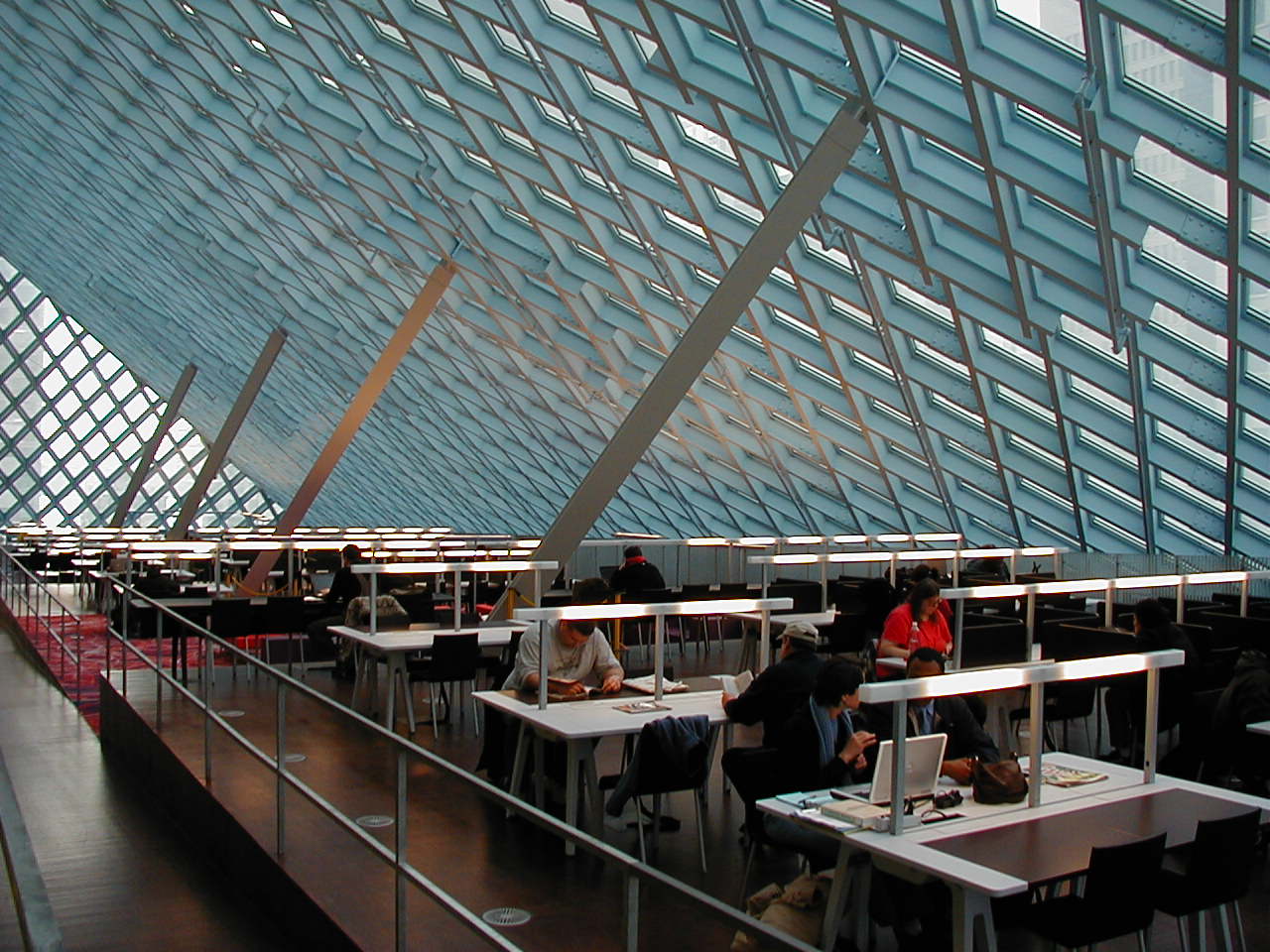
I can, however, share my great pleasure at having a chance to visit with my colleague, Stu Weibel, who is temporarily ensconced in Seattle and very much enjoying the place and his extended contact with the University of Washington iSchool. Weather intervened the first night he, I, and several other OCLC colleagues hoped to rendezvous for a dinner, so no Stu and much sitting in traffic later, we dined Italian without him. But on the day following, Stu and I met and together explored the absolutely fabulous Seattle Public Library (see Stu’s blog entry & pictures). I also took a few photos (and Michael Porter took kind notice of one I contributed to the flickr Libraries and Librarians Group – thanks, Michael!). We capped off the evening with an excellent dinner at a local pub, and a stimulating discussion of many things, especially the matter of the use and care of identifiers. Stu has kindly loaned me his copy of Linked by Albert-Laszló Barabási which I am enjoying and finding every bit as readable and stimulating as Stu promised.
The trip also allowed time for a brief, unannounced (OK, well in truth I did call Leslie Dillon in our OCLC Information Center to find Chrystie Hill’s phone number and called Chrystie while in route), and all too brief visit to WebJunction’s offices in Seattle. They received me like I was a long lost relative and even treated me to delicious homemade goodies (yum!). It was great to finally meet so many of the wonderful folks at WebJunction in person. And I’m rather jealous of the marvelous view from their offices. (Very nice – the Gates Foundation offices overlook the same area. And -- not that IAG does recruiting -- but FYI, gentle readers, WJ has jobs open!)
And last, but not least I took some time off to see the sights including two excellent museums, the Science Fiction Museum and Hall of Fame, and the Museum of Flight. All in all, a great trip. My special thanks to Stu Weibel and the WebJunction folks for their kind hospitality. [Oh, and BTW...George, did I mention I’m available to travel to Seattle?]
Wednesday, March 15, 2006
CIL, PLA blogging
We're preparing for two upcoming conferences here at IAG: CIL and PLA.
If you remember from last year, Ginny Browne was our guest blogger from the conference. It turns out, she plans to attend again and has graciously agreed to post again this year. We look forward to her insights and photos; welcome aboard Ginny!
OCLC and OCLC CAPCON events promise to be fun. I do believe Alane might be there as well, doing a presentation on the Perceptions report? So we'll have multiple perspectives from D.C., coming up.
Further north, George and I will be carousing with lots of public librarians in Boston for PLA. I hope to see lots of you at events, the booth (#3101) and WebJunction reception.
Side note: We had toyed with the idea of having a very unofficial official "Blogger Meet-up" at a local watering hole one night...and then schedules got very, very complicated. So I'm inviting you instead, to breakfast on Friday at the Colonnade hotel, Huntington Ballroom at 7:30 AM. We do ask you to register, so we'll have enough muffins and pastries for everyone.
Readers, bloggers, friends: see you soon!
If you remember from last year, Ginny Browne was our guest blogger from the conference. It turns out, she plans to attend again and has graciously agreed to post again this year. We look forward to her insights and photos; welcome aboard Ginny!
OCLC and OCLC CAPCON events promise to be fun. I do believe Alane might be there as well, doing a presentation on the Perceptions report? So we'll have multiple perspectives from D.C., coming up.
Further north, George and I will be carousing with lots of public librarians in Boston for PLA. I hope to see lots of you at events, the booth (#3101) and WebJunction reception.
Side note: We had toyed with the idea of having a very unofficial official "Blogger Meet-up" at a local watering hole one night...and then schedules got very, very complicated. So I'm inviting you instead, to breakfast on Friday at the Colonnade hotel, Huntington Ballroom at 7:30 AM. We do ask you to register, so we'll have enough muffins and pastries for everyone.
Readers, bloggers, friends: see you soon!
"Solutions for Our Future" campaign
George is hosting his own personal "March Madness" with travel this week. I have just gotten back from a week of illness and then some traveling, myself. I have a ton of photos to post. I'll flickr 'em and let you know...but here's some news on advertising during the *real* March Madness:
Colleges and Universities in the U.S. will get an image boost during the NCAA basketball tournament that begins tomorrow night, with the "Solutions for Our Future" campaign. Here's a blip from UB Daily and Chronicle articles on the project:
Read more in the Chicago Tribune and on the official site. From here, you can even send pre-populated messages to your elected officials. They have a bibliography and further white paper reading, as well.
Now does this project sound familiar to you, IAG readers? Of course it does. OCLC has been doing library advocacy to policymakers for a couple of years now. We're working on a school library advocacy ad now. It's a great idea and I am excited to see the NCAA ads tomorrow.
Maybe it's reason enough to even watch the game?
Colleges and Universities in the U.S. will get an image boost during the NCAA basketball tournament that begins tomorrow night, with the "Solutions for Our Future" campaign. Here's a blip from UB Daily and Chronicle articles on the project:
The campaign will include efforts by nearly 400 colleges to reach out to local communities and policymakers and explain their contributions to society. They hope to convince the public that higher education remains essential to the country's future and that it should be a state and national funding priority as government support has lagged during the past few years.
Read more in the Chicago Tribune and on the official site. From here, you can even send pre-populated messages to your elected officials. They have a bibliography and further white paper reading, as well.
Now does this project sound familiar to you, IAG readers? Of course it does. OCLC has been doing library advocacy to policymakers for a couple of years now. We're working on a school library advocacy ad now. It's a great idea and I am excited to see the NCAA ads tomorrow.
Maybe it's reason enough to even watch the game?
Tuesday, March 14, 2006
Amazon S3 - Storage Web Service
Interesting...Amazon has just announced a web service (no customer interface) called Simple Storage Solution. It looks like any data format can be stored at low costs per gigabyte, with no limit to the amount of data stored. Commentators speculate this will be very attractive to developers who haven't adequate storage capacity for their projects. Spotted on tech.memeorandum with links to other discussions.
From Amazon: "Amazon S3 provides a simple web services interface that can be used to store and retrieve any amount of data, at any time, from anywhere on the web. It gives any developer access to the same highly scalable, reliable, fast, inexpensive data storage infrastructure that Amazon uses to run its own global network of web sites. The service aims to maximize benefits of scale and to pass those benefits on to developers."
From the Business Week blog Tech Watch: 'So what's Amazon turning into? "They want to be seen as a platform for Web 2.0 applications," says Schmelzer. That still may take awhile. But it's clearer than ever that Amazon intends to keep pace with the big guns on the Web.'
Amazon S3? Why not WorldCat S3?
From Amazon: "Amazon S3 provides a simple web services interface that can be used to store and retrieve any amount of data, at any time, from anywhere on the web. It gives any developer access to the same highly scalable, reliable, fast, inexpensive data storage infrastructure that Amazon uses to run its own global network of web sites. The service aims to maximize benefits of scale and to pass those benefits on to developers."
From the Business Week blog Tech Watch: 'So what's Amazon turning into? "They want to be seen as a platform for Web 2.0 applications," says Schmelzer. That still may take awhile. But it's clearer than ever that Amazon intends to keep pace with the big guns on the Web.'
Amazon S3? Why not WorldCat S3?
Google Selling Online Books
Danny Sullivan at SearchEngineWatch.com has a write-up of this recently announced extension of Google's Book Search service. A semantic curiosity: everything I read about this used the term "online books", not "e-books". I wonder why?
Monday, March 13, 2006
March Madness, Library Version
This is the busiest week of the spring for this IAG blogger. I'm giving five talks in six days in four different cities this week, but at least they are all in the Eastern time zone.
Tonight, I'm the guest lecturer in Nancy Lensenmayer's Kent State University Library Automation class. That talk focuses on the Scan and the Perceptions reports, with a goal of encouraging flexibility of thought in the next generation of librarians.
Tomorrow, it's Savannah, Georgia, for a report on Perceptions to the ASERL (Association of Southeastern Research Libraries) meeting. I'll also be visiting the Live Oak Public Libraries in Savannah, hosted by my friend Lace Keaton.
Thursday, it's the conference called "Teens: Plays, Games and Libraries" for the Miami Valley Libraries in Xenia, Ohio. This is a reprise of the games presentation I did in Chicago in December.
Friday, Joyce and I are doing a joint presentation for the Rotary Club in Dublin about how to become a contestant on Jeopardy. We've never done a program together, but I think our marriage can survive this. The only time we've ever had serious trouble is when we tried to hang wallpaper together. Just think Lucy and Ethel without the laugh track and you get some idea of what THAT was like. Never again...
Saturday, it's Utica, New York, for the Mid-York Library System, with a Scan/Perceptions presentation followed by a white board exercise on what libraries might look like if we were creating them from scratch today.
And next week, it's on to PLA in Boston. So who needs Dick Vitale? We librarians have our own version of March Madness!
Tonight, I'm the guest lecturer in Nancy Lensenmayer's Kent State University Library Automation class. That talk focuses on the Scan and the Perceptions reports, with a goal of encouraging flexibility of thought in the next generation of librarians.
Tomorrow, it's Savannah, Georgia, for a report on Perceptions to the ASERL (Association of Southeastern Research Libraries) meeting. I'll also be visiting the Live Oak Public Libraries in Savannah, hosted by my friend Lace Keaton.
Thursday, it's the conference called "Teens: Plays, Games and Libraries" for the Miami Valley Libraries in Xenia, Ohio. This is a reprise of the games presentation I did in Chicago in December.
Friday, Joyce and I are doing a joint presentation for the Rotary Club in Dublin about how to become a contestant on Jeopardy. We've never done a program together, but I think our marriage can survive this. The only time we've ever had serious trouble is when we tried to hang wallpaper together. Just think Lucy and Ethel without the laugh track and you get some idea of what THAT was like. Never again...
Saturday, it's Utica, New York, for the Mid-York Library System, with a Scan/Perceptions presentation followed by a white board exercise on what libraries might look like if we were creating them from scratch today.
And next week, it's on to PLA in Boston. So who needs Dick Vitale? We librarians have our own version of March Madness!
Netflix for What???
Several weeks ago, I did a post on how I think the Netflix model should be applied to library circulation systems. Little did I know what a Pandora's box I would be opening.
Now, thanks to Andy Havens, here is Netflix carried to an illogical conclusion: accessories. (My dear long-suffering wife would ask, "And what on earth do you know about accessorizing?")
Self-service, disaggregation, collaboration, internationalization---this has to fit in here somewhere!
Now, thanks to Andy Havens, here is Netflix carried to an illogical conclusion: accessories. (My dear long-suffering wife would ask, "And what on earth do you know about accessorizing?")
Self-service, disaggregation, collaboration, internationalization---this has to fit in here somewhere!
Tuesday, March 07, 2006
We're All Gone
Your IAGers are all away from their computers for significant amounts of time this week, for one reason or another. So, blogging will be lighter than usual, I expect.
I was in Nashville over the weekend to speak to attendees of the SirsiDynix Executive Program that preceded their annual SuperConference for users. I had to leave yesterday before Jenny Levine and Aaron Schmidt spoke, unfortunately. But I did hear Patricia Martin and luckily (because I took no notes and my computer was packed), Jenny did too and she blogged Pat's talk which was very good. Pat was one of our panelists at the OCLC Symposium at ALA Midwinter and her talk there was great too (webcasts are here). Plus she's funny.
On Sunday morning, Lee Rainie, Director of the Pew Internet and American Life Project, spoke and I did take notes, but they're on the back of a crossword puzzle that I left at home today. It was a pleasure to meet him as I think the Pew reports are invaluable--certainly several of them figured large in our research and reading for the Environmental Scan--but also because he's a good presenter and nice guy.
Later....
I was in Nashville over the weekend to speak to attendees of the SirsiDynix Executive Program that preceded their annual SuperConference for users. I had to leave yesterday before Jenny Levine and Aaron Schmidt spoke, unfortunately. But I did hear Patricia Martin and luckily (because I took no notes and my computer was packed), Jenny did too and she blogged Pat's talk which was very good. Pat was one of our panelists at the OCLC Symposium at ALA Midwinter and her talk there was great too (webcasts are here). Plus she's funny.
On Sunday morning, Lee Rainie, Director of the Pew Internet and American Life Project, spoke and I did take notes, but they're on the back of a crossword puzzle that I left at home today. It was a pleasure to meet him as I think the Pew reports are invaluable--certainly several of them figured large in our research and reading for the Environmental Scan--but also because he's a good presenter and nice guy.
Later....
Monday, March 06, 2006
Phoenix Rising
Sunday and Monday, I had the good fortune to participate in the Arizona Convocation, an annual event sponsored by Arizona State Library, Archives and Public Records. I delivered a talk Sunday night called "Living in the Amazoogle World." (Thanks, Lorcan, for the neologism "Amazoogle;" people get it instantly!) The convocation is unique, I think: I'm not aware of another conference that brings together representatives from all sorts of cultural heritage organizations the way this one does. GladysAnn Wells, the state librarian of Arizona, has responsibility for assisting all of these institutions, and this gives her a great position from which to call this type of meeting.
Today, Karen Smith, the Director of the Water Quality Division of the Arizona Department of Environmental Quality, delivered a fascinating program about water management for the 21st century. For someone like me, who has spent all but 7 of his 50 years in states bordering the Great Lakes, the whole idea of even having to talk about water was an eye-opening experience. But even an Easterner like me sees the craziness of importing all sorts of thirsty, non-native plants and sports (like golf) to a city in the desert.
Today, there were two sets of breakout sessions, one by type of institution, and one by geographic region. The geographic discussion revolved around what libraries, museums, and other cultural institutions could do to increase awareness of water issues in the state.
There were some great quotes. One gentleman was talking about the difficulty of introducing change into an institution. He said the attitude is generally "Change is great: you go first!"
The museum group talked about ways to find out how people are reacting to their exhibits. One person suggested using the docents to gather guest reactions. It reminded me of how libraries are looking for ways of incorporating the circ staff into the planning process.
Marisa Ramirez introduced the new Arizona Memory Project. The site includes photos, video, documents, and other artifacts. It would be way too commercial for me to mention that the project is powered by CONTENTdm, so I won't.
Today, Karen Smith, the Director of the Water Quality Division of the Arizona Department of Environmental Quality, delivered a fascinating program about water management for the 21st century. For someone like me, who has spent all but 7 of his 50 years in states bordering the Great Lakes, the whole idea of even having to talk about water was an eye-opening experience. But even an Easterner like me sees the craziness of importing all sorts of thirsty, non-native plants and sports (like golf) to a city in the desert.
Today, there were two sets of breakout sessions, one by type of institution, and one by geographic region. The geographic discussion revolved around what libraries, museums, and other cultural institutions could do to increase awareness of water issues in the state.
There were some great quotes. One gentleman was talking about the difficulty of introducing change into an institution. He said the attitude is generally "Change is great: you go first!"
The museum group talked about ways to find out how people are reacting to their exhibits. One person suggested using the docents to gather guest reactions. It reminded me of how libraries are looking for ways of incorporating the circ staff into the planning process.
Marisa Ramirez introduced the new Arizona Memory Project. The site includes photos, video, documents, and other artifacts. It would be way too commercial for me to mention that the project is powered by CONTENTdm, so I won't.
Friday, March 03, 2006
Windmill, Windmill

“Windmill, Windmill for the land,
Turn forever hand in hand,
...
Love forever, love is free,
Let’s turn forever, you and me.”
(“Feel Good, Inc.” - Gorillaz (composer: Gorillaz/Jolicoeur, D.) [band’s Wikipedia entry, web site]
The animated music video of “Feel Good, Inc.” [video in real & winmedia from Toshiba-EMI Japan] by Gorillaz (a “virtual band” composed of four fictional animated characters which are featured in the bands’ animated music videos) has enjoyed popularity and seems apropos as a segue to noting a very important anniversary in popular media – 2006 is the 100th anniversary of the animated film.
In April, 1906, Englishman-in-America James Stuart Blackton created what is regarded as the first American animated film – “...Blackton directed "Humorous Phases of Funny Faces" [video in mpg from America’s Library] which uses stop-motion as well as stick puppetry to produce a series of effects. After Blackton's hand draws two faces on a chalkboard, they appear to come to life and engage in antics. Most of the film uses life action effects instead of animation, but nevertheless this film had a huge effect in stimulating the creation of animated films in America” [quoted text from Wikipedia, additional information from here].
Animated films have come a long way from these humble beginnings, and what was an exotic novelty a century ago is now the stuff of the universal childhood experience, and a high circulation genre at most public libraries. In recent years Japanese anime has become extremely popular and influential beyond the shores of Japan. I thoroughly enjoyed watching several films by Hayao Miyazaki that were featured on sequential Thursday nights on AMC not long ago, and I was not the least surprised to learn that my colleague, Roger Thompson, is at his local video store the day the latest release (3 volumes and running) in the Ghost in the Shell series hits retail shelves.
Libraries, archives, and museums no doubt have a lot of work going on this space, but I’ll admit my knowledge is a bit limited as to what’s going on. A search of the still-growing directory (search the “Archive Explore” directory) for animation collections at the Moving Image Collections (MIC) site yielded 81 agencies. Though unfortunately not yet listed at MIC (as I said MIC’s directory is a work in progress – add your collection if yours is not yet listed), worth noting is the ASIFA-Hollywood Archives which “acts as a repository for papers, production materials, publications and artwork of animation artists, organizations and studios, and makes them available to scholars, journalists and filmmakers” [source]. Their blog is promoting the 100th anniversary of animated film and offering news about ASIFA-Hollywood’s work on a project [Wikipedia entry] that “involves the creation of a VIRTUAL ARCHIVE which will house images, movie clips and sound files pertaining to the art of animation” [some interesting technical details here]. Courtesy of a post on the Rogue Scholar, catalogers in particular may wish to consult a great article, “Graphic Novels! Japanese Anime! Help!!!,” by Jeanne Poole, in the December 2005 issue of TechKNOW.
Finally, as a historical note, for those of us who remember when MTV was young, the first major high-end animation music video was by the Norwegian group, A-ha [Wikipedia entry] whose song, “Take Me On” [video on MTV] enjoyed well-deserved heavy rotation on its debut. Stylistically different from the Gorillaz music videos, “Take Me On” displays uncommonly high production values given the general state of music videos issued during the same period.
So over to you, gentle IAG readers, where are the stand-out scholarly animation collections? What cool animation projects and animation-for-the-users stories are out there that everyone should know about? And is it just me, or does anyone else think ALA should get Gorillaz to pose for a celebrity READ poster?
(Note, image of Demon Days album cover is from here, and it’s use in this posting is believed to fair use)
Michigan Outreach
One of the women with whom I work here in OCLC's Member Services has a daughter who was just accepted at the University of Michigan. (No Ohio State versus Michigan jokes to follow, I promise!)
Amy hasn't decided whether or not she's going to Michigan, but the U-M has already sent her a long e-mail, introducing the University, and providing key information about the library's services. In fact, the library is discussed before the athletic program at Ann Arbor. Here's how the library section of the e-mail reads:
Library Resources
It's not just that U-M has an undergraduate library that's open from 8 a.m. to 5 a.m. (that's right: 5 a.m.) everyday. It's not just that there are 7,348,460 books in the U-M collections, not to mention the millions of periodicals, microfilms, and audio and visual materials. It's not just that there's a library here for every subject you might be interested in (see for yourself: www.lib.umich.edu/libinfo/liblist.html). It's the fact that there are only a handful of places in the entire world whose library resources are equal to ours. Whatever you want to know about, it's here for you to find. Start now; get to know the U-M library system at www.lib.umich.edu.
Great placement for the library, and a wonderful way to get new students thinking about the library before they ever set foot on the campus.
Amy hasn't decided whether or not she's going to Michigan, but the U-M has already sent her a long e-mail, introducing the University, and providing key information about the library's services. In fact, the library is discussed before the athletic program at Ann Arbor. Here's how the library section of the e-mail reads:
Library Resources
It's not just that U-M has an undergraduate library that's open from 8 a.m. to 5 a.m. (that's right: 5 a.m.) everyday. It's not just that there are 7,348,460 books in the U-M collections, not to mention the millions of periodicals, microfilms, and audio and visual materials. It's not just that there's a library here for every subject you might be interested in (see for yourself: www.lib.umich.edu/libinfo/liblist.html). It's the fact that there are only a handful of places in the entire world whose library resources are equal to ours. Whatever you want to know about, it's here for you to find. Start now; get to know the U-M library system at www.lib.umich.edu.
Great placement for the library, and a wonderful way to get new students thinking about the library before they ever set foot on the campus.
Friday Odds and Ends
Herewith a posting with no central theme but which pretty closely resembles my ramblings around the Web this week.
* VP of the Technology Development group at Yahoo!, Bradley Horowitz, has started a blog. It's always interesting to read blogs written by senior people at companies, particularly well-known ones, and most especially interesting when that company has a major role in Libraryland. His first few posts have been most interesting. For example..."In a previous post, I mentioned our efforts around lowering barriers to entry for participation, i.e. empowering consumers with tools that transform them into creators. Tagging is perhaps the simplest and most direct example of how lowering a barrier to entry can drive and spur participation."
* No DRM on ebooks? The poster , John Scalzi, is a sci-fi author published by Tor Books. "No DRM? Really? Really really. Why? Allow me to quote Tor's Patrick Nielsen Hayden on this one:We've tested a lot of e-book waters, including various cockamamie schemes involving overpriced e-books laden with DRM.Oddly enough, a lot of those "books" didn't even sell enough copies to pay for their file-conversion costs. [snip] My information does not want to be free; it wants to pay my mortgage. But slapping DRM onto an e-book doesn't do a damn thing other than annoy people who buy the book online -- i.e., one's actual customers. The only possible way to make DRM work for e-books at all is to stop selling physical books, and even then it's doomed to failure. You can lock down the text, you can even lock down the computer (so, say, you can't take a screenshot of the page while the DRM-protected text is online). But you can't lock down people's eyeballs."
* An late 2005 article based on a conference presentation (pdf) very much related to our Perceptions report. "Gaining Mindshare and Timeshare: Marketing Public Libraries." It's housed in the E-LIS open archive.
Here's the abstract:
"This presentation is an examination of how the [Singapore] National Library Board had successfully gained market share by redefining its market space and remaking the image of libraries and librarians. Libraries were repositioned to gain mindshare and timeshare among Singaporeans, competing against the cinema, TV, video games and other leisure activities, becoming the Third Place after home and work for many."
* Online Publishers Association conference keynote, given by the CEO of Reuters, Tom Glocer. “If the user wants to be both author and editor, and technology is increasingly enabling this, what will be the role of the media company…?” He has three answers: Media companies will be a “seeder of clouds.” Live blogging from Jeff Jarvis at BuzzMachine. Rafat Ali at paidContent also covers: "Too much choices means not choosing at all...brands serve a filtering function. Choice means letting professionals do it, and sometimes the wisdom of crowds help us do it. If you lose the trust of your audience...you lose the audience." Rafat provides an audio link.
Definitely one of those items I suggest you read wearing your library lens.
UPDATE (3:45PM edt) Scott Karp at Publishing 2.0 has some carping to do about Mr. Glocer's speech. "Here’s what I think of this — Tom Glocer has fooled 2.0 advocates like Jeff Jarvis into thinking he’s drunk the Koolaid, but the truth is, he hasn’t. This is Media 1.1 at best, and it still represents a formlua for perpetuating the entrenchment of Old Media at the center."
And I'm off tomorrow to Nashville where I am on the Sunday program of the SirsiDynix Executive Conference (preceding their SuperConference). I'll be speaking about the data from the Perceptions report that pertains to respondents attending a postsecondary institution. Other speakers include Ernie Ingles, Jenny Levine, Pat Martin (who was one of our Symposium speakers at ALA MidWinter) Aaron Schmidt, Chris Sherman, Lee Rainie, and of course, Stephen Abram.
* VP of the Technology Development group at Yahoo!, Bradley Horowitz, has started a blog. It's always interesting to read blogs written by senior people at companies, particularly well-known ones, and most especially interesting when that company has a major role in Libraryland. His first few posts have been most interesting. For example..."In a previous post, I mentioned our efforts around lowering barriers to entry for participation, i.e. empowering consumers with tools that transform them into creators. Tagging is perhaps the simplest and most direct example of how lowering a barrier to entry can drive and spur participation."
* No DRM on ebooks? The poster , John Scalzi, is a sci-fi author published by Tor Books. "No DRM? Really? Really really. Why? Allow me to quote Tor's Patrick Nielsen Hayden on this one:We've tested a lot of e-book waters, including various cockamamie schemes involving overpriced e-books laden with DRM.Oddly enough, a lot of those "books" didn't even sell enough copies to pay for their file-conversion costs. [snip] My information does not want to be free; it wants to pay my mortgage. But slapping DRM onto an e-book doesn't do a damn thing other than annoy people who buy the book online -- i.e., one's actual customers. The only possible way to make DRM work for e-books at all is to stop selling physical books, and even then it's doomed to failure. You can lock down the text, you can even lock down the computer (so, say, you can't take a screenshot of the page while the DRM-protected text is online). But you can't lock down people's eyeballs."
* An late 2005 article based on a conference presentation (pdf) very much related to our Perceptions report. "Gaining Mindshare and Timeshare: Marketing Public Libraries." It's housed in the E-LIS open archive.
Here's the abstract:
"This presentation is an examination of how the [Singapore] National Library Board had successfully gained market share by redefining its market space and remaking the image of libraries and librarians. Libraries were repositioned to gain mindshare and timeshare among Singaporeans, competing against the cinema, TV, video games and other leisure activities, becoming the Third Place after home and work for many."
* Online Publishers Association conference keynote, given by the CEO of Reuters, Tom Glocer. “If the user wants to be both author and editor, and technology is increasingly enabling this, what will be the role of the media company…?” He has three answers: Media companies will be a “seeder of clouds.” Live blogging from Jeff Jarvis at BuzzMachine. Rafat Ali at paidContent also covers: "Too much choices means not choosing at all...brands serve a filtering function. Choice means letting professionals do it, and sometimes the wisdom of crowds help us do it. If you lose the trust of your audience...you lose the audience." Rafat provides an audio link.
Definitely one of those items I suggest you read wearing your library lens.
UPDATE (3:45PM edt) Scott Karp at Publishing 2.0 has some carping to do about Mr. Glocer's speech. "Here’s what I think of this — Tom Glocer has fooled 2.0 advocates like Jeff Jarvis into thinking he’s drunk the Koolaid, but the truth is, he hasn’t. This is Media 1.1 at best, and it still represents a formlua for perpetuating the entrenchment of Old Media at the center."
And I'm off tomorrow to Nashville where I am on the Sunday program of the SirsiDynix Executive Conference (preceding their SuperConference). I'll be speaking about the data from the Perceptions report that pertains to respondents attending a postsecondary institution. Other speakers include Ernie Ingles, Jenny Levine, Pat Martin (who was one of our Symposium speakers at ALA MidWinter) Aaron Schmidt, Chris Sherman, Lee Rainie, and of course, Stephen Abram.
Wednesday, March 01, 2006
We Love Stories
Especially happy ones. I am pulling this one from our comments, specifically, George's post about the Montana OFFLINE conference. K-12 librarian Lyn McKinney left this note:
"It was really a treat for us to hear some the wisest library thinkers share ideas that got us thinking. I have to tell you that thanks to all of you - I took your ideas to my principal yesterday and was talking to him about the application of the flat world concept in education. We had a great conversation.
Two hours later he called me and said that a local telecommunications company wanted to donate $2,000.00 to our school and he couldn't think of a better place to put the money! So we got two thousand dollars yesterday to purchase some technology upgrades for the library! The most ironic part of this story is that the people who came to bring us the check and take the photo for publicity were not from that telecommunications company - they were from an advertising company outsourced to give away the money - the world really is flat!
One last comment - you are so right about Bruce Newell and his contributions that benefit library users in Montana and in this flat world, all library users. Bruce sees Montana for what it is - a big space with a small population - and has helped us build on the principals of trust and doing what is best for our users. He understands that we are all in this together - and building on his latest mantra, "hope trust and guts" we will continue Montana's rich history of service to library users everywhere."
As you'll see though, from this article (a few years old), Lyn and her colleague Jan Allen are seasoned "change-agents". I'm sure she didn't really need our ideas to convince her principal that Lyn and Jan's library is a wise place to invest windfalls. But it's a good story!
"It was really a treat for us to hear some the wisest library thinkers share ideas that got us thinking. I have to tell you that thanks to all of you - I took your ideas to my principal yesterday and was talking to him about the application of the flat world concept in education. We had a great conversation.
Two hours later he called me and said that a local telecommunications company wanted to donate $2,000.00 to our school and he couldn't think of a better place to put the money! So we got two thousand dollars yesterday to purchase some technology upgrades for the library! The most ironic part of this story is that the people who came to bring us the check and take the photo for publicity were not from that telecommunications company - they were from an advertising company outsourced to give away the money - the world really is flat!
One last comment - you are so right about Bruce Newell and his contributions that benefit library users in Montana and in this flat world, all library users. Bruce sees Montana for what it is - a big space with a small population - and has helped us build on the principals of trust and doing what is best for our users. He understands that we are all in this together - and building on his latest mantra, "hope trust and guts" we will continue Montana's rich history of service to library users everywhere."
As you'll see though, from this article (a few years old), Lyn and her colleague Jan Allen are seasoned "change-agents". I'm sure she didn't really need our ideas to convince her principal that Lyn and Jan's library is a wise place to invest windfalls. But it's a good story!
Tuesday, February 28, 2006
So which am I?
From this week's Newsweek (March 6, 2006):
"Unless you 're a geek, obsessed with DJs, or under the age of 35, chances are you've never heard the word 'mash-up.'" ("Time for Your Mash-Up?," by N'Gai Croal, page 61.)
I'm not adept enough to be a geek, the last DJ I cared about was Wolfman Jack, and that should tell you I'm not under 35. But thanks to this week's Montana OFFLINE, I learned a lot about mash-ups. Thanks, Alane!
"Unless you 're a geek, obsessed with DJs, or under the age of 35, chances are you've never heard the word 'mash-up.'" ("Time for Your Mash-Up?," by N'Gai Croal, page 61.)
I'm not adept enough to be a geek, the last DJ I cared about was Wolfman Jack, and that should tell you I'm not under 35. But thanks to this week's Montana OFFLINE, I learned a lot about mash-ups. Thanks, Alane!
Google goes Archival and other beautiful stories of global cooperation through digital media
Just spied on eContentMag.com:
Archivist of the United States Allen Weinstein and Google Co-Founder and President of Technology Sergey Brin have announced the launch of a pilot program to make holdings of the National Archives available for free online. This non-exclusive agreement will enable researchers and the general public to access a diverse collection of historic movies, documentaries and other films from the National Archives via Google Video as well as the National Archives site.
The pilot program undertaken by the National Archives and Google features 103 films from the audiovisual collections preserved at the Archives....more
The National Archives and Google are exploring the possibilities of expanding the on-line film collection and making the Archives extensive textual holdings available via the Internet.
***
Alice asks politely, "How about through the nation's libraries, too?"
I had a really cool experience yesterday, as I worked away on sorting out the Web pieces parts of our NetLibrary 25% off Subject Sets offer. Unrelated to the offer, but there we are.
I received a message referred to me from a magazine editor in Brazil. She had found WWII propaganda posters online, from the Northwestern University Library's Digital Collections.
Naturally, being an editor she needed these images right away and provided her FTP address for upload.
Well it took me about 2 minutes to e-mail Beth Clausen, the head of the Government and Geographic Information and Data Services, to explain the situation. And by the time I blinked twice, Beth had e-mailed the editor, explained the pricing and this brazilian editor was good to go with her images.
In a manner of hours, we had 4 locations, 3 institutions and 2 languages connected and in fact, the goods delivered. Viva la Internet! The world is flat indeed.
Archivist of the United States Allen Weinstein and Google Co-Founder and President of Technology Sergey Brin have announced the launch of a pilot program to make holdings of the National Archives available for free online. This non-exclusive agreement will enable researchers and the general public to access a diverse collection of historic movies, documentaries and other films from the National Archives via Google Video as well as the National Archives site.
The pilot program undertaken by the National Archives and Google features 103 films from the audiovisual collections preserved at the Archives....more
The National Archives and Google are exploring the possibilities of expanding the on-line film collection and making the Archives extensive textual holdings available via the Internet.
***
Alice asks politely, "How about through the nation's libraries, too?"
I had a really cool experience yesterday, as I worked away on sorting out the Web pieces parts of our NetLibrary 25% off Subject Sets offer. Unrelated to the offer, but there we are.
I received a message referred to me from a magazine editor in Brazil. She had found WWII propaganda posters online, from the Northwestern University Library's Digital Collections.
Naturally, being an editor she needed these images right away and provided her FTP address for upload.
Well it took me about 2 minutes to e-mail Beth Clausen, the head of the Government and Geographic Information and Data Services, to explain the situation. And by the time I blinked twice, Beth had e-mailed the editor, explained the pricing and this brazilian editor was good to go with her images.
In a manner of hours, we had 4 locations, 3 institutions and 2 languages connected and in fact, the goods delivered. Viva la Internet! The world is flat indeed.
Monday, February 27, 2006
What Stephen Said
In this post, at the end, I mused that discussions in the biblioblogosphere about Lib2.0 hadn't focused much on the ramifications of a central concept for any of the 2.0 discussions (Web 2.0 and its relatives): that the original owners of services and institutions are not the only--and perhaps not the primary--designers and developers of new services. I gave only one example, that of LibraryThing.
Stephen Abram has written a long post, The Library 2.0 'Bandwagon', in which he suggests in what concrete ways Lib2.0 would be different from Lib1.0. If you're feeling woolly-headed about Lib2.0, read Stephen's take on it. What he said.
"The users are moving into the control position. Libraries are no longer able to drive the good bus 'library' alone."
I am pretty sure that when libraries' systems and services are more transparent and accessible to users, and so may be changed and added to by users, many wonderful things will flower.
One example: Ron Moody is the current chairperson of the Montana State Library Commission. He's new to the Commission and cheerfully admits he knows little about Libraryland. To begin his education, he attended the OFFLINE conference George, Pam Bailey, and I spoke at--kudos to him, for that. Saturday morning, in a break, Ron was chatting with George and me, and he told us he has a personal library of 3000 books. What if, he wondered, he used LibraryThing to catalogue his books and then was able to add his records to his public library's catalogue? Dead silence while George and Alane absorb this really cool idea. I mean, why not? Ron's tag clouds could be added to any existing bib record to enrich the "official" metadata. Wouldn't it be a fabulous way to make an OPAC a real reflection of a community? And I'd love to see WorldCat accommodate civilian-produced metadata. Then it really would be WORLDCat. Alane speaking as herself...the notion of this may cause cardiac arrest somewhere at OCLC. On the other hand, maybe it won't. After all, our Founder fretted, way back in 1977, "are we automating nineteenth–century librarianship?"
Stephen Abram has written a long post, The Library 2.0 'Bandwagon', in which he suggests in what concrete ways Lib2.0 would be different from Lib1.0. If you're feeling woolly-headed about Lib2.0, read Stephen's take on it. What he said.
"The users are moving into the control position. Libraries are no longer able to drive the good bus 'library' alone."
I am pretty sure that when libraries' systems and services are more transparent and accessible to users, and so may be changed and added to by users, many wonderful things will flower.
One example: Ron Moody is the current chairperson of the Montana State Library Commission. He's new to the Commission and cheerfully admits he knows little about Libraryland. To begin his education, he attended the OFFLINE conference George, Pam Bailey, and I spoke at--kudos to him, for that. Saturday morning, in a break, Ron was chatting with George and me, and he told us he has a personal library of 3000 books. What if, he wondered, he used LibraryThing to catalogue his books and then was able to add his records to his public library's catalogue? Dead silence while George and Alane absorb this really cool idea. I mean, why not? Ron's tag clouds could be added to any existing bib record to enrich the "official" metadata. Wouldn't it be a fabulous way to make an OPAC a real reflection of a community? And I'd love to see WorldCat accommodate civilian-produced metadata. Then it really would be WORLDCat. Alane speaking as herself...the notion of this may cause cardiac arrest somewhere at OCLC. On the other hand, maybe it won't. After all, our Founder fretted, way back in 1977, "are we automating nineteenth–century librarianship?"
Jeeves, we hardly knew ye...
Say farewell to Jeeves, the accommodating butler who introduced the "Ask Jeeves" service several years ago. Now, it's just plain vanilla (oops, they preferred to be thought of as "sleek") Ask.com.
No one asked me, but I wish they had kept the butler. Google owns the stripped down search engine user interface. Yahoo! owns the bazaar approach. Jeeves offered a human face to searching.
No one asked me, but I wish they had kept the butler. Google owns the stripped down search engine user interface. Yahoo! owns the bazaar approach. Jeeves offered a human face to searching.
Sunday, February 26, 2006
Montana OFFLINE is Right On
Bruce Newell convinced me to come to Helena for this weekend's OFFLINE, the annual program co-sponsored by the Montana Library Association and the Montana Library Network. I'm sure glad he did.
First, because Bruce and Lyn McKinney, the other Members Council delegate from Montana, convinced me to read Ivan Doig's This House of Sky, a beautiful rumination on the land and people of the state. I recommend it to anyone who wants to understand the love of father and son.
Second, because I got to hear a couple of my colleagues (Pam Bailey of OCLC Western and IAG's own Alane Wilson) give splendid presentations. Since we are rarely presenting at the same event, this was quite a treat.
And third, because I got to hear Mark Sheehan, the Executive Director for Information Services and Chief Information Officer at Montana State University -- Bozeman. In fact, I had the misfortune to follow Mark, who gave the funniest, most comprehensive, and most perfectly pitched technology update I've ever heard. He was marvelous, and just hearing him would have made the trip worthwhile.
But what finally aced it was the fellowship. Montana is a huge state, and sparsely populated. Despite the reputation of Western rugged individuality, this is a state where collaboration and cooperation are the hallmarks of library service. Montana had the equivalent of an OCLC group catalog before we even had that name coined. Bruce has provided true servant leadership in his state, creating consensus and offering a vision that attracts the support of people in disparate libraries and circumstances. We need to clone him, because if Montana is smart, it will never let him go!
First, because Bruce and Lyn McKinney, the other Members Council delegate from Montana, convinced me to read Ivan Doig's This House of Sky, a beautiful rumination on the land and people of the state. I recommend it to anyone who wants to understand the love of father and son.
Second, because I got to hear a couple of my colleagues (Pam Bailey of OCLC Western and IAG's own Alane Wilson) give splendid presentations. Since we are rarely presenting at the same event, this was quite a treat.
And third, because I got to hear Mark Sheehan, the Executive Director for Information Services and Chief Information Officer at Montana State University -- Bozeman. In fact, I had the misfortune to follow Mark, who gave the funniest, most comprehensive, and most perfectly pitched technology update I've ever heard. He was marvelous, and just hearing him would have made the trip worthwhile.
But what finally aced it was the fellowship. Montana is a huge state, and sparsely populated. Despite the reputation of Western rugged individuality, this is a state where collaboration and cooperation are the hallmarks of library service. Montana had the equivalent of an OCLC group catalog before we even had that name coined. Bruce has provided true servant leadership in his state, creating consensus and offering a vision that attracts the support of people in disparate libraries and circumstances. We need to clone him, because if Montana is smart, it will never let him go!
Friday, February 24, 2006
Mardi Gras weekend
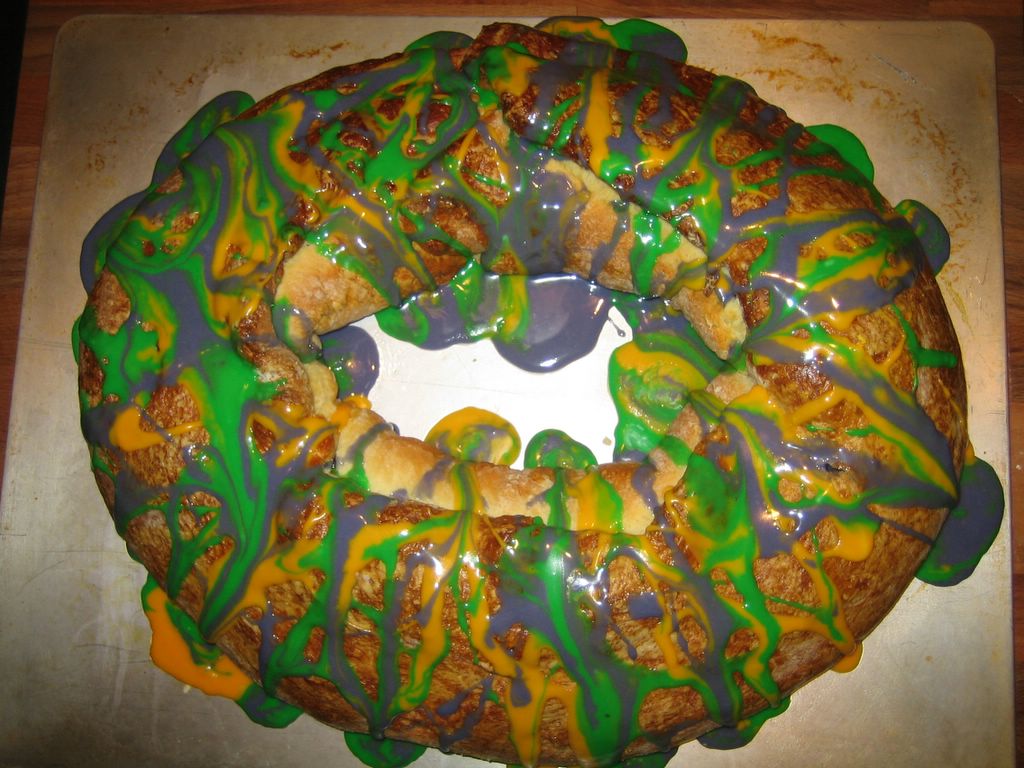
Just in case you northerners forgot: It's Mardi Gras weekend! So hop in your car and head south. You've still got plenty of time to catch some good parades. Here's the Times-Picayune Mardi Gras planner.
I'll post a photo if my King Cake turns out. Or you make a cake and flickr it to us.
I just discovered today that one of my new friends has a Certificate in Pastry and Baking from the Institute for Culinary Education, NYC! (and no, this is not her real job.) So perhaps I will recruit her for some special assistance in the Cake-making area.
(If you haven't spent quality time in Lowe's, that last sentence will make not sense to you. If you HAVE spent quality time in Lowe's you will laugh and laugh...)
Laissez les bon temps rouler!
I'll post a photo if my King Cake turns out. Or you make a cake and flickr it to us.
I just discovered today that one of my new friends has a Certificate in Pastry and Baking from the Institute for Culinary Education, NYC! (and no, this is not her real job.) So perhaps I will recruit her for some special assistance in the Cake-making area.
(If you haven't spent quality time in Lowe's, that last sentence will make not sense to you. If you HAVE spent quality time in Lowe's you will laugh and laugh...)
Laissez les bon temps rouler!
PALINET unveils new logo
Just saw this new brand identity PDF this morning, on the PALINET site. Congratulations to Cathy and all the staff at PALINET. I know what a long slog it can be, to develop a new brand identity, out of the pieces parts of the existing brand. It's a lot of soul-searching and gut-driven decisions, then tempered with a lot of focus-group testing!
They've done a good job at summarizing what their new logo means and why they decided to update it. Here's a quick hit for more than you could ever hope to read, on re-branding insights from brandchannel.com.
They've done a good job at summarizing what their new logo means and why they decided to update it. Here's a quick hit for more than you could ever hope to read, on re-branding insights from brandchannel.com.
Materially in Montana
George and I are in Helena, MT to give presentations to the participants of the OFFLINE conference, at the invitation of Bruce Newell, the director of the Montana Library Network, delegate to OCLC Members Council, and friend. OFFLINE is an interest group of the Montana Library Association, and began in the 80s as a venue to help librarians become better Dialog searchers. We've come a long way since then, haven't we?
It's actually rare for us professional windbags to be at the same event so I will have the pleasure, this afternoon, of being able to see George's presentation "Living in an immaterial world" which is a great mashup title, invoking George Harrison, Madonna and The Police.
I will be talking about a toolbox of stuff....blogging, podcasting, mashups. I am even going to mention Web 2.0 and Library 2.0 which we have devoted few pixels to here at IAG. For my part, that's because I am loath to talk about something I really hadn't got my head around yet. But, I am going to keep it very simple as this represents my level of understanding at the moment. Like this....
Web 1.0: taking traditional media and making it web accessible. Static. Broadcasting. Often the same "look and feel" as the non-digital version. "Owners" are the designers, presenters and deliverers. Same for Library 1.0.
Web 2.0: Web presence becomes a participatory space and is added to, enhanced and changed by participants, not just owners, in a decentralized structure. Same for Library 2.0.
My example of the latter will be LibraryThing which is a very, very interesting phenomenon. Created by Tim Spaulding, (not a librarian), LibraryThing is a product, a service, a social network, a blog, a catalog and a cataloging tool with hundreds of participants. Tim has a quote on the home page from an article by the Christian Science Monitor:
"LibraryThing appears poised to turn the cataloging of books into a form of communal recreation."
For all the talking and writing about Lib2.0 in Libraryland, I don't think there's really been much said about the "owners" not being the drivers of change. If Lib2.0 unfolds as Web2.0 is, I suspect we may not have much control over what happens to our Lib1.0 services. LibraryThing is a good example of a shift in control. Make sure your seatbelts are safely fastened. It's going to be an interesting ride.
It's actually rare for us professional windbags to be at the same event so I will have the pleasure, this afternoon, of being able to see George's presentation "Living in an immaterial world" which is a great mashup title, invoking George Harrison, Madonna and The Police.
I will be talking about a toolbox of stuff....blogging, podcasting, mashups. I am even going to mention Web 2.0 and Library 2.0 which we have devoted few pixels to here at IAG. For my part, that's because I am loath to talk about something I really hadn't got my head around yet. But, I am going to keep it very simple as this represents my level of understanding at the moment. Like this....
Web 1.0: taking traditional media and making it web accessible. Static. Broadcasting. Often the same "look and feel" as the non-digital version. "Owners" are the designers, presenters and deliverers. Same for Library 1.0.
Web 2.0: Web presence becomes a participatory space and is added to, enhanced and changed by participants, not just owners, in a decentralized structure. Same for Library 2.0.
My example of the latter will be LibraryThing which is a very, very interesting phenomenon. Created by Tim Spaulding, (not a librarian), LibraryThing is a product, a service, a social network, a blog, a catalog and a cataloging tool with hundreds of participants. Tim has a quote on the home page from an article by the Christian Science Monitor:
"LibraryThing appears poised to turn the cataloging of books into a form of communal recreation."
For all the talking and writing about Lib2.0 in Libraryland, I don't think there's really been much said about the "owners" not being the drivers of change. If Lib2.0 unfolds as Web2.0 is, I suspect we may not have much control over what happens to our Lib1.0 services. LibraryThing is a good example of a shift in control. Make sure your seatbelts are safely fastened. It's going to be an interesting ride.
Wednesday, February 22, 2006
Have a laugh
"The Library Llama Sings About You." Dumb. Hysterical. And they mention "It's All Good." Who could ask for anything more?
Alice and I got into a discussion about whether the Library Llama was a take off on the Library Administration and Management Association (better known as LAMA) at ALA. I thought that was too big a stretch, but I did think of the old Ogden Nash poem:
A one-l lama
He's a priest.
A two-l llama
He's a beast.
And I will bet
A silk pajama
That there is
No three-l llama.
Alice and I got into a discussion about whether the Library Llama was a take off on the Library Administration and Management Association (better known as LAMA) at ALA. I thought that was too big a stretch, but I did think of the old Ogden Nash poem:
A one-l lama
He's a priest.
A two-l llama
He's a beast.
And I will bet
A silk pajama
That there is
No three-l llama.
Tuesday, February 21, 2006
ISBN goes to 13!
ISBN numbers will grow to 13 digits.
Had a wonderful long catch-up post, and then my Firefox browser bit the dust. So I will reconstruct...later...lots of fun stuff going on with me!
Had a wonderful long catch-up post, and then my Firefox browser bit the dust. So I will reconstruct...later...lots of fun stuff going on with me!
Change at the Human Level
For a couple of years now, I've been on the road talking about how libraries need to change. Based on the environmental scan (and more recently the Perceptions report), my talks have focused on changing the direction of library public services, about becoming more user-centric, about implementing aspects of self-service, disaggregation, and collaboration.
Not long ago, I spent some time with a very good friend who is in middle to upper management in a library. Both she and the library shall remain nameless. Her library is in the process of implementing a lot of these changes, and, basically, she blamed me and OCLC for destroying her life.
She was kidding.
I think.
Her library is studying and has proposed a variety of changes. They are thinking of taking out a whole level of middle management (which could cause her a demotion, or perhaps even cost her her job). They are considering de-emphasizing reference, moving to a readers' advisor/roving support model that we have heard described in several places, deprofessionalizing the positions along the way. They are centralizing materials selection, and administration wants staff to be trained and willing to work at multiple locations rather than the single location for which they were hired.
The kicker is that my friend supports every one of these changes. But she is seen as being part of the ancien régime of the library, and, as a result, not part of the modern, agile leadership that the administration seeks. She faults herself for being more deliberative than assertive in the system. She feels that her skills in teaching and building consensus are out of the current mainstream in her system. And she's not sure that she's ready to make a major change in her approach to the world at the age of 54.
The fact is that changing an institution, whether it's a large, complex academic library or a suburban public library or a one room school media center is never easy, and it's frequently very painful. People are invested in the status quo, and we as librarians take a great deal of pride in what we do. As the world around us has changed, we sincerely believe that the processes and services we provide hold enduring value.
I don't know what to tell my friend. She's a smart, thoughtful, dedicated professional who feels the way the monks in a scriptorium must have felt the first time they saw a Gutenberg printing press.
If you are in a situation like this, from whatever position, I would love to know more about your experience. Maybe you can help me help my friend. Maybe we can come up with some new strategies for dealing with change. Because the only thing of which we can be very sure is that the change is going to happen either with us or to us.
Not long ago, I spent some time with a very good friend who is in middle to upper management in a library. Both she and the library shall remain nameless. Her library is in the process of implementing a lot of these changes, and, basically, she blamed me and OCLC for destroying her life.
She was kidding.
I think.
Her library is studying and has proposed a variety of changes. They are thinking of taking out a whole level of middle management (which could cause her a demotion, or perhaps even cost her her job). They are considering de-emphasizing reference, moving to a readers' advisor/roving support model that we have heard described in several places, deprofessionalizing the positions along the way. They are centralizing materials selection, and administration wants staff to be trained and willing to work at multiple locations rather than the single location for which they were hired.
The kicker is that my friend supports every one of these changes. But she is seen as being part of the ancien régime of the library, and, as a result, not part of the modern, agile leadership that the administration seeks. She faults herself for being more deliberative than assertive in the system. She feels that her skills in teaching and building consensus are out of the current mainstream in her system. And she's not sure that she's ready to make a major change in her approach to the world at the age of 54.
The fact is that changing an institution, whether it's a large, complex academic library or a suburban public library or a one room school media center is never easy, and it's frequently very painful. People are invested in the status quo, and we as librarians take a great deal of pride in what we do. As the world around us has changed, we sincerely believe that the processes and services we provide hold enduring value.
I don't know what to tell my friend. She's a smart, thoughtful, dedicated professional who feels the way the monks in a scriptorium must have felt the first time they saw a Gutenberg printing press.
If you are in a situation like this, from whatever position, I would love to know more about your experience. Maybe you can help me help my friend. Maybe we can come up with some new strategies for dealing with change. Because the only thing of which we can be very sure is that the change is going to happen either with us or to us.
Public Broadcasting 2.0
"Understanding and adapting to this on-demand world will help us serve both old and new audiences better. Public broadcasting will have to reinvent its business and operational practices and learn to sustain its mission in a new way, and do it quickly."
"Through the looking glass to Public Broadcasting 2.0"
Some familiar issues raised in Current by Dennis L. Haarsager.
I love Mr Haarsager's blog tagline: "Somebody has to do something, and it's just incredibly pathetic that it has to be us." --Jerry Garcia
"Through the looking glass to Public Broadcasting 2.0"
Some familiar issues raised in Current by Dennis L. Haarsager.
I love Mr Haarsager's blog tagline: "Somebody has to do something, and it's just incredibly pathetic that it has to be us." --Jerry Garcia
Reading Tea Leaves
Based on conversations I've participated in, blog posts I've read, questions I've answered after presentations, worst fears that librarians have shared with me, many in our community fret about Google. They fret that Google will supplant libraries, librarians, reference, cataloging, the buildings...
As I've said often, I doubt it. Google has already changed all of the above (except maybe the buildings), and will continue to, but it's pretty fruitless to fret about change, and about "the future." I'm not a professional futurist, but during two day-long courses (as a prelude to the World Future Society conference) on the study of the future and on using foresight tools, I learned one of the fundamental tenets of "futuring" is that the future is actually plural. There are futures.
In my notes from one of the sessions, either Peter or Wendy said "When we learned history, we learned one past, so the tendency is to think there's one future." Not so...possible futures emerge from the trends, innovations, evolutions, and revolutions that are change. Futurists develop scenarios for a range of plausible futures that help decision makers prepare for a wider range of contingencies than planning for "the future" does.
Planning for "the future" can lead to big problems. If one future is decided upon, then all energy and activity and planning is focused on that scenario. What if it isn't right? In the 70s, the founder of Digital Equipment Corporation, said, "There is no reason for any individual to have a computer in their home."
Here's what I fret about. I fret that too many people in Libraryland are indulging in predicting the future instead of forecasting futures. And so I direct your attention to a recent article in Business2.0 called "Imagining the Google Future." It's an excellent example of creating scenarios, and the people asked to assist with this scenario-building included the futurist Ray Kurzweil (yes, that Kurzweil).
The four scenarios are:
- Google is the Media
- Google is the Internet
- Google is Dead
- Google is God
Each of these scenarios is described, supported by various publications and events, and given a timeline. That's how scenarios work. They're not (completely) wild-eyed imaginings and their roots are in current events and trends.
Right now, there's a good deal of talk and writing about Web 2.0 and Library 2.0 and what these presage for the future of Libraryland, if anything at all (depending if you're pro or con). It would be helpful and healthy, seems to me, to have some scenarios built around these memes that would help people understand the contingencies and contribute to the development of a preferred future.
Imagine the possible. Envision the preferred. Plan and implement. Forget the "Chicken Little" behaviour. The sky falling is only one scenario among many and I doubt it's anyone's preferred future.
OK, stepping off the soapbox....
As I've said often, I doubt it. Google has already changed all of the above (except maybe the buildings), and will continue to, but it's pretty fruitless to fret about change, and about "the future." I'm not a professional futurist, but during two day-long courses (as a prelude to the World Future Society conference) on the study of the future and on using foresight tools, I learned one of the fundamental tenets of "futuring" is that the future is actually plural. There are futures.
In my notes from one of the sessions, either Peter or Wendy said "When we learned history, we learned one past, so the tendency is to think there's one future." Not so...possible futures emerge from the trends, innovations, evolutions, and revolutions that are change. Futurists develop scenarios for a range of plausible futures that help decision makers prepare for a wider range of contingencies than planning for "the future" does.
Planning for "the future" can lead to big problems. If one future is decided upon, then all energy and activity and planning is focused on that scenario. What if it isn't right? In the 70s, the founder of Digital Equipment Corporation, said, "There is no reason for any individual to have a computer in their home."
Here's what I fret about. I fret that too many people in Libraryland are indulging in predicting the future instead of forecasting futures. And so I direct your attention to a recent article in Business2.0 called "Imagining the Google Future." It's an excellent example of creating scenarios, and the people asked to assist with this scenario-building included the futurist Ray Kurzweil (yes, that Kurzweil).
The four scenarios are:
- Google is the Media
- Google is the Internet
- Google is Dead
- Google is God
Each of these scenarios is described, supported by various publications and events, and given a timeline. That's how scenarios work. They're not (completely) wild-eyed imaginings and their roots are in current events and trends.
Right now, there's a good deal of talk and writing about Web 2.0 and Library 2.0 and what these presage for the future of Libraryland, if anything at all (depending if you're pro or con). It would be helpful and healthy, seems to me, to have some scenarios built around these memes that would help people understand the contingencies and contribute to the development of a preferred future.
Imagine the possible. Envision the preferred. Plan and implement. Forget the "Chicken Little" behaviour. The sky falling is only one scenario among many and I doubt it's anyone's preferred future.
OK, stepping off the soapbox....
Friday, February 17, 2006
Beyond the Yellow Brick Road
“Oh I've finally decided my future lies,
Beyond the yellow brick road.” (“Goodbye Yellow Brick Road”* – Elton John)
You’ve seen several posts recently on IAG about the OCLC Members Council meeting earlier this week. It’s a thrice-yearly gathering of the clan – delegates from OCLC member libraries around the globe, select observers from various library groups, OCLC and OCLC PICA staff, staff from OCLC’s regional service providers and special guests. The effort for all concerned to prepare for, travel to the meeting, and engage in the business of guiding the work of the world’s largest cooperative of libraries, is by no means small, but the reward for OCLC, our members, and – we hope – the delegates is great. Much is shared, discussed and debated, and direction is offered to OCLC. Professional connections are made or renewed. Information and ideas flow. We get a chance to ask/answer questions, listen, and, as needed, adjust course. As gatherings of librarians go – and I’ve been to my share – I think OCLC Members Council meetings boast one of the better meeting-to-action ratios in library land. Indeed, a few items from this week’s meeting are already on my to-do list.
But I was not writing this post to wax poetic on Members Council – as pleasant a task as that may be – but rather as lead-in to my real topic, the future. The occasion of each Members Council meeting is also an opportunity for RONDAC (Regional OCLC Network Directors Advisory Committee) to meet. At this meeting RONDAC requested a briefing on emerging technology/trends from OCLC Research, and yours truly was very pleased to be selected as the messenger.
So what did I prognosticate? Well – by way of metaphor – rather than continuing to walk the mostly comfortable path-of-incremental-change yellow brick road that once trailed before us, my own impression is that the future will look a bit more like a painting by Roger Dean (samples) – simultaneously familiar yet undeniably fantastic, and, definitely beyond the comfort of our 20th century yellow brick road.
As the full presentation I gave to RONDAC is a bit long to blog in a single post, here’s a mildly modified, condensed version (with thanks to several colleagues who offered counsel as I worked through the original presentation):
The backstage – global, high tech, high touch:
RONDAC patiently listened to my presentation and improved the overall session content greatly with thoughtful interjections, smart discussion, and insightful-but-hard-to-answer questions. My thanks to them, and to my colleagues, Doug Potts, and Suzanne Lauer, for arranging for my participation in the meeting.
So over to you, gentle IAG readers – are my pronouncements on-track/off-track? Did I miss any big ticket items? And more importantly, did George avoid my presentation because he really had more important business to attend to, or just so I’d have to blog a quick-read version for him later?
**"Refactoring is the process of changing a software system in such a way that it does not alter the external behavior of the code yet improves its internal structure." – Martin Fowler in Refactoring : improving the design of existing code (Reading, MA : Addison-Wesley, 1999.) (as quoted here)
(*“Goodbye Yellow Brick Road” - Music by Elton John; Lyrics by Bernie Taupin. The song initially appeared on Elton John’s Goodbye Yellow Brick Road album)
Beyond the yellow brick road.” (“Goodbye Yellow Brick Road”* – Elton John)
You’ve seen several posts recently on IAG about the OCLC Members Council meeting earlier this week. It’s a thrice-yearly gathering of the clan – delegates from OCLC member libraries around the globe, select observers from various library groups, OCLC and OCLC PICA staff, staff from OCLC’s regional service providers and special guests. The effort for all concerned to prepare for, travel to the meeting, and engage in the business of guiding the work of the world’s largest cooperative of libraries, is by no means small, but the reward for OCLC, our members, and – we hope – the delegates is great. Much is shared, discussed and debated, and direction is offered to OCLC. Professional connections are made or renewed. Information and ideas flow. We get a chance to ask/answer questions, listen, and, as needed, adjust course. As gatherings of librarians go – and I’ve been to my share – I think OCLC Members Council meetings boast one of the better meeting-to-action ratios in library land. Indeed, a few items from this week’s meeting are already on my to-do list.
But I was not writing this post to wax poetic on Members Council – as pleasant a task as that may be – but rather as lead-in to my real topic, the future. The occasion of each Members Council meeting is also an opportunity for RONDAC (Regional OCLC Network Directors Advisory Committee) to meet. At this meeting RONDAC requested a briefing on emerging technology/trends from OCLC Research, and yours truly was very pleased to be selected as the messenger.
So what did I prognosticate? Well – by way of metaphor – rather than continuing to walk the mostly comfortable path-of-incremental-change yellow brick road that once trailed before us, my own impression is that the future will look a bit more like a painting by Roger Dean (samples) – simultaneously familiar yet undeniably fantastic, and, definitely beyond the comfort of our 20th century yellow brick road.
As the full presentation I gave to RONDAC is a bit long to blog in a single post, here’s a mildly modified, condensed version (with thanks to several colleagues who offered counsel as I worked through the original presentation):
The backstage – global, high tech, high touch:
- Everyone lives, works and learns in the Global Village (or at least its suburbs)
- An everywhere, immersive network (web, cellular, GPS) connects all
- Content is increasingly digital, and massive content increasingly portable
- Users are embracing self-service, personalization, social networking/contribution and micro services/content (e.g., ringtones)
- Modular (micro-services, remixing, data and functions from multiple sources)
- Layered (loosely-coupled systems)
- Interoperable (low-friction, high reuse) – [Note: lightweight protocols gaining favor (e.g., SRW/SRU, microformats)]
- Machine-oriented services (web services)
- Open Source/Content intellectual property is being built and leveraged widely (e.g., Apache software, Creative Commons content)
- Release here, remix there: For example, Mash-ups deliver remixed functions & data from multiple providers in a seamless, integrated experience (with tools like Greasemonkey, etc. making lightweight mixing simple, easy, user-driven) [Note: Lorcan references a Science Library Pad post as illustration of this idea]
- “Acquire-Catalog-Circulate” fades into new “Integrate-Manage-Analyze” model [thanks to Robin Murray of OCLC PICA for this excellent conceptual frame – see Alane’s post and hear Robin’s remarks in a podcast for a fuller picture]
- Surfacing seamlessly – library content and services will/must show up in non-library spaces (e.g., the web, office applications, learning management systems) to satisfy point-of-need demands of users
- New models (e.g., FRBR) to build on, new user experiences to develop and deliver – lighter, easier, more relevant modes of delivering D2D (discovery to delivery) will appear
- Non-library spaces will inform library spaces and vice-versa far more in the future than they did in the past: As illustration, witness the degree to which bookseller, publisher, library catalogs are starting to show feature & content convergence (e.g., enriched content (dust covers, TOCs) is increasingly a common feature, commonly expressed in form and content)
RONDAC patiently listened to my presentation and improved the overall session content greatly with thoughtful interjections, smart discussion, and insightful-but-hard-to-answer questions. My thanks to them, and to my colleagues, Doug Potts, and Suzanne Lauer, for arranging for my participation in the meeting.
So over to you, gentle IAG readers – are my pronouncements on-track/off-track? Did I miss any big ticket items? And more importantly, did George avoid my presentation because he really had more important business to attend to, or just so I’d have to blog a quick-read version for him later?
**"Refactoring is the process of changing a software system in such a way that it does not alter the external behavior of the code yet improves its internal structure." – Martin Fowler in Refactoring : improving the design of existing code (Reading, MA : Addison-Wesley, 1999.) (as quoted here)
(*“Goodbye Yellow Brick Road” - Music by Elton John; Lyrics by Bernie Taupin. The song initially appeared on Elton John’s Goodbye Yellow Brick Road album)
Wednesday, February 15, 2006
More from Members Council
Another thing I wanted to note from Monday's Members Council sessions: I attended an afternoon meeting of the discussion group for public and school libraries. George was there too.
The convenor, Donna Nicely, the Director of Nashville Public Library had asked Cathy De Rosa to speak briefly about the Perceptions report which she did. Donna then asked what did people think about the data and the implications of the data. And, as so many minutes of meetings record, "a lively discussion followed".
But a lively discussion happening at these dicussion group meetings (there are also groups for academic libraries, government and special libraries and consortia) is not unusual--in fact, it's completely usual. What struck me about this particular meeting was the stories. And don't we all love stories?
In response to Donna's question--what do we do with the information given to us in the Perceptions report?--many of the meetings attendees told a story about what things were being done in their libraries already to meet the needs of the people in their communities. What struck me was that these librarians were describing changes that did address the perceptions of libraries as expressed by the respondents to the OCLC report. Already. Now. Big changes.
And even better was that these changes sounded like there were positive ramifications both internally for the library organization, and most definitely externally, for people using the library.
One of the most inspiring stories was recounted by George Bishop, Director of the Information Center of the Ovid-Elsie Schools in Michigan. Now, George and Lynn McKinney (Head Librarian, Billings Senior High School Library, Montana) are the only school librarians who are current delegates to Members Council (I think they may be our first, as well) and we treasure them because OCLC needs to hear from K-12 librarians.
George's library has gone from an annual budget of $4000 to one over $100,000 in a region that is not wealthy by any stretch, and his library is well used by kids, even on Fridays after school is finished. So, his library is valued and the proof is in his funding and in use.
Well, the OCLC staff attending (lurking, sort of) the meeting loved these stories--positive, upbeat, successful--and we want to share them. So, I think we'll see a space created on the OCLC Community discussion pages here for librarians to share good stories about changes they're making at their libraries. But I'm going to email the people who were in that meeting and ask them to send me stories as well, and I am going to post them here. Because we especially love happy stories.
The convenor, Donna Nicely, the Director of Nashville Public Library had asked Cathy De Rosa to speak briefly about the Perceptions report which she did. Donna then asked what did people think about the data and the implications of the data. And, as so many minutes of meetings record, "a lively discussion followed".
But a lively discussion happening at these dicussion group meetings (there are also groups for academic libraries, government and special libraries and consortia) is not unusual--in fact, it's completely usual. What struck me about this particular meeting was the stories. And don't we all love stories?
In response to Donna's question--what do we do with the information given to us in the Perceptions report?--many of the meetings attendees told a story about what things were being done in their libraries already to meet the needs of the people in their communities. What struck me was that these librarians were describing changes that did address the perceptions of libraries as expressed by the respondents to the OCLC report. Already. Now. Big changes.
And even better was that these changes sounded like there were positive ramifications both internally for the library organization, and most definitely externally, for people using the library.
One of the most inspiring stories was recounted by George Bishop, Director of the Information Center of the Ovid-Elsie Schools in Michigan. Now, George and Lynn McKinney (Head Librarian, Billings Senior High School Library, Montana) are the only school librarians who are current delegates to Members Council (I think they may be our first, as well) and we treasure them because OCLC needs to hear from K-12 librarians.
George's library has gone from an annual budget of $4000 to one over $100,000 in a region that is not wealthy by any stretch, and his library is well used by kids, even on Fridays after school is finished. So, his library is valued and the proof is in his funding and in use.
Well, the OCLC staff attending (lurking, sort of) the meeting loved these stories--positive, upbeat, successful--and we want to share them. So, I think we'll see a space created on the OCLC Community discussion pages here for librarians to share good stories about changes they're making at their libraries. But I'm going to email the people who were in that meeting and ask them to send me stories as well, and I am going to post them here. Because we especially love happy stories.
Tuesday, February 14, 2006
Valentine's Day gift for new library blog readers
A good day for all, I hope. As we wrap up the work day here on the U.S. East Coast and everyone heads for dinner, dancing, wine and roses (or at least a good movie), I thought I'd share the Free Range Librarian's library blogroll.
Here at IAG, we've consciously chosen NOT to blogroll--but it is nice, especially if you're a library staff person new to the blogsphere, to know where you might start looking for RSS feeds!
Here at IAG, we've consciously chosen NOT to blogroll--but it is nice, especially if you're a library staff person new to the blogsphere, to know where you might start looking for RSS feeds!
Twiddly Bits
Light blogging here...the Dublin-based IAGers have been attending the OCLC Members' Council. I think we all might have things we want to post about based on the meeting.
Yesterday morning, Robin Murray gave a good presentation on library systems. Robin is the CEO of Fretwell-Downing Informatics which was acquired by OCLC PICA recently. He provided a written version of his presentation that would be of interest to many, I think, so I'll see if we can provide a digital version. I could reproduce the text but he had some informative graphics that I can't although these will eventually be available on the OCLC web site.
The talk was titled "Library Systems: Synthesize, Specialize, Moblilize" and the essential point was that the business and service model of libraries is evolving from acquiring, cataloging and circulating physical collections to synthesizing, specializing and mobilizing web-based services.
Here's some points from his conclusion:
"Library systems have traditionally been synonymous with the ILS. The classical ILS is increasingly managed and focused on a legacy business process. While the ILS will remain a critical component in the management of a library service, its functions will gradually become peripheral to the core of library service.
While the 'new library model' is an evolution of the traditional model, the IT systems required to support it are clearly not an evolutionary development of the ILS. At some point there will be a critical jump in perception as to what is the core system supporting the library.
[...]
-Libraries need to keep aware of new services that can be synthesized into the offering.
-Libraries need to be ready to outsource internal services to network service providers who can realize enormous economies of scale.
Network service providers have to be looking for opportunities to provide new 'synthesizable services.'
- Library systems providers have to ensure 'plug-and-play compatibility with network services.
Above all, to maximize the value of our library services the industry needs to be far more externally focused."
And my favorite quote from Robin's talk was in his comment on something Pat Sommers, the CEO of SirsiDynix, said in a presentation--about the ILS-- to delegates on Sunday evening. Pat was responding, if I recall correctly, to a question from the floor about why ILS vendors don't innovate more quickly. Pat remarked that his company spends $10 million a year tweaking their systems to respond to requests from customers, and that left scant time and resources to make big changes. Robin rephrased this to describe all that activity as "building twiddly bits."
I was probably not the only OCLC person in the audience that thought we, OCLC, also spend a lot of time and resources building twiddly bits. Enhancements to this product and that service. Interface design changes. And so on. It is a Scylla and Charybdis that any product-and-service providing company must navigate between,
Yesterday morning, Robin Murray gave a good presentation on library systems. Robin is the CEO of Fretwell-Downing Informatics which was acquired by OCLC PICA recently. He provided a written version of his presentation that would be of interest to many, I think, so I'll see if we can provide a digital version. I could reproduce the text but he had some informative graphics that I can't although these will eventually be available on the OCLC web site.
The talk was titled "Library Systems: Synthesize, Specialize, Moblilize" and the essential point was that the business and service model of libraries is evolving from acquiring, cataloging and circulating physical collections to synthesizing, specializing and mobilizing web-based services.
Here's some points from his conclusion:
"Library systems have traditionally been synonymous with the ILS. The classical ILS is increasingly managed and focused on a legacy business process. While the ILS will remain a critical component in the management of a library service, its functions will gradually become peripheral to the core of library service.
While the 'new library model' is an evolution of the traditional model, the IT systems required to support it are clearly not an evolutionary development of the ILS. At some point there will be a critical jump in perception as to what is the core system supporting the library.
[...]
-Libraries need to keep aware of new services that can be synthesized into the offering.
-Libraries need to be ready to outsource internal services to network service providers who can realize enormous economies of scale.
Network service providers have to be looking for opportunities to provide new 'synthesizable services.'
- Library systems providers have to ensure 'plug-and-play compatibility with network services.
Above all, to maximize the value of our library services the industry needs to be far more externally focused."
And my favorite quote from Robin's talk was in his comment on something Pat Sommers, the CEO of SirsiDynix, said in a presentation--about the ILS-- to delegates on Sunday evening. Pat was responding, if I recall correctly, to a question from the floor about why ILS vendors don't innovate more quickly. Pat remarked that his company spends $10 million a year tweaking their systems to respond to requests from customers, and that left scant time and resources to make big changes. Robin rephrased this to describe all that activity as "building twiddly bits."
I was probably not the only OCLC person in the audience that thought we, OCLC, also spend a lot of time and resources building twiddly bits. Enhancements to this product and that service. Interface design changes. And so on. It is a Scylla and Charybdis that any product-and-service providing company must navigate between,
Wednesday, February 08, 2006
Digital Library Environment - Ten Years On
A must-read article by our colleague and co-OCLC-blogger Lorcan Dempsey, published in the tenth anniversary edition of Ariadne. It's a thorough and elegant overview of the not so elegant toilings of (mostly UK) efforts to move library functions onto the Web. Modestly, he doesn't mention this article on his own blog.
It's a long article and I have in the past, lightly (because I never could write in that academic way?), characterized Lorcan's writing as "prolix" but that is unfair....it just demands attention. If you've heard any OCLC people speaking in the last few years you will recognize some themes, albeit expressed a wee bit more academically:
It's a long article and I have in the past, lightly (because I never could write in that academic way?), characterized Lorcan's writing as "prolix" but that is unfair....it just demands attention. If you've heard any OCLC people speaking in the last few years you will recognize some themes, albeit expressed a wee bit more academically:
- System-wide, there was an ambition to achieve systemic change in how information services were provided as part of the wider provision of research and learning support
- We are moving to a flatter network world, where the gap between the Web and business applications is narrowing.
- Many large Internet presences involve the user in the creation of the service or in their own experience of information resources are flowing onto the network, free at the point of use or available for a small fee.
- We do not release the investment in structured data in engaging and interesting user experiences.
I've just picked a few "sound bites"... go read the article. Think.
Thank you and happy birthday, Ariadne.
Tuesday, February 07, 2006
Google and the Suburbs
The London Review of Books has an interesting "review" of two books about Google. I put "" around review because I can find barely any mention of the books in the interesting article called "Google Id" by John Lancaster. The article is more a review of Google and its founders, Larry Page and Sergei Brin and a musing on the significance of a company "wired straight into the global id."
I was struck by the last paragraph, hence the title:
"The best historical analogy for where Google is today probably comes from the time when the railroads were being built. Everyone knew that trains and railways would change the world, but no one predicted the invention of suburbs. Google, and the increased flow of information on which it rides and from which it benefits, is the railway. I don’t think we’ve yet seen the first suburbs."
I was struck by the last paragraph, hence the title:
"The best historical analogy for where Google is today probably comes from the time when the railroads were being built. Everyone knew that trains and railways would change the world, but no one predicted the invention of suburbs. Google, and the increased flow of information on which it rides and from which it benefits, is the railway. I don’t think we’ve yet seen the first suburbs."
Digital Rivers, Paper Lakes
“All this time,
The river flowed,
Endlessly,
To the sea.” (“All This Time” – Sting)
We’re delighted to have guests in Dublin, all the more so when the guests aren’t so much guests as us we haven’t properly met yet – in this case new faces in the OCLC family: Eric Hellman, and several other new colleagues from Openly Informatics -- now OCLC Openly Informatics -- from Bloomfield, New Jersey. Openly’s substantial collection(s) of data about e-serials, specialized software to support linking, extensive OpenURL knowledge/experience, and a very talented staff advance OCLC a significant step forward towards OCLC’s objective to be as good at helping libraries provide services for their electronic resources as we’ve been at helping libraries leverage their physical holdings. That said, it’s not so easy to explain what Openly does. When I mentioned the visit to some non-librarian relatives, I put aside the jargon and simply described Openly as a company that helps make getting to e-resources through your library seamless.
Yesterday, Eric Hellman presented an overview of Openly’s various products and services which include a range of linking/identifier-related offerings (including link calculation engines, link resolvers, and more) for OCLC staff here in Dublin. I found Eric’s metaphor of a digital river (e-content -- esp. e-serials -- which constantly shift and flow and aren’t necessarily physically hosted by a library) versus a paper lake (physical resources are typically held in library collections and display a different dynamic) quite useful, and it led me to reflect on some of my nearly-forgotten undergraduate ecology/geography coursework – perhaps some lake and river ecological concepts could be used to build on the image? Hmm...
Long and short of it: Openly has very valuable expertise and data to help libraries do what they do best, help users find information. And the value of Openly to the OCLC cooperative was made especially clear when Q&A in the overview session brought out the excellence of fit of Openly with OCLC’s e-serials pilot work.
Today, at our invitation, the Openly folks kindly joined several of us in OCLC Research, and gave us a chance to show off several projects including WikiD and xISBN. The conversation went very well, but the time quickly ran out, and we have a lot more to share with them (and vice-versa). This, no doubt, will be the first of what promises to be many conversations about matters of mutual interest.
So a hearty welcome to our new colleagues at Openly, and fair notice – we promise to overbook you with meetings on every trip. It’s an honor we accord all our non-Dublin-based staff. But as recompense we also promise to introduce you to the finer dining establishments in historic Dublin, perched on the river bank, where the river flows endlessly to the sea.
The river flowed,
Endlessly,
To the sea.” (“All This Time” – Sting)
We’re delighted to have guests in Dublin, all the more so when the guests aren’t so much guests as us we haven’t properly met yet – in this case new faces in the OCLC family: Eric Hellman, and several other new colleagues from Openly Informatics -- now OCLC Openly Informatics -- from Bloomfield, New Jersey. Openly’s substantial collection(s) of data about e-serials, specialized software to support linking, extensive OpenURL knowledge/experience, and a very talented staff advance OCLC a significant step forward towards OCLC’s objective to be as good at helping libraries provide services for their electronic resources as we’ve been at helping libraries leverage their physical holdings. That said, it’s not so easy to explain what Openly does. When I mentioned the visit to some non-librarian relatives, I put aside the jargon and simply described Openly as a company that helps make getting to e-resources through your library seamless.
Yesterday, Eric Hellman presented an overview of Openly’s various products and services which include a range of linking/identifier-related offerings (including link calculation engines, link resolvers, and more) for OCLC staff here in Dublin. I found Eric’s metaphor of a digital river (e-content -- esp. e-serials -- which constantly shift and flow and aren’t necessarily physically hosted by a library) versus a paper lake (physical resources are typically held in library collections and display a different dynamic) quite useful, and it led me to reflect on some of my nearly-forgotten undergraduate ecology/geography coursework – perhaps some lake and river ecological concepts could be used to build on the image? Hmm...
Long and short of it: Openly has very valuable expertise and data to help libraries do what they do best, help users find information. And the value of Openly to the OCLC cooperative was made especially clear when Q&A in the overview session brought out the excellence of fit of Openly with OCLC’s e-serials pilot work.
Today, at our invitation, the Openly folks kindly joined several of us in OCLC Research, and gave us a chance to show off several projects including WikiD and xISBN. The conversation went very well, but the time quickly ran out, and we have a lot more to share with them (and vice-versa). This, no doubt, will be the first of what promises to be many conversations about matters of mutual interest.
So a hearty welcome to our new colleagues at Openly, and fair notice – we promise to overbook you with meetings on every trip. It’s an honor we accord all our non-Dublin-based staff. But as recompense we also promise to introduce you to the finer dining establishments in historic Dublin, perched on the river bank, where the river flows endlessly to the sea.
"Death by Risk Aversion"
Today's title comes courtesy of a longish post from Creating Passionate Users blogger Kathy Sierra. Kathy's posts often have funny and enlightening pictures associated with them to go along with the thought-provoking comments, and this one is no exception. And there's some words we don't use here at IAG but I trust you'll get over the shock.
I plan on using today's graphics in presentations (with full credit to CPU) One of the graphics illustrates very well a phenomenon highlighted in our Perceptions report by this question.
Is the information you get from library sources more or less trustworthy compared to the information you can get from search engines? 69% of respondents felt libraries and search engines provide the same level of trustworthiness. Same is bad...the "Zone of Mediocrity" as Sierra calls it and suggests that risk aversion lands companies and organizations in the Zone.
(graphic from Creating Passionate Users, January 30, 2006)
That would apply to libraries. Oh, and OCLC too. But we're in august company. "Sure the big companies have it bad and may fall the hardest if they don't get a clue and a cure, but none of us is immune. You see the safe path everywhere."
And the leaf people among us will appreciate this: "In other words, the leaf node/individual contributors often think about the effect of their work on users, while the mid-level managers often think about the effect of their work on their job. And whose fault is that? All those layers of bosses. Even one risk-averse boss in the chain-of-command can do major damage to innovation, spirit, motivation, etc."
(graphic from Creating Passionate Users, January 30, 2006.)
Creating Passionate Users advice:
I plan on using today's graphics in presentations (with full credit to CPU) One of the graphics illustrates very well a phenomenon highlighted in our Perceptions report by this question.
Is the information you get from library sources more or less trustworthy compared to the information you can get from search engines? 69% of respondents felt libraries and search engines provide the same level of trustworthiness. Same is bad...the "Zone of Mediocrity" as Sierra calls it and suggests that risk aversion lands companies and organizations in the Zone.

(graphic from Creating Passionate Users, January 30, 2006)
That would apply to libraries. Oh, and OCLC too. But we're in august company. "Sure the big companies have it bad and may fall the hardest if they don't get a clue and a cure, but none of us is immune. You see the safe path everywhere."
And the leaf people among us will appreciate this: "In other words, the leaf node/individual contributors often think about the effect of their work on users, while the mid-level managers often think about the effect of their work on their job. And whose fault is that? All those layers of bosses. Even one risk-averse boss in the chain-of-command can do major damage to innovation, spirit, motivation, etc."
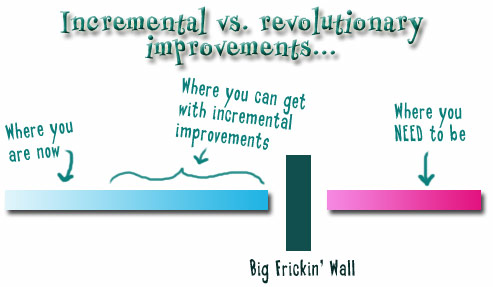
(graphic from Creating Passionate Users, January 30, 2006.)
Creating Passionate Users advice:
- Regularly review your sacred cows
- Regularly review the assumptions behind all your decisions
- Practice LETTING GO
- Push the boundaries strategically, one-by-one
- Use blogs to build support within the company
- If all else fails and the culture of risk-aversion is stealing your soul, consider going into "short-timer" mode
- Keep reminding yourself that life is short!
And perhaps the management at this woman's library needs to get a copy of CPU's post.
Sunday, February 05, 2006
Ads during the Super Bowl
Yes friends, this is a post for the Yanks among us. If you are not based in the U.S., I am hard-pressed to explain the cultural significance of the SuperBowl. Suffice it to say, I watch it mostly for the commercials.
So here I sit watching the Steelers vs. Seahawks on the Biggest Day of the television advertising year. So far (the game's not over), my top favorite commercial is the Dove campaign for real beauty.
Watch the commercial, and then tell me if this isn't a brilliant move for the beauty manufacturer. It invokes the heart, invites me as a viewer to participate, and generally makes me believe that Unilever cares about the self-esteem of girls growing up today.
My second favorite is probably the first ESPN mobile Sportsheaven, (See the commercial under the "unveiled" section) where it shows a regular guy walking down the street, watching his mobile phone while all these athletes do their thing around him.
Okay I did like herestobeer.com, too.
Honerable mention:
The Budweiser commercial "Clydesdale American Dream" where the little horse is pulling the Budweiser carriage, and then the camera shows the older horses pushing it from the back. Somewhere I think I read that Budweiser mandates that one of their Super Bowl commercials must always be a sentimental clip with horses. This one worked for me...
The Hummer3 commercial was clever--a little slow to develop to the punchline--but a unique take nonetheless.
Did anyone else see the game? Any other noteworthy ads?
I WAS sitting here wishing there was a "Support Your Library" commercial being queued up...even though I know that doing a SuperBowl ad is the quickest way to waste marketing money!
So here I sit watching the Steelers vs. Seahawks on the Biggest Day of the television advertising year. So far (the game's not over), my top favorite commercial is the Dove campaign for real beauty.
Watch the commercial, and then tell me if this isn't a brilliant move for the beauty manufacturer. It invokes the heart, invites me as a viewer to participate, and generally makes me believe that Unilever cares about the self-esteem of girls growing up today.
My second favorite is probably the first ESPN mobile Sportsheaven, (See the commercial under the "unveiled" section) where it shows a regular guy walking down the street, watching his mobile phone while all these athletes do their thing around him.
Okay I did like herestobeer.com, too.
Honerable mention:
The Budweiser commercial "Clydesdale American Dream" where the little horse is pulling the Budweiser carriage, and then the camera shows the older horses pushing it from the back. Somewhere I think I read that Budweiser mandates that one of their Super Bowl commercials must always be a sentimental clip with horses. This one worked for me...
The Hummer3 commercial was clever--a little slow to develop to the punchline--but a unique take nonetheless.
Did anyone else see the game? Any other noteworthy ads?
I WAS sitting here wishing there was a "Support Your Library" commercial being queued up...even though I know that doing a SuperBowl ad is the quickest way to waste marketing money!
Friday, February 03, 2006
Libraries and the Heart
"Putting the personal into what we do! I honestly believe the best libraries of the future will encourage the heart and librarians will put humanity into the library's virtual presence." The title and the quote are lifted from a recent post by Mr Tame The Web, Michael Stephens.
I thought of Micheal's comment--one of his "top ten for 2006" items--when I read a post on Liz Lawley's blog, mamamusings, in which she tells a story about what happened when she posted an old family photo on Flikr. Briefly, her grandfather had lost track many years ago of the four siblings shown with him and their parents in the photo but shortly after it went up on Flikr, a second cousin of Liz's from Brazil left a comment--and connections were made.
One of the wonderful, fabulous by-products of the technology we have at our fingertips is this web of humanity that can be built from exposing artifacts. Liz posted a personal photograph, but libraries and historical societies are treasure houses of letters, photos, building plans, fire maps, and oral histories that belonged to, were created by, used by real people who had families and who have descendents. When we digitize these treasures we are not just creating versions of these objects, we create opportunities for people to enrich their lives, to contribute to the stories they tell.
I have my own story. Some years ago, when I was working in Sales here at OCLC, I set up a small library in Montana with access to WorldCat on a trial basis. That year, the Denver Public Library had begun adding to WorldCat records for their extraordinary Western History photographic collection. Many of the records contained a link to the photo described. Many of those photos contain images of Native Americans who lived in the Little Big Horn area, now served by that library I was working with.
After a few weeks into the trial of WorldCat, I called the librarian to see how things were going. He told me there was a line-up of people at his one computer to use WorldCat, in a community that did not usually make heavy use of the library. Well, I like WorldCat myself but what was this about?
A woman in his community had come across the DPL photos and had recognized her grandmother, in a photo she had never seen. When she told others, they too found images of relatives and people the elders of the community had known. They could name these people who were unnamed by the photographer. But, there was no way to add those names to the photos then (and indeed, as there isn't in local systems or WorldCat, still) to enrich the documentary record of the community. But now there are services like Flikr that allow people--members of some library's community--to do this themselves.
But libraries need to help people by providing access to the documentary records of communities they serve, and by providing structure in the search environment to help people find pictures of ancestors, and by linking to and blending in content owned and generated by people in their communities with library-curated material.
I'll quote Michael again: "Technology and libraries in the 21st century are wedded, and this marriage is a long-lasting one. A library that recognizes how technology can improve services for its community is destined for success." And I'd add, not just improve services for the community but also enrich their lives.
I thought of Micheal's comment--one of his "top ten for 2006" items--when I read a post on Liz Lawley's blog, mamamusings, in which she tells a story about what happened when she posted an old family photo on Flikr. Briefly, her grandfather had lost track many years ago of the four siblings shown with him and their parents in the photo but shortly after it went up on Flikr, a second cousin of Liz's from Brazil left a comment--and connections were made.
One of the wonderful, fabulous by-products of the technology we have at our fingertips is this web of humanity that can be built from exposing artifacts. Liz posted a personal photograph, but libraries and historical societies are treasure houses of letters, photos, building plans, fire maps, and oral histories that belonged to, were created by, used by real people who had families and who have descendents. When we digitize these treasures we are not just creating versions of these objects, we create opportunities for people to enrich their lives, to contribute to the stories they tell.
I have my own story. Some years ago, when I was working in Sales here at OCLC, I set up a small library in Montana with access to WorldCat on a trial basis. That year, the Denver Public Library had begun adding to WorldCat records for their extraordinary Western History photographic collection. Many of the records contained a link to the photo described. Many of those photos contain images of Native Americans who lived in the Little Big Horn area, now served by that library I was working with.
After a few weeks into the trial of WorldCat, I called the librarian to see how things were going. He told me there was a line-up of people at his one computer to use WorldCat, in a community that did not usually make heavy use of the library. Well, I like WorldCat myself but what was this about?
A woman in his community had come across the DPL photos and had recognized her grandmother, in a photo she had never seen. When she told others, they too found images of relatives and people the elders of the community had known. They could name these people who were unnamed by the photographer. But, there was no way to add those names to the photos then (and indeed, as there isn't in local systems or WorldCat, still) to enrich the documentary record of the community. But now there are services like Flikr that allow people--members of some library's community--to do this themselves.
But libraries need to help people by providing access to the documentary records of communities they serve, and by providing structure in the search environment to help people find pictures of ancestors, and by linking to and blending in content owned and generated by people in their communities with library-curated material.
I'll quote Michael again: "Technology and libraries in the 21st century are wedded, and this marriage is a long-lasting one. A library that recognizes how technology can improve services for its community is destined for success." And I'd add, not just improve services for the community but also enrich their lives.
Subscribe to:
Posts (Atom)


