Helena is where I am until Wednesday. I am here to do some work with the Montana Library Network, Networking Task Force, as well as the Montana State Library Commission members. "Futuring" sort of stuff, using the Environmental Scan as a model for thinking "outside in" in terms of what library services might be like in the near future.
I am staying at Sanders B&B in the "Teddy Buckaroo" guestroom. Wilbur Fisk Sanders was Montana's first State Senator elected in 1890, and he lived in Akron, Ohio as a young adult. The house was built in 1889 and he lived here with his wife Harriet and their children. It's a large house and was considered a mansion when it was built. Many of the furnishings are original, including the big claw-footed bathtubs. Mining funded many of the mansions in Helena, but Sanders was a lawyer.
Another interesting historical connection is through Rock Ringling, one of the owners. Yes, that's a well-known last name, and Rock is a great grandson of one of the six Ringling Bothers who began their circus in the late 19th century. In 1907, Ringling Brothers purchased their biggest competitor, Barnum and Bailey Circus. The combined company Ringling Brothers Barnum and Bailey Circus is still in business, although the Ringling family is not involved anymore.
My breakfast companions were Rock, his dad Paul, Dennis, a colleague of Paul's and Allen, a boyhood friend of Rock's who'd stopped by for one of Rock's good breakfasts. Dennis and Paul are ranchers--and despite Paul being in his 80s, he still works the ranch. I like being back out west where regular workwear includes cowboy boots, big silver belt buckles and cowboy hats, because people here still ride horses as part of their workday. And I like being able to see the horizon--when I first moved to Ohio in the late 90s, I found all the trees stifling which many found downright weird, but when you've lived for a time in places where the sky is big and you can see for miles, you get used to that long view.
So there you go...not much about libraries today and a couple of historical anecdotes.
Saturday, January 29, 2005
Thursday, January 27, 2005
Real People Using Audiobooks
Make that "real person." My husband is an avid audiobooks listener. He has been borrowing at least one audiobook a week from our local library for several years. He listens to the same kind of books he reads...books that have submarines or fighter jets or bullseyes on the cover. Airport books. He listens to them while he cuts our grass. We have seven acres and perhaps 1.5 of that is grass. Way too much, I think, but he gets on his beloved Kubota tractor and zips around mowing. It's a big enough space that frequently he'll have to come inside and change CDs. He also listens to audiobooks in his car and on plane trips.
He likes reading historical fiction and non-fiction and is working his way through the audiobooks of the Master and Commander series.....do you know how many CDs make up one of these books? A lot!
A few months ago he bought himself an MP3 player and has been building a music collection (his musical tastes ended with Blood, Sweat and Tears), downloading music. But he's also downloading audiobooks which means he won't be borrowing these titles from the library...it's not that he really wants to own and pay for the content. What he does want to own is convenience. He won't have to change CDs and the titles he's looking for are always "in".
Often, when we baby boomers talk/write about digital content, somewhere is this, "you can't read an ebook in the bathtub". Sure, but you can't read a print book while you're driving a car or a tractor. Time to stop this meaningless observation and time to realize that there are many many ways to consume content. The more libraries embrace all methods of consumption equally, the more visits people like my husband will make to use the collection.
He likes reading historical fiction and non-fiction and is working his way through the audiobooks of the Master and Commander series.....do you know how many CDs make up one of these books? A lot!
A few months ago he bought himself an MP3 player and has been building a music collection (his musical tastes ended with Blood, Sweat and Tears), downloading music. But he's also downloading audiobooks which means he won't be borrowing these titles from the library...it's not that he really wants to own and pay for the content. What he does want to own is convenience. He won't have to change CDs and the titles he's looking for are always "in".
Often, when we baby boomers talk/write about digital content, somewhere is this, "you can't read an ebook in the bathtub". Sure, but you can't read a print book while you're driving a car or a tractor. Time to stop this meaningless observation and time to realize that there are many many ways to consume content. The more libraries embrace all methods of consumption equally, the more visits people like my husband will make to use the collection.
Ride This Wave!
Alice beat me in blogging about the NPR story on audio books this morning...and there's a few things I want to add. I too was disappointed that Lynn Neary didn't mention libraries and their place in the distribution channel, but the Audio Publishers Association mentioned in the story does recognize the role librarians play...they have a section of their web site for librarians. "The Audio Publishers Association (APA) is grateful to the library community for its support of the audiobook market."
And there's something interesting there for retailers that I think should be extended to libraries. This would be a great way for librarians to become more familiar with a method of content delivery that appeals to "Information Consumers."
As the NPR story reported audiobook sales are increasing at double digit rates in the US with a 14% increase in sales between 2001 and 2003. This info was based on an APA survey: "The Audio Publishers Association (APA) released the results of its sales survey today, showing significant growth in retail, wholesale and library sales. APA’s publisher members participated in the sales survey that looked at sales data from 2001- 2003, with 76% of the respondents providing data from 2002 - 2003. According to the survey, retail and wholesale sales increased 14 percent and library sales increased by 7 percent."
And the Open ebook Forum, the organization representing the ebook community recently published the top selling titles for 2004. Library Journal reported on this on January 17, and listed the top 10 titles for 2004. The full list of 30 best selling titles can be found here.
PaidContent.org also reports online subscriptions are up for newspapers: the Wall Street Journal and those in the Knight Ridder group.
And what's the message here? I suggest that it's a very clear one. People will buy digital content if it's on topics of interest to them. And people will borrow digital content if it's on topics of interest to them. I will be so bold as to predict that audiobooks will become a hugely successful way of lending popular titles, both adult and juvenile titles...way more so than ebooks and perhaps even more than print eventually.
And there's something interesting there for retailers that I think should be extended to libraries. This would be a great way for librarians to become more familiar with a method of content delivery that appeals to "Information Consumers."
Retail Store Staff Listening Copies Program
Store Staff can’t handsell what they don’t know firsthand. To help retailers encourage staff recommendations of audiobooks and to further educate store staff about audiobook content, the APA is sending participating stores a lending library of staff listening copies (5-10 audiobooks per store). Booksellers will be able to sample and listen to an assortment of titles to get better acquainted with audiobooks in time for Audiobook month.
As the NPR story reported audiobook sales are increasing at double digit rates in the US with a 14% increase in sales between 2001 and 2003. This info was based on an APA survey: "The Audio Publishers Association (APA) released the results of its sales survey today, showing significant growth in retail, wholesale and library sales. APA’s publisher members participated in the sales survey that looked at sales data from 2001- 2003, with 76% of the respondents providing data from 2002 - 2003. According to the survey, retail and wholesale sales increased 14 percent and library sales increased by 7 percent."
And the Open ebook Forum, the organization representing the ebook community recently published the top selling titles for 2004. Library Journal reported on this on January 17, and listed the top 10 titles for 2004. The full list of 30 best selling titles can be found here.
PaidContent.org also reports online subscriptions are up for newspapers: the Wall Street Journal and those in the Knight Ridder group.
And what's the message here? I suggest that it's a very clear one. People will buy digital content if it's on topics of interest to them. And people will borrow digital content if it's on topics of interest to them. I will be so bold as to predict that audiobooks will become a hugely successful way of lending popular titles, both adult and juvenile titles...way more so than ebooks and perhaps even more than print eventually.
NPR and Audiobooks
Anyone else cheered but disappointed to hear Lynn Neary's story this morning for audiobooks?
The library is mentioned--but only as a place for printed materials! So I thought the loyal, public-access-minded listeners of NPR would also appreciate know that Downloadable Audiobooks are soon to be available in their public library. And I fired off a message to the NPR ombudsman.
Feel free to send in your comments, as well. I'm sure it was an oversight--but to me it's vital to keep the library (and by extension, the library's Web services) positioned in the general public's mind as technology-hub/community gathering place/hip-with-the-times/movin' and shakin' space.
The library is mentioned--but only as a place for printed materials! So I thought the loyal, public-access-minded listeners of NPR would also appreciate know that Downloadable Audiobooks are soon to be available in their public library. And I fired off a message to the NPR ombudsman.
Feel free to send in your comments, as well. I'm sure it was an oversight--but to me it's vital to keep the library (and by extension, the library's Web services) positioned in the general public's mind as technology-hub/community gathering place/hip-with-the-times/movin' and shakin' space.
Wednesday, January 26, 2005
Keeping Up with Search News
Here are two blogs from outside Libraryland that cover happenings in search technologies--which means a lot of coverage on Google.
One is older, John Batelle's Searchblog. Batelle is one of the co-founders of Wired magazine, a professor at UC Berkeley's School of Journalism, and a columnist for Business 2.0. He has a handy list of search companies in the right margin of his blog.
And a much newer blog, Steve Green's Weblog, was recommended by Tim Bray from his ongoing blog. Green is the principal investigator for the Advanced Search Technologies project at Sun Systems, the same place Tim now works.
One is older, John Batelle's Searchblog. Batelle is one of the co-founders of Wired magazine, a professor at UC Berkeley's School of Journalism, and a columnist for Business 2.0. He has a handy list of search companies in the right margin of his blog.
And a much newer blog, Steve Green's Weblog, was recommended by Tim Bray from his ongoing blog. Green is the principal investigator for the Advanced Search Technologies project at Sun Systems, the same place Tim now works.
Johnny Carson's Legacy --- and the Scan?
The other night I watched Jay Leno’s hour-long tribute to Johnny Carson on The Tonight Show. About ¾ of the way through the show, Drew Carey leaned over to Leno and said, “Y’know, when you die, they aren’t going to do this for you.” Leno and the audience roared. But Drew was right.* And the reason he was right actually has something to do with the Scan.
Johnny Carson was one of the last stars of old-fashioned, network-driven broadcast television. His show was a triumph of mass entertainment in an era when popular culture was largely driven by NBC, CBS, and ABC. He came on the air before videotape replaced live broadcasting, and he left the air just before the Mosaic browser was introduced. In the years since he retired, the number of choices people have for late night entertainment has mushroomed, with everything from cable networks to pay-per-view to surfing the web to massively multiplayer online games available. The successful options are the ones that find a target audience and do a good job serving them.
Libraries have tried for many years to be all things to all people. We were loath to aim at target audiences or create niche services (although frequently what we thought of as a service that was open to all was used by only a few). We were slow to recognize the various competitors we faced. In the Scan we talk about the need to look at nontraditional content, to accommodate our users, to address new audiences with new staff, all things that the commercial broadcast networks have had to learn to do in order to compete in their new environment.
The major networks have all made real changes to try to stay viable in this environment. The Scan is about how we can do that in the library world.
_______________________________________________
* For some reason, I’ve always felt a kinship with Drew Carey. Fat guy, glasses (then Lasik), bad hair, class clown, got his start in a library…don't know why I'd feel a kinship with him!
Johnny Carson was one of the last stars of old-fashioned, network-driven broadcast television. His show was a triumph of mass entertainment in an era when popular culture was largely driven by NBC, CBS, and ABC. He came on the air before videotape replaced live broadcasting, and he left the air just before the Mosaic browser was introduced. In the years since he retired, the number of choices people have for late night entertainment has mushroomed, with everything from cable networks to pay-per-view to surfing the web to massively multiplayer online games available. The successful options are the ones that find a target audience and do a good job serving them.
Libraries have tried for many years to be all things to all people. We were loath to aim at target audiences or create niche services (although frequently what we thought of as a service that was open to all was used by only a few). We were slow to recognize the various competitors we faced. In the Scan we talk about the need to look at nontraditional content, to accommodate our users, to address new audiences with new staff, all things that the commercial broadcast networks have had to learn to do in order to compete in their new environment.
The major networks have all made real changes to try to stay viable in this environment. The Scan is about how we can do that in the library world.
_______________________________________________
* For some reason, I’ve always felt a kinship with Drew Carey. Fat guy, glasses (then Lasik), bad hair, class clown, got his start in a library…don't know why I'd feel a kinship with him!
Tuesday, January 25, 2005
The Library as Community Gathering Place
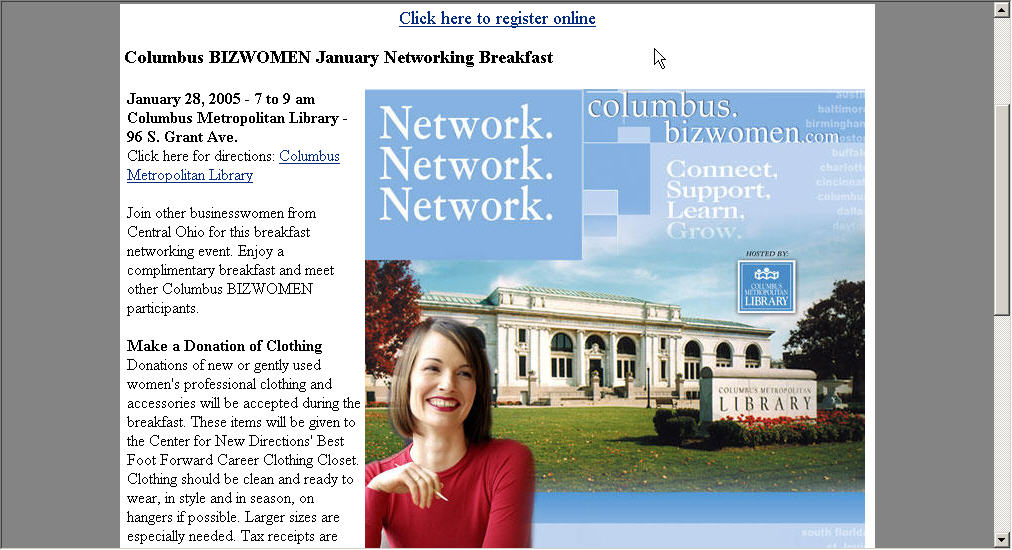
Late-breaking news from an OCLC staffer on the move, Carrie Benseler. The Columbus Metropolitan Library will host the January meeting of the Columbus Businesswomen's networking breakfast.

Information is a Conversation, not a Lecture
I stole the title from Karen's Free Range Librarian post from yesterday "Pensees from WebCred" in which she muses "out loud" on things informational in a most effective and elegant way. Jenny Levine also clipped a sentence or two for The Shifted Librarian. Go read Karen's whole (longish) post. Karen mused in an earlier post that she feels she has regained her (writing) groove and I agree. Lots to chew on.
And I do like to know Karen relishes red sweaters!
Two pensees particularly resonated. One on metadata and one on what Jenny called being part of information seekers' "trusted circles" when I interviewed her for the Scan.
"Metadata should be firmly lashed to information at the beginning of its journey and if possible added to along the way, over the Donner Pass and through cordones sanitaire, so that information becomes less "lossy" and in fact richer in meaning."
"Anne Lipow, a great librarian, innovator, educator, and publisher, often said that the user is not remote from the librarian, the librarian is remote from the user. This is true for all information communities. Our users (readers, patrons) are right there, where they should be; we are the ones who need to close the distance."
There was another Blog conference going on almost the same time as WebCred in Boston...Blog Business Summit happened on the opposite coast--Seattle. Tom Peters' blog has several posts on this.
And in other news....hardly worth commenting on due to the vast coverage but Google Video has debuted as a beta--just as was predicted a few short weeks ago, and which we faithfully reported. I tested it by searching "Donald Trump" although given the vast coverage of that non-event (although I am sure it was a meaningful event to The Donald and Melania) perhaps that was too easy. And it's the 'in' thing to do. Blinkx and Yahoo also released video search engines.
Another interesting Pew study was released, also commented on in many places: Search Engine Users "Users paint a very rosy picture of their online search experiences. They feel in control as searchers; nearly all express confidence in their searching skills. They are happy with the results they find; again, nearly all report that they are usually successful in finding what they’re looking for. And searchers are very trusting of search engines, the vast majority declaring that search engines are a fair and unbiased source of information. " This is, of course, an extension of the research we reported on in the Environmental Scan--that people are generally satisfied looking for things on their own. A must-read for librarians.
And noted in Wired News, "Information Wants to Be Liquid." "Frode Hegland, a researcher at University College London, wants to change the basic structure of information on the net." There's a demo. And no mention of the Semantic Web.
And that's just a few of the information conversations happening "out there".
And I do like to know Karen relishes red sweaters!
Two pensees particularly resonated. One on metadata and one on what Jenny called being part of information seekers' "trusted circles" when I interviewed her for the Scan.
"Metadata should be firmly lashed to information at the beginning of its journey and if possible added to along the way, over the Donner Pass and through cordones sanitaire, so that information becomes less "lossy" and in fact richer in meaning."
"Anne Lipow, a great librarian, innovator, educator, and publisher, often said that the user is not remote from the librarian, the librarian is remote from the user. This is true for all information communities. Our users (readers, patrons) are right there, where they should be; we are the ones who need to close the distance."
There was another Blog conference going on almost the same time as WebCred in Boston...Blog Business Summit happened on the opposite coast--Seattle. Tom Peters' blog has several posts on this.
And in other news....hardly worth commenting on due to the vast coverage but Google Video has debuted as a beta--just as was predicted a few short weeks ago, and which we faithfully reported. I tested it by searching "Donald Trump" although given the vast coverage of that non-event (although I am sure it was a meaningful event to The Donald and Melania) perhaps that was too easy. And it's the 'in' thing to do. Blinkx and Yahoo also released video search engines.
Another interesting Pew study was released, also commented on in many places: Search Engine Users "Users paint a very rosy picture of their online search experiences. They feel in control as searchers; nearly all express confidence in their searching skills. They are happy with the results they find; again, nearly all report that they are usually successful in finding what they’re looking for. And searchers are very trusting of search engines, the vast majority declaring that search engines are a fair and unbiased source of information. " This is, of course, an extension of the research we reported on in the Environmental Scan--that people are generally satisfied looking for things on their own. A must-read for librarians.
And noted in Wired News, "Information Wants to Be Liquid." "Frode Hegland, a researcher at University College London, wants to change the basic structure of information on the net." There's a demo. And no mention of the Semantic Web.
And that's just a few of the information conversations happening "out there".
Monday, January 24, 2005
Habbo Hotel
Alane sent me this link, as a possible safe, fun game. Go ahead, stick your toe in the Habbo Hotel.
And check out their disclaimer:
Sounds familiar, eh?
And check out their disclaimer:
In Habbo Hotel, real people use virtual characters to have authentic conversations, play games, enter competitions, and develop new friendships. It is a fun and nonviolent game environment where the benefits are great, but care must be taken.
Sounds familiar, eh?
Friday, January 21, 2005
Gaming in the Toledo Library
Is the library community on to something or what?
The Toledo-Lucas County Public Library is offering Madden Madness 2005 tomorrow (Saturday, January 22). This is a video game competition with the winner, according to the article in today's Toledo Blade, receiving "an all-expense-paid trip to the Bahamas and a 2006 version of the game."
And to think---I used to get in trouble for showing non-educational 16mm films in the Buffalo and Erie County Public Library branch I worked in as a student!
The Toledo-Lucas County Public Library is offering Madden Madness 2005 tomorrow (Saturday, January 22). This is a video game competition with the winner, according to the article in today's Toledo Blade, receiving "an all-expense-paid trip to the Bahamas and a 2006 version of the game."
And to think---I used to get in trouble for showing non-educational 16mm films in the Buffalo and Erie County Public Library branch I worked in as a student!
How Games are Reshaping Business & Learning
This is a link to an article from the Wisconsin Technology Network ("the region's leading source for news, commentary and analysis for technology and life science") that reports on a program held at U Wisconsin-Madison on gaming yesterday. I found the link in a Slashdot post.
And yes, "our" panelists from the OCLC Symposium, Kurt Squire and Constance Steinkuehler, were two of the three speakers. Their colleague James Gee (a professor of reading) was the third, and are all members of Academic Advanced Distributed Learning (ADL) Co-Lab. All three are described by the authors as "among the top researchers in learning through game-playing."
You'll see some familiar facts in the article and there is active commenting going on--last time I checked there were 29, some lengthy.
But the really cool thing is that this program "How Games are Reshaping Business & Learning" was simulcast via the Web so if you go here, you can click on the red title and the program will open up in a new window and begin. The program is just over 95 minutes long.
If you attended the Symposium, you'll see that Constance picked up a good intro from John "Got Game" Beck who began his presentation with "Name That Tune". And the ideas presented by Kurt and Constance at the Symposium are amplified and reinforced through this program. There's also a link to a paper called "Good Video Games Reinforce Good Learning" coauthored by Kurt and Jim Gee, and others.
And yes, "our" panelists from the OCLC Symposium, Kurt Squire and Constance Steinkuehler, were two of the three speakers. Their colleague James Gee (a professor of reading) was the third, and are all members of Academic Advanced Distributed Learning (ADL) Co-Lab. All three are described by the authors as "among the top researchers in learning through game-playing."
You'll see some familiar facts in the article and there is active commenting going on--last time I checked there were 29, some lengthy.
But the really cool thing is that this program "How Games are Reshaping Business & Learning" was simulcast via the Web so if you go here, you can click on the red title and the program will open up in a new window and begin. The program is just over 95 minutes long.
If you attended the Symposium, you'll see that Constance picked up a good intro from John "Got Game" Beck who began his presentation with "Name That Tune". And the ideas presented by Kurt and Constance at the Symposium are amplified and reinforced through this program. There's also a link to a paper called "Good Video Games Reinforce Good Learning" coauthored by Kurt and Jim Gee, and others.
Thursday, January 20, 2005
Bits and Pieces
Our fellow OCLC blogger, Lorcan Dempsey, notes some things over on his blog that are interesting.
"Worldcat in your pocket" talks about "how far we have come in being able to manipulate and move large amounts of data." WorldCat on your iPod and a 24-node (48-cpu) Beowulf cluster with 96 Gigabytes of memory--whatever this is! Whatever it is, it's hardware that puts data manipulation at warp speed.
And in this posting, Lorcan comments on Stanley Wilder's recent article in the Chronicle of Higher Education (subscription required for online, if you have access to the print, it's the January 7 issue) titled "Information Literacy Makes All the Wrong Assumptions." As someone who did a lot of bibliographic instruction once, I have long thought that something is wrong with the whole approach to information literacy, and while I don't entirely agree with Wilder's proposed solutions, I do agree with his articulation of the problems and issues.
Along with this article, I read Brenda Bailey-Hainer's Library Journal article "Virtual Reference: Alive and Well" and Stephen Abrams article on Google...which, dang it all, I can't lay my hands on right this minute and I only had it in paper. I'll cite when I find it. But, reading these three articles one after another (I was waiting for my car to get a new battery--all the cold weather has been hard on aging parts, automotive and other) was interesting--refreshing, in a way. All three authors are, in essence, asking readers to have another look, another think about topics, we either don't think about or that we think we know everything about, and twisting the issues slightly. All worth reading.
Noted on the Worthwhile blog, an article called Your Third Place Workspace? Given our interest in libraries as a third place, I was happy to see two comments identifying libraries as readers' fav 3rd places.
Addendum: 9pm EST. Here's the Stephen Abram article citation. "Google Scholar: Thin End of the Wedge?" Information Outlook, January 2005, v.9 (1): 44-46. I think this is not on the open web because I got stopped...so, any SLA member want to tell us why this good library content is not available to general readership? I can guarantee "protecting" this content is not going to win SLA more members.
"Worldcat in your pocket" talks about "how far we have come in being able to manipulate and move large amounts of data." WorldCat on your iPod and a 24-node (48-cpu) Beowulf cluster with 96 Gigabytes of memory--whatever this is! Whatever it is, it's hardware that puts data manipulation at warp speed.
And in this posting, Lorcan comments on Stanley Wilder's recent article in the Chronicle of Higher Education (subscription required for online, if you have access to the print, it's the January 7 issue) titled "Information Literacy Makes All the Wrong Assumptions." As someone who did a lot of bibliographic instruction once, I have long thought that something is wrong with the whole approach to information literacy, and while I don't entirely agree with Wilder's proposed solutions, I do agree with his articulation of the problems and issues.
Along with this article, I read Brenda Bailey-Hainer's Library Journal article "Virtual Reference: Alive and Well" and Stephen Abrams article on Google...which, dang it all, I can't lay my hands on right this minute and I only had it in paper. I'll cite when I find it. But, reading these three articles one after another (I was waiting for my car to get a new battery--all the cold weather has been hard on aging parts, automotive and other) was interesting--refreshing, in a way. All three authors are, in essence, asking readers to have another look, another think about topics, we either don't think about or that we think we know everything about, and twisting the issues slightly. All worth reading.
Noted on the Worthwhile blog, an article called Your Third Place Workspace? Given our interest in libraries as a third place, I was happy to see two comments identifying libraries as readers' fav 3rd places.
Addendum: 9pm EST. Here's the Stephen Abram article citation. "Google Scholar: Thin End of the Wedge?" Information Outlook, January 2005, v.9 (1): 44-46. I think this is not on the open web because I got stopped...so, any SLA member want to tell us why this good library content is not available to general readership? I can guarantee "protecting" this content is not going to win SLA more members.


The Paradox of Choice
I subscribe to a great blog called "Good Experience," and it's all about getting companies (and marketing people within companies) to remember that the reason they are in business is the customer. And as such, they should focus their business on the customer experience.
Today's installment had a nice interview with Barry Schwartz, the author of The Paradox of Choice.
Read the interview about the paradox of choice and how it affects the customer experience.
The gist of Schwartz's theory says that the less choices we're faced with in a purchasing decision, the more likely we are to actually make a purchase. With 200 choices, we are overwhelmed and walked away. With 12, we might actually pick something and buy it.
I wonder what happens when we apply the choice-paradox theory to our concept of the library. It's our library-sacred cow that more choice of materials is always better. Right? I want every iteration of The Tempest that is available and I want it at my fingertips--FRBRized, no less.
But what happens when we apply Schwartz's theory to information-shopping? If we remove the price tag (library materials are "free" to the consumer) then the choice rules don't apply? Or is the idea of weeding through information choices applying, while purchasing choices are not?
Food for thought, my friends.
Today's installment had a nice interview with Barry Schwartz, the author of The Paradox of Choice.
Read the interview about the paradox of choice and how it affects the customer experience.
The gist of Schwartz's theory says that the less choices we're faced with in a purchasing decision, the more likely we are to actually make a purchase. With 200 choices, we are overwhelmed and walked away. With 12, we might actually pick something and buy it.
I wonder what happens when we apply the choice-paradox theory to our concept of the library. It's our library-sacred cow that more choice of materials is always better. Right? I want every iteration of The Tempest that is available and I want it at my fingertips--FRBRized, no less.
But what happens when we apply Schwartz's theory to information-shopping? If we remove the price tag (library materials are "free" to the consumer) then the choice rules don't apply? Or is the idea of weeding through information choices applying, while purchasing choices are not?
Food for thought, my friends.
Wednesday, January 19, 2005
The Guardian's Gamesblog
Just came across this blog as I wandered from link to link. What a handy thing to add to My Yahoo! The blog began in mid 2004 and the bloggers are 2 males, 1 female.
"Welcome to Gamesblog, the new computer games weblog from the Guardian. Our aim here is to talk about games in an entertaining, adult way, and help enjoy playing games on whatever gadget you own - PC, games console, handheld device or mobile phone."
This looks like it would be a good way to keep up not only with what's happening with games (they promise no lengthy geeky reviews) but also with game culture. Aleks Krotoski, the female blogger, speaks and writes about women and gaming, something I know Constance Steinkeuhler and at least two symposium attendees were avidly discussing after the program.
And for you librarians interested in this topic but not sure what's what? Remember that blogs are designed to be two way...if you leave a comment or a question for bloggers, you'll get a reply.
"Welcome to Gamesblog, the new computer games weblog from the Guardian. Our aim here is to talk about games in an entertaining, adult way, and help enjoy playing games on whatever gadget you own - PC, games console, handheld device or mobile phone."
This looks like it would be a good way to keep up not only with what's happening with games (they promise no lengthy geeky reviews) but also with game culture. Aleks Krotoski, the female blogger, speaks and writes about women and gaming, something I know Constance Steinkeuhler and at least two symposium attendees were avidly discussing after the program.
And for you librarians interested in this topic but not sure what's what? Remember that blogs are designed to be two way...if you leave a comment or a question for bloggers, you'll get a reply.
Tuesday, January 18, 2005
The Seattle Public Library:Shattering Stereotypes
One of the side benefits of being an old greybeard like myself is that occasionally you get asked to serve on a cool committee. Deb Robertson, the director of ALA's Public Programs Office, nominated me for a spot on the first advisory committee for the office. Deborah Jacobs, the director of the Seattle Public Library, chairs the committee, and we had our first official meetings at this Midwinter conference. One of the things we spent a lot of time talking about (and I swear I didn't introduce the topic) was the idea of creating some public programs for libraries to host about gaming. But that's not what I'm blogging about here.
Rather, I'm afraid I've made some rather intemperate remarks recently about the new downtown Seattle Public Library (different link). I understand that I am utterly in the minority here, that everyone but your humbled correspondent seems to be unreservedly enamored of this building. Of course, word of my remarks got back to Deb Jacobs, as these things will do in our very small field. (And, that, young librarians, is one lesson to take home from today's blog!)
Deb was quite forgiving of my remarks (which you can be when you are dealing with the only oddball in a crowd), but she also told me about an event that sounds fascinating. She's hosting a conference sponsored by the Public Libraries International Network and the Library called "The Seattle Public Library: Shattering Stereotypes." The conference will be held April 27 through 29, with a postconference tour of three new SPL branches on April 30. This conference will showcase not only the new library, but best practices in leading public libraries from around the world. Because space is limited, and only two representatives from any organization will be able to register, you might want to act fast on this one. Deb also tells me that, in keeping with European tradition, the conference will feature a dance!
Rather, I'm afraid I've made some rather intemperate remarks recently about the new downtown Seattle Public Library (different link). I understand that I am utterly in the minority here, that everyone but your humbled correspondent seems to be unreservedly enamored of this building. Of course, word of my remarks got back to Deb Jacobs, as these things will do in our very small field. (And, that, young librarians, is one lesson to take home from today's blog!)
Deb was quite forgiving of my remarks (which you can be when you are dealing with the only oddball in a crowd), but she also told me about an event that sounds fascinating. She's hosting a conference sponsored by the Public Libraries International Network and the Library called "The Seattle Public Library: Shattering Stereotypes." The conference will be held April 27 through 29, with a postconference tour of three new SPL branches on April 30. This conference will showcase not only the new library, but best practices in leading public libraries from around the world. Because space is limited, and only two representatives from any organization will be able to register, you might want to act fast on this one. Deb also tells me that, in keeping with European tradition, the conference will feature a dance!
Home again, Home again, jiggedy jig
Now that almost everyone is back home again...back to eating steamed vegetables instead of cream chowder, milk instead of martinis, I challenge all the ALA MW 2005 attendees to ponder for a minute:
*What did I learn at this conference?
*What new information has challenged my thinking?
*What positive changes can I make in my library because of what I've experienced?
*How can I translate my experience for the staff members who did not attend?
When I was a camp counselor--back in the day--we designated time for the kids to process their "mountaintop experience" on the lasy day of camp, before they went back to the "real world." It's hard to spend 5 days being fed knowledge from all directions, and then find yourself returned to an uncomfortable realization that everyone else not at camp has been living their regular old humdrum life.
And now you, too, have returned to the humdrum...except that that's the wonderful part that happens when we get together as an industry: the formerly mundane becomes exciting again, and lively staff discussion ensues.
Welcome home.
*What did I learn at this conference?
*What new information has challenged my thinking?
*What positive changes can I make in my library because of what I've experienced?
*How can I translate my experience for the staff members who did not attend?
When I was a camp counselor--back in the day--we designated time for the kids to process their "mountaintop experience" on the lasy day of camp, before they went back to the "real world." It's hard to spend 5 days being fed knowledge from all directions, and then find yourself returned to an uncomfortable realization that everyone else not at camp has been living their regular old humdrum life.
And now you, too, have returned to the humdrum...except that that's the wonderful part that happens when we get together as an industry: the formerly mundane becomes exciting again, and lively staff discussion ensues.
Welcome home.
"Gaming in the Library" - NOLA [Ohio] program
This is all good! In a roundabout way today I heard that the April program for NOLA members is "Gaming in the Library." Check here for an interesting sounding program that sounds to me like a full-day version of Migell's portion of the Symposium. So, if any of you live reasonably close to Warren, OH (outside of Cleveland) and are interesting in bringing gaming into your library, this is a program for you.
NOLA Regional Library System is a multitype library agency, consisting of 91 libraries: 37 public, five academic, 43 schools districts and six special libraries in nine northern Ohio counties: Ashtabula, Columbiana, Geauga, Lake, Lorain, Mahoning, Portage, Stark, and Trumbull.
NOLA Regional Library System is a multitype library agency, consisting of 91 libraries: 37 public, five academic, 43 schools districts and six special libraries in nine northern Ohio counties: Ashtabula, Columbiana, Geauga, Lake, Lorain, Mahoning, Portage, Stark, and Trumbull.
"Libraries, the Princeton campus's unknown repository of sexiness"
A must read:
http://www.dailyprincetonian.com/archives/2005/01/17/opinion/11826.shtml
A sample quote:
"Education no doubt can be suggested in the classroom; but education happens in the library."
Thank you, Professor John V. Fleming!
http://www.dailyprincetonian.com/archives/2005/01/17/opinion/11826.shtml
A sample quote:
"Education no doubt can be suggested in the classroom; but education happens in the library."
Thank you, Professor John V. Fleming!
Monday, January 17, 2005
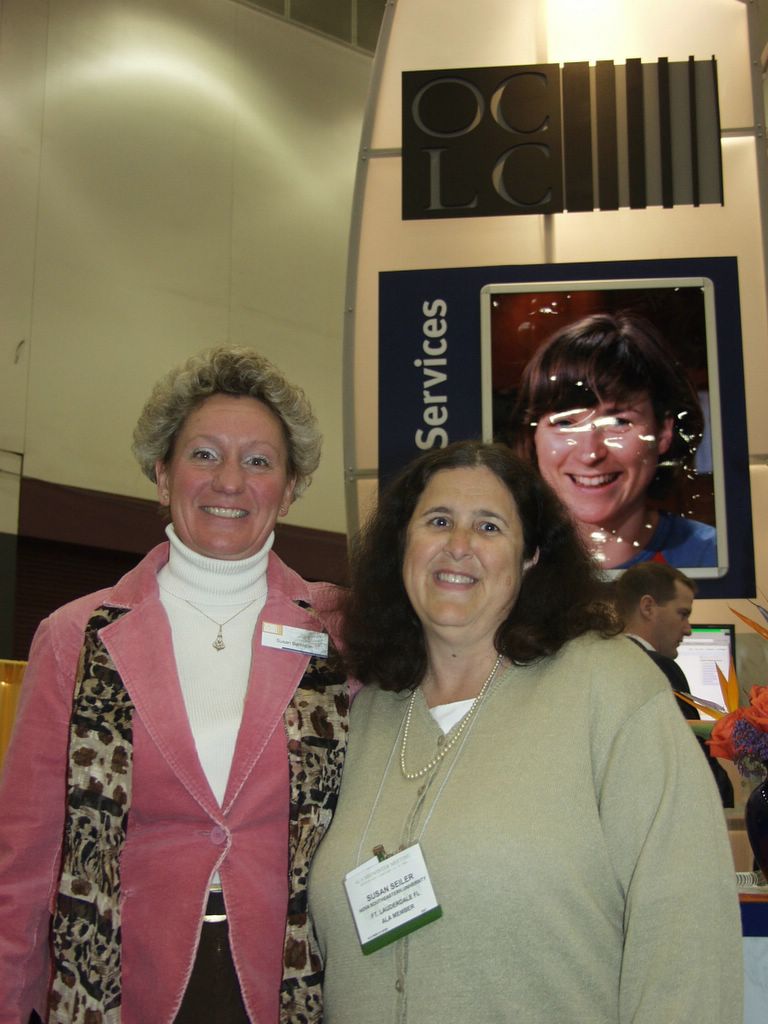
The winner of the OCLC opening reception basket, Susi Seiler. Susi is the Head of Technical Services for Nova Southeastern University Libraries, and she has been a gamer for years. She is pictured here with our own Susan Berntson (left), who came out of retirement to help with this ALA. On an interesting note, Susi said she "never wins anything," but that she AND her ALA-roommate both won baskets this year! Congratulations Susi, and happy listening to your new portable digital audio player while you game!

A poster of the Downloadable Audiobooks offer in the Recorded Books booth. In case you haven't heard, OCLC has partnered with Recorded Books to make eAudiobooks available through the NetLibrary platform. The core collection has 500 titles, and there are also Pimsleur language and biblical audiobooks as well.


Rent-a-dog
Alane set me up for this one! We were talking about entrepreneurship in the hotel bar, and I explained my small business idea: Rent-a-dog.
It all came to me while we lived in Hawaii. I was in Honolulu, working downtown, and my boyfriend-turned-fiancee-now-husband was in Pearl City at Pearl Harbor. Both of us liked dogs but didn't want the responsibility of a dog. I mean, let's face it--dogs are awesome but they are a commitment.
Thus the idea of rent-a-dog was born. It's all the fun of owning a dog, but none of the work. You rent your dog for the day, week or month--and they come fully trained with doggie treats, frisbees and everything. It seemed like a great "girl magnet" for guys, too. Personally, I really wanted a (well-behaved) dog to go to the beach with, so we could play fetch and romp around. Rent-a-dog would have been perfect for me.
Maybe once I become a very wealthy library blogger (ha ha ha), I can finance the venture capital needed to get rent-a-dog off the ground. Any dog-loving capitalists out there, look me up.
It all came to me while we lived in Hawaii. I was in Honolulu, working downtown, and my boyfriend-turned-fiancee-now-husband was in Pearl City at Pearl Harbor. Both of us liked dogs but didn't want the responsibility of a dog. I mean, let's face it--dogs are awesome but they are a commitment.
Thus the idea of rent-a-dog was born. It's all the fun of owning a dog, but none of the work. You rent your dog for the day, week or month--and they come fully trained with doggie treats, frisbees and everything. It seemed like a great "girl magnet" for guys, too. Personally, I really wanted a (well-behaved) dog to go to the beach with, so we could play fetch and romp around. Rent-a-dog would have been perfect for me.
Maybe once I become a very wealthy library blogger (ha ha ha), I can finance the venture capital needed to get rent-a-dog off the ground. Any dog-loving capitalists out there, look me up.
Post ALA musings
I know many librarians would still have been at ALA today but those of us who work for companies rather than libraries are usually gone once the exhibits are over--except for the very hard-working conference staff who are still there tearing down the booth and packing things up so they can be sent to the next conference. Our conference staff does an outstanding job of keeping track of people, OCLC bags, hotel rooms and everything else.
So, I didn't blog from Boston. Alice was doing a good job of populating It's All Good, and I spent a lot of time at the booth and it's hard to blog on a laptop standing up. Or at least I find it hard. ALA is a very different conference for those of us working the exhibits--we exhibitors don't personally get programs and don't have access to the agenda planner ALA has on its website. This makes it quite difficult to figure out what programs and meetings are happening when. And for sure, we don't get invited to the parties! I am still sorry I didn't get to go to the party held at the Kennedy Library--no idea who hosted but a conference attendee asked me about it at the booth and I was envious of the location.
I want to thank Beth Gallaway for her detailed posts about the OCLC Symposium over on the PLA blog. She clearly listened and took excellent notes and I am grateful to her for posting them. The symposium was filmed and will be available on the main OCLC web site in about 3 weeks. We're going to also put the slides up as Kurt Squire, Constance Steinkuehler and John Beck had interesting things on slides they did not explicitly refer to. As the person responsible for the symposium "content" (although my colleague Wendy McGinnis, Director of PR, deserves all the credit for convincing John Beck to speak) I don't want to sound like I am tootling my own horn, but I did think it was a most interesting session, and that is entirely due to the panelists--and the moderator. I'd asked them to make as many connections as they could to gaming's relevance to libraries and librarians and I think they succeeded.
Many people who stopped by the OCLC booth mentioned how much they had got out of the symposium and even though John Beck wasn't there to sign books, we still sold quite a few after he left. One academic librarian said she was giving it to her university's administrators. Jenny Levine's boss Pamela Brown stopped by too. She also liked the symposium and reads It's All Good as well. And Jenny pointed to Beth's excellent summary of the Gaming symposium way before I did!
I ran into Karen Schneider at the President's Advocacy program and had a short conversation about the oddness of meeting people who read our blogs (Karen's is The Free Range Librarian and she also blogged for PLA--and she's right, there's something wonky with the PLA blog, so be patient). It's not that we write into a vacuum because we know there are readers "out there", but meeting them in person is quite different than thinking about an abstract audience. And it's gratifying....well, it is if they like what you do!
And kudos to PLA for blogging ALA. It was most interesting reading and a whole lot better than reading just Cognotes...that human voice is very important. I hope that more associations try this as a way of reaching constituents...it's a whole lot better than quarterly newsletters.
I, like Alice, thoroughly enjoyed Malcolm Gladwell's presentation. He is an engaging speaker--and he's Canadian although my national attennae did not tell me this ahead of him announcing this. In John Beck's parlance, Gladwell would be a Strategy Guide (instead of a Level Boss) showing us interesting things and then reframing these things in a way we hadn't thought of. For me, after Gladwell spoke, presentations were back to the same-old, same-old--in the "how we did it good" mode and there was a tad too much self-congratulation and not enough real examination of what he had suggested. If advocacy efforts in the 90s were so successful, why would funding and profiles of libraries be so low now?
At dinner after the Symposium, John Beck told me that he had just come up with that "Strategy Guide" analogy as a good role for librarians as he was preparing the presentation so it isn't described in his book.
To all of you who stopped at the OCLC booth to talk to us, thanks! We learn things in every conversation.
And I am going to refrain from blogging about our miserable trip to Boston because it'd be very long, and whiney in places. Besides, I think most people travelling from the middle and east of the country had a hard time so I wasn't alone...in fact I had very good company in Moby Dick (a white Buick Le Sabre) on the 6 hour drive from Syracuse, NY to Boston late Thursday night. Despite the problems, my fellow travellers remained cheerful and calm. It did occur to us on that long (expensive) ride that ALA may save money by having conferences in "off season" places, but we, the attendees, often end up spending a lot of extra money due to travel mishaps, especially in the winter--although perhaps that's not altogether true as I recall a couple of unfortunately memorable trips home during thunderstorms from ALA in the summer.
Maybe Alice will tell you about her "Rent-A-Dog" business idea...she shared this with me yesterday as we had a very late lunch in the Marriott hotel bar where just about everyone else was watching the Patriots-Colts game.
So, I didn't blog from Boston. Alice was doing a good job of populating It's All Good, and I spent a lot of time at the booth and it's hard to blog on a laptop standing up. Or at least I find it hard. ALA is a very different conference for those of us working the exhibits--we exhibitors don't personally get programs and don't have access to the agenda planner ALA has on its website. This makes it quite difficult to figure out what programs and meetings are happening when. And for sure, we don't get invited to the parties! I am still sorry I didn't get to go to the party held at the Kennedy Library--no idea who hosted but a conference attendee asked me about it at the booth and I was envious of the location.
I want to thank Beth Gallaway for her detailed posts about the OCLC Symposium over on the PLA blog. She clearly listened and took excellent notes and I am grateful to her for posting them. The symposium was filmed and will be available on the main OCLC web site in about 3 weeks. We're going to also put the slides up as Kurt Squire, Constance Steinkuehler and John Beck had interesting things on slides they did not explicitly refer to. As the person responsible for the symposium "content" (although my colleague Wendy McGinnis, Director of PR, deserves all the credit for convincing John Beck to speak) I don't want to sound like I am tootling my own horn, but I did think it was a most interesting session, and that is entirely due to the panelists--and the moderator. I'd asked them to make as many connections as they could to gaming's relevance to libraries and librarians and I think they succeeded.
Many people who stopped by the OCLC booth mentioned how much they had got out of the symposium and even though John Beck wasn't there to sign books, we still sold quite a few after he left. One academic librarian said she was giving it to her university's administrators. Jenny Levine's boss Pamela Brown stopped by too. She also liked the symposium and reads It's All Good as well. And Jenny pointed to Beth's excellent summary of the Gaming symposium way before I did!
I ran into Karen Schneider at the President's Advocacy program and had a short conversation about the oddness of meeting people who read our blogs (Karen's is The Free Range Librarian and she also blogged for PLA--and she's right, there's something wonky with the PLA blog, so be patient). It's not that we write into a vacuum because we know there are readers "out there", but meeting them in person is quite different than thinking about an abstract audience. And it's gratifying....well, it is if they like what you do!
And kudos to PLA for blogging ALA. It was most interesting reading and a whole lot better than reading just Cognotes...that human voice is very important. I hope that more associations try this as a way of reaching constituents...it's a whole lot better than quarterly newsletters.
I, like Alice, thoroughly enjoyed Malcolm Gladwell's presentation. He is an engaging speaker--and he's Canadian although my national attennae did not tell me this ahead of him announcing this. In John Beck's parlance, Gladwell would be a Strategy Guide (instead of a Level Boss) showing us interesting things and then reframing these things in a way we hadn't thought of. For me, after Gladwell spoke, presentations were back to the same-old, same-old--in the "how we did it good" mode and there was a tad too much self-congratulation and not enough real examination of what he had suggested. If advocacy efforts in the 90s were so successful, why would funding and profiles of libraries be so low now?
At dinner after the Symposium, John Beck told me that he had just come up with that "Strategy Guide" analogy as a good role for librarians as he was preparing the presentation so it isn't described in his book.
To all of you who stopped at the OCLC booth to talk to us, thanks! We learn things in every conversation.
And I am going to refrain from blogging about our miserable trip to Boston because it'd be very long, and whiney in places. Besides, I think most people travelling from the middle and east of the country had a hard time so I wasn't alone...in fact I had very good company in Moby Dick (a white Buick Le Sabre) on the 6 hour drive from Syracuse, NY to Boston late Thursday night. Despite the problems, my fellow travellers remained cheerful and calm. It did occur to us on that long (expensive) ride that ALA may save money by having conferences in "off season" places, but we, the attendees, often end up spending a lot of extra money due to travel mishaps, especially in the winter--although perhaps that's not altogether true as I recall a couple of unfortunately memorable trips home during thunderstorms from ALA in the summer.
Maybe Alice will tell you about her "Rent-A-Dog" business idea...she shared this with me yesterday as we had a very late lunch in the Marriott hotel bar where just about everyone else was watching the Patriots-Colts game.
Creating an Advocacy Epidemic
Alane and I attended the ALA President's Program, "Creating an Advocacy Epidemic." The program was geared for public libraries, although there were some academic folks in the back, I saw.
Malcolm Gladwell was fantastic. Totally want to run out and find his latest books The Tipping Point and Blink.
He tee'd us up for thinking about library advocacy in an epidemic way.
Background on epidemics
Epidemics differ from marketing campaigns or advertising because the word has it's roots in medical terminology. It differs from marketing in that it is non-linear and typically gets spread by word-of-mouth, at a grassroots level. [Alice aside: sounds suspiciously like viral marketing to me, but there we are.]
Malcom gave a great example of a recent (American) epidemic: the Atkins diet. Why did it catch on like wildfire? Because Atkins reframed our concept of diet and made it simpler. Instead of doing complicated math for calorie counts and portion control, simply eliminate carbs. And everyone loved it because it was a new way to diet that was easy to follow.
Reframing
Malcolm talked about reframing the concept of libraries, in order to shift the general public's perception of what we are all about. In old-fashioned marketing terms, this sounds like nothing more than re-positioning your brand. Or put another way, repurposing your product. One of my favorite examples of this phenomenon is baking soda.
Baking soda sales were flat. Arm and Hammer had developed all the recipes it could that used baking soda instead of powder, and no amount of marketing the leavening power of baking soda was going to save the company. So someone figured out that baking soda can also eliminate unpleasant odors. Voila, a whole other aspect of the product that no one even knew it could do. They reframed baking soda to highlight its odor-removal use. And they did it so effectively that now all of us buy 2 boxes of baking soda--one for the frig and one to use in cooking. And the product itself did not change one bit. It kept on being baking soda. But the world around it changed.
[NB Malcom Gladwell didn't talk about baking soda. It's the value-added perspective you get from having your ALA MW covered by Weegee.]
Baking soda for libraries
So your sermon today is: can libraries be like baking soda? Can we reframe our position in people's minds? I think we can--and we've started to do it with the "Your public library is a small-business incubator" theme. We reframed the public library from a place you drop your kids for storytime, to a high-tech hub with resources, answers and a space for entrepreneurship to happen. At least, that's the idea.
As my former boss Gregor used to say, "If we can't be aspirational about this issue, who will be? Shoot the moon!" And I couldn't agree more. Let's use our social power to make this happpen. Ideas? Comments?
Malcolm Gladwell was fantastic. Totally want to run out and find his latest books The Tipping Point and Blink.
He tee'd us up for thinking about library advocacy in an epidemic way.
Background on epidemics
Epidemics differ from marketing campaigns or advertising because the word has it's roots in medical terminology. It differs from marketing in that it is non-linear and typically gets spread by word-of-mouth, at a grassroots level. [Alice aside: sounds suspiciously like viral marketing to me, but there we are.]
Malcom gave a great example of a recent (American) epidemic: the Atkins diet. Why did it catch on like wildfire? Because Atkins reframed our concept of diet and made it simpler. Instead of doing complicated math for calorie counts and portion control, simply eliminate carbs. And everyone loved it because it was a new way to diet that was easy to follow.
Reframing
Malcolm talked about reframing the concept of libraries, in order to shift the general public's perception of what we are all about. In old-fashioned marketing terms, this sounds like nothing more than re-positioning your brand. Or put another way, repurposing your product. One of my favorite examples of this phenomenon is baking soda.
Baking soda sales were flat. Arm and Hammer had developed all the recipes it could that used baking soda instead of powder, and no amount of marketing the leavening power of baking soda was going to save the company. So someone figured out that baking soda can also eliminate unpleasant odors. Voila, a whole other aspect of the product that no one even knew it could do. They reframed baking soda to highlight its odor-removal use. And they did it so effectively that now all of us buy 2 boxes of baking soda--one for the frig and one to use in cooking. And the product itself did not change one bit. It kept on being baking soda. But the world around it changed.
[NB Malcom Gladwell didn't talk about baking soda. It's the value-added perspective you get from having your ALA MW covered by Weegee.]
Baking soda for libraries
So your sermon today is: can libraries be like baking soda? Can we reframe our position in people's minds? I think we can--and we've started to do it with the "Your public library is a small-business incubator" theme. We reframed the public library from a place you drop your kids for storytime, to a high-tech hub with resources, answers and a space for entrepreneurship to happen. At least, that's the idea.
As my former boss Gregor used to say, "If we can't be aspirational about this issue, who will be? Shoot the moon!" And I couldn't agree more. Let's use our social power to make this happpen. Ideas? Comments?
Sunday, January 16, 2005

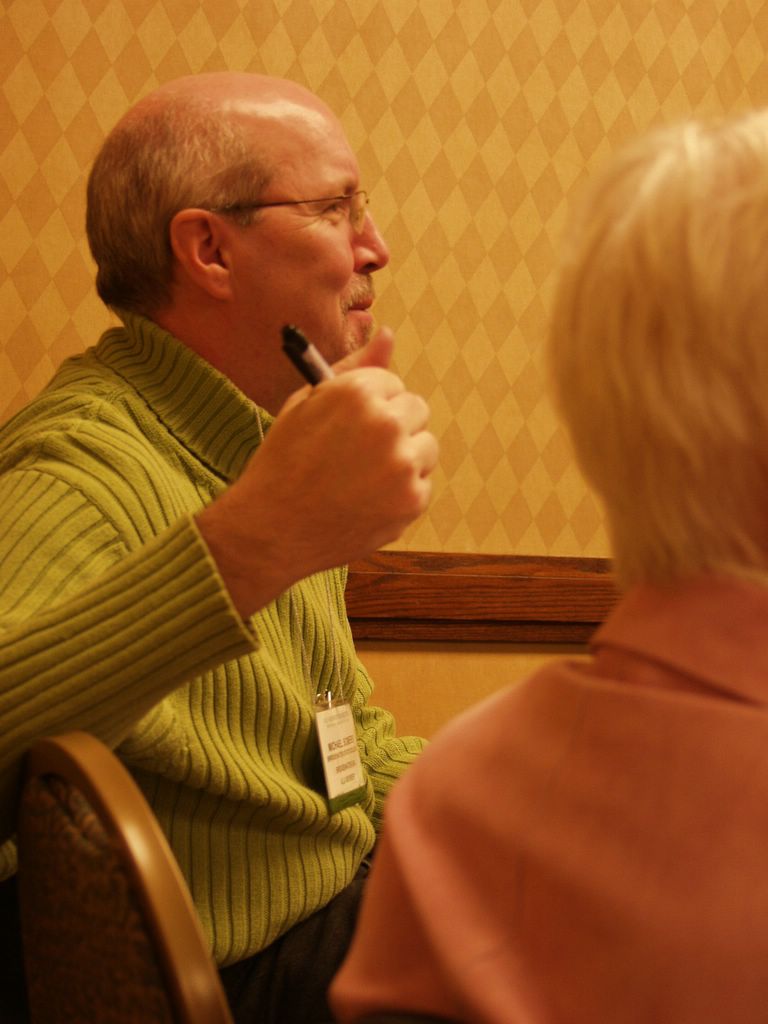
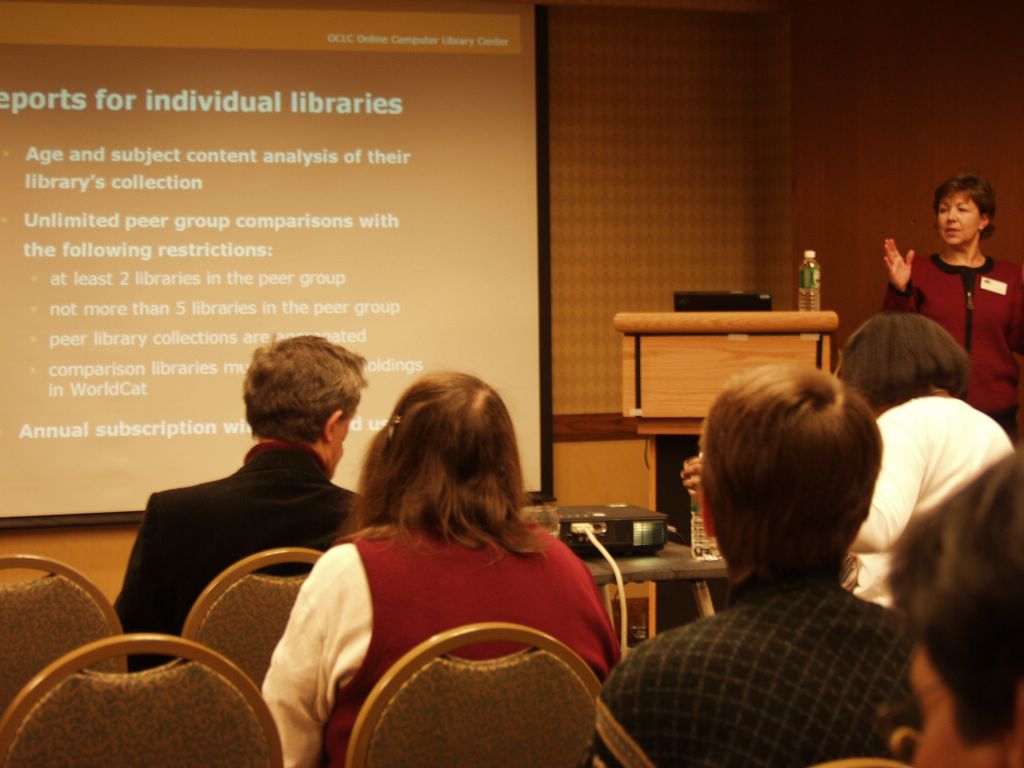
Michael Somers, a library director from Bridgewater State College, Mass. asks what the turnaround time will be for WorldCat Collection Analysis results. Answer: 24-72 hours, with real-time data manipulation capabilities after that.
WorldCat Collection Analysis
I attended Glenda Lammers informational session on this new product, slated to come out in March. WorldCat Collection Analysis is a very sensible way to get even more value out of our collective industry investment in WorldCat. Duh, we should use it as a tool for comparitive analysis betwixt and between libraries.
The service relies on up-to-date holdings in WorldCat, and then you select your peer group to compare against. The interface look and feel is very similar to FirstSearch. So similar, in fact, that I think it is a tab on your FirstSearch authorization. No new password required. That's a small but appreciated nod to OCLC's attempt to simplify what on my desk is a growing wad of sticky notes...
So from the tenor of the room today, what everyone is quite eager about is to be able to do an in-depth collection analysis with only a 72 hour turn-around time for the data. (Instead of 3 weeks and hours of paperpushing, I take it?) Of course, seeing some sample results screens got us all very curious to think about who we'd set our library up to compare against. Who are some of your peer library collections?
Another cool thing is that once you do the comparisons and identify titles you'd like to acquire, you can link straight out to Alibris, Abe Books, etc and buy the books! Talk about efficiency. This is cool.
The service is available for individual libraries or library groups, and the pricing is based on your number of holdings. Even for the biggest category--more than 1 million holdings--a year's subscription was only $8500 plus a one-time $500 set up fee.
The service relies on up-to-date holdings in WorldCat, and then you select your peer group to compare against. The interface look and feel is very similar to FirstSearch. So similar, in fact, that I think it is a tab on your FirstSearch authorization. No new password required. That's a small but appreciated nod to OCLC's attempt to simplify what on my desk is a growing wad of sticky notes...
So from the tenor of the room today, what everyone is quite eager about is to be able to do an in-depth collection analysis with only a 72 hour turn-around time for the data. (Instead of 3 weeks and hours of paperpushing, I take it?) Of course, seeing some sample results screens got us all very curious to think about who we'd set our library up to compare against. Who are some of your peer library collections?
Another cool thing is that once you do the comparisons and identify titles you'd like to acquire, you can link straight out to Alibris, Abe Books, etc and buy the books! Talk about efficiency. This is cool.
The service is available for individual libraries or library groups, and the pricing is based on your number of holdings. Even for the biggest category--more than 1 million holdings--a year's subscription was only $8500 plus a one-time $500 set up fee.
He's Back!
Tom Lehrer, one of my favorite songwriters and performers, once complained about the endless stream of plays, books, and movies about people who have trouble communicating. Lehrer said, "If you can't communicate, the least you can do is shut up!" Early on when Alice and Alane asked me about starting this blog, I decided that if I didn't have anything to say, I wasn't going to say it here. So for the last few weeks, I haven't had a lot to contribute. But this weekend at ALA Midwinter has given me something I want to talk about.
The Symposium, pictures of which have been posted by OCLC's answer to Weegee, Alice Sneary, was terrific. Each of the participants brought an interesting perspective to the question of what libraries can learn from gamers. Kurt Squire and Constance Steinkuehler took the academic perspective and coupled it with Constance's personal interest in Lineage. Marilyn Mason tied WebJunction to games, and Migell Acosta talked about how the Santa Monica Public Library has used LAN parties in a mutually beneficial way: the kids get a safe place to play with well-networked machines, and the library gets exposure to a new source of input on how to appeal to this generation. (Kurt, Constance, and Migell had spoken at OCLC in October. Kurt and Constance were the keynoters at Members Council, and Migell spoke on a panel presentation for staff in a program immediately after the Council meeting.) After a break, John Beck, author of "Got Game: How the Gamers Generation Is Reshaping Business Forever," made a superb case for how the generation of people conceived in Pong, weaned on SuperMario and matured in Massively Multiplayer Online Games, are changing and will change the workplace.
The questions and answers were excellent, and it seems like the audience really got it. We got a lot less of "Why is this important to libraries?" than we might have expected. Instead, attendees learned more about a way to think about their users from a generational perspective, and they heard some interesting ideas about how this perspective could be applied. Gamers impress me with their enthusiasm, their optimism, and their willingness to try new things. If the gamer generation can apply these traits in our libraries, we have nothing to worry about for the future of libraries. We just need to have enough sense to take advantage of what they bring to the table!
I've also spent several hours working in the OCLC Exhibit Hall booth. Donna Gehring, who manages our conference presence with unbelieveable patience and an almost Zen calm, assigns me as a generalist on the booth, which means basically I get to help people sign up for the drawing and then direct them to someone who actually knows something about OCLC products and services. What has been most gratifying this week is that a number of blog readers have stopped by to tell us how much they enjoy "It's All Good." It was a real ego trip, and now I know why authors like book signings!
The Symposium, pictures of which have been posted by OCLC's answer to Weegee, Alice Sneary, was terrific. Each of the participants brought an interesting perspective to the question of what libraries can learn from gamers. Kurt Squire and Constance Steinkuehler took the academic perspective and coupled it with Constance's personal interest in Lineage. Marilyn Mason tied WebJunction to games, and Migell Acosta talked about how the Santa Monica Public Library has used LAN parties in a mutually beneficial way: the kids get a safe place to play with well-networked machines, and the library gets exposure to a new source of input on how to appeal to this generation. (Kurt, Constance, and Migell had spoken at OCLC in October. Kurt and Constance were the keynoters at Members Council, and Migell spoke on a panel presentation for staff in a program immediately after the Council meeting.) After a break, John Beck, author of "Got Game: How the Gamers Generation Is Reshaping Business Forever," made a superb case for how the generation of people conceived in Pong, weaned on SuperMario and matured in Massively Multiplayer Online Games, are changing and will change the workplace.
The questions and answers were excellent, and it seems like the audience really got it. We got a lot less of "Why is this important to libraries?" than we might have expected. Instead, attendees learned more about a way to think about their users from a generational perspective, and they heard some interesting ideas about how this perspective could be applied. Gamers impress me with their enthusiasm, their optimism, and their willingness to try new things. If the gamer generation can apply these traits in our libraries, we have nothing to worry about for the future of libraries. We just need to have enough sense to take advantage of what they bring to the table!
I've also spent several hours working in the OCLC Exhibit Hall booth. Donna Gehring, who manages our conference presence with unbelieveable patience and an almost Zen calm, assigns me as a generalist on the booth, which means basically I get to help people sign up for the drawing and then direct them to someone who actually knows something about OCLC products and services. What has been most gratifying this week is that a number of blog readers have stopped by to tell us how much they enjoy "It's All Good." It was a real ego trip, and now I know why authors like book signings!
Ready for Advocacy session
Okay gang, I have more photos to download and post for you...but I'm gearing up to attend the ALA President's Advocacy forum. It starts at 3 pm so I'd better motor. Wish it was easier to moblog at this show. I'm been mourning my technical nonconvergeance...no bluetooth, no picture phone, no wifi. But lots and lots of bloggable moments.
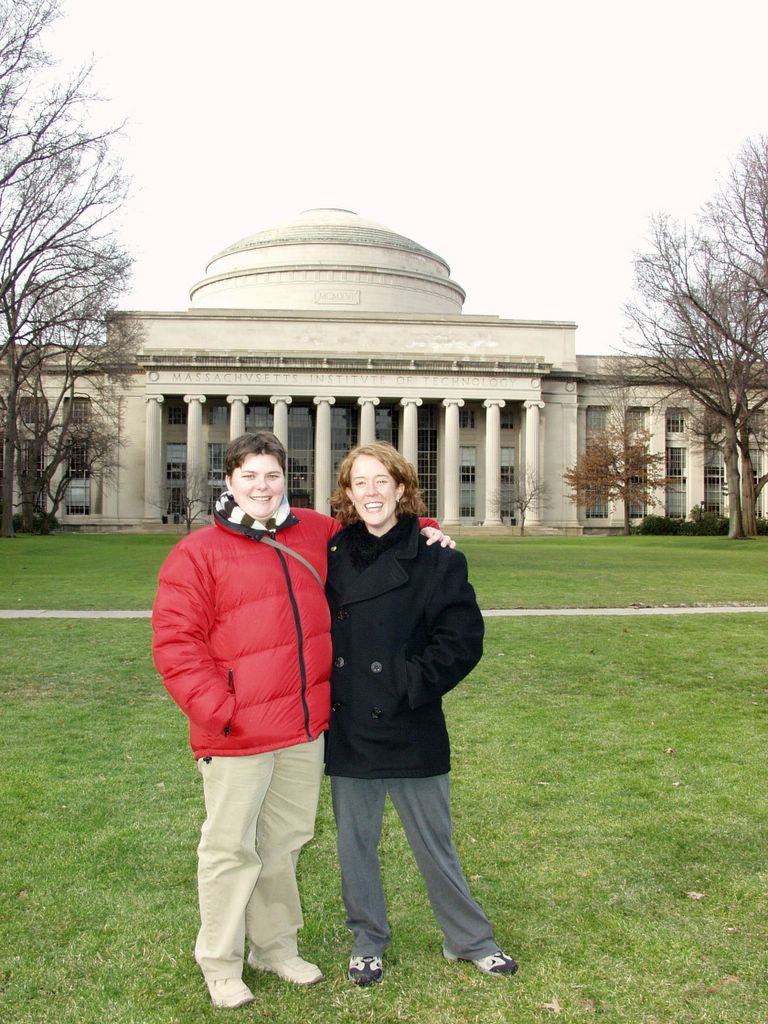
Boston is full of great sights--in addition to the OCLC activities. Because I am committed to bringing you the WHOLE experience of the conference, I of course had to wander offsite for a quick tour of MIT
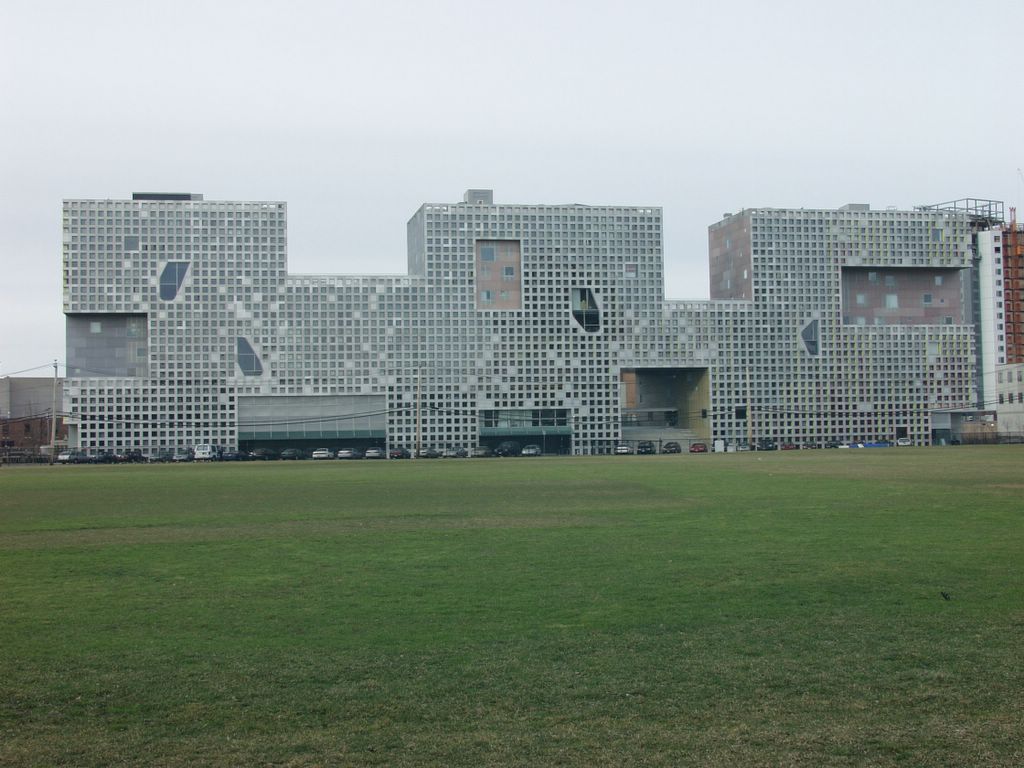
Can you believe this is a dorm? It's called Simmons and this photo does not adequately capture the architectural presence. Here's the back story on it.


OCLC Library Services staff compare notes and relax after the first full day of exhibits on Saturday. Pictured L-R are Robert Norvell, Carmen Candlin, Ron Glass and Danny Overstreet. If you haven't heard about the new Downloadable Audiobooks or the NetLibrary Collection Developer series yet, one of these guys would be happy to demo it for you.
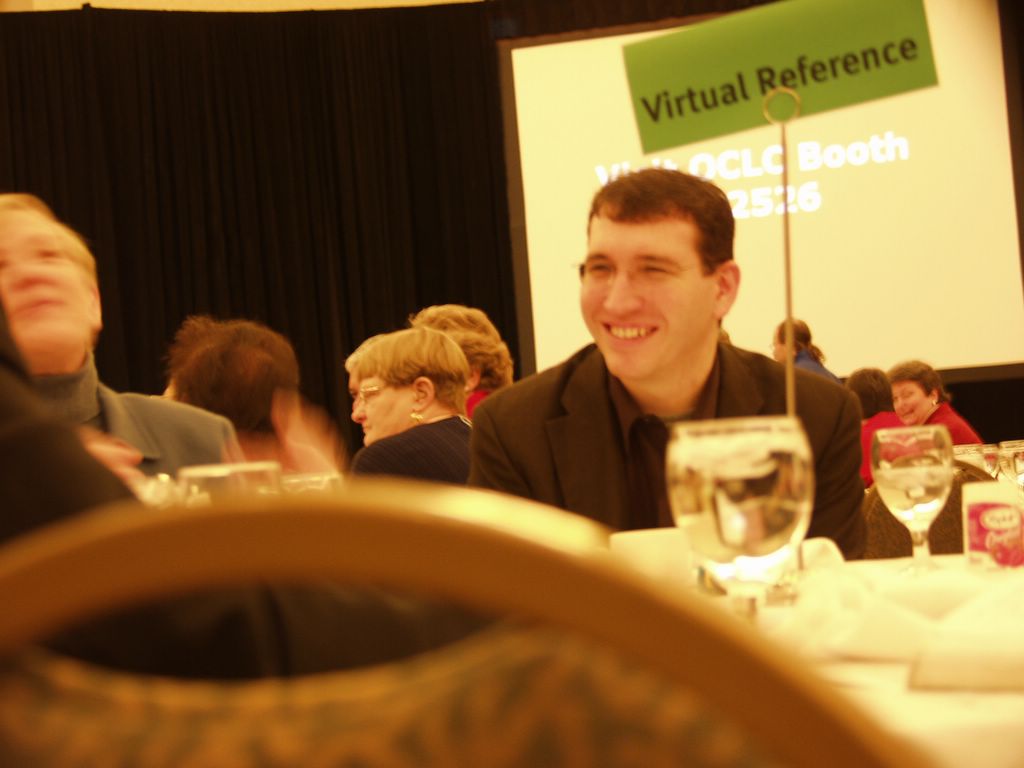


Saturday, January 15, 2005

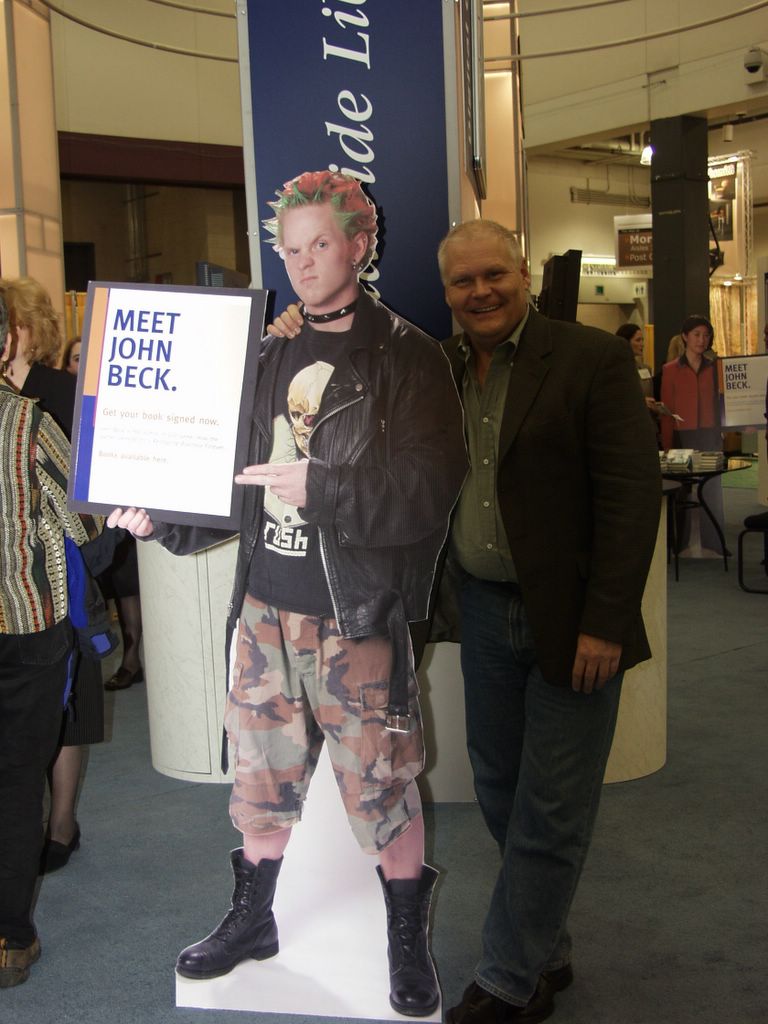


Symposium, Opening reception, Book signing and more
So much happened yesterday! Promise to get you up to speed--but I also have to dash to an 11:30 meeting soon.
My day yesterday was the OCLC exhibit booth. We hung the ring header (yes, the riggers finally came) and got everything put in place. Had a madcap dash to buy a few essentials--trash cans can be precious commodities sometimes--and voila the booth was ready, right on time.
Good thing, because while I was setting up over in the exhibit hall, the Symposium was going like gangbusters. Alane said she looked out over the crowd and realized it was the youngest audience we'd ever had--and people stayed to hear about Gaming and the significance for information literacy and learning.
John Beck, author of Got Game? was a panelist, as well as Kurt Squire, Constance Steinkuehler, Marilyn Mason, Migell Acosta and our own blogger-bud, George Needham. I hear it was a fantastic time and that we'll have it available on the OCLC Web site as a streaming video. Alane even mentioned something about editing out the umms and ahhhs. I can't wait to watch it. If the discussions we had a dinner later were any indication of the enthusiasm of the Symposium, it's going to be a great show, indeed.
The gamers then celebrated the successful Symposium, book signing and opening reception with a smashing dinner together. They invited me because of course, they wanted their celebrity presence blogged.
Now for photos!
My day yesterday was the OCLC exhibit booth. We hung the ring header (yes, the riggers finally came) and got everything put in place. Had a madcap dash to buy a few essentials--trash cans can be precious commodities sometimes--and voila the booth was ready, right on time.
Good thing, because while I was setting up over in the exhibit hall, the Symposium was going like gangbusters. Alane said she looked out over the crowd and realized it was the youngest audience we'd ever had--and people stayed to hear about Gaming and the significance for information literacy and learning.
John Beck, author of Got Game? was a panelist, as well as Kurt Squire, Constance Steinkuehler, Marilyn Mason, Migell Acosta and our own blogger-bud, George Needham. I hear it was a fantastic time and that we'll have it available on the OCLC Web site as a streaming video. Alane even mentioned something about editing out the umms and ahhhs. I can't wait to watch it. If the discussions we had a dinner later were any indication of the enthusiasm of the Symposium, it's going to be a great show, indeed.
The gamers then celebrated the successful Symposium, book signing and opening reception with a smashing dinner together. They invited me because of course, they wanted their celebrity presence blogged.
Now for photos!
Friday, January 14, 2005
Live and Direct from Boston
Good morning scanbloggers.
Thought I'd catch you up on latest news from your favorite worldwide library cooperative:
I'm going to bring you the news as it happens from ALA MW 2005...so even if you're not enjoying balmy Boston, you can still be in the know from OCLC.
I'm here on the exhibits floor in-progress in the Hynes Convention Center, waiting for the riggers. I have a fantastic camera (you'll see results as soon as I dig out the USB cable) this trip, loaned to me by our resident photographer, printing expert and all-around go-to-him-and-he-can-get-it-done-guy, Rich Skopin.
Our rigging director just showed up--more later.
Thought I'd catch you up on latest news from your favorite worldwide library cooperative:
I'm going to bring you the news as it happens from ALA MW 2005...so even if you're not enjoying balmy Boston, you can still be in the know from OCLC.
I'm here on the exhibits floor in-progress in the Hynes Convention Center, waiting for the riggers. I have a fantastic camera (you'll see results as soon as I dig out the USB cable) this trip, loaned to me by our resident photographer, printing expert and all-around go-to-him-and-he-can-get-it-done-guy, Rich Skopin.
Our rigging director just showed up--more later.
Tuesday, January 11, 2005
Left brain or right brain?
If you've been reading "It's All Good" for a while, you may recall that a few months ago I lamented that OCLC hadn't got anything to show for the long time we've been mulling over visual display of information. Well, good news. The pilot has been launched. Our colleague Tom Storey is the editor of the OCLC Abstracts and I stole the title from his notice about the pilot.
Here's what he wrote.
"OCLC and Antarctica Systems, Inc. to test library users’ search preferences.
OCLC is launching a pilot to evaluate library users’ experiences with searching and display of search results using a visual interface developed by Antarctica Systems, Inc. The pilot will run from January through April 2005 and will be implemented on a database of electronic books that will be available to all users of the OCLC Base Package and the OCLC Collection on the OCLC FirstSearch service.
Antarctica Systems, Inc. will use its VisualNet data visualization software to create a visual interface to the electronic books database. When users select the electronic books database on FirstSearch, they will be given the option to use the visual interface for searching and viewing results. OCLC will conduct a user survey to gauge feedback during this pilot and will also collect usage statistics that will be evaluated for future applications."
If you are not a FirstSearch subscriber, Antarctica has a link to the ebooks data here.
Here's what he wrote.
"OCLC and Antarctica Systems, Inc. to test library users’ search preferences.
OCLC is launching a pilot to evaluate library users’ experiences with searching and display of search results using a visual interface developed by Antarctica Systems, Inc. The pilot will run from January through April 2005 and will be implemented on a database of electronic books that will be available to all users of the OCLC Base Package and the OCLC Collection on the OCLC FirstSearch service.
Antarctica Systems, Inc. will use its VisualNet data visualization software to create a visual interface to the electronic books database. When users select the electronic books database on FirstSearch, they will be given the option to use the visual interface for searching and viewing results. OCLC will conduct a user survey to gauge feedback during this pilot and will also collect usage statistics that will be evaluated for future applications."
If you are not a FirstSearch subscriber, Antarctica has a link to the ebooks data here.
Friday, January 07, 2005
Why we need advocacy--and more research
ALA president Carol Brey-Casiano and Bernard Margolis, president of the Boston Public Library have an article in the January 5 Boston Globe on the sorry state of public library funding. "Despite the fact that more people are using libraries than ever before, their funding continues to decrease. More than $80 million has been cut from public library budgets in the past year alone, which has weakened or closed libraries in more than 40 states."
Gloomy as this is there was another statement in the article that particularly caught my attention: "Librarians truly are the 'ultimate search engine,' an incredibly knowledgeable human resource far more responsive and interactive than virtual commercial ones." It did so because I had just read something on the same topic expressing a different view. Rafat Ali at PaidContent.org posted some comments yesterday from an interview on digital media. Here's Rafat's posting.
"The Future of Digital Media: Hank Barry: An excellent interview with Hank Barry, who is a partner at the venture capital firm Hummer Winblad, and has been a close observer of the evolution of digital media - he was CEO of Napster and previously was a partner with Wilson Sonsini Goodrich & Rosati. This point is excellent: 'I think all businesses have tremendous opportunity here. To survive and prosper, they simply need to adapt...They have moved much of their ordering and sales configuration online. It's working. Perhaps contrary to expectations, customers prefer a consistent machine interface to an inconsistent human interface.' That's why I like banking online completely, than going into the bank or even the ATM" (my emphasis)
Now, Carol and Bernie, and Hank and Rafat aren't (necessarily) talking about the same kind of interactions but one of the major trends we focus on in the Environmental Scan is disintermediation of the sort Rafat mentions...interacting with a screen rather than a human.
There is good evidence that for many types of interactions, people actually prefer the machine.
In presentations we do, we often mention an article from Fast Company that George pointed us to called The Toll of the New Machine by Charles Fishman. This long article contains many interesting and important points and "offers a glimpse of the continued power of computers, automation, and the Internet to transform our lives as both workers and consumers--a power that, far from having plateaued, is only just getting started. Information technology hasn't touched lots of things that are just waiting to be automated, computerized, or kiosked. That they will be automated seems inevitable."
I think we continue to give too much weight to the notion that people coming to libraries want to be "served" by a human and I also know that I have no empirical evidence that library users prefer asking where the bathrooms are or why the sky is blue from humans. It's yet another area in our profession where emotion rules over fact, in my very own personal opinion. We don't actually know this; we just assume. And as Mr Fishman points out in his article, "Part of self-service is paying attention to how many different selves you might be serving. " So, I think we need to pay attention to the many kinds of interactions people have in libraries and decide where the real value of human interaction and service lies and focus on those selves and then get cracking on the things that are waiting to be automated.
Gloomy as this is there was another statement in the article that particularly caught my attention: "Librarians truly are the 'ultimate search engine,' an incredibly knowledgeable human resource far more responsive and interactive than virtual commercial ones." It did so because I had just read something on the same topic expressing a different view. Rafat Ali at PaidContent.org posted some comments yesterday from an interview on digital media. Here's Rafat's posting.
"The Future of Digital Media: Hank Barry: An excellent interview with Hank Barry, who is a partner at the venture capital firm Hummer Winblad, and has been a close observer of the evolution of digital media - he was CEO of Napster and previously was a partner with Wilson Sonsini Goodrich & Rosati. This point is excellent: 'I think all businesses have tremendous opportunity here. To survive and prosper, they simply need to adapt...They have moved much of their ordering and sales configuration online. It's working. Perhaps contrary to expectations, customers prefer a consistent machine interface to an inconsistent human interface.' That's why I like banking online completely, than going into the bank or even the ATM" (my emphasis)
Now, Carol and Bernie, and Hank and Rafat aren't (necessarily) talking about the same kind of interactions but one of the major trends we focus on in the Environmental Scan is disintermediation of the sort Rafat mentions...interacting with a screen rather than a human.
There is good evidence that for many types of interactions, people actually prefer the machine.
In presentations we do, we often mention an article from Fast Company that George pointed us to called The Toll of the New Machine by Charles Fishman. This long article contains many interesting and important points and "offers a glimpse of the continued power of computers, automation, and the Internet to transform our lives as both workers and consumers--a power that, far from having plateaued, is only just getting started. Information technology hasn't touched lots of things that are just waiting to be automated, computerized, or kiosked. That they will be automated seems inevitable."
I think we continue to give too much weight to the notion that people coming to libraries want to be "served" by a human and I also know that I have no empirical evidence that library users prefer asking where the bathrooms are or why the sky is blue from humans. It's yet another area in our profession where emotion rules over fact, in my very own personal opinion. We don't actually know this; we just assume. And as Mr Fishman points out in his article, "Part of self-service is paying attention to how many different selves you might be serving. " So, I think we need to pay attention to the many kinds of interactions people have in libraries and decide where the real value of human interaction and service lies and focus on those selves and then get cracking on the things that are waiting to be automated.
Thursday, January 06, 2005
Advocacy advertisement
This is one of three advertisements. You can view it so you can read the words at the OCLC web site.
Check out our Advocacy initiative
We've hinted at this program a couple of times in this space but now we have something to point you to. Alice did a lot of hard creative and phone work, and George and I swanned in now and then and gave opinions and ideas--not at all hard work for us.
Here's some of what we say on the Advocacy pages: "OCLC has developed an advertising campaign on behalf of libraries, aimed at library budget decision-makers.
The 12-18 month campaign consists of a series of national print ads and customizable, local posters." And here's why.
"The idea of doing advocacy grew naturally out of OCLC's 2003 Environmental Scan: Pattern Recognition report and the many presentations and discussions that resulted from it. As library staff members read and reflected on trends in our larger culture, the idea of 'branding the library experience' continued to resonate. The necessity of marketing library values—especially in the era of tighter budgets—was obvious.
So OCLC decided to put our money where our mouth was.
For the calendar year 2005, OCLC shifted advertising from library-specific publications to a new audience of nonlibrarians who influence budget decisions and technology purchasing for libraries. See the advertising schedule of placements."
There's lots more information about the program and the resources related to it at the web site.
And Happy 30th Birthday, Alice.
Here's some of what we say on the Advocacy pages: "OCLC has developed an advertising campaign on behalf of libraries, aimed at library budget decision-makers.
The 12-18 month campaign consists of a series of national print ads and customizable, local posters." And here's why.
"The idea of doing advocacy grew naturally out of OCLC's 2003 Environmental Scan: Pattern Recognition report and the many presentations and discussions that resulted from it. As library staff members read and reflected on trends in our larger culture, the idea of 'branding the library experience' continued to resonate. The necessity of marketing library values—especially in the era of tighter budgets—was obvious.
So OCLC decided to put our money where our mouth was.
For the calendar year 2005, OCLC shifted advertising from library-specific publications to a new audience of nonlibrarians who influence budget decisions and technology purchasing for libraries. See the advertising schedule of placements."
There's lots more information about the program and the resources related to it at the web site.
And Happy 30th Birthday, Alice.
Tuesday, January 04, 2005
It's 2005 - do you know where your content is?
"Happy New Year" just seems a bit too chipper, considering millions of the living in the tsunami-affected regions of the world are miserable physically and mentally beyond the comprehension of most of us. I'll repeat myself: please donate whatever money you can. You don't want to be visited by the Ghost of Christmas Present tonight.
So, here we are back, in a new year. I've been reading lots of summaries of 2004 and musings for 2005 on various blogs.
John Blossom at Shore Communications has a piece called Models for Success: 2005 Ushers in an Era of Major Shifts in Content Business Models as well as a view in the Crystal Ball Redux: Looking Back on Shore's 2004 Forecast - and Peeking at 2005
The Write News reports on the Online Publishers Association announcement that "consumer spending for online content in the U.S. grew to $853 million in the first half of 2004, an increase of 14 percent over the same period last year." This tracks with the only place shopping did well over the holidays--online.
They also have an entire section called The Editorial Dead Zone that reports on the shutterings and staff reductions in media, bookselling and publishing communities. Don't go there if your unrealized dream is to be a reporter or the publisher of a magazine.
Paula Hahn at Information Today is Wrapping Up 2004; Looking Forward.
And along with a zillion other bloggers, I note the Pew Internet & American Life report The State of Blogging. As well, Outsell Inc has released its 2005 predictions...I haven't read this yet but the previous ones have been most interesting. This one is called Outlook 2005: Power Play In The Information Industry.
You'll need to wander around a bit to read all the bits associated with Jay Rosen's Top Ten Ideas for 2004 at Pressthink. Not all the ideas are on the main page so look for the links. Number 6 is "Content Will be More Important than its Container" Hey, where've I heard that before?
And somehow I missed this at the beginning of December...RageBoy, aka Chris Locke, co-author of The Cluetrain Manifesto, was hired by HighBeam Research to blog. The RageBoy blog is still here and The ChiefBloggingOfficer is here. I've landed you on the "About" page because I want you to scroll down and look at what may or may not be a "real" poster. It's great though: For Greater Knowledge on More Subjects, Use Your Library Often!
And from a gaggle of biz publications: Fortune published its 10 Tech Trends, Business 2.0 The 5 Lessons of 2004, Red Herring, Top Ten Trends for 2005 and Fast Company Top Trends for 2005.
And not a trend summary, but 'in theme' with the upcoming OCLC Symposium, Jenny "The Shifted Librarian" Levine talks about her son and daughter's interests (different) in social gaming, Internet Use Goes Social at Our House.
And if the deluge of trend watching and musing is weighing you down, along with all the news and images from sad places, spend a few minutes with this WMD (weapon of mass distraction), peacefully virtually snipping paper into lovely snowflakes.
As my dad said in a New Year's email: Lang may yer lum reek.
So, here we are back, in a new year. I've been reading lots of summaries of 2004 and musings for 2005 on various blogs.
John Blossom at Shore Communications has a piece called Models for Success: 2005 Ushers in an Era of Major Shifts in Content Business Models as well as a view in the Crystal Ball Redux: Looking Back on Shore's 2004 Forecast - and Peeking at 2005
The Write News reports on the Online Publishers Association announcement that "consumer spending for online content in the U.S. grew to $853 million in the first half of 2004, an increase of 14 percent over the same period last year." This tracks with the only place shopping did well over the holidays--online.
They also have an entire section called The Editorial Dead Zone that reports on the shutterings and staff reductions in media, bookselling and publishing communities. Don't go there if your unrealized dream is to be a reporter or the publisher of a magazine.
Paula Hahn at Information Today is Wrapping Up 2004; Looking Forward.
And along with a zillion other bloggers, I note the Pew Internet & American Life report The State of Blogging. As well, Outsell Inc has released its 2005 predictions...I haven't read this yet but the previous ones have been most interesting. This one is called Outlook 2005: Power Play In The Information Industry.
You'll need to wander around a bit to read all the bits associated with Jay Rosen's Top Ten Ideas for 2004 at Pressthink. Not all the ideas are on the main page so look for the links. Number 6 is "Content Will be More Important than its Container" Hey, where've I heard that before?
And somehow I missed this at the beginning of December...RageBoy, aka Chris Locke, co-author of The Cluetrain Manifesto, was hired by HighBeam Research to blog. The RageBoy blog is still here and The ChiefBloggingOfficer is here. I've landed you on the "About" page because I want you to scroll down and look at what may or may not be a "real" poster. It's great though: For Greater Knowledge on More Subjects, Use Your Library Often!
And from a gaggle of biz publications: Fortune published its 10 Tech Trends, Business 2.0 The 5 Lessons of 2004, Red Herring, Top Ten Trends for 2005 and Fast Company Top Trends for 2005.
And not a trend summary, but 'in theme' with the upcoming OCLC Symposium, Jenny "The Shifted Librarian" Levine talks about her son and daughter's interests (different) in social gaming, Internet Use Goes Social at Our House.
And if the deluge of trend watching and musing is weighing you down, along with all the news and images from sad places, spend a few minutes with this WMD (weapon of mass distraction), peacefully virtually snipping paper into lovely snowflakes.
As my dad said in a New Year's email: Lang may yer lum reek.
Thursday, December 30, 2004
It's not all good
What does one say in the face of such widespread devastation and suffering? Not much. If you can afford to donate money to any of the various NGOs and relief agencies operating in South East Asia, please do. And please check to see if your organization matches such donations.
At OCLC, we sponsor the IFLA/OCLC Fellows, a program that brings librarians to Dublin, to OCLC, for six weeks each year. For the most part, the Fellows are from what we call here in the West "developing economies". Malaysia, Sri Lanka, Indonesia, Vietnam, Mauritius, Rwanda, Kenya, India. You'll have heard most of these country names this week. George, who oversees the progam, reports that our Fellows from Mauritius, India and Sri Lanka are OK, although Nayana in Sri Lanka lost friends. We haven't heard yet from Ferry and Zarina who live in Indonesia and Malyasia.
Nothing like a real, large scale tragedy to put things in perspective... "doesn't take much to see that the problems of three little [OCLC] people don't amount to a hill of beans in this crazy world. Someday you'll understand that. Now, now... Here's looking at you kid."
At OCLC, we sponsor the IFLA/OCLC Fellows, a program that brings librarians to Dublin, to OCLC, for six weeks each year. For the most part, the Fellows are from what we call here in the West "developing economies". Malaysia, Sri Lanka, Indonesia, Vietnam, Mauritius, Rwanda, Kenya, India. You'll have heard most of these country names this week. George, who oversees the progam, reports that our Fellows from Mauritius, India and Sri Lanka are OK, although Nayana in Sri Lanka lost friends. We haven't heard yet from Ferry and Zarina who live in Indonesia and Malyasia.
Nothing like a real, large scale tragedy to put things in perspective... "doesn't take much to see that the problems of three little [OCLC] people don't amount to a hill of beans in this crazy world. Someday you'll understand that. Now, now... Here's looking at you kid."
Monday, December 27, 2004
GoogleWhack
I'm in New Orleans now, watching "Good Morning America." They're describing a game people are playing with Google, called Google Whack. Apparently it's been around for awhile...
Anyway, the game is to put 2 terms in the Google search box and get one result returned. Examples of successful GoogleWhacking include:
braggadocoious illuminator
hippopotami plethora
lambating scallopini
Try it yourself!
Anyway, the game is to put 2 terms in the Google search box and get one result returned. Examples of successful GoogleWhacking include:
braggadocoious illuminator
hippopotami plethora
lambating scallopini
Try it yourself!
Monday, December 20, 2004
Geoffrey Nunberg on Google, text and libraries
You may recall, if you've read the Environmental Scan, that we quote a poem by Geoffrey Nunberg called "We're Coming Unwired" at the front of the Social Landscape. And he edited a book called The Future of the Book, published in 1996, that still is worth a read. He is a professor of linguistics at Stanford University, and is, on many levels, a good person to comment on Google's plans to digitize books owned by his university. Read the December 19 LA Times article here.
What next?
From the "keep an eye on this" files...
The summary is from Hot Bytes newsletter, put out by the e-Content Institute. The whole article from Internetnews.com (linked below) is worth reading.
"Google magazine search?
Writer Susan Kuchinskas notes that Google may have found a way to make money from its still-in-beta News service without alienating publishers, as indicated by a patent application on file with the USPTO. She writes: If Google could pull off what it outlines in that broad patent application, it may open new revenue streams to publishers of print, CD and DVD media, while broadening its own revenue base. U.S. Patent Application No. 20040122811, filed by Google co-founder Larry Page, has a deceptively simple name: "Method for searching media." But the application illuminates possible plans by the Mountain View, Calif.-based search leader to enable search of printed material, offer pay-per-view documents, scanned documents with clickable ads and even the ability for print publishers to swap out ads in digital copies of their printed pages. There are two key elements of the patent: a method for executing a permission protocol so that the publisher could authorize Google to display more text from the relevant publication; and storing scanned versions of printed documents along with data sets representing the ads that went with them. Source: Internetnews.com "
The summary is from Hot Bytes newsletter, put out by the e-Content Institute. The whole article from Internetnews.com (linked below) is worth reading.
"Google magazine search?
Writer Susan Kuchinskas notes that Google may have found a way to make money from its still-in-beta News service without alienating publishers, as indicated by a patent application on file with the USPTO. She writes: If Google could pull off what it outlines in that broad patent application, it may open new revenue streams to publishers of print, CD and DVD media, while broadening its own revenue base. U.S. Patent Application No. 20040122811, filed by Google co-founder Larry Page, has a deceptively simple name: "Method for searching media." But the application illuminates possible plans by the Mountain View, Calif.-based search leader to enable search of printed material, offer pay-per-view documents, scanned documents with clickable ads and even the ability for print publishers to swap out ads in digital copies of their printed pages. There are two key elements of the patent: a method for executing a permission protocol so that the publisher could authorize Google to display more text from the relevant publication; and storing scanned versions of printed documents along with data sets representing the ads that went with them. Source: Internetnews.com "
Wednesday, December 15, 2004
Indexing Uncooperative Cats
Art Rhyno is a funny guy (despite the fact that he lives in that Honduras-of-the-North, land of my citizenship). After the Google news yesterday flooded the web and the blogosphere, Art posted 4 funny, completely fake (please note this, Google legal staff) press releases.
Here's the first one.
Google to Index Dog Droppings
Press snippet: In a major initiative, Google will index the geometric properties of dog droppings around the world. Searchers will be able to upload pictures of the offending materials and be matched instantly with the dog that created them. "We are limiting this to dogs in the first phase" said a spokesperson from Google, "the cats are too uncooperative at this point".
Go to Art's blog, LibraryCog, to read the other equally amusing three. Thanks, Art, for a laugh.
Here's the first one.
Google to Index Dog Droppings
Press snippet: In a major initiative, Google will index the geometric properties of dog droppings around the world. Searchers will be able to upload pictures of the offending materials and be matched instantly with the dog that created them. "We are limiting this to dogs in the first phase" said a spokesperson from Google, "the cats are too uncooperative at this point".
Go to Art's blog, LibraryCog, to read the other equally amusing three. Thanks, Art, for a laugh.
Tuesday, December 14, 2004
Google and Lots of Books
This isn't really news considering more than 120 news sources (according to, what else, Google) have picked up the story from the AP source last night. Here's one version but this story isn't hard to find. This version is CNet posting a New York Times article which is handy as the NYT requires registration.
"It may be only a step on a long road toward the long-predicted global virtual library. But the collaboration of Google and research institutions that also include Harvard, the University of Michigan, Stanford and the New York Public Library is a major stride in an ambitious Internet effort by various parties. The goal is to expand the Web beyond its current valuable, if eclectic, body of material and create a digital card catalog and searchable library for the world's books, scholarly papers and special collections."
This is all good, isn't it?
"It may be only a step on a long road toward the long-predicted global virtual library. But the collaboration of Google and research institutions that also include Harvard, the University of Michigan, Stanford and the New York Public Library is a major stride in an ambitious Internet effort by various parties. The goal is to expand the Web beyond its current valuable, if eclectic, body of material and create a digital card catalog and searchable library for the world's books, scholarly papers and special collections."
This is all good, isn't it?
Monday, December 13, 2004
Griefers, griefers everywhere
Here's an interesting article about people who deliberately spoil the game experience in MMOGs (Massively Multiplayer Online Gaming) like EverQuest, Star Wars Galaxies and Sims Online. They are known as "griefers" and are "a small but seemingly irradicable set of players who want nothing more than to murder, loot and otherwise frustrate the heck out of everyone else."
The article points to the strong social rules that govern games and their communities. But I found myself thinking about the "griefers" I have worked with in libraries that didn't commit cardinal sins but who definitely inflicted pain on their colleagues and people using the libraries, and frustrated the heck out of people.
There was Negative Naomi who was impatient and sarcastic with students, and who sucked all the life out of committee work (which flickers with a weak spark anyway) because nothing would ever make librarianship as good as it used to be when she was young.
There was Jaded Janet who used every coffee break, every lunch conversation to decry the sorry state of professionalism and management abilities among absent colleagues.
And there was Peeved Pete who would have been much happier if "technology" had never been invented.
Griefers, all of them. Seems to me our workplaces have things to learn from the gamer communities in managing real social misfits.
The article points to the strong social rules that govern games and their communities. But I found myself thinking about the "griefers" I have worked with in libraries that didn't commit cardinal sins but who definitely inflicted pain on their colleagues and people using the libraries, and frustrated the heck out of people.
There was Negative Naomi who was impatient and sarcastic with students, and who sucked all the life out of committee work (which flickers with a weak spark anyway) because nothing would ever make librarianship as good as it used to be when she was young.
There was Jaded Janet who used every coffee break, every lunch conversation to decry the sorry state of professionalism and management abilities among absent colleagues.
And there was Peeved Pete who would have been much happier if "technology" had never been invented.
Griefers, all of them. Seems to me our workplaces have things to learn from the gamer communities in managing real social misfits.
Saturday, December 11, 2004
ACS sues Google Scholar
Just saw this story on slashdot...
American Chemical Society suing Google over the use of "Scholar" on Google Scholar.
!! Truth? I did a cursory check and didn't see anything on the ACS Web site about it. Anyone heard anything about it?
American Chemical Society suing Google over the use of "Scholar" on Google Scholar.
!! Truth? I did a cursory check and didn't see anything on the ACS Web site about it. Anyone heard anything about it?
Friday, December 10, 2004
"We fought him all the way to his promised land."
Apparently the title is what the presenter of the 1978 Melvil Dewey Award said of that year's recipient, Frederick G. Kilgour. If you are but a casual reader of this blog, you may not know that Fred is OCLC's founder--the inventor, really. He was born in 1914 and is still writing and being a serious birdwatcher.
I have been thinking about Fred today because I am reading and musing for a couple of pieces I am working on. And, as usual, when I read "Fred quotes" I am struck by the vision of the guy, as well as what a hard-nose he was (probably still is) in terms of his conviction that libraries needed to move on from what he termed "nineteenth century" practices. Here's the title quote in context:
"OCLC would not have come into being if it had not been for a quadripartite skein of skills and qualities possessed, perhaps uniquely, by Fred Kilgour. First, he was a thoroughly competent librarian. Second, he had a high degree of technical acumen. Third, he was a consummate politician. And fourth, he had skin a foot thick, which was fortunate indeed because we fought him every step of the way en route to his Promised Land"
(Anne Marie Allison and Ann Allen. OCLC, A National Library Network. Short Hills, N.J.: Enslow, 1979. p. 12)
And I have to think his skin must have been a foot thick because in a May, 1976 article by Art Plotnick in American Libraries he said:
"We do things to libraries, not for them. We want to make resources more available to users of libraries, and to reduce the unit costs. We are not essentially a catalog card-producing agency. We want to put the card catalog out of business. we've made a new kind of catalog--the on-line- totally different from the book catalog of the 17th century and the card catalog of the 19th. The library has become dehumanized. We have to bend ourselves to the demands and limitations of the catalog; but a computer can produce a miniature, custom made catalog just for the user--a special gathering of data that may never be put out again."
Many librarians reading that first sentence must have been most put-out by that opinion. And yet, I see a strong parallel between Fred's belief that OCLC led libraries--and should lead libraries-- into new territories in the 70s, and the OCLC of today, leading libraries out of the building, out of the OPAC, onto the open Web, with Open WorldCat being the first step towards the "promised land".
"New applications of technology will enable libraries to shift from their traditional packages of data to furnishing information for decsions and action. Hence, the new technology will provide librarians with the opportunity of developing new concepts of librarianship, having as their main emphasis the provision of information to individuals when and where they need it."
Are these words from Jay Jordan, announcing the Open WorldCat program? No, this is Fred Kilgour in 1981.
Movie Reviewers
Just came across (I know, I'm so behind these days) the call for movie reviews of The Librarian.
I heard the film was not living up to its full potential...though I have not yet seen it and do admire Dr. Carter's character evolution on ER through the years.
It's on TNT again tonight at 11:45 pm. Post your comments on ref:blog:spot.
Carrot for the idea. Stick for the execution?
I heard the film was not living up to its full potential...though I have not yet seen it and do admire Dr. Carter's character evolution on ER through the years.
It's on TNT again tonight at 11:45 pm. Post your comments on ref:blog:spot.
Carrot for the idea. Stick for the execution?
Thursday, December 09, 2004
Call me Alane
Hey gang. Alane has been filling in for me, as I slog through a lot of advertising deadlines and chasing imagery all over the world. It's been great fun--and it's not over yet.
I just wanted to stick my nose out of the water quickly and pop you a couple of cool links:
Article on libraries in NYT
We love good library exposure. An article in the New York Times today, "Libraries Reach Out, Online". Disclaimer: yes, it mentions OCLC. Also touches on gaming, audiobooks, eBooks and many of the trends near and dear to our "It's all good" readers.
Software company I applaud
A company called Hyperion will give any employee who buys/owns a car that makes more than 45 mpg a $5,000 check. How cool is that? Hear the whole story on Marketplace (NPR). Get the clip from the SF Chronicle.
Grapevine
I heard WorldCat might be the largest text database in Oracle. Oracle sources said they didn't actually keep lists--but that WorldCat was "definitely in the top 10." Way to go, OCLC Cooperative!
ALA-APA contest
Last week Alane and I met (virtually met) with Jennifer Grady of the ALA-APA office. She's got a lot of cool things going on, including a video: "Working@your library: for love or money." And there's a contest to write the accompanying print guide that goes with it. There's also a PDF toolkit on better salaries and pay equity (beware: 72 pages).
The title spoke to me about why we're putting together the Advocacy advertising program, geared for nonlibrarians. It's to explain that libraries (and librarians) cannot live on love alone. To get the cool technology described in the NYTimes article, you have to fund it.
Have the ALA MW 2005 Conference Program Guide ad due tomorrow.
Back to swimming.
I just wanted to stick my nose out of the water quickly and pop you a couple of cool links:
Article on libraries in NYT
We love good library exposure. An article in the New York Times today, "Libraries Reach Out, Online". Disclaimer: yes, it mentions OCLC. Also touches on gaming, audiobooks, eBooks and many of the trends near and dear to our "It's all good" readers.
Software company I applaud
A company called Hyperion will give any employee who buys/owns a car that makes more than 45 mpg a $5,000 check. How cool is that? Hear the whole story on Marketplace (NPR). Get the clip from the SF Chronicle.
Grapevine
I heard WorldCat might be the largest text database in Oracle. Oracle sources said they didn't actually keep lists--but that WorldCat was "definitely in the top 10." Way to go, OCLC Cooperative!
ALA-APA contest
Last week Alane and I met (virtually met) with Jennifer Grady of the ALA-APA office. She's got a lot of cool things going on, including a video: "Working@your library: for love or money." And there's a contest to write the accompanying print guide that goes with it. There's also a PDF toolkit on better salaries and pay equity (beware: 72 pages).
The title spoke to me about why we're putting together the Advocacy advertising program, geared for nonlibrarians. It's to explain that libraries (and librarians) cannot live on love alone. To get the cool technology described in the NYTimes article, you have to fund it.
Have the ALA MW 2005 Conference Program Guide ad due tomorrow.
Back to swimming.
Tuesday, December 07, 2004
Just Call Me Alice
Alice is very busy making webby things for ALA and also putting the finishing touches on material for the library advocacy advertising campaign we are weeks away from launching (more on that soon), so I will be Alice and tell you that the OCLC web site listing of all the OCLC hosted events at ALA Midwinter 2005 is now up here. The Symposium is listed first and not surprisingly (to me) I got 2 major pieces of information wrong in my previous posting about the Symposium location. It's at the Westin Copley Place, America South Room.
The book signing by John Beck, co-author of Got Game, will be at the OCLC booth (#2526) beginning at 5:30pm on Friday, January 14 (after the Symposium). This is during the Grand Opening of the Exhibits so with any luck there will be libations and snacks.
As I said earlier, registration is not required at OCLC events but it's kind of like an RSVP to a dinner party. We can make sure we have enough chairs.
The book signing by John Beck, co-author of Got Game, will be at the OCLC booth (#2526) beginning at 5:30pm on Friday, January 14 (after the Symposium). This is during the Grand Opening of the Exhibits so with any luck there will be libations and snacks.
As I said earlier, registration is not required at OCLC events but it's kind of like an RSVP to a dinner party. We can make sure we have enough chairs.
"Learning is a Community-Wide Responsibility"
Robert Martin, the director of the Institute of Museum and Library Services, has a short piece in C&RL News, December 2004 (thanks to ResourceShelf for pointing to it on Dec. 4) titled "Libraries and librarians in the 21st century: Fostering a learning society." As usual, Bob is worth reading. He always seems able to say important things succinctly and clearly.
And happily, he quotes several passages from the Scan. It's all good when someone we respect does so. Of course, we quoted Bob several times in the Scan....perhaps I am indulging in blogrolling?
And happily, he quotes several passages from the Scan. It's all good when someone we respect does so. Of course, we quoted Bob several times in the Scan....perhaps I am indulging in blogrolling?
Monday, December 06, 2004
The Greatest Show on Earth
I just logged in to read "Go Ask Alice," and realized it's been three weeks since my last post. In that three weeks, we celebrated Thanksgiving in the US, my long-suffering wife and I celebrated our 12th wedding anniversary, and we took our five year old grandson Jake to the circus.
I don't know if you've been to the Ringling Brothers and Barnum and Bailey circus recently (or ever, for that matter) but they now have a special event one hour before show time. You can go down on the arena floor and meet the performers, see the jugglers and the acrobats close up, shake hands with the clowns (and get free red plastic noses), and examine close up some of the incredible costumes that the performers wear. This last was of special interest to my wife, who does theatrical and special event costume design and creation.
So what does this have to do with the Scan? Just this---the owners of the circus have realized that people expect more in entertainment today. They don't just want to come into a 20,000-seat mega-arena to be entertained from 200 feet away. They want to get close to the action. They want to see the performers as human beings. They want to see for themselves that the animals are not being mistreated, PETA notwithstanding. The lesson is that even with amazing amounts of spectacle, human scale is important.
As we design our services and our facilities, we need to mix the personal with the awesome. Ol' Phineas T. Barnum would still recognize his namesake, but he'd also understand that you have to put it all into context.
Next week, it's off to Cleveland State University to do my last Scan program of the year. Since my last presentation, we've seen the announcement of the Google Scholar program (do you really need a hyperlink to THAT one?) and an AC Neilsen survey (sponsored by eBay) that claims that 40% of Americans now participate in online communities. The best part about doing these Scan presentations is that no two are ever the same: as the environment changes, so does the presentation!
I don't know if you've been to the Ringling Brothers and Barnum and Bailey circus recently (or ever, for that matter) but they now have a special event one hour before show time. You can go down on the arena floor and meet the performers, see the jugglers and the acrobats close up, shake hands with the clowns (and get free red plastic noses), and examine close up some of the incredible costumes that the performers wear. This last was of special interest to my wife, who does theatrical and special event costume design and creation.
So what does this have to do with the Scan? Just this---the owners of the circus have realized that people expect more in entertainment today. They don't just want to come into a 20,000-seat mega-arena to be entertained from 200 feet away. They want to get close to the action. They want to see the performers as human beings. They want to see for themselves that the animals are not being mistreated, PETA notwithstanding. The lesson is that even with amazing amounts of spectacle, human scale is important.
As we design our services and our facilities, we need to mix the personal with the awesome. Ol' Phineas T. Barnum would still recognize his namesake, but he'd also understand that you have to put it all into context.
Next week, it's off to Cleveland State University to do my last Scan program of the year. Since my last presentation, we've seen the announcement of the Google Scholar program (do you really need a hyperlink to THAT one?) and an AC Neilsen survey (sponsored by eBay) that claims that 40% of Americans now participate in online communities. The best part about doing these Scan presentations is that no two are ever the same: as the environment changes, so does the presentation!
Saturday, December 04, 2004
Go Ask Alice - Symposium Details
You know, I am just the warm-up act, the scout running ahead of the real posse...the reason I mentioned the upcoming OCLC Symposium is because I am one of several people organizing it. This happens way ahead of getting info up on the official OCLC web site...I mean, does ALA have the Midwinter program up yet? Not on Dec 3rd they didn't.
So, for those of you who need to know now....the OCLC Symposium is always on the Friday of ALA. For this Boston Midwinter meeting, that's January 14th. It begins at 1:30pm and ends at 4:30pm. I can't recall the room it's in....but it'll be at the Marriott Copley (that's where the OCLC staff will be staying), in a large room probably with "Ballroom" in the name. It's not an invitation-only event. In fact, all you really need do is show up although we do like it if you register, at the OCLC web site (but you can't until it's up on the web, can you?) And there's a good chance the whole thing will be captured so people unable to attend will be able to view it afterwards.
We'll be very happy if you do attend and you'll get a small token of our appreciation. In past years, this has been the popular OCLC bags. Don't know what it is this conference.
Here's an aside about the bags. The first edition of these was the green ones. That year we gave them away at the OCLC booth. Well, we didn't really give them away. They were grabbed away...we completely underestimated the desire people had to get not one, not two, but sometimes a dozen of those bags. OCLC booth staff had bruises from being elbowed aside as librarians converged on the middle of the booth where the bags were stacked. OK, I am exaggerating....slightly. In subsequent years, the bags have only been given to people attending OCLC events and those of us working the booth at ALA have heard many interesting stories at the booth from people who are hoping to score a bag. Reference librarians....know how you tell "war stories" about reference interactions? Well, I confess, booth staff do the same.
The "go ask Alice" in the title is because our Alice is one of the talented and overworked people doing webby work at OCLC. So, I'll ask Alice...when will the OCLC-at-ALA-Midwinter info be up on the OCLC web site?
So, for those of you who need to know now....the OCLC Symposium is always on the Friday of ALA. For this Boston Midwinter meeting, that's January 14th. It begins at 1:30pm and ends at 4:30pm. I can't recall the room it's in....but it'll be at the Marriott Copley (that's where the OCLC staff will be staying), in a large room probably with "Ballroom" in the name. It's not an invitation-only event. In fact, all you really need do is show up although we do like it if you register, at the OCLC web site (but you can't until it's up on the web, can you?) And there's a good chance the whole thing will be captured so people unable to attend will be able to view it afterwards.
We'll be very happy if you do attend and you'll get a small token of our appreciation. In past years, this has been the popular OCLC bags. Don't know what it is this conference.
Here's an aside about the bags. The first edition of these was the green ones. That year we gave them away at the OCLC booth. Well, we didn't really give them away. They were grabbed away...we completely underestimated the desire people had to get not one, not two, but sometimes a dozen of those bags. OCLC booth staff had bruises from being elbowed aside as librarians converged on the middle of the booth where the bags were stacked. OK, I am exaggerating....slightly. In subsequent years, the bags have only been given to people attending OCLC events and those of us working the booth at ALA have heard many interesting stories at the booth from people who are hoping to score a bag. Reference librarians....know how you tell "war stories" about reference interactions? Well, I confess, booth staff do the same.
The "go ask Alice" in the title is because our Alice is one of the talented and overworked people doing webby work at OCLC. So, I'll ask Alice...when will the OCLC-at-ALA-Midwinter info be up on the OCLC web site?
Friday, December 03, 2004
OCLC Symposium - A Reelly Reelly Big Shew
I don't know how I missed mentioning this. George--yes, this blog's George Needham--is going to be the host and moderator of the forthcoming OCLC Symposium at ALA (blogged here a few days ago). See, worth coming just for this, right?
There's another "it's all good" thing, though. Through the efforts of Wendy McGinnis, OCLC's Director of PR, John Beck, the co-author of Got Game (also mentioned here a few days ago) has agreed to participate in the Symposium. Don't worry if you've not read Got Game...there will be an author-signing at the OCLC booth. Details will be posted here and on the OCLC web site closer to ALA.
And this has nothing to do with anything else in this post, but I wanted to note the passing at 84 of a great Canadian personality: author, journalist and broadcaster Pierre Berton. I discovered this late because neither the Columbus Dispatch (the local newspaper), NPR, or my digest of the New York Times noted his death, which is as if Canadian newspapers had ignored the death of someone of the stature of Tom Brokaw. Although it's hard to imagine that Mr Brokaw's last television interview would have been on how to roll a good joint.
Said Pierre, "If people who are of age want to have a smoke, let them have a smoke, I say."
Probably a good thing he decided to remain a big frog in a small pond and not move to the US like Peter Jennings, and John Roberts.
There's another "it's all good" thing, though. Through the efforts of Wendy McGinnis, OCLC's Director of PR, John Beck, the co-author of Got Game (also mentioned here a few days ago) has agreed to participate in the Symposium. Don't worry if you've not read Got Game...there will be an author-signing at the OCLC booth. Details will be posted here and on the OCLC web site closer to ALA.
And this has nothing to do with anything else in this post, but I wanted to note the passing at 84 of a great Canadian personality: author, journalist and broadcaster Pierre Berton. I discovered this late because neither the Columbus Dispatch (the local newspaper), NPR, or my digest of the New York Times noted his death, which is as if Canadian newspapers had ignored the death of someone of the stature of Tom Brokaw. Although it's hard to imagine that Mr Brokaw's last television interview would have been on how to roll a good joint.
Said Pierre, "If people who are of age want to have a smoke, let them have a smoke, I say."
Probably a good thing he decided to remain a big frog in a small pond and not move to the US like Peter Jennings, and John Roberts.
Wednesday, December 01, 2004
Making It Work
There has been a lot of thinking and work going on among clever people with regard to Google Scholar and Google Desktop.
Art Rhyno, at the University of Windsor Library, and Peter Binkley, at the University of Alberta Libraries, have been tinkering with Google Desktop and Google Scholar with most interesting and promising results.
Art has blogged his Google Desktop tinkerings on his own blog, LibraryCog which is the best place to read the details--and I confess I skim over the techie parts but I am jazzed about the results.
In a nutshell, he started musing on what it would mean to have catalogue searching carried out by "third parties" (say, Google Desktop), and he's come up with a proof of concept, using Google Desktop against the library catalogue at Windsor. I know Art so I emailed him and said, so, if Google Desktop might be able to search against OPACs does this make the Open WordCat program redundant? Why would records need to go to Yahoo! and Google if bib records can be crawled from point of origin? And this is what Art replied to me (posted with his permission).
"I am impressed by the efficiency of Google Desktop though I don't know if what I am doing with our collection will go any further than our public stations. It's a bit like the "teachable moment" that we talk about in Information Literacy, how to make library access seamless at the point of information need. The advantage of Google Desktop over fighting it out with the billions of documents that Google indexes through the web is that it reserves some prime real estate for displaying the results.
But I know that anything that relies on software to be installed locally is going to be problematic. I think OCLC's approach of working with Google is still the best. I would love to see some dialogue on how to inject rights management into this process. Google's business model depends a lot on instant gratification, exposing content that can't be accessed immediately treads on to some tough ground and I am sure the folks at Google understand this. Even going outside of the Google cache is a bit tough because it shakes the fault tolerance of Google's infrastructure, but I am sure many publishers get nervous about caching licensed content.
We are revamping our lookup bookmarklet to augment URLs in Google Scholar which are listed in our proxy tables. The idea is to automatically give patrons some chance to access content that has already been licensed for them, but this is still a pretty weak measure. Even building a toolbar, which some of my colleagues are very keen on, seems to me to be competing in a space where there are powerful forces that can squeeze us out. Still, Google has some facility now for creating profiles, and I think the hooks for an infrastructure for rights management already exist, what's missing is a forum plugging the two together, though maybe this is already happening.
To be honest, at least some of my interest in Google Desktop comes from a game that I worked on with my kids a few years ago. We named it StackQuest and the idea was that creatures chased you around library bookstacks and the lead characters had to find books on certain topics to throw at the creatures in order to escape. I have always been a big fan of Don Norman
and I loved that the Environmental Scan looked at gaming. I think we tend to badly underestimate how powerful the notion of fun can be in learning. Interestingly, I have discovered that games have a long history in [Canadian] indigenous cultures for teaching."
One of the reasons I asked Art if I could post his comments to "It's All Good" is because of the last paragraph--our faithful readers know how interested we are in gaming.
And on to Peter Binkley. What about Google Scholar, rights management, and the appropriate copy problem, Peter? No problem...he's been working on that.
Yesterday, on the Web4Lib listserv, Peter announced that "As a proof-of-concept I've built a Firefox extension that adds OpenURL links to the results lists in Google Scholar. It can be downloaded here: http://www.ualberta.ca/~pbinkley/gso/ . The functionality is pretty basic but it shows what might be possible."
If you don't belong to the Web4Lib listserv, you might want to join if you're interested in keeping track what Peter, Art and others are doing to develop practical, usable ways of integrating library metadata into the shared space of the web.
This really is All Good.
Art Rhyno, at the University of Windsor Library, and Peter Binkley, at the University of Alberta Libraries, have been tinkering with Google Desktop and Google Scholar with most interesting and promising results.
Art has blogged his Google Desktop tinkerings on his own blog, LibraryCog which is the best place to read the details--and I confess I skim over the techie parts but I am jazzed about the results.
In a nutshell, he started musing on what it would mean to have catalogue searching carried out by "third parties" (say, Google Desktop), and he's come up with a proof of concept, using Google Desktop against the library catalogue at Windsor. I know Art so I emailed him and said, so, if Google Desktop might be able to search against OPACs does this make the Open WordCat program redundant? Why would records need to go to Yahoo! and Google if bib records can be crawled from point of origin? And this is what Art replied to me (posted with his permission).
"I am impressed by the efficiency of Google Desktop though I don't know if what I am doing with our collection will go any further than our public stations. It's a bit like the "teachable moment" that we talk about in Information Literacy, how to make library access seamless at the point of information need. The advantage of Google Desktop over fighting it out with the billions of documents that Google indexes through the web is that it reserves some prime real estate for displaying the results.
But I know that anything that relies on software to be installed locally is going to be problematic. I think OCLC's approach of working with Google is still the best. I would love to see some dialogue on how to inject rights management into this process. Google's business model depends a lot on instant gratification, exposing content that can't be accessed immediately treads on to some tough ground and I am sure the folks at Google understand this. Even going outside of the Google cache is a bit tough because it shakes the fault tolerance of Google's infrastructure, but I am sure many publishers get nervous about caching licensed content.
We are revamping our lookup bookmarklet to augment URLs in Google Scholar which are listed in our proxy tables. The idea is to automatically give patrons some chance to access content that has already been licensed for them, but this is still a pretty weak measure. Even building a toolbar, which some of my colleagues are very keen on, seems to me to be competing in a space where there are powerful forces that can squeeze us out. Still, Google has some facility now for creating profiles, and I think the hooks for an infrastructure for rights management already exist, what's missing is a forum plugging the two together, though maybe this is already happening.
To be honest, at least some of my interest in Google Desktop comes from a game that I worked on with my kids a few years ago. We named it StackQuest and the idea was that creatures chased you around library bookstacks and the lead characters had to find books on certain topics to throw at the creatures in order to escape. I have always been a big fan of Don Norman
and I loved that the Environmental Scan looked at gaming. I think we tend to badly underestimate how powerful the notion of fun can be in learning. Interestingly, I have discovered that games have a long history in [Canadian] indigenous cultures for teaching."
One of the reasons I asked Art if I could post his comments to "It's All Good" is because of the last paragraph--our faithful readers know how interested we are in gaming.
And on to Peter Binkley. What about Google Scholar, rights management, and the appropriate copy problem, Peter? No problem...he's been working on that.
Yesterday, on the Web4Lib listserv, Peter announced that "As a proof-of-concept I've built a Firefox extension that adds OpenURL links to the results lists in Google Scholar. It can be downloaded here: http://www.ualberta.ca/~pbinkley/gso/ . The functionality is pretty basic but it shows what might be possible."
If you don't belong to the Web4Lib listserv, you might want to join if you're interested in keeping track what Peter, Art and others are doing to develop practical, usable ways of integrating library metadata into the shared space of the web.
This really is All Good.
Subscribe to:
Posts (Atom)

