Several days old but Outsell Now has an interesting musing on the nature of content and owning it. An excerpt: "Content is like the municipal water supply: we all own the water we buy from the city, but that doesn't mean we want to store it in barrels around the house. What we want is reliable and instant access to water, not possession [...]We've concluded that all parts of the content industry are lined up along a "rent vs. buy" spectrum, but that the concept of owning content is slowly losing ground to other models of access."
And from Moco.News, some info about how that content is going to move to portable/handheld devices "Nokia confidently predicted there will be 70 million 3G handsets in use by the end of 2005, up from 16 million at the end of last year (but still a drop in the mobile handset ocean)." 3G handsets are third generation cell phones--although the term cell phone is increasingly antiquated for what 3G devices can do with regard to sending and receiving mobile content. So, these cell phones thatt aren't cell phones make me think of Rene Magritte's painting of a tobacco pipe that includes the words (in French) "This is not a pipe."
Wednesday, February 16, 2005
Monday, February 14, 2005
Library Daydreams....
...is the name of a post to a blog called "iBeth: everyday reflections of an academic mom." It's a longish post about internet features she'd like to see added to her library's environment. Worth reading for the non-librarian's view of what's useful--and also because Beth is an engaging writer from a world close to ours (and if you have small kids, the same world!)
And there have been lively discussions in several places (also on the Web4Lib listserv) about the value of RSS, and peoples' perceived preferences for getting updates (RSS or email?). Beth offers her view in the post linked to above: "Anyway, what I've been daydreaming about is the ability to export a list of books I've checked out so that it could be put on my university website and automatically be updated--sort of like Bloglines maintains my blogroll. A "currently reading" list on my university website would help communicate my current research interests. I guess I can do this via allconsuming.net (still need to check out that site, recommended by Mel earlier), but it would be neat to do it through my own library."
Which I think is what Peter Rukavina did back in August for himself and which we blogged.
There's been a fair bit of "regular" press about Answers.com which bills itself as "The best definitions and explanations for over 1 million topics." And certainly the author of this Forbes article thinks it is the "best internet innovation in years." For fact-based searching, this may be the case. Did you notice the tagline in the top right corner? "The New Standard in Reference." How interesting. And so is this.
And there have been lively discussions in several places (also on the Web4Lib listserv) about the value of RSS, and peoples' perceived preferences for getting updates (RSS or email?). Beth offers her view in the post linked to above: "Anyway, what I've been daydreaming about is the ability to export a list of books I've checked out so that it could be put on my university website and automatically be updated--sort of like Bloglines maintains my blogroll. A "currently reading" list on my university website would help communicate my current research interests. I guess I can do this via allconsuming.net (still need to check out that site, recommended by Mel earlier), but it would be neat to do it through my own library."
Which I think is what Peter Rukavina did back in August for himself and which we blogged.
There's been a fair bit of "regular" press about Answers.com which bills itself as "The best definitions and explanations for over 1 million topics." And certainly the author of this Forbes article thinks it is the "best internet innovation in years." For fact-based searching, this may be the case. Did you notice the tagline in the top right corner? "The New Standard in Reference." How interesting. And so is this.
AskJeeves bought Bloglines
I am shocked, shocked I tell you. I had written AskJeeves off years ago (sorry to all the AskJeeves fans out there)...and now it seems that they have bought Bloglines, my RSS blogreader freeware!
Just when I think that Google is the only game in town, a scrappy underdog says there is still plenty of searchers out there for all of us.
Anyone else surprised by this move?
Just when I think that Google is the only game in town, a scrappy underdog says there is still plenty of searchers out there for all of us.
Anyone else surprised by this move?
Blogger culture
Did you guys hear about the bloggers who have now taken down a second prominent journalist figure?
Read the story in today's NYT.
I'm just back in from 2 days in Bridgewater, New Jersey with our new friends at Baker & Taylor, YBP and Majors. If you haven't heard, OCLC has entered into an agreement to make it easier than ever to get your eContent alongside your pContent. The very same selector/acquisitions/collection development librarian will soon be able to select cloth, paper or electronic formats--at the same time.
As one Baker & Taylor/YBP staffer put it, "What this means is that e is now normal. eBooks are as normal as print books."
Which was pretty cool to hear, I must admit.
Read the story in today's NYT.
I'm just back in from 2 days in Bridgewater, New Jersey with our new friends at Baker & Taylor, YBP and Majors. If you haven't heard, OCLC has entered into an agreement to make it easier than ever to get your eContent alongside your pContent. The very same selector/acquisitions/collection development librarian will soon be able to select cloth, paper or electronic formats--at the same time.
As one Baker & Taylor/YBP staffer put it, "What this means is that e is now normal. eBooks are as normal as print books."
Which was pretty cool to hear, I must admit.
Thursday, February 10, 2005
Help OCLC with its Terminologies pilot project!
I am posting this on behalf on our colleague Susan Westberg. Maybe in the spirit of Google we should call this Terminologies Beta.
Does your institution use thesauri other than LCSH or LC Names when adding access points to your bibliographic records?
Are you a Connexion browser user?
Have you upgraded to Microsoft Office 2003 with MS Internet Explorer 6.x?
If so, consider joining the OCLC Terminologies pilot.
What is the pilot? Its goal is to explore a service offering additional terminologies/thesauri/vocabularies for libraries, museums and archives. The pilot is to test functionality of current technology as well as which thesauri OCLC might offer. While the targeted thesauri will be searchable and use a copy and paste methodology from thesaurus to bibliographic record, authority control of these headings will not be available. However, you can be assured that the headings are both accurate (i.e., no typos) and valid terms.
The pilot requires using OCLC Connexion browser (MARC text area), MS Office 2003, and MS Internet Explorer 6.x. MS Office and IE offer a Research Pane that allows you to add services that you can access in Microsoft applications, in this case, URLs that provide access to available thesauri. While the pilot offers only a few thesauri, and for some, limited subsets, another purpose of the pilot is to find out if this presentation method is feasible and desirable. The pilot should last 3-4 months and begin in early March.
The intention of the pilot is to provide a means to access and search thesauri you currently use (be it in paper or web formats) in one place in an online environment. During the pilot, you would search, copy and paste terms from a variety of thesauri into the bibliographic records you are creating or updating,using the Connexion browser and the Research pane available with MS Office 2003. This allows you to expedite adding valid access points to bibliographic records rather than keying them in. Pasting the text into the MARC text area does include the correct tags and subfields.
The list of potential thesauri is:
- gsafd – Guidelines on subject access to individual works of fiction, drama, etc. (ALA)
- gmgpc lctgm – Thesaurus of graphic materials, TGM I & II (LC)
- radfg – Radio form / genre terms guide (LC)
- mim – Moving image materials: genre terms (LC)
- ngl – Newspaper Genre List (University of Washington)
- aat, tgn, ULAN – Getty vocabularies (subsets only): AAT (Art & Architecture Thesaurus), TGN (Thesaurus of Geographic Names), and ULAN (Union List of Artists’ Names)
- mesh – Medical Subject Headings (NLM)
We plan on a phased approach, adding thesauri during the pilot, beginning with GSAFD. If you are interested in participating in the pilot or would like more information, please let me know by February 18.
Thanks,
Susan Westberg
OCLC
Digital Collection Services
Toll-free phone: 800-848-5878 (USA and Canada only)
Direct phone: 614-761-5079
Email: susan_westberg@oclc.org; westbers@oclc.org
Does your institution use thesauri other than LCSH or LC Names when adding access points to your bibliographic records?
Are you a Connexion browser user?
Have you upgraded to Microsoft Office 2003 with MS Internet Explorer 6.x?
If so, consider joining the OCLC Terminologies pilot.
What is the pilot? Its goal is to explore a service offering additional terminologies/thesauri/vocabularies for libraries, museums and archives. The pilot is to test functionality of current technology as well as which thesauri OCLC might offer. While the targeted thesauri will be searchable and use a copy and paste methodology from thesaurus to bibliographic record, authority control of these headings will not be available. However, you can be assured that the headings are both accurate (i.e., no typos) and valid terms.
The pilot requires using OCLC Connexion browser (MARC text area), MS Office 2003, and MS Internet Explorer 6.x. MS Office and IE offer a Research Pane that allows you to add services that you can access in Microsoft applications, in this case, URLs that provide access to available thesauri. While the pilot offers only a few thesauri, and for some, limited subsets, another purpose of the pilot is to find out if this presentation method is feasible and desirable. The pilot should last 3-4 months and begin in early March.
The intention of the pilot is to provide a means to access and search thesauri you currently use (be it in paper or web formats) in one place in an online environment. During the pilot, you would search, copy and paste terms from a variety of thesauri into the bibliographic records you are creating or updating,using the Connexion browser and the Research pane available with MS Office 2003. This allows you to expedite adding valid access points to bibliographic records rather than keying them in. Pasting the text into the MARC text area does include the correct tags and subfields.
The list of potential thesauri is:
- gsafd – Guidelines on subject access to individual works of fiction, drama, etc. (ALA)
- gmgpc lctgm – Thesaurus of graphic materials, TGM I & II (LC)
- radfg – Radio form / genre terms guide (LC)
- mim – Moving image materials: genre terms (LC)
- ngl – Newspaper Genre List (University of Washington)
- aat, tgn, ULAN – Getty vocabularies (subsets only): AAT (Art & Architecture Thesaurus), TGN (Thesaurus of Geographic Names), and ULAN (Union List of Artists’ Names)
- mesh – Medical Subject Headings (NLM)
We plan on a phased approach, adding thesauri during the pilot, beginning with GSAFD. If you are interested in participating in the pilot or would like more information, please let me know by February 18.
Thanks,
Susan Westberg
OCLC
Digital Collection Services
Toll-free phone: 800-848-5878 (USA and Canada only)
Direct phone: 614-761-5079
Email: susan_westberg@oclc.org; westbers@oclc.org
BBC program on libraries
I haven't listened yet but the Board Chair of the Edmonton (Alberta) Public Library posted this note to an Alberta-focused library listserv, Jerome-L: "An excellent program, aired February 8, on public libraries, including interviews with the director of The British Library, the European rep for Google, and the director of libraries for Tower Hamlets, a multicultural/working class suburb of London which has moved to the concept of "Idea Stores". Listen in Real Audio. Click on libraries and then Listen Again."
The BBC site says: "If you can get the information that you want, wherever you happen to be, why would you visit a library? And if you don't, what use will all that public space be put to?"
And I haven't listened because I don't have RealPlayer loaded on my work laptop...this broadcast requires RealPlayer.
The BBC site says: "If you can get the information that you want, wherever you happen to be, why would you visit a library? And if you don't, what use will all that public space be put to?"
And I haven't listened because I don't have RealPlayer loaded on my work laptop...this broadcast requires RealPlayer.
Wednesday, February 09, 2005
Prolific
Prolific is the word for your bloggers, my friends! Too bad we're not getting paid by the word.
Just a quick note: Was catching up on my Chronicle of Higher Education reading, and I ran across the latest "Balancing Act" column that made me laugh out loud.
[It's page C3 in the Jan. 28, 2005 print issue--not online unfortunately.]
In the article, a tenure-track professor realizes that a rural, small-town campus is no place to be single. So she eventually leaves the academy and finds a job in industry. She still does history, finds success, etc. Happier with the numerous book groups that she now belongs to, and how much she appreciates the socialization aspects of a larger metropolitan area...
At the end of the article, she mentions her friend Emily, who had pursued a PhD but then dropped out. Emily is "bright, funny and well-read...now working as a librarian."
And so of course our professor cannot understand why anyone would decline a professorship to become *a librarian* --so she finally asks Emily what gives.
And Emily's response is classic: "Early on, I realized that academe has no office culture...but I realized that as a single person, I was going to need some interaction at work. Academe couldn't offer me that—but a library could."
How cool is that. A former tenure-track professor admits that librarians are the socially outgoing species at our universities. (Duhhhhh is probably our collective librarian response...)
It brings to mind that Hepburn film Desk Set where she is the sharp-tongued, quick-witted information specialist...
Just a quick note: Was catching up on my Chronicle of Higher Education reading, and I ran across the latest "Balancing Act" column that made me laugh out loud.
[It's page C3 in the Jan. 28, 2005 print issue--not online unfortunately.]
In the article, a tenure-track professor realizes that a rural, small-town campus is no place to be single. So she eventually leaves the academy and finds a job in industry. She still does history, finds success, etc. Happier with the numerous book groups that she now belongs to, and how much she appreciates the socialization aspects of a larger metropolitan area...
At the end of the article, she mentions her friend Emily, who had pursued a PhD but then dropped out. Emily is "bright, funny and well-read...now working as a librarian."
And so of course our professor cannot understand why anyone would decline a professorship to become *a librarian* --so she finally asks Emily what gives.
And Emily's response is classic: "Early on, I realized that academe has no office culture...but I realized that as a single person, I was going to need some interaction at work. Academe couldn't offer me that—but a library could."
How cool is that. A former tenure-track professor admits that librarians are the socially outgoing species at our universities. (Duhhhhh is probably our collective librarian response...)
It brings to mind that Hepburn film Desk Set where she is the sharp-tongued, quick-witted information specialist...
Tuesday, February 08, 2005
Gaming for Librarians
Rochelle at Tinfoil+Raccoon (and also a PLA blogger at ALA MW) points us to the most recent issue of the VOYA (Voice of Youth Advocates) magazine which features gaming. There's a really good article called "Gaming for Librarians: An Introduction." written by Heather Wilson (which also happens to be the name of my youngest sister) who, according to the blurb at the end of the article works at the Bunker Hill Community College Library in Charlestown, MA. So, readers, if you are looking for speakers on this topic in the northeast part of the US, perhaps Heather can share her expertise. She has a web site here
And it's amazing the things I don't know...I am completely unfamiliar with VOYA which is "a bimonthly journal addressing librarians, educators, and other professionals who work with young adults. The only magazine devoted exclusively to the informational needs of teenagers, it was founded in 1978 by librarians and renowned intellectual freedom advocates Dorothy M. Broderick and Mary K. Chelton 'to identify the social myths that keep us from serving young people and replace them with knowledge.'"
Well, that's a mission that I can support.
Addendum, February 10: Too funny! An astute reader points out the misplaced modifier in the last sentence of the quote above. "Them" is intended to refer to social myths but instead makes it sound like young people will be replaced with knowledge! Of course, parents of teenagers might be willing to swap.
And it's amazing the things I don't know...I am completely unfamiliar with VOYA which is "a bimonthly journal addressing librarians, educators, and other professionals who work with young adults. The only magazine devoted exclusively to the informational needs of teenagers, it was founded in 1978 by librarians and renowned intellectual freedom advocates Dorothy M. Broderick and Mary K. Chelton 'to identify the social myths that keep us from serving young people and replace them with knowledge.'"
Well, that's a mission that I can support.
Addendum, February 10: Too funny! An astute reader points out the misplaced modifier in the last sentence of the quote above. "Them" is intended to refer to social myths but instead makes it sound like young people will be replaced with knowledge! Of course, parents of teenagers might be willing to swap.
Discover, locate, request, deliver
I offer up a few loosely connected things that caught my attention in the last few days.
1. On Sunday night (Feb 6), as Alice has posted, Richard Madaus spoke to Members Council delegates about gizmos, and storage (this presentation will be available on the OCLC web site). He noted that portable computing will allow us to carry massive amounts of content around with us--as we've told you here, Thom Hickey of OCLC Research loaded all the WorldCat records on a 40G iPod and had space left over. Not the indexes or a search interface--just the records. Now, why any of us might want to carry Worldcat in our pockets escapes me just yet--although perhaps the very romance of carrying a goodly amount of documentary heritage in your pocket might be reason enough.
I can imagine that one reason I don't know why it would be All Good to have more bib records in my pocket than any library on the planet has is...because I am not under 30. In fact, amazingly (to me) I turn 50 in 2006. As I don't have children, I can only survey the real digital divide from afar but I am pretty sure that John "Got Game" Beck and others are correct...that the "digital natives" (as Richard Madeus called them) are fundamentally different from we (older) "digital immigrants", even those of us who are gizmo-savvy.
2. Just before I went to Montana, Cathy De Rosa (my boss, and VP of Marketing and Library Services), Chip Nilges (among other things, the guy in charge of the Open Worldcat project) and Lorcan Dempsey (VP, OCLC Research and blogger) had a meeting--the sort where lots of things get drawn on white boards. As we wrestled with some meaty topics Lorcan wrote the four words that are in the title (discover, locate, request, deliver) on the whiteboard as a list: search at the top and deliver at the bottom. Basically, and really generally, these are the main activities of a library and Lorcan suggests the task becomes more difficult and more expensive the further down the list one goes. We agreed that the first activity, "Discover" (or search) has in large part been taken away from the library community as its exclusive domain by search engines, and that perhaps we should all stop spending a lot of resources on this. More on this as we mull this over.
3. Here's another thing I'd like to leave behind: librarians talking about Google as "the competition". If that is so, Google has won and the implication that libraries lost is one I cannot agree with. Outsell Now comments on this in a posting about the SIAA Information Industry Summit:
"Google as the Devil" is no more. What is new is the event’s – and the traditional information industry’s – apparent new attitude toward Google (and by association, the rest of the open Internet as a force in the industry). No longer are businesses describing how they are protecting their turf from Google. Most are actively working with Google on some level, and more importantly, many are going way beyond that, working with other sites and channels that do not involve Google.
4. From the ZDNet blog, "Google as Mental Prosthetic." "Google may actually be nurturing a very different attitude toward life-long learning, and in so doing may be creating a fundamentally new kind of person--someone who's less patient, more inquisitive, less willing to take "No" for an answer and more certain of his or her facts." This echoes back to Richard Madeus asking if kids using handheld devices to find answers among themselves during tests is cheating or collaboration. Banning cell phones in libraries is not going to stop the merry-go-round, folks.
5. From the UK. CIE (Common Information Environment Group) is an interesting collaboration among what we called "libraries and allied organizations" in the Environmental Scan. There are 14 sponsoring or participating organizations ranging from The British Library, to the BBC, to JISC. Too bad we don't have a similar organization here in the US.
Last week, a CEI-commissioned report on trends on UK web use was released. From the press release: "A new MORI survey published today is the first to take a wide-ranging look at the issues of reliability of information found on the Internet, and the extent to which users feel they can trust the information they find there. The reputation of an organisation and the trustworthiness of the content of websites are important factors in people's attitudes, the survey found. Information provided via the websites of more established organisations such as museums, libraries and archives are most likely to gain a great deal or fair amount of trust from people. This is particularly the case in comparison to more commercial websites such as utility companies, travel agencies and Internet-only retail companies." The whole report is available as PDF.
1. On Sunday night (Feb 6), as Alice has posted, Richard Madaus spoke to Members Council delegates about gizmos, and storage (this presentation will be available on the OCLC web site). He noted that portable computing will allow us to carry massive amounts of content around with us--as we've told you here, Thom Hickey of OCLC Research loaded all the WorldCat records on a 40G iPod and had space left over. Not the indexes or a search interface--just the records. Now, why any of us might want to carry Worldcat in our pockets escapes me just yet--although perhaps the very romance of carrying a goodly amount of documentary heritage in your pocket might be reason enough.
I can imagine that one reason I don't know why it would be All Good to have more bib records in my pocket than any library on the planet has is...because I am not under 30. In fact, amazingly (to me) I turn 50 in 2006. As I don't have children, I can only survey the real digital divide from afar but I am pretty sure that John "Got Game" Beck and others are correct...that the "digital natives" (as Richard Madeus called them) are fundamentally different from we (older) "digital immigrants", even those of us who are gizmo-savvy.
2. Just before I went to Montana, Cathy De Rosa (my boss, and VP of Marketing and Library Services), Chip Nilges (among other things, the guy in charge of the Open Worldcat project) and Lorcan Dempsey (VP, OCLC Research and blogger) had a meeting--the sort where lots of things get drawn on white boards. As we wrestled with some meaty topics Lorcan wrote the four words that are in the title (discover, locate, request, deliver) on the whiteboard as a list: search at the top and deliver at the bottom. Basically, and really generally, these are the main activities of a library and Lorcan suggests the task becomes more difficult and more expensive the further down the list one goes. We agreed that the first activity, "Discover" (or search) has in large part been taken away from the library community as its exclusive domain by search engines, and that perhaps we should all stop spending a lot of resources on this. More on this as we mull this over.
3. Here's another thing I'd like to leave behind: librarians talking about Google as "the competition". If that is so, Google has won and the implication that libraries lost is one I cannot agree with. Outsell Now comments on this in a posting about the SIAA Information Industry Summit:
"Google as the Devil" is no more. What is new is the event’s – and the traditional information industry’s – apparent new attitude toward Google (and by association, the rest of the open Internet as a force in the industry). No longer are businesses describing how they are protecting their turf from Google. Most are actively working with Google on some level, and more importantly, many are going way beyond that, working with other sites and channels that do not involve Google.
4. From the ZDNet blog, "Google as Mental Prosthetic." "Google may actually be nurturing a very different attitude toward life-long learning, and in so doing may be creating a fundamentally new kind of person--someone who's less patient, more inquisitive, less willing to take "No" for an answer and more certain of his or her facts." This echoes back to Richard Madeus asking if kids using handheld devices to find answers among themselves during tests is cheating or collaboration. Banning cell phones in libraries is not going to stop the merry-go-round, folks.
5. From the UK. CIE (Common Information Environment Group) is an interesting collaboration among what we called "libraries and allied organizations" in the Environmental Scan. There are 14 sponsoring or participating organizations ranging from The British Library, to the BBC, to JISC. Too bad we don't have a similar organization here in the US.
Last week, a CEI-commissioned report on trends on UK web use was released. From the press release: "A new MORI survey published today is the first to take a wide-ranging look at the issues of reliability of information found on the Internet, and the extent to which users feel they can trust the information they find there. The reputation of an organisation and the trustworthiness of the content of websites are important factors in people's attitudes, the survey found. Information provided via the websites of more established organisations such as museums, libraries and archives are most likely to gain a great deal or fair amount of trust from people. This is particularly the case in comparison to more commercial websites such as utility companies, travel agencies and Internet-only retail companies." The whole report is available as PDF.
OCLC Symposium "Gaming and the Significance for Information Literacy"
The web cast of the symposium is available now here! Kudos to our clever all things visual guy, Rich Skopin, and the web guys, Chris Galvin and Anson Chan.
Monday, February 07, 2005
Demonstrating Value
From the Members Council's Public and State Libraries Group: We were just talking about the fact that this is the legislative season in many states. OCLC just released a set of advocacy ads that are very useful, and Cynthia Cobb from Florida talked about how she is going to use those, "How Libraries Stack Up," and other materials to make the case at Florida's Legislative Day next month.
If you need to make the case for your library---to the legislature, to the city council, to a business group, or (God forbid) even to your board---don't forget to check out WebJunction. In January, Joe Anderson posted a ton of terrific new information on Demonstrating Impact 2005. This was a follow up to last year's compilation, which turned out to be one of the year's most popular topics.
If you need to make the case for your library---to the legislature, to the city council, to a business group, or (God forbid) even to your board---don't forget to check out WebJunction. In January, Joe Anderson posted a ton of terrific new information on Demonstrating Impact 2005. This was a follow up to last year's compilation, which turned out to be one of the year's most popular topics.
Recognition
Speaking of Members Council, the wonderful Bruce Newell, the director of the Montana Library Network who also represents OCLC Western on Council, was talking to Alane Wilson, Alice Sneary, and me at the reception last night. All of a sudden he blurted out, "You're Alice of the Blog!"
If Bruce ever starts a blog, make sure you read it. He has more ideas before lunch than most of us have in a week!
If Bruce ever starts a blog, make sure you read it. He has more ideas before lunch than most of us have in a week!
Cadavers: A New Use for Metadata?
Maybe it's just because I'm so tired at the moment, but the story that broke this weekend about using barcodes or RFID to track cadavers at the University of California really interested me. The school was involved in a big scandal a while back about the disposition of corpses that had been donated for medical research. Hence, they want to be able to track the cadavers more efficiently.
Maybe they just need better metadata. I've known catalogers who could describe an object in a way that would make an FBI agent envious. A fully complete MARC record for each body could go a long way to helping them with collection analysis and control. And talk about the ultimate authority file...
Maybe they just need better metadata. I've known catalogers who could describe an object in a way that would make an FBI agent envious. A fully complete MARC record for each body could go a long way to helping them with collection analysis and control. And talk about the ultimate authority file...
What goes around...
Comes around.
It turns out that today, oddly enough, is my 5 year anniversary at OCLC.
And what a crazy 5 years it has been! I've often remarked that I never expected to be here so long. Each time I've thought to explore "life after OCLC," something or someone new comes along and shakes up the status quo. A little curiousity goes a long way. A lot of curiosity goes more than 5 years, as it turns out...
I was hired by Debbie Hysell into the Documentation Department as a Web intern in 2000. Lance Osborne and Lisa Plymale were my office mates--they kept me out of trouble and taught me HTML, Dreamweaver and Photoshop as fast as I could absorb it.
It was back in the heydey of Webmania. Let's see if I can find a wayback machine view of the site: Feb. 29, 2000. Can anyone else say UGLY? And we knew it was ugly--but the rush to publish daily, get the news out, watch the stats go up, fix the broken links (by hand...)--it was all heady stuff. We loved it.
There's nothing I can quite compare to those first months. I would look up from being totally absorbed in a task--only to realize it was 4 pm and I was still drinking my morning coffee...
Then in July 2000, I moved into the then-Communications group headed by Phil Schieber. Under Phil and crew, I learned the print world. Back then, we proofed bluelines and prepped CMYK ad negs for publishers. PDFs did not exist! I learned to write ad copy, dig for facts from product managers and do conference signage in spades.
As luck would have it, Cathy De Rosa came on board as our new Vice-President for Corporate Marketing in November 2001. And she brought in our then-outside branding consultant Jenny Johnson in March 2002. Jenny became our Creative Director and jumped into the OCLC fray with both feet. From Cathy I learned strategic vision and action. From Jenny I learned branding and creative execution skills. And OCLC got a revised brand architecture, new WorldCat brand, expanded color palette, new Web site, a Web store, the "Librarians make the difference" campaign and much more...
Sometime around August 2002, Gregor Gilliom joined the team as our Information Designer and manager for our creative group. Gregor was instrumental in making me a better writer and visual information designer. Now I find myself recommending his edits to my own (and others') copy. He and Phil are my two writing pillars of OCLC.
So here we are at 5 years.
Of course, there have been plenty of additional influential people along the way, who've since gone on to explore life after OCLC: Kerri Allen, Susan Berntson, George Promenshenkel, Diana DiPaolo, Linda Shepard...to name a few.
Thanks for the memories. Onward and Upward!
It turns out that today, oddly enough, is my 5 year anniversary at OCLC.
And what a crazy 5 years it has been! I've often remarked that I never expected to be here so long. Each time I've thought to explore "life after OCLC," something or someone new comes along and shakes up the status quo. A little curiousity goes a long way. A lot of curiosity goes more than 5 years, as it turns out...
I was hired by Debbie Hysell into the Documentation Department as a Web intern in 2000. Lance Osborne and Lisa Plymale were my office mates--they kept me out of trouble and taught me HTML, Dreamweaver and Photoshop as fast as I could absorb it.
It was back in the heydey of Webmania. Let's see if I can find a wayback machine view of the site: Feb. 29, 2000. Can anyone else say UGLY? And we knew it was ugly--but the rush to publish daily, get the news out, watch the stats go up, fix the broken links (by hand...)--it was all heady stuff. We loved it.
There's nothing I can quite compare to those first months. I would look up from being totally absorbed in a task--only to realize it was 4 pm and I was still drinking my morning coffee...
Then in July 2000, I moved into the then-Communications group headed by Phil Schieber. Under Phil and crew, I learned the print world. Back then, we proofed bluelines and prepped CMYK ad negs for publishers. PDFs did not exist! I learned to write ad copy, dig for facts from product managers and do conference signage in spades.
As luck would have it, Cathy De Rosa came on board as our new Vice-President for Corporate Marketing in November 2001. And she brought in our then-outside branding consultant Jenny Johnson in March 2002. Jenny became our Creative Director and jumped into the OCLC fray with both feet. From Cathy I learned strategic vision and action. From Jenny I learned branding and creative execution skills. And OCLC got a revised brand architecture, new WorldCat brand, expanded color palette, new Web site, a Web store, the "Librarians make the difference" campaign and much more...
Sometime around August 2002, Gregor Gilliom joined the team as our Information Designer and manager for our creative group. Gregor was instrumental in making me a better writer and visual information designer. Now I find myself recommending his edits to my own (and others') copy. He and Phil are my two writing pillars of OCLC.
So here we are at 5 years.
Of course, there have been plenty of additional influential people along the way, who've since gone on to explore life after OCLC: Kerri Allen, Susan Berntson, George Promenshenkel, Diana DiPaolo, Linda Shepard...to name a few.
Thanks for the memories. Onward and Upward!
Sunday, February 06, 2005
Members Council Opening Session, part 2
We did some house-cleaning tonight, such as the introduction of new OCLC Board Members: Vickey Johnson, Elizabeth Niggerman, Dave Roselle and Bob Seal.
Turns out that 4 of the 12 library representatives selected to go to Shanghai this spring are closely associated with OCLC.
We had some considerations about OCLC membership, such as:
1. Should we revise the criteria for being a governing member, with the WorldCat-PICA databases finally being fully linked?
2. What OCLC activities should be included in the member delegate algorithm? Brand new services may or may not "count"...
3. Next steps for globalization after May 2007?
Globalization was a hot topic.
And then we had a delightful keynote speaker--Dr. J. Richard Madaus of the College Center for Library Automation in Florida.
Dr. Madaus's presentation was on the future direction of technology in libraries: the "hurrieder" we go, the "behinder" we get.
He talked about technology trends and gave us a few recommendations and laughs along the way:
1. Realize the "gizmos" (technology) will change every year
2. Realize it's not about the technology--it's about the PEOPLE
3. Time to move beyond site-bound (physical collections as inventory) librarianship
Amd we had some "whoah" moments--like when he showed us the Ngage (Nokia) phone, or the 80 gig iPod.
Company to watch (in addition to Apple) is Creative. They've won the CES best-of-show for the past 2 years running.
We're all meant to request the Gutenburg DVD for free and check out the Research button in Microsoft Word 2003.
Then we talked about the Webspace lifestyle. For "native digital" people--those kids under 21--they ONLY know a world with a corresponding digital life on the Web. Here was an interesting corollary: is classroom-wide text-messaging the answers to a test considered cheating or collaborative problem-solving?
Shout out to one of our biggest fans, Bruce Newell.
You future OCLC Members Council delegates, I'll keep you posted on tomorrow's events...
Turns out that 4 of the 12 library representatives selected to go to Shanghai this spring are closely associated with OCLC.
We had some considerations about OCLC membership, such as:
1. Should we revise the criteria for being a governing member, with the WorldCat-PICA databases finally being fully linked?
2. What OCLC activities should be included in the member delegate algorithm? Brand new services may or may not "count"...
3. Next steps for globalization after May 2007?
Globalization was a hot topic.
And then we had a delightful keynote speaker--Dr. J. Richard Madaus of the College Center for Library Automation in Florida.
Dr. Madaus's presentation was on the future direction of technology in libraries: the "hurrieder" we go, the "behinder" we get.
He talked about technology trends and gave us a few recommendations and laughs along the way:
1. Realize the "gizmos" (technology) will change every year
2. Realize it's not about the technology--it's about the PEOPLE
3. Time to move beyond site-bound (physical collections as inventory) librarianship
Amd we had some "whoah" moments--like when he showed us the Ngage (Nokia) phone, or the 80 gig iPod.
Company to watch (in addition to Apple) is Creative. They've won the CES best-of-show for the past 2 years running.
We're all meant to request the Gutenburg DVD for free and check out the Research button in Microsoft Word 2003.
Then we talked about the Webspace lifestyle. For "native digital" people--those kids under 21--they ONLY know a world with a corresponding digital life on the Web. Here was an interesting corollary: is classroom-wide text-messaging the answers to a test considered cheating or collaborative problem-solving?
Shout out to one of our biggest fans, Bruce Newell.
You future OCLC Members Council delegates, I'll keep you posted on tomorrow's events...
Members Council
Hosted by Members Council President Charles Kratz, tonight was the opening session and dinner for the February 2005 OCLC Members Council meeting.
The theme this meeting is "Pattern Recognition: Moving Beyond Our Comfort Zones." And I for one would like to move us beyond our comfort zones with ages, too. I looked around the room and realized, even in my relative old age, I was one of the youngest people in the room. And I think this situation could change. Of course, this idea may or may not reflect the wishes of OCLC or OCLC Members Council delegates...but I'd love to hear what we'd be talking about with a good mix of ages in Members Council.
Of course the challenge is, the issues that face a Library Director can be quite different from the issues facing a day-to-day e-resource, reference, cataloging, acquisition or children's librarian. And I agree, Members Council is not a place to solve day-to-day problems--but it is a chance to step back and look at our libraries together as a massive body of unified force.
We're a force to be reckoned with, that's for sure. A force that knows no age barriers. So support your up-and-coming someday-Directors! We Gen Xers and Millenials are up to the task, with your Baby Boomer guidance and direction.
Side note: Check out the Boomer Project data: only $US50.
Homer Simpson (on after the Super Bowl) just quoted that "the Internet wasn't made for entertainment. The Internet was made for academic universities to share large data sets." --Sound familiar?
The theme this meeting is "Pattern Recognition: Moving Beyond Our Comfort Zones." And I for one would like to move us beyond our comfort zones with ages, too. I looked around the room and realized, even in my relative old age, I was one of the youngest people in the room. And I think this situation could change. Of course, this idea may or may not reflect the wishes of OCLC or OCLC Members Council delegates...but I'd love to hear what we'd be talking about with a good mix of ages in Members Council.
Of course the challenge is, the issues that face a Library Director can be quite different from the issues facing a day-to-day e-resource, reference, cataloging, acquisition or children's librarian. And I agree, Members Council is not a place to solve day-to-day problems--but it is a chance to step back and look at our libraries together as a massive body of unified force.
We're a force to be reckoned with, that's for sure. A force that knows no age barriers. So support your up-and-coming someday-Directors! We Gen Xers and Millenials are up to the task, with your Baby Boomer guidance and direction.
Side note: Check out the Boomer Project data: only $US50.
Homer Simpson (on after the Super Bowl) just quoted that "the Internet wasn't made for entertainment. The Internet was made for academic universities to share large data sets." --Sound familiar?
Patriots won
New England just won the Super Bowl of American Football.
(And I would like to say, my Sunday night soccer team also won our what-the-rest-of-the-world-calls-football game tonight, as well.)
Buy your memorabilia now.
And watch the ads you missed. (Most of them are car companies and telecom that I can tell...) I was at Members Council, so I didn't get to see all of them. I did see that Blockbuster just announced a Netflix equivalent...and that Napster announced subscription music. We've all been waiting for both of those announcements to come out.
On to Members Council...
(And I would like to say, my Sunday night soccer team also won our what-the-rest-of-the-world-calls-football game tonight, as well.)
Buy your memorabilia now.
And watch the ads you missed. (Most of them are car companies and telecom that I can tell...) I was at Members Council, so I didn't get to see all of them. I did see that Blockbuster just announced a Netflix equivalent...and that Napster announced subscription music. We've all been waiting for both of those announcements to come out.
On to Members Council...
Thursday, February 03, 2005
Common Purpose
As I was catching up on my blog reading I spotted the comment below on the Demos site. And interestingly, the Amazon UK site (which the British author of the comment understandably linked to) has more positive reviews than does the US Amazon site here.
"I am currently reading an extremely inspiring and interesting book called Common Purpose by the Harvard scholar Lisbeth Schorr. Using a multitude of examples and wide-ranging evidence she talks about why successful community initiatives and programmes in social care and education in the US have found it so difficult to 'scale-up' and how the 'system' can be transformed to allow effective grassroot interventions to reach the lives of millions rather than hundreds."
I haven't read the book yet, but the subject would seem to be closely tied to the discussion in the Scan about the receding public interest in funding the "public good" as is so clearly evidenced by numerous stories of libraries at risk. Mind you, to balance this a little, is the Library Journal story of the wonderful community support that the Haines Borough Public Library in Haines, Alaska, receives. This little community (and it really is...I've been there) is made up of people "who tax themselves to the tune of $113 per capita for library service." How amazing and heartening. HBPL deserves its "Best Small Town Library in America" award.
The topic of funding the public good was on my mind anyway as one of the Montana State Library Commissioners brought this up during my day with the Commission on Tuesday. He asked (and I am paraphrasing) why a psychology of scarcity has pervaded what is by any standards a wealthy country. And the question was rhetorical only because none of the 9 people in the room had answers as to why people seem to be perfectly willing to take on a lot of debt to increase their house size and their vehicle size, and to spend a lot of money on gadgets and adult toys, but be mostly unwilling to support increasing public funds to libraries. And in some cases, perfectly willing to see their local libraries close or severely reduce access.
So, perhaps there are lessons to be learned from Haines and the book, Common Purpose.
"I am currently reading an extremely inspiring and interesting book called Common Purpose by the Harvard scholar Lisbeth Schorr. Using a multitude of examples and wide-ranging evidence she talks about why successful community initiatives and programmes in social care and education in the US have found it so difficult to 'scale-up' and how the 'system' can be transformed to allow effective grassroot interventions to reach the lives of millions rather than hundreds."
I haven't read the book yet, but the subject would seem to be closely tied to the discussion in the Scan about the receding public interest in funding the "public good" as is so clearly evidenced by numerous stories of libraries at risk. Mind you, to balance this a little, is the Library Journal story of the wonderful community support that the Haines Borough Public Library in Haines, Alaska, receives. This little community (and it really is...I've been there) is made up of people "who tax themselves to the tune of $113 per capita for library service." How amazing and heartening. HBPL deserves its "Best Small Town Library in America" award.
The topic of funding the public good was on my mind anyway as one of the Montana State Library Commissioners brought this up during my day with the Commission on Tuesday. He asked (and I am paraphrasing) why a psychology of scarcity has pervaded what is by any standards a wealthy country. And the question was rhetorical only because none of the 9 people in the room had answers as to why people seem to be perfectly willing to take on a lot of debt to increase their house size and their vehicle size, and to spend a lot of money on gadgets and adult toys, but be mostly unwilling to support increasing public funds to libraries. And in some cases, perfectly willing to see their local libraries close or severely reduce access.
So, perhaps there are lessons to be learned from Haines and the book, Common Purpose.
Audiobooks won't drown you
I am back from Montana--you know, there is no snow west of Minneapolis. It was clear yesterday as we flew into morning, east from Helena, and all across Montana and North Dakota--no snow at all. This is not good.
On January 27, I blogged about my husband's audio reading habits and suggested it's time we all stop saying digital books won't replace print ones because you can't read them in the bathtub. One of our OCLC corporate librarians emailed me a funny close to this thought. Ginny wrote "A friend of ours writes very long, heavy books and he says he has a recurring dream that some woman gets into the tub with one of his books and dips it in the water without realizing it. The book soaks up the water until eventually it weighs her down and she drowns. And the family sues him!!"
On January 27, I blogged about my husband's audio reading habits and suggested it's time we all stop saying digital books won't replace print ones because you can't read them in the bathtub. One of our OCLC corporate librarians emailed me a funny close to this thought. Ginny wrote "A friend of ours writes very long, heavy books and he says he has a recurring dream that some woman gets into the tub with one of his books and dips it in the water without realizing it. The book soaks up the water until eventually it weighs her down and she drowns. And the family sues him!!"
Tuesday, February 01, 2005
Members Council this weekend
We're gearing up for Members Council here in Dublin.
You think it's any coincidence that it falls on Mardi Gras weekend?
Maybe we can scrounge some beads for the delegates. I can hear it now...
The G-rated version of library Mardi Gras
"Hey Mister, throw me some eContent!"
(and the response comes back...)
"Show us your Metadata!"
Okay, so maybe that's a stretch...but maybe we can get some King Cake in, at least! (Note to George: Gambino's is my favorite bakery.)
You think it's any coincidence that it falls on Mardi Gras weekend?
Maybe we can scrounge some beads for the delegates. I can hear it now...
The G-rated version of library Mardi Gras
"Hey Mister, throw me some eContent!"
(and the response comes back...)
"Show us your Metadata!"
Okay, so maybe that's a stretch...but maybe we can get some King Cake in, at least! (Note to George: Gambino's is my favorite bakery.)
Monday, January 31, 2005
Merger mania and brand bravado
So Procter & Gamble merges with Gillette.
SBC buys AT&T.
What next?
In other news, Apple edges Google as the hottest brand of 2005.
(Along with Al Jazeera...how crazy is that?)
*It's a free registration on washingtonpost.com*
SBC buys AT&T.
What next?
In other news, Apple edges Google as the hottest brand of 2005.
(Along with Al Jazeera...how crazy is that?)
*It's a free registration on washingtonpost.com*
Saturday, January 29, 2005
Helena, Montana
Helena is where I am until Wednesday. I am here to do some work with the Montana Library Network, Networking Task Force, as well as the Montana State Library Commission members. "Futuring" sort of stuff, using the Environmental Scan as a model for thinking "outside in" in terms of what library services might be like in the near future.
I am staying at Sanders B&B in the "Teddy Buckaroo" guestroom. Wilbur Fisk Sanders was Montana's first State Senator elected in 1890, and he lived in Akron, Ohio as a young adult. The house was built in 1889 and he lived here with his wife Harriet and their children. It's a large house and was considered a mansion when it was built. Many of the furnishings are original, including the big claw-footed bathtubs. Mining funded many of the mansions in Helena, but Sanders was a lawyer.
Another interesting historical connection is through Rock Ringling, one of the owners. Yes, that's a well-known last name, and Rock is a great grandson of one of the six Ringling Bothers who began their circus in the late 19th century. In 1907, Ringling Brothers purchased their biggest competitor, Barnum and Bailey Circus. The combined company Ringling Brothers Barnum and Bailey Circus is still in business, although the Ringling family is not involved anymore.
My breakfast companions were Rock, his dad Paul, Dennis, a colleague of Paul's and Allen, a boyhood friend of Rock's who'd stopped by for one of Rock's good breakfasts. Dennis and Paul are ranchers--and despite Paul being in his 80s, he still works the ranch. I like being back out west where regular workwear includes cowboy boots, big silver belt buckles and cowboy hats, because people here still ride horses as part of their workday. And I like being able to see the horizon--when I first moved to Ohio in the late 90s, I found all the trees stifling which many found downright weird, but when you've lived for a time in places where the sky is big and you can see for miles, you get used to that long view.
So there you go...not much about libraries today and a couple of historical anecdotes.
I am staying at Sanders B&B in the "Teddy Buckaroo" guestroom. Wilbur Fisk Sanders was Montana's first State Senator elected in 1890, and he lived in Akron, Ohio as a young adult. The house was built in 1889 and he lived here with his wife Harriet and their children. It's a large house and was considered a mansion when it was built. Many of the furnishings are original, including the big claw-footed bathtubs. Mining funded many of the mansions in Helena, but Sanders was a lawyer.
Another interesting historical connection is through Rock Ringling, one of the owners. Yes, that's a well-known last name, and Rock is a great grandson of one of the six Ringling Bothers who began their circus in the late 19th century. In 1907, Ringling Brothers purchased their biggest competitor, Barnum and Bailey Circus. The combined company Ringling Brothers Barnum and Bailey Circus is still in business, although the Ringling family is not involved anymore.
My breakfast companions were Rock, his dad Paul, Dennis, a colleague of Paul's and Allen, a boyhood friend of Rock's who'd stopped by for one of Rock's good breakfasts. Dennis and Paul are ranchers--and despite Paul being in his 80s, he still works the ranch. I like being back out west where regular workwear includes cowboy boots, big silver belt buckles and cowboy hats, because people here still ride horses as part of their workday. And I like being able to see the horizon--when I first moved to Ohio in the late 90s, I found all the trees stifling which many found downright weird, but when you've lived for a time in places where the sky is big and you can see for miles, you get used to that long view.
So there you go...not much about libraries today and a couple of historical anecdotes.
Thursday, January 27, 2005
Real People Using Audiobooks
Make that "real person." My husband is an avid audiobooks listener. He has been borrowing at least one audiobook a week from our local library for several years. He listens to the same kind of books he reads...books that have submarines or fighter jets or bullseyes on the cover. Airport books. He listens to them while he cuts our grass. We have seven acres and perhaps 1.5 of that is grass. Way too much, I think, but he gets on his beloved Kubota tractor and zips around mowing. It's a big enough space that frequently he'll have to come inside and change CDs. He also listens to audiobooks in his car and on plane trips.
He likes reading historical fiction and non-fiction and is working his way through the audiobooks of the Master and Commander series.....do you know how many CDs make up one of these books? A lot!
A few months ago he bought himself an MP3 player and has been building a music collection (his musical tastes ended with Blood, Sweat and Tears), downloading music. But he's also downloading audiobooks which means he won't be borrowing these titles from the library...it's not that he really wants to own and pay for the content. What he does want to own is convenience. He won't have to change CDs and the titles he's looking for are always "in".
Often, when we baby boomers talk/write about digital content, somewhere is this, "you can't read an ebook in the bathtub". Sure, but you can't read a print book while you're driving a car or a tractor. Time to stop this meaningless observation and time to realize that there are many many ways to consume content. The more libraries embrace all methods of consumption equally, the more visits people like my husband will make to use the collection.
He likes reading historical fiction and non-fiction and is working his way through the audiobooks of the Master and Commander series.....do you know how many CDs make up one of these books? A lot!
A few months ago he bought himself an MP3 player and has been building a music collection (his musical tastes ended with Blood, Sweat and Tears), downloading music. But he's also downloading audiobooks which means he won't be borrowing these titles from the library...it's not that he really wants to own and pay for the content. What he does want to own is convenience. He won't have to change CDs and the titles he's looking for are always "in".
Often, when we baby boomers talk/write about digital content, somewhere is this, "you can't read an ebook in the bathtub". Sure, but you can't read a print book while you're driving a car or a tractor. Time to stop this meaningless observation and time to realize that there are many many ways to consume content. The more libraries embrace all methods of consumption equally, the more visits people like my husband will make to use the collection.
Ride This Wave!
Alice beat me in blogging about the NPR story on audio books this morning...and there's a few things I want to add. I too was disappointed that Lynn Neary didn't mention libraries and their place in the distribution channel, but the Audio Publishers Association mentioned in the story does recognize the role librarians play...they have a section of their web site for librarians. "The Audio Publishers Association (APA) is grateful to the library community for its support of the audiobook market."
And there's something interesting there for retailers that I think should be extended to libraries. This would be a great way for librarians to become more familiar with a method of content delivery that appeals to "Information Consumers."
As the NPR story reported audiobook sales are increasing at double digit rates in the US with a 14% increase in sales between 2001 and 2003. This info was based on an APA survey: "The Audio Publishers Association (APA) released the results of its sales survey today, showing significant growth in retail, wholesale and library sales. APA’s publisher members participated in the sales survey that looked at sales data from 2001- 2003, with 76% of the respondents providing data from 2002 - 2003. According to the survey, retail and wholesale sales increased 14 percent and library sales increased by 7 percent."
And the Open ebook Forum, the organization representing the ebook community recently published the top selling titles for 2004. Library Journal reported on this on January 17, and listed the top 10 titles for 2004. The full list of 30 best selling titles can be found here.
PaidContent.org also reports online subscriptions are up for newspapers: the Wall Street Journal and those in the Knight Ridder group.
And what's the message here? I suggest that it's a very clear one. People will buy digital content if it's on topics of interest to them. And people will borrow digital content if it's on topics of interest to them. I will be so bold as to predict that audiobooks will become a hugely successful way of lending popular titles, both adult and juvenile titles...way more so than ebooks and perhaps even more than print eventually.
And there's something interesting there for retailers that I think should be extended to libraries. This would be a great way for librarians to become more familiar with a method of content delivery that appeals to "Information Consumers."
Retail Store Staff Listening Copies Program
Store Staff can’t handsell what they don’t know firsthand. To help retailers encourage staff recommendations of audiobooks and to further educate store staff about audiobook content, the APA is sending participating stores a lending library of staff listening copies (5-10 audiobooks per store). Booksellers will be able to sample and listen to an assortment of titles to get better acquainted with audiobooks in time for Audiobook month.
As the NPR story reported audiobook sales are increasing at double digit rates in the US with a 14% increase in sales between 2001 and 2003. This info was based on an APA survey: "The Audio Publishers Association (APA) released the results of its sales survey today, showing significant growth in retail, wholesale and library sales. APA’s publisher members participated in the sales survey that looked at sales data from 2001- 2003, with 76% of the respondents providing data from 2002 - 2003. According to the survey, retail and wholesale sales increased 14 percent and library sales increased by 7 percent."
And the Open ebook Forum, the organization representing the ebook community recently published the top selling titles for 2004. Library Journal reported on this on January 17, and listed the top 10 titles for 2004. The full list of 30 best selling titles can be found here.
PaidContent.org also reports online subscriptions are up for newspapers: the Wall Street Journal and those in the Knight Ridder group.
And what's the message here? I suggest that it's a very clear one. People will buy digital content if it's on topics of interest to them. And people will borrow digital content if it's on topics of interest to them. I will be so bold as to predict that audiobooks will become a hugely successful way of lending popular titles, both adult and juvenile titles...way more so than ebooks and perhaps even more than print eventually.
NPR and Audiobooks
Anyone else cheered but disappointed to hear Lynn Neary's story this morning for audiobooks?
The library is mentioned--but only as a place for printed materials! So I thought the loyal, public-access-minded listeners of NPR would also appreciate know that Downloadable Audiobooks are soon to be available in their public library. And I fired off a message to the NPR ombudsman.
Feel free to send in your comments, as well. I'm sure it was an oversight--but to me it's vital to keep the library (and by extension, the library's Web services) positioned in the general public's mind as technology-hub/community gathering place/hip-with-the-times/movin' and shakin' space.
The library is mentioned--but only as a place for printed materials! So I thought the loyal, public-access-minded listeners of NPR would also appreciate know that Downloadable Audiobooks are soon to be available in their public library. And I fired off a message to the NPR ombudsman.
Feel free to send in your comments, as well. I'm sure it was an oversight--but to me it's vital to keep the library (and by extension, the library's Web services) positioned in the general public's mind as technology-hub/community gathering place/hip-with-the-times/movin' and shakin' space.
Wednesday, January 26, 2005
Keeping Up with Search News
Here are two blogs from outside Libraryland that cover happenings in search technologies--which means a lot of coverage on Google.
One is older, John Batelle's Searchblog. Batelle is one of the co-founders of Wired magazine, a professor at UC Berkeley's School of Journalism, and a columnist for Business 2.0. He has a handy list of search companies in the right margin of his blog.
And a much newer blog, Steve Green's Weblog, was recommended by Tim Bray from his ongoing blog. Green is the principal investigator for the Advanced Search Technologies project at Sun Systems, the same place Tim now works.
One is older, John Batelle's Searchblog. Batelle is one of the co-founders of Wired magazine, a professor at UC Berkeley's School of Journalism, and a columnist for Business 2.0. He has a handy list of search companies in the right margin of his blog.
And a much newer blog, Steve Green's Weblog, was recommended by Tim Bray from his ongoing blog. Green is the principal investigator for the Advanced Search Technologies project at Sun Systems, the same place Tim now works.
Johnny Carson's Legacy --- and the Scan?
The other night I watched Jay Leno’s hour-long tribute to Johnny Carson on The Tonight Show. About ¾ of the way through the show, Drew Carey leaned over to Leno and said, “Y’know, when you die, they aren’t going to do this for you.” Leno and the audience roared. But Drew was right.* And the reason he was right actually has something to do with the Scan.
Johnny Carson was one of the last stars of old-fashioned, network-driven broadcast television. His show was a triumph of mass entertainment in an era when popular culture was largely driven by NBC, CBS, and ABC. He came on the air before videotape replaced live broadcasting, and he left the air just before the Mosaic browser was introduced. In the years since he retired, the number of choices people have for late night entertainment has mushroomed, with everything from cable networks to pay-per-view to surfing the web to massively multiplayer online games available. The successful options are the ones that find a target audience and do a good job serving them.
Libraries have tried for many years to be all things to all people. We were loath to aim at target audiences or create niche services (although frequently what we thought of as a service that was open to all was used by only a few). We were slow to recognize the various competitors we faced. In the Scan we talk about the need to look at nontraditional content, to accommodate our users, to address new audiences with new staff, all things that the commercial broadcast networks have had to learn to do in order to compete in their new environment.
The major networks have all made real changes to try to stay viable in this environment. The Scan is about how we can do that in the library world.
_______________________________________________
* For some reason, I’ve always felt a kinship with Drew Carey. Fat guy, glasses (then Lasik), bad hair, class clown, got his start in a library…don't know why I'd feel a kinship with him!
Johnny Carson was one of the last stars of old-fashioned, network-driven broadcast television. His show was a triumph of mass entertainment in an era when popular culture was largely driven by NBC, CBS, and ABC. He came on the air before videotape replaced live broadcasting, and he left the air just before the Mosaic browser was introduced. In the years since he retired, the number of choices people have for late night entertainment has mushroomed, with everything from cable networks to pay-per-view to surfing the web to massively multiplayer online games available. The successful options are the ones that find a target audience and do a good job serving them.
Libraries have tried for many years to be all things to all people. We were loath to aim at target audiences or create niche services (although frequently what we thought of as a service that was open to all was used by only a few). We were slow to recognize the various competitors we faced. In the Scan we talk about the need to look at nontraditional content, to accommodate our users, to address new audiences with new staff, all things that the commercial broadcast networks have had to learn to do in order to compete in their new environment.
The major networks have all made real changes to try to stay viable in this environment. The Scan is about how we can do that in the library world.
_______________________________________________
* For some reason, I’ve always felt a kinship with Drew Carey. Fat guy, glasses (then Lasik), bad hair, class clown, got his start in a library…don't know why I'd feel a kinship with him!
Tuesday, January 25, 2005
The Library as Community Gathering Place
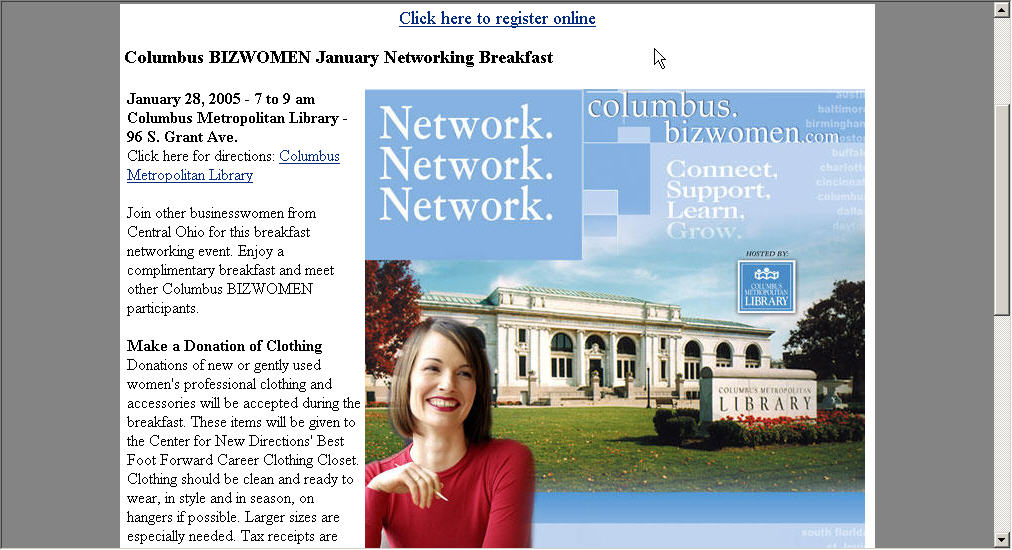
Late-breaking news from an OCLC staffer on the move, Carrie Benseler. The Columbus Metropolitan Library will host the January meeting of the Columbus Businesswomen's networking breakfast.

Information is a Conversation, not a Lecture
I stole the title from Karen's Free Range Librarian post from yesterday "Pensees from WebCred" in which she muses "out loud" on things informational in a most effective and elegant way. Jenny Levine also clipped a sentence or two for The Shifted Librarian. Go read Karen's whole (longish) post. Karen mused in an earlier post that she feels she has regained her (writing) groove and I agree. Lots to chew on.
And I do like to know Karen relishes red sweaters!
Two pensees particularly resonated. One on metadata and one on what Jenny called being part of information seekers' "trusted circles" when I interviewed her for the Scan.
"Metadata should be firmly lashed to information at the beginning of its journey and if possible added to along the way, over the Donner Pass and through cordones sanitaire, so that information becomes less "lossy" and in fact richer in meaning."
"Anne Lipow, a great librarian, innovator, educator, and publisher, often said that the user is not remote from the librarian, the librarian is remote from the user. This is true for all information communities. Our users (readers, patrons) are right there, where they should be; we are the ones who need to close the distance."
There was another Blog conference going on almost the same time as WebCred in Boston...Blog Business Summit happened on the opposite coast--Seattle. Tom Peters' blog has several posts on this.
And in other news....hardly worth commenting on due to the vast coverage but Google Video has debuted as a beta--just as was predicted a few short weeks ago, and which we faithfully reported. I tested it by searching "Donald Trump" although given the vast coverage of that non-event (although I am sure it was a meaningful event to The Donald and Melania) perhaps that was too easy. And it's the 'in' thing to do. Blinkx and Yahoo also released video search engines.
Another interesting Pew study was released, also commented on in many places: Search Engine Users "Users paint a very rosy picture of their online search experiences. They feel in control as searchers; nearly all express confidence in their searching skills. They are happy with the results they find; again, nearly all report that they are usually successful in finding what they’re looking for. And searchers are very trusting of search engines, the vast majority declaring that search engines are a fair and unbiased source of information. " This is, of course, an extension of the research we reported on in the Environmental Scan--that people are generally satisfied looking for things on their own. A must-read for librarians.
And noted in Wired News, "Information Wants to Be Liquid." "Frode Hegland, a researcher at University College London, wants to change the basic structure of information on the net." There's a demo. And no mention of the Semantic Web.
And that's just a few of the information conversations happening "out there".
And I do like to know Karen relishes red sweaters!
Two pensees particularly resonated. One on metadata and one on what Jenny called being part of information seekers' "trusted circles" when I interviewed her for the Scan.
"Metadata should be firmly lashed to information at the beginning of its journey and if possible added to along the way, over the Donner Pass and through cordones sanitaire, so that information becomes less "lossy" and in fact richer in meaning."
"Anne Lipow, a great librarian, innovator, educator, and publisher, often said that the user is not remote from the librarian, the librarian is remote from the user. This is true for all information communities. Our users (readers, patrons) are right there, where they should be; we are the ones who need to close the distance."
There was another Blog conference going on almost the same time as WebCred in Boston...Blog Business Summit happened on the opposite coast--Seattle. Tom Peters' blog has several posts on this.
And in other news....hardly worth commenting on due to the vast coverage but Google Video has debuted as a beta--just as was predicted a few short weeks ago, and which we faithfully reported. I tested it by searching "Donald Trump" although given the vast coverage of that non-event (although I am sure it was a meaningful event to The Donald and Melania) perhaps that was too easy. And it's the 'in' thing to do. Blinkx and Yahoo also released video search engines.
Another interesting Pew study was released, also commented on in many places: Search Engine Users "Users paint a very rosy picture of their online search experiences. They feel in control as searchers; nearly all express confidence in their searching skills. They are happy with the results they find; again, nearly all report that they are usually successful in finding what they’re looking for. And searchers are very trusting of search engines, the vast majority declaring that search engines are a fair and unbiased source of information. " This is, of course, an extension of the research we reported on in the Environmental Scan--that people are generally satisfied looking for things on their own. A must-read for librarians.
And noted in Wired News, "Information Wants to Be Liquid." "Frode Hegland, a researcher at University College London, wants to change the basic structure of information on the net." There's a demo. And no mention of the Semantic Web.
And that's just a few of the information conversations happening "out there".
Monday, January 24, 2005
Habbo Hotel
Alane sent me this link, as a possible safe, fun game. Go ahead, stick your toe in the Habbo Hotel.
And check out their disclaimer:
Sounds familiar, eh?
And check out their disclaimer:
In Habbo Hotel, real people use virtual characters to have authentic conversations, play games, enter competitions, and develop new friendships. It is a fun and nonviolent game environment where the benefits are great, but care must be taken.
Sounds familiar, eh?
Friday, January 21, 2005
Gaming in the Toledo Library
Is the library community on to something or what?
The Toledo-Lucas County Public Library is offering Madden Madness 2005 tomorrow (Saturday, January 22). This is a video game competition with the winner, according to the article in today's Toledo Blade, receiving "an all-expense-paid trip to the Bahamas and a 2006 version of the game."
And to think---I used to get in trouble for showing non-educational 16mm films in the Buffalo and Erie County Public Library branch I worked in as a student!
The Toledo-Lucas County Public Library is offering Madden Madness 2005 tomorrow (Saturday, January 22). This is a video game competition with the winner, according to the article in today's Toledo Blade, receiving "an all-expense-paid trip to the Bahamas and a 2006 version of the game."
And to think---I used to get in trouble for showing non-educational 16mm films in the Buffalo and Erie County Public Library branch I worked in as a student!
How Games are Reshaping Business & Learning
This is a link to an article from the Wisconsin Technology Network ("the region's leading source for news, commentary and analysis for technology and life science") that reports on a program held at U Wisconsin-Madison on gaming yesterday. I found the link in a Slashdot post.
And yes, "our" panelists from the OCLC Symposium, Kurt Squire and Constance Steinkuehler, were two of the three speakers. Their colleague James Gee (a professor of reading) was the third, and are all members of Academic Advanced Distributed Learning (ADL) Co-Lab. All three are described by the authors as "among the top researchers in learning through game-playing."
You'll see some familiar facts in the article and there is active commenting going on--last time I checked there were 29, some lengthy.
But the really cool thing is that this program "How Games are Reshaping Business & Learning" was simulcast via the Web so if you go here, you can click on the red title and the program will open up in a new window and begin. The program is just over 95 minutes long.
If you attended the Symposium, you'll see that Constance picked up a good intro from John "Got Game" Beck who began his presentation with "Name That Tune". And the ideas presented by Kurt and Constance at the Symposium are amplified and reinforced through this program. There's also a link to a paper called "Good Video Games Reinforce Good Learning" coauthored by Kurt and Jim Gee, and others.
And yes, "our" panelists from the OCLC Symposium, Kurt Squire and Constance Steinkuehler, were two of the three speakers. Their colleague James Gee (a professor of reading) was the third, and are all members of Academic Advanced Distributed Learning (ADL) Co-Lab. All three are described by the authors as "among the top researchers in learning through game-playing."
You'll see some familiar facts in the article and there is active commenting going on--last time I checked there were 29, some lengthy.
But the really cool thing is that this program "How Games are Reshaping Business & Learning" was simulcast via the Web so if you go here, you can click on the red title and the program will open up in a new window and begin. The program is just over 95 minutes long.
If you attended the Symposium, you'll see that Constance picked up a good intro from John "Got Game" Beck who began his presentation with "Name That Tune". And the ideas presented by Kurt and Constance at the Symposium are amplified and reinforced through this program. There's also a link to a paper called "Good Video Games Reinforce Good Learning" coauthored by Kurt and Jim Gee, and others.
Thursday, January 20, 2005
Bits and Pieces
Our fellow OCLC blogger, Lorcan Dempsey, notes some things over on his blog that are interesting.
"Worldcat in your pocket" talks about "how far we have come in being able to manipulate and move large amounts of data." WorldCat on your iPod and a 24-node (48-cpu) Beowulf cluster with 96 Gigabytes of memory--whatever this is! Whatever it is, it's hardware that puts data manipulation at warp speed.
And in this posting, Lorcan comments on Stanley Wilder's recent article in the Chronicle of Higher Education (subscription required for online, if you have access to the print, it's the January 7 issue) titled "Information Literacy Makes All the Wrong Assumptions." As someone who did a lot of bibliographic instruction once, I have long thought that something is wrong with the whole approach to information literacy, and while I don't entirely agree with Wilder's proposed solutions, I do agree with his articulation of the problems and issues.
Along with this article, I read Brenda Bailey-Hainer's Library Journal article "Virtual Reference: Alive and Well" and Stephen Abrams article on Google...which, dang it all, I can't lay my hands on right this minute and I only had it in paper. I'll cite when I find it. But, reading these three articles one after another (I was waiting for my car to get a new battery--all the cold weather has been hard on aging parts, automotive and other) was interesting--refreshing, in a way. All three authors are, in essence, asking readers to have another look, another think about topics, we either don't think about or that we think we know everything about, and twisting the issues slightly. All worth reading.
Noted on the Worthwhile blog, an article called Your Third Place Workspace? Given our interest in libraries as a third place, I was happy to see two comments identifying libraries as readers' fav 3rd places.
Addendum: 9pm EST. Here's the Stephen Abram article citation. "Google Scholar: Thin End of the Wedge?" Information Outlook, January 2005, v.9 (1): 44-46. I think this is not on the open web because I got stopped...so, any SLA member want to tell us why this good library content is not available to general readership? I can guarantee "protecting" this content is not going to win SLA more members.
"Worldcat in your pocket" talks about "how far we have come in being able to manipulate and move large amounts of data." WorldCat on your iPod and a 24-node (48-cpu) Beowulf cluster with 96 Gigabytes of memory--whatever this is! Whatever it is, it's hardware that puts data manipulation at warp speed.
And in this posting, Lorcan comments on Stanley Wilder's recent article in the Chronicle of Higher Education (subscription required for online, if you have access to the print, it's the January 7 issue) titled "Information Literacy Makes All the Wrong Assumptions." As someone who did a lot of bibliographic instruction once, I have long thought that something is wrong with the whole approach to information literacy, and while I don't entirely agree with Wilder's proposed solutions, I do agree with his articulation of the problems and issues.
Along with this article, I read Brenda Bailey-Hainer's Library Journal article "Virtual Reference: Alive and Well" and Stephen Abrams article on Google...which, dang it all, I can't lay my hands on right this minute and I only had it in paper. I'll cite when I find it. But, reading these three articles one after another (I was waiting for my car to get a new battery--all the cold weather has been hard on aging parts, automotive and other) was interesting--refreshing, in a way. All three authors are, in essence, asking readers to have another look, another think about topics, we either don't think about or that we think we know everything about, and twisting the issues slightly. All worth reading.
Noted on the Worthwhile blog, an article called Your Third Place Workspace? Given our interest in libraries as a third place, I was happy to see two comments identifying libraries as readers' fav 3rd places.
Addendum: 9pm EST. Here's the Stephen Abram article citation. "Google Scholar: Thin End of the Wedge?" Information Outlook, January 2005, v.9 (1): 44-46. I think this is not on the open web because I got stopped...so, any SLA member want to tell us why this good library content is not available to general readership? I can guarantee "protecting" this content is not going to win SLA more members.


The Paradox of Choice
I subscribe to a great blog called "Good Experience," and it's all about getting companies (and marketing people within companies) to remember that the reason they are in business is the customer. And as such, they should focus their business on the customer experience.
Today's installment had a nice interview with Barry Schwartz, the author of The Paradox of Choice.
Read the interview about the paradox of choice and how it affects the customer experience.
The gist of Schwartz's theory says that the less choices we're faced with in a purchasing decision, the more likely we are to actually make a purchase. With 200 choices, we are overwhelmed and walked away. With 12, we might actually pick something and buy it.
I wonder what happens when we apply the choice-paradox theory to our concept of the library. It's our library-sacred cow that more choice of materials is always better. Right? I want every iteration of The Tempest that is available and I want it at my fingertips--FRBRized, no less.
But what happens when we apply Schwartz's theory to information-shopping? If we remove the price tag (library materials are "free" to the consumer) then the choice rules don't apply? Or is the idea of weeding through information choices applying, while purchasing choices are not?
Food for thought, my friends.
Today's installment had a nice interview with Barry Schwartz, the author of The Paradox of Choice.
Read the interview about the paradox of choice and how it affects the customer experience.
The gist of Schwartz's theory says that the less choices we're faced with in a purchasing decision, the more likely we are to actually make a purchase. With 200 choices, we are overwhelmed and walked away. With 12, we might actually pick something and buy it.
I wonder what happens when we apply the choice-paradox theory to our concept of the library. It's our library-sacred cow that more choice of materials is always better. Right? I want every iteration of The Tempest that is available and I want it at my fingertips--FRBRized, no less.
But what happens when we apply Schwartz's theory to information-shopping? If we remove the price tag (library materials are "free" to the consumer) then the choice rules don't apply? Or is the idea of weeding through information choices applying, while purchasing choices are not?
Food for thought, my friends.
Wednesday, January 19, 2005
The Guardian's Gamesblog
Just came across this blog as I wandered from link to link. What a handy thing to add to My Yahoo! The blog began in mid 2004 and the bloggers are 2 males, 1 female.
"Welcome to Gamesblog, the new computer games weblog from the Guardian. Our aim here is to talk about games in an entertaining, adult way, and help enjoy playing games on whatever gadget you own - PC, games console, handheld device or mobile phone."
This looks like it would be a good way to keep up not only with what's happening with games (they promise no lengthy geeky reviews) but also with game culture. Aleks Krotoski, the female blogger, speaks and writes about women and gaming, something I know Constance Steinkeuhler and at least two symposium attendees were avidly discussing after the program.
And for you librarians interested in this topic but not sure what's what? Remember that blogs are designed to be two way...if you leave a comment or a question for bloggers, you'll get a reply.
"Welcome to Gamesblog, the new computer games weblog from the Guardian. Our aim here is to talk about games in an entertaining, adult way, and help enjoy playing games on whatever gadget you own - PC, games console, handheld device or mobile phone."
This looks like it would be a good way to keep up not only with what's happening with games (they promise no lengthy geeky reviews) but also with game culture. Aleks Krotoski, the female blogger, speaks and writes about women and gaming, something I know Constance Steinkeuhler and at least two symposium attendees were avidly discussing after the program.
And for you librarians interested in this topic but not sure what's what? Remember that blogs are designed to be two way...if you leave a comment or a question for bloggers, you'll get a reply.
Tuesday, January 18, 2005
The Seattle Public Library:Shattering Stereotypes
One of the side benefits of being an old greybeard like myself is that occasionally you get asked to serve on a cool committee. Deb Robertson, the director of ALA's Public Programs Office, nominated me for a spot on the first advisory committee for the office. Deborah Jacobs, the director of the Seattle Public Library, chairs the committee, and we had our first official meetings at this Midwinter conference. One of the things we spent a lot of time talking about (and I swear I didn't introduce the topic) was the idea of creating some public programs for libraries to host about gaming. But that's not what I'm blogging about here.
Rather, I'm afraid I've made some rather intemperate remarks recently about the new downtown Seattle Public Library (different link). I understand that I am utterly in the minority here, that everyone but your humbled correspondent seems to be unreservedly enamored of this building. Of course, word of my remarks got back to Deb Jacobs, as these things will do in our very small field. (And, that, young librarians, is one lesson to take home from today's blog!)
Deb was quite forgiving of my remarks (which you can be when you are dealing with the only oddball in a crowd), but she also told me about an event that sounds fascinating. She's hosting a conference sponsored by the Public Libraries International Network and the Library called "The Seattle Public Library: Shattering Stereotypes." The conference will be held April 27 through 29, with a postconference tour of three new SPL branches on April 30. This conference will showcase not only the new library, but best practices in leading public libraries from around the world. Because space is limited, and only two representatives from any organization will be able to register, you might want to act fast on this one. Deb also tells me that, in keeping with European tradition, the conference will feature a dance!
Rather, I'm afraid I've made some rather intemperate remarks recently about the new downtown Seattle Public Library (different link). I understand that I am utterly in the minority here, that everyone but your humbled correspondent seems to be unreservedly enamored of this building. Of course, word of my remarks got back to Deb Jacobs, as these things will do in our very small field. (And, that, young librarians, is one lesson to take home from today's blog!)
Deb was quite forgiving of my remarks (which you can be when you are dealing with the only oddball in a crowd), but she also told me about an event that sounds fascinating. She's hosting a conference sponsored by the Public Libraries International Network and the Library called "The Seattle Public Library: Shattering Stereotypes." The conference will be held April 27 through 29, with a postconference tour of three new SPL branches on April 30. This conference will showcase not only the new library, but best practices in leading public libraries from around the world. Because space is limited, and only two representatives from any organization will be able to register, you might want to act fast on this one. Deb also tells me that, in keeping with European tradition, the conference will feature a dance!
Home again, Home again, jiggedy jig
Now that almost everyone is back home again...back to eating steamed vegetables instead of cream chowder, milk instead of martinis, I challenge all the ALA MW 2005 attendees to ponder for a minute:
*What did I learn at this conference?
*What new information has challenged my thinking?
*What positive changes can I make in my library because of what I've experienced?
*How can I translate my experience for the staff members who did not attend?
When I was a camp counselor--back in the day--we designated time for the kids to process their "mountaintop experience" on the lasy day of camp, before they went back to the "real world." It's hard to spend 5 days being fed knowledge from all directions, and then find yourself returned to an uncomfortable realization that everyone else not at camp has been living their regular old humdrum life.
And now you, too, have returned to the humdrum...except that that's the wonderful part that happens when we get together as an industry: the formerly mundane becomes exciting again, and lively staff discussion ensues.
Welcome home.
*What did I learn at this conference?
*What new information has challenged my thinking?
*What positive changes can I make in my library because of what I've experienced?
*How can I translate my experience for the staff members who did not attend?
When I was a camp counselor--back in the day--we designated time for the kids to process their "mountaintop experience" on the lasy day of camp, before they went back to the "real world." It's hard to spend 5 days being fed knowledge from all directions, and then find yourself returned to an uncomfortable realization that everyone else not at camp has been living their regular old humdrum life.
And now you, too, have returned to the humdrum...except that that's the wonderful part that happens when we get together as an industry: the formerly mundane becomes exciting again, and lively staff discussion ensues.
Welcome home.
"Gaming in the Library" - NOLA [Ohio] program
This is all good! In a roundabout way today I heard that the April program for NOLA members is "Gaming in the Library." Check here for an interesting sounding program that sounds to me like a full-day version of Migell's portion of the Symposium. So, if any of you live reasonably close to Warren, OH (outside of Cleveland) and are interesting in bringing gaming into your library, this is a program for you.
NOLA Regional Library System is a multitype library agency, consisting of 91 libraries: 37 public, five academic, 43 schools districts and six special libraries in nine northern Ohio counties: Ashtabula, Columbiana, Geauga, Lake, Lorain, Mahoning, Portage, Stark, and Trumbull.
NOLA Regional Library System is a multitype library agency, consisting of 91 libraries: 37 public, five academic, 43 schools districts and six special libraries in nine northern Ohio counties: Ashtabula, Columbiana, Geauga, Lake, Lorain, Mahoning, Portage, Stark, and Trumbull.
"Libraries, the Princeton campus's unknown repository of sexiness"
A must read:
http://www.dailyprincetonian.com/archives/2005/01/17/opinion/11826.shtml
A sample quote:
"Education no doubt can be suggested in the classroom; but education happens in the library."
Thank you, Professor John V. Fleming!
http://www.dailyprincetonian.com/archives/2005/01/17/opinion/11826.shtml
A sample quote:
"Education no doubt can be suggested in the classroom; but education happens in the library."
Thank you, Professor John V. Fleming!
Monday, January 17, 2005
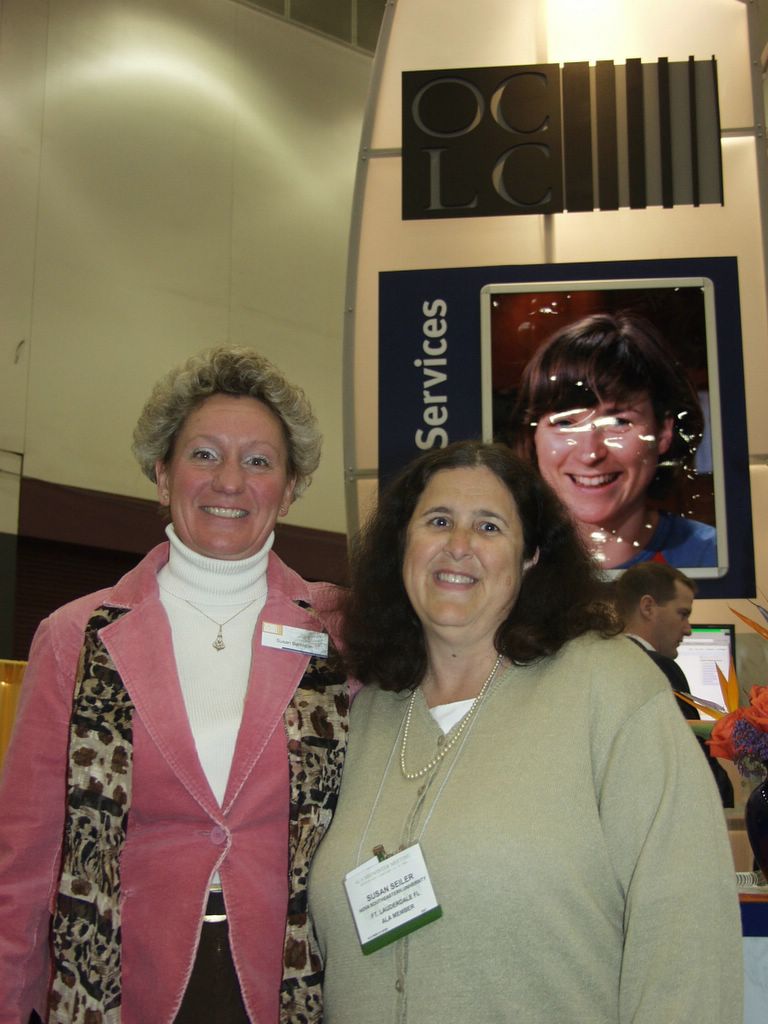
The winner of the OCLC opening reception basket, Susi Seiler. Susi is the Head of Technical Services for Nova Southeastern University Libraries, and she has been a gamer for years. She is pictured here with our own Susan Berntson (left), who came out of retirement to help with this ALA. On an interesting note, Susi said she "never wins anything," but that she AND her ALA-roommate both won baskets this year! Congratulations Susi, and happy listening to your new portable digital audio player while you game!

A poster of the Downloadable Audiobooks offer in the Recorded Books booth. In case you haven't heard, OCLC has partnered with Recorded Books to make eAudiobooks available through the NetLibrary platform. The core collection has 500 titles, and there are also Pimsleur language and biblical audiobooks as well.



Rent-a-dog
Alane set me up for this one! We were talking about entrepreneurship in the hotel bar, and I explained my small business idea: Rent-a-dog.
It all came to me while we lived in Hawaii. I was in Honolulu, working downtown, and my boyfriend-turned-fiancee-now-husband was in Pearl City at Pearl Harbor. Both of us liked dogs but didn't want the responsibility of a dog. I mean, let's face it--dogs are awesome but they are a commitment.
Thus the idea of rent-a-dog was born. It's all the fun of owning a dog, but none of the work. You rent your dog for the day, week or month--and they come fully trained with doggie treats, frisbees and everything. It seemed like a great "girl magnet" for guys, too. Personally, I really wanted a (well-behaved) dog to go to the beach with, so we could play fetch and romp around. Rent-a-dog would have been perfect for me.
Maybe once I become a very wealthy library blogger (ha ha ha), I can finance the venture capital needed to get rent-a-dog off the ground. Any dog-loving capitalists out there, look me up.
It all came to me while we lived in Hawaii. I was in Honolulu, working downtown, and my boyfriend-turned-fiancee-now-husband was in Pearl City at Pearl Harbor. Both of us liked dogs but didn't want the responsibility of a dog. I mean, let's face it--dogs are awesome but they are a commitment.
Thus the idea of rent-a-dog was born. It's all the fun of owning a dog, but none of the work. You rent your dog for the day, week or month--and they come fully trained with doggie treats, frisbees and everything. It seemed like a great "girl magnet" for guys, too. Personally, I really wanted a (well-behaved) dog to go to the beach with, so we could play fetch and romp around. Rent-a-dog would have been perfect for me.
Maybe once I become a very wealthy library blogger (ha ha ha), I can finance the venture capital needed to get rent-a-dog off the ground. Any dog-loving capitalists out there, look me up.
Post ALA musings
I know many librarians would still have been at ALA today but those of us who work for companies rather than libraries are usually gone once the exhibits are over--except for the very hard-working conference staff who are still there tearing down the booth and packing things up so they can be sent to the next conference. Our conference staff does an outstanding job of keeping track of people, OCLC bags, hotel rooms and everything else.
So, I didn't blog from Boston. Alice was doing a good job of populating It's All Good, and I spent a lot of time at the booth and it's hard to blog on a laptop standing up. Or at least I find it hard. ALA is a very different conference for those of us working the exhibits--we exhibitors don't personally get programs and don't have access to the agenda planner ALA has on its website. This makes it quite difficult to figure out what programs and meetings are happening when. And for sure, we don't get invited to the parties! I am still sorry I didn't get to go to the party held at the Kennedy Library--no idea who hosted but a conference attendee asked me about it at the booth and I was envious of the location.
I want to thank Beth Gallaway for her detailed posts about the OCLC Symposium over on the PLA blog. She clearly listened and took excellent notes and I am grateful to her for posting them. The symposium was filmed and will be available on the main OCLC web site in about 3 weeks. We're going to also put the slides up as Kurt Squire, Constance Steinkuehler and John Beck had interesting things on slides they did not explicitly refer to. As the person responsible for the symposium "content" (although my colleague Wendy McGinnis, Director of PR, deserves all the credit for convincing John Beck to speak) I don't want to sound like I am tootling my own horn, but I did think it was a most interesting session, and that is entirely due to the panelists--and the moderator. I'd asked them to make as many connections as they could to gaming's relevance to libraries and librarians and I think they succeeded.
Many people who stopped by the OCLC booth mentioned how much they had got out of the symposium and even though John Beck wasn't there to sign books, we still sold quite a few after he left. One academic librarian said she was giving it to her university's administrators. Jenny Levine's boss Pamela Brown stopped by too. She also liked the symposium and reads It's All Good as well. And Jenny pointed to Beth's excellent summary of the Gaming symposium way before I did!
I ran into Karen Schneider at the President's Advocacy program and had a short conversation about the oddness of meeting people who read our blogs (Karen's is The Free Range Librarian and she also blogged for PLA--and she's right, there's something wonky with the PLA blog, so be patient). It's not that we write into a vacuum because we know there are readers "out there", but meeting them in person is quite different than thinking about an abstract audience. And it's gratifying....well, it is if they like what you do!
And kudos to PLA for blogging ALA. It was most interesting reading and a whole lot better than reading just Cognotes...that human voice is very important. I hope that more associations try this as a way of reaching constituents...it's a whole lot better than quarterly newsletters.
I, like Alice, thoroughly enjoyed Malcolm Gladwell's presentation. He is an engaging speaker--and he's Canadian although my national attennae did not tell me this ahead of him announcing this. In John Beck's parlance, Gladwell would be a Strategy Guide (instead of a Level Boss) showing us interesting things and then reframing these things in a way we hadn't thought of. For me, after Gladwell spoke, presentations were back to the same-old, same-old--in the "how we did it good" mode and there was a tad too much self-congratulation and not enough real examination of what he had suggested. If advocacy efforts in the 90s were so successful, why would funding and profiles of libraries be so low now?
At dinner after the Symposium, John Beck told me that he had just come up with that "Strategy Guide" analogy as a good role for librarians as he was preparing the presentation so it isn't described in his book.
To all of you who stopped at the OCLC booth to talk to us, thanks! We learn things in every conversation.
And I am going to refrain from blogging about our miserable trip to Boston because it'd be very long, and whiney in places. Besides, I think most people travelling from the middle and east of the country had a hard time so I wasn't alone...in fact I had very good company in Moby Dick (a white Buick Le Sabre) on the 6 hour drive from Syracuse, NY to Boston late Thursday night. Despite the problems, my fellow travellers remained cheerful and calm. It did occur to us on that long (expensive) ride that ALA may save money by having conferences in "off season" places, but we, the attendees, often end up spending a lot of extra money due to travel mishaps, especially in the winter--although perhaps that's not altogether true as I recall a couple of unfortunately memorable trips home during thunderstorms from ALA in the summer.
Maybe Alice will tell you about her "Rent-A-Dog" business idea...she shared this with me yesterday as we had a very late lunch in the Marriott hotel bar where just about everyone else was watching the Patriots-Colts game.
So, I didn't blog from Boston. Alice was doing a good job of populating It's All Good, and I spent a lot of time at the booth and it's hard to blog on a laptop standing up. Or at least I find it hard. ALA is a very different conference for those of us working the exhibits--we exhibitors don't personally get programs and don't have access to the agenda planner ALA has on its website. This makes it quite difficult to figure out what programs and meetings are happening when. And for sure, we don't get invited to the parties! I am still sorry I didn't get to go to the party held at the Kennedy Library--no idea who hosted but a conference attendee asked me about it at the booth and I was envious of the location.
I want to thank Beth Gallaway for her detailed posts about the OCLC Symposium over on the PLA blog. She clearly listened and took excellent notes and I am grateful to her for posting them. The symposium was filmed and will be available on the main OCLC web site in about 3 weeks. We're going to also put the slides up as Kurt Squire, Constance Steinkuehler and John Beck had interesting things on slides they did not explicitly refer to. As the person responsible for the symposium "content" (although my colleague Wendy McGinnis, Director of PR, deserves all the credit for convincing John Beck to speak) I don't want to sound like I am tootling my own horn, but I did think it was a most interesting session, and that is entirely due to the panelists--and the moderator. I'd asked them to make as many connections as they could to gaming's relevance to libraries and librarians and I think they succeeded.
Many people who stopped by the OCLC booth mentioned how much they had got out of the symposium and even though John Beck wasn't there to sign books, we still sold quite a few after he left. One academic librarian said she was giving it to her university's administrators. Jenny Levine's boss Pamela Brown stopped by too. She also liked the symposium and reads It's All Good as well. And Jenny pointed to Beth's excellent summary of the Gaming symposium way before I did!
I ran into Karen Schneider at the President's Advocacy program and had a short conversation about the oddness of meeting people who read our blogs (Karen's is The Free Range Librarian and she also blogged for PLA--and she's right, there's something wonky with the PLA blog, so be patient). It's not that we write into a vacuum because we know there are readers "out there", but meeting them in person is quite different than thinking about an abstract audience. And it's gratifying....well, it is if they like what you do!
And kudos to PLA for blogging ALA. It was most interesting reading and a whole lot better than reading just Cognotes...that human voice is very important. I hope that more associations try this as a way of reaching constituents...it's a whole lot better than quarterly newsletters.
I, like Alice, thoroughly enjoyed Malcolm Gladwell's presentation. He is an engaging speaker--and he's Canadian although my national attennae did not tell me this ahead of him announcing this. In John Beck's parlance, Gladwell would be a Strategy Guide (instead of a Level Boss) showing us interesting things and then reframing these things in a way we hadn't thought of. For me, after Gladwell spoke, presentations were back to the same-old, same-old--in the "how we did it good" mode and there was a tad too much self-congratulation and not enough real examination of what he had suggested. If advocacy efforts in the 90s were so successful, why would funding and profiles of libraries be so low now?
At dinner after the Symposium, John Beck told me that he had just come up with that "Strategy Guide" analogy as a good role for librarians as he was preparing the presentation so it isn't described in his book.
To all of you who stopped at the OCLC booth to talk to us, thanks! We learn things in every conversation.
And I am going to refrain from blogging about our miserable trip to Boston because it'd be very long, and whiney in places. Besides, I think most people travelling from the middle and east of the country had a hard time so I wasn't alone...in fact I had very good company in Moby Dick (a white Buick Le Sabre) on the 6 hour drive from Syracuse, NY to Boston late Thursday night. Despite the problems, my fellow travellers remained cheerful and calm. It did occur to us on that long (expensive) ride that ALA may save money by having conferences in "off season" places, but we, the attendees, often end up spending a lot of extra money due to travel mishaps, especially in the winter--although perhaps that's not altogether true as I recall a couple of unfortunately memorable trips home during thunderstorms from ALA in the summer.
Maybe Alice will tell you about her "Rent-A-Dog" business idea...she shared this with me yesterday as we had a very late lunch in the Marriott hotel bar where just about everyone else was watching the Patriots-Colts game.
Creating an Advocacy Epidemic
Alane and I attended the ALA President's Program, "Creating an Advocacy Epidemic." The program was geared for public libraries, although there were some academic folks in the back, I saw.
Malcolm Gladwell was fantastic. Totally want to run out and find his latest books The Tipping Point and Blink.
He tee'd us up for thinking about library advocacy in an epidemic way.
Background on epidemics
Epidemics differ from marketing campaigns or advertising because the word has it's roots in medical terminology. It differs from marketing in that it is non-linear and typically gets spread by word-of-mouth, at a grassroots level. [Alice aside: sounds suspiciously like viral marketing to me, but there we are.]
Malcom gave a great example of a recent (American) epidemic: the Atkins diet. Why did it catch on like wildfire? Because Atkins reframed our concept of diet and made it simpler. Instead of doing complicated math for calorie counts and portion control, simply eliminate carbs. And everyone loved it because it was a new way to diet that was easy to follow.
Reframing
Malcolm talked about reframing the concept of libraries, in order to shift the general public's perception of what we are all about. In old-fashioned marketing terms, this sounds like nothing more than re-positioning your brand. Or put another way, repurposing your product. One of my favorite examples of this phenomenon is baking soda.
Baking soda sales were flat. Arm and Hammer had developed all the recipes it could that used baking soda instead of powder, and no amount of marketing the leavening power of baking soda was going to save the company. So someone figured out that baking soda can also eliminate unpleasant odors. Voila, a whole other aspect of the product that no one even knew it could do. They reframed baking soda to highlight its odor-removal use. And they did it so effectively that now all of us buy 2 boxes of baking soda--one for the frig and one to use in cooking. And the product itself did not change one bit. It kept on being baking soda. But the world around it changed.
[NB Malcom Gladwell didn't talk about baking soda. It's the value-added perspective you get from having your ALA MW covered by Weegee.]
Baking soda for libraries
So your sermon today is: can libraries be like baking soda? Can we reframe our position in people's minds? I think we can--and we've started to do it with the "Your public library is a small-business incubator" theme. We reframed the public library from a place you drop your kids for storytime, to a high-tech hub with resources, answers and a space for entrepreneurship to happen. At least, that's the idea.
As my former boss Gregor used to say, "If we can't be aspirational about this issue, who will be? Shoot the moon!" And I couldn't agree more. Let's use our social power to make this happpen. Ideas? Comments?
Malcolm Gladwell was fantastic. Totally want to run out and find his latest books The Tipping Point and Blink.
He tee'd us up for thinking about library advocacy in an epidemic way.
Background on epidemics
Epidemics differ from marketing campaigns or advertising because the word has it's roots in medical terminology. It differs from marketing in that it is non-linear and typically gets spread by word-of-mouth, at a grassroots level. [Alice aside: sounds suspiciously like viral marketing to me, but there we are.]
Malcom gave a great example of a recent (American) epidemic: the Atkins diet. Why did it catch on like wildfire? Because Atkins reframed our concept of diet and made it simpler. Instead of doing complicated math for calorie counts and portion control, simply eliminate carbs. And everyone loved it because it was a new way to diet that was easy to follow.
Reframing
Malcolm talked about reframing the concept of libraries, in order to shift the general public's perception of what we are all about. In old-fashioned marketing terms, this sounds like nothing more than re-positioning your brand. Or put another way, repurposing your product. One of my favorite examples of this phenomenon is baking soda.
Baking soda sales were flat. Arm and Hammer had developed all the recipes it could that used baking soda instead of powder, and no amount of marketing the leavening power of baking soda was going to save the company. So someone figured out that baking soda can also eliminate unpleasant odors. Voila, a whole other aspect of the product that no one even knew it could do. They reframed baking soda to highlight its odor-removal use. And they did it so effectively that now all of us buy 2 boxes of baking soda--one for the frig and one to use in cooking. And the product itself did not change one bit. It kept on being baking soda. But the world around it changed.
[NB Malcom Gladwell didn't talk about baking soda. It's the value-added perspective you get from having your ALA MW covered by Weegee.]
Baking soda for libraries
So your sermon today is: can libraries be like baking soda? Can we reframe our position in people's minds? I think we can--and we've started to do it with the "Your public library is a small-business incubator" theme. We reframed the public library from a place you drop your kids for storytime, to a high-tech hub with resources, answers and a space for entrepreneurship to happen. At least, that's the idea.
As my former boss Gregor used to say, "If we can't be aspirational about this issue, who will be? Shoot the moon!" And I couldn't agree more. Let's use our social power to make this happpen. Ideas? Comments?
Sunday, January 16, 2005

Michael Somers, a library director from Bridgewater State College, Mass. asks what the turnaround time will be for WorldCat Collection Analysis results. Answer: 24-72 hours, with real-time data manipulation capabilities after that.
WorldCat Collection Analysis
I attended Glenda Lammers informational session on this new product, slated to come out in March. WorldCat Collection Analysis is a very sensible way to get even more value out of our collective industry investment in WorldCat. Duh, we should use it as a tool for comparitive analysis betwixt and between libraries.
The service relies on up-to-date holdings in WorldCat, and then you select your peer group to compare against. The interface look and feel is very similar to FirstSearch. So similar, in fact, that I think it is a tab on your FirstSearch authorization. No new password required. That's a small but appreciated nod to OCLC's attempt to simplify what on my desk is a growing wad of sticky notes...
So from the tenor of the room today, what everyone is quite eager about is to be able to do an in-depth collection analysis with only a 72 hour turn-around time for the data. (Instead of 3 weeks and hours of paperpushing, I take it?) Of course, seeing some sample results screens got us all very curious to think about who we'd set our library up to compare against. Who are some of your peer library collections?
Another cool thing is that once you do the comparisons and identify titles you'd like to acquire, you can link straight out to Alibris, Abe Books, etc and buy the books! Talk about efficiency. This is cool.
The service is available for individual libraries or library groups, and the pricing is based on your number of holdings. Even for the biggest category--more than 1 million holdings--a year's subscription was only $8500 plus a one-time $500 set up fee.
The service relies on up-to-date holdings in WorldCat, and then you select your peer group to compare against. The interface look and feel is very similar to FirstSearch. So similar, in fact, that I think it is a tab on your FirstSearch authorization. No new password required. That's a small but appreciated nod to OCLC's attempt to simplify what on my desk is a growing wad of sticky notes...
So from the tenor of the room today, what everyone is quite eager about is to be able to do an in-depth collection analysis with only a 72 hour turn-around time for the data. (Instead of 3 weeks and hours of paperpushing, I take it?) Of course, seeing some sample results screens got us all very curious to think about who we'd set our library up to compare against. Who are some of your peer library collections?
Another cool thing is that once you do the comparisons and identify titles you'd like to acquire, you can link straight out to Alibris, Abe Books, etc and buy the books! Talk about efficiency. This is cool.
The service is available for individual libraries or library groups, and the pricing is based on your number of holdings. Even for the biggest category--more than 1 million holdings--a year's subscription was only $8500 plus a one-time $500 set up fee.
He's Back!
Tom Lehrer, one of my favorite songwriters and performers, once complained about the endless stream of plays, books, and movies about people who have trouble communicating. Lehrer said, "If you can't communicate, the least you can do is shut up!" Early on when Alice and Alane asked me about starting this blog, I decided that if I didn't have anything to say, I wasn't going to say it here. So for the last few weeks, I haven't had a lot to contribute. But this weekend at ALA Midwinter has given me something I want to talk about.
The Symposium, pictures of which have been posted by OCLC's answer to Weegee, Alice Sneary, was terrific. Each of the participants brought an interesting perspective to the question of what libraries can learn from gamers. Kurt Squire and Constance Steinkuehler took the academic perspective and coupled it with Constance's personal interest in Lineage. Marilyn Mason tied WebJunction to games, and Migell Acosta talked about how the Santa Monica Public Library has used LAN parties in a mutually beneficial way: the kids get a safe place to play with well-networked machines, and the library gets exposure to a new source of input on how to appeal to this generation. (Kurt, Constance, and Migell had spoken at OCLC in October. Kurt and Constance were the keynoters at Members Council, and Migell spoke on a panel presentation for staff in a program immediately after the Council meeting.) After a break, John Beck, author of "Got Game: How the Gamers Generation Is Reshaping Business Forever," made a superb case for how the generation of people conceived in Pong, weaned on SuperMario and matured in Massively Multiplayer Online Games, are changing and will change the workplace.
The questions and answers were excellent, and it seems like the audience really got it. We got a lot less of "Why is this important to libraries?" than we might have expected. Instead, attendees learned more about a way to think about their users from a generational perspective, and they heard some interesting ideas about how this perspective could be applied. Gamers impress me with their enthusiasm, their optimism, and their willingness to try new things. If the gamer generation can apply these traits in our libraries, we have nothing to worry about for the future of libraries. We just need to have enough sense to take advantage of what they bring to the table!
I've also spent several hours working in the OCLC Exhibit Hall booth. Donna Gehring, who manages our conference presence with unbelieveable patience and an almost Zen calm, assigns me as a generalist on the booth, which means basically I get to help people sign up for the drawing and then direct them to someone who actually knows something about OCLC products and services. What has been most gratifying this week is that a number of blog readers have stopped by to tell us how much they enjoy "It's All Good." It was a real ego trip, and now I know why authors like book signings!
The Symposium, pictures of which have been posted by OCLC's answer to Weegee, Alice Sneary, was terrific. Each of the participants brought an interesting perspective to the question of what libraries can learn from gamers. Kurt Squire and Constance Steinkuehler took the academic perspective and coupled it with Constance's personal interest in Lineage. Marilyn Mason tied WebJunction to games, and Migell Acosta talked about how the Santa Monica Public Library has used LAN parties in a mutually beneficial way: the kids get a safe place to play with well-networked machines, and the library gets exposure to a new source of input on how to appeal to this generation. (Kurt, Constance, and Migell had spoken at OCLC in October. Kurt and Constance were the keynoters at Members Council, and Migell spoke on a panel presentation for staff in a program immediately after the Council meeting.) After a break, John Beck, author of "Got Game: How the Gamers Generation Is Reshaping Business Forever," made a superb case for how the generation of people conceived in Pong, weaned on SuperMario and matured in Massively Multiplayer Online Games, are changing and will change the workplace.
The questions and answers were excellent, and it seems like the audience really got it. We got a lot less of "Why is this important to libraries?" than we might have expected. Instead, attendees learned more about a way to think about their users from a generational perspective, and they heard some interesting ideas about how this perspective could be applied. Gamers impress me with their enthusiasm, their optimism, and their willingness to try new things. If the gamer generation can apply these traits in our libraries, we have nothing to worry about for the future of libraries. We just need to have enough sense to take advantage of what they bring to the table!
I've also spent several hours working in the OCLC Exhibit Hall booth. Donna Gehring, who manages our conference presence with unbelieveable patience and an almost Zen calm, assigns me as a generalist on the booth, which means basically I get to help people sign up for the drawing and then direct them to someone who actually knows something about OCLC products and services. What has been most gratifying this week is that a number of blog readers have stopped by to tell us how much they enjoy "It's All Good." It was a real ego trip, and now I know why authors like book signings!
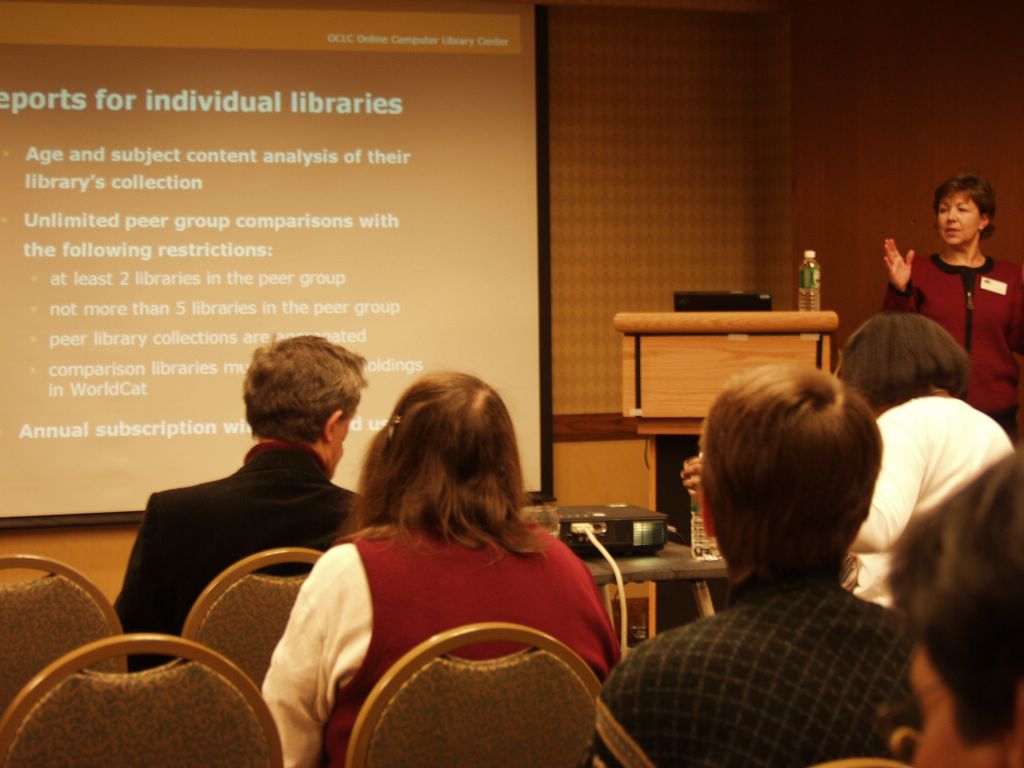
Ready for Advocacy session
Okay gang, I have more photos to download and post for you...but I'm gearing up to attend the ALA President's Advocacy forum. It starts at 3 pm so I'd better motor. Wish it was easier to moblog at this show. I'm been mourning my technical nonconvergeance...no bluetooth, no picture phone, no wifi. But lots and lots of bloggable moments.
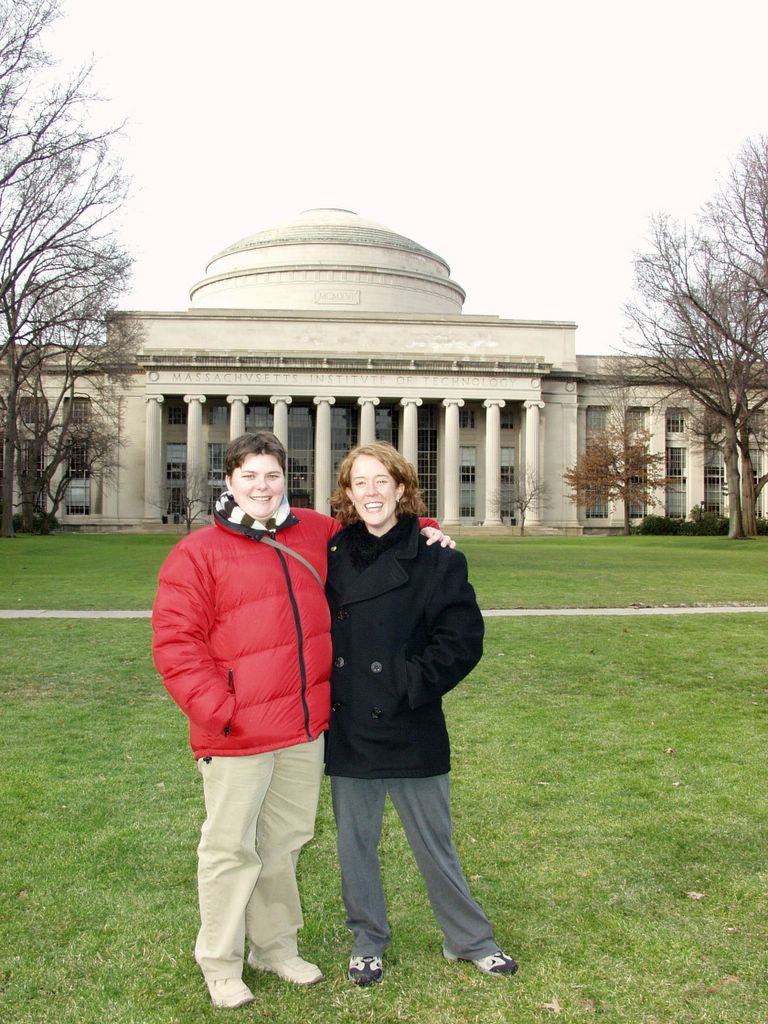
Boston is full of great sights--in addition to the OCLC activities. Because I am committed to bringing you the WHOLE experience of the conference, I of course had to wander offsite for a quick tour of MIT
Can you believe this is a dorm? It's called Simmons and this photo does not adequately capture the architectural presence. Here's the back story on it.


OCLC Library Services staff compare notes and relax after the first full day of exhibits on Saturday. Pictured L-R are Robert Norvell, Carmen Candlin, Ron Glass and Danny Overstreet. If you haven't heard about the new Downloadable Audiobooks or the NetLibrary Collection Developer series yet, one of these guys would be happy to demo it for you.
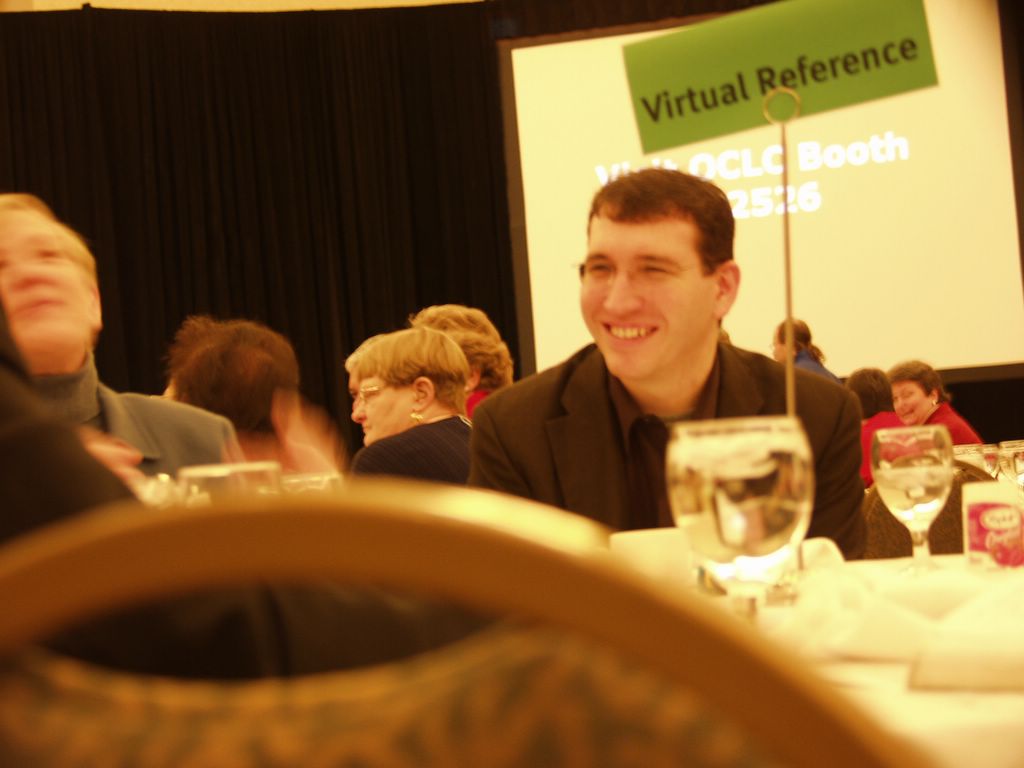


Saturday, January 15, 2005

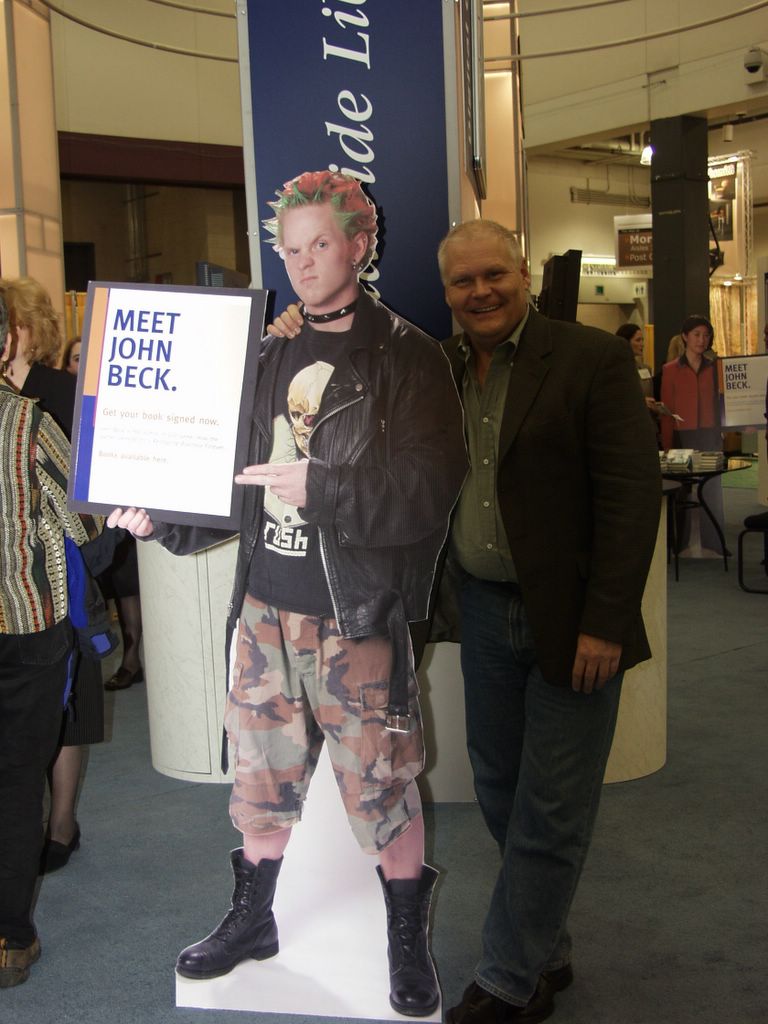


Symposium, Opening reception, Book signing and more
So much happened yesterday! Promise to get you up to speed--but I also have to dash to an 11:30 meeting soon.
My day yesterday was the OCLC exhibit booth. We hung the ring header (yes, the riggers finally came) and got everything put in place. Had a madcap dash to buy a few essentials--trash cans can be precious commodities sometimes--and voila the booth was ready, right on time.
Good thing, because while I was setting up over in the exhibit hall, the Symposium was going like gangbusters. Alane said she looked out over the crowd and realized it was the youngest audience we'd ever had--and people stayed to hear about Gaming and the significance for information literacy and learning.
John Beck, author of Got Game? was a panelist, as well as Kurt Squire, Constance Steinkuehler, Marilyn Mason, Migell Acosta and our own blogger-bud, George Needham. I hear it was a fantastic time and that we'll have it available on the OCLC Web site as a streaming video. Alane even mentioned something about editing out the umms and ahhhs. I can't wait to watch it. If the discussions we had a dinner later were any indication of the enthusiasm of the Symposium, it's going to be a great show, indeed.
The gamers then celebrated the successful Symposium, book signing and opening reception with a smashing dinner together. They invited me because of course, they wanted their celebrity presence blogged.
Now for photos!
My day yesterday was the OCLC exhibit booth. We hung the ring header (yes, the riggers finally came) and got everything put in place. Had a madcap dash to buy a few essentials--trash cans can be precious commodities sometimes--and voila the booth was ready, right on time.
Good thing, because while I was setting up over in the exhibit hall, the Symposium was going like gangbusters. Alane said she looked out over the crowd and realized it was the youngest audience we'd ever had--and people stayed to hear about Gaming and the significance for information literacy and learning.
John Beck, author of Got Game? was a panelist, as well as Kurt Squire, Constance Steinkuehler, Marilyn Mason, Migell Acosta and our own blogger-bud, George Needham. I hear it was a fantastic time and that we'll have it available on the OCLC Web site as a streaming video. Alane even mentioned something about editing out the umms and ahhhs. I can't wait to watch it. If the discussions we had a dinner later were any indication of the enthusiasm of the Symposium, it's going to be a great show, indeed.
The gamers then celebrated the successful Symposium, book signing and opening reception with a smashing dinner together. They invited me because of course, they wanted their celebrity presence blogged.
Now for photos!
Friday, January 14, 2005
Live and Direct from Boston
Good morning scanbloggers.
Thought I'd catch you up on latest news from your favorite worldwide library cooperative:
I'm going to bring you the news as it happens from ALA MW 2005...so even if you're not enjoying balmy Boston, you can still be in the know from OCLC.
I'm here on the exhibits floor in-progress in the Hynes Convention Center, waiting for the riggers. I have a fantastic camera (you'll see results as soon as I dig out the USB cable) this trip, loaned to me by our resident photographer, printing expert and all-around go-to-him-and-he-can-get-it-done-guy, Rich Skopin.
Our rigging director just showed up--more later.
Thought I'd catch you up on latest news from your favorite worldwide library cooperative:
I'm going to bring you the news as it happens from ALA MW 2005...so even if you're not enjoying balmy Boston, you can still be in the know from OCLC.
I'm here on the exhibits floor in-progress in the Hynes Convention Center, waiting for the riggers. I have a fantastic camera (you'll see results as soon as I dig out the USB cable) this trip, loaned to me by our resident photographer, printing expert and all-around go-to-him-and-he-can-get-it-done-guy, Rich Skopin.
Our rigging director just showed up--more later.
Tuesday, January 11, 2005
Left brain or right brain?
If you've been reading "It's All Good" for a while, you may recall that a few months ago I lamented that OCLC hadn't got anything to show for the long time we've been mulling over visual display of information. Well, good news. The pilot has been launched. Our colleague Tom Storey is the editor of the OCLC Abstracts and I stole the title from his notice about the pilot.
Here's what he wrote.
"OCLC and Antarctica Systems, Inc. to test library users’ search preferences.
OCLC is launching a pilot to evaluate library users’ experiences with searching and display of search results using a visual interface developed by Antarctica Systems, Inc. The pilot will run from January through April 2005 and will be implemented on a database of electronic books that will be available to all users of the OCLC Base Package and the OCLC Collection on the OCLC FirstSearch service.
Antarctica Systems, Inc. will use its VisualNet data visualization software to create a visual interface to the electronic books database. When users select the electronic books database on FirstSearch, they will be given the option to use the visual interface for searching and viewing results. OCLC will conduct a user survey to gauge feedback during this pilot and will also collect usage statistics that will be evaluated for future applications."
If you are not a FirstSearch subscriber, Antarctica has a link to the ebooks data here.
Here's what he wrote.
"OCLC and Antarctica Systems, Inc. to test library users’ search preferences.
OCLC is launching a pilot to evaluate library users’ experiences with searching and display of search results using a visual interface developed by Antarctica Systems, Inc. The pilot will run from January through April 2005 and will be implemented on a database of electronic books that will be available to all users of the OCLC Base Package and the OCLC Collection on the OCLC FirstSearch service.
Antarctica Systems, Inc. will use its VisualNet data visualization software to create a visual interface to the electronic books database. When users select the electronic books database on FirstSearch, they will be given the option to use the visual interface for searching and viewing results. OCLC will conduct a user survey to gauge feedback during this pilot and will also collect usage statistics that will be evaluated for future applications."
If you are not a FirstSearch subscriber, Antarctica has a link to the ebooks data here.
Friday, January 07, 2005
Why we need advocacy--and more research
ALA president Carol Brey-Casiano and Bernard Margolis, president of the Boston Public Library have an article in the January 5 Boston Globe on the sorry state of public library funding. "Despite the fact that more people are using libraries than ever before, their funding continues to decrease. More than $80 million has been cut from public library budgets in the past year alone, which has weakened or closed libraries in more than 40 states."
Gloomy as this is there was another statement in the article that particularly caught my attention: "Librarians truly are the 'ultimate search engine,' an incredibly knowledgeable human resource far more responsive and interactive than virtual commercial ones." It did so because I had just read something on the same topic expressing a different view. Rafat Ali at PaidContent.org posted some comments yesterday from an interview on digital media. Here's Rafat's posting.
"The Future of Digital Media: Hank Barry: An excellent interview with Hank Barry, who is a partner at the venture capital firm Hummer Winblad, and has been a close observer of the evolution of digital media - he was CEO of Napster and previously was a partner with Wilson Sonsini Goodrich & Rosati. This point is excellent: 'I think all businesses have tremendous opportunity here. To survive and prosper, they simply need to adapt...They have moved much of their ordering and sales configuration online. It's working. Perhaps contrary to expectations, customers prefer a consistent machine interface to an inconsistent human interface.' That's why I like banking online completely, than going into the bank or even the ATM" (my emphasis)
Now, Carol and Bernie, and Hank and Rafat aren't (necessarily) talking about the same kind of interactions but one of the major trends we focus on in the Environmental Scan is disintermediation of the sort Rafat mentions...interacting with a screen rather than a human.
There is good evidence that for many types of interactions, people actually prefer the machine.
In presentations we do, we often mention an article from Fast Company that George pointed us to called The Toll of the New Machine by Charles Fishman. This long article contains many interesting and important points and "offers a glimpse of the continued power of computers, automation, and the Internet to transform our lives as both workers and consumers--a power that, far from having plateaued, is only just getting started. Information technology hasn't touched lots of things that are just waiting to be automated, computerized, or kiosked. That they will be automated seems inevitable."
I think we continue to give too much weight to the notion that people coming to libraries want to be "served" by a human and I also know that I have no empirical evidence that library users prefer asking where the bathrooms are or why the sky is blue from humans. It's yet another area in our profession where emotion rules over fact, in my very own personal opinion. We don't actually know this; we just assume. And as Mr Fishman points out in his article, "Part of self-service is paying attention to how many different selves you might be serving. " So, I think we need to pay attention to the many kinds of interactions people have in libraries and decide where the real value of human interaction and service lies and focus on those selves and then get cracking on the things that are waiting to be automated.
Gloomy as this is there was another statement in the article that particularly caught my attention: "Librarians truly are the 'ultimate search engine,' an incredibly knowledgeable human resource far more responsive and interactive than virtual commercial ones." It did so because I had just read something on the same topic expressing a different view. Rafat Ali at PaidContent.org posted some comments yesterday from an interview on digital media. Here's Rafat's posting.
"The Future of Digital Media: Hank Barry: An excellent interview with Hank Barry, who is a partner at the venture capital firm Hummer Winblad, and has been a close observer of the evolution of digital media - he was CEO of Napster and previously was a partner with Wilson Sonsini Goodrich & Rosati. This point is excellent: 'I think all businesses have tremendous opportunity here. To survive and prosper, they simply need to adapt...They have moved much of their ordering and sales configuration online. It's working. Perhaps contrary to expectations, customers prefer a consistent machine interface to an inconsistent human interface.' That's why I like banking online completely, than going into the bank or even the ATM" (my emphasis)
Now, Carol and Bernie, and Hank and Rafat aren't (necessarily) talking about the same kind of interactions but one of the major trends we focus on in the Environmental Scan is disintermediation of the sort Rafat mentions...interacting with a screen rather than a human.
There is good evidence that for many types of interactions, people actually prefer the machine.
In presentations we do, we often mention an article from Fast Company that George pointed us to called The Toll of the New Machine by Charles Fishman. This long article contains many interesting and important points and "offers a glimpse of the continued power of computers, automation, and the Internet to transform our lives as both workers and consumers--a power that, far from having plateaued, is only just getting started. Information technology hasn't touched lots of things that are just waiting to be automated, computerized, or kiosked. That they will be automated seems inevitable."
I think we continue to give too much weight to the notion that people coming to libraries want to be "served" by a human and I also know that I have no empirical evidence that library users prefer asking where the bathrooms are or why the sky is blue from humans. It's yet another area in our profession where emotion rules over fact, in my very own personal opinion. We don't actually know this; we just assume. And as Mr Fishman points out in his article, "Part of self-service is paying attention to how many different selves you might be serving. " So, I think we need to pay attention to the many kinds of interactions people have in libraries and decide where the real value of human interaction and service lies and focus on those selves and then get cracking on the things that are waiting to be automated.
Subscribe to:
Posts (Atom)

