Monday, October 10, 2005

Open WorldCat Reviews (revised)

Revision added October 12. Ok, ok...sometimes I write/talk before I think/do (I am an ENTJ on the Myers-Briggs scale) and this was one of those times. As several of my esteemed colleagues informed me...I am flat out wrong about linking in the Open WorldCat reviews feature. Lorcan clarifies in the comments to his original post, linked below. Here's what he said:

Thom Hickey writes a little about how the review functionality is implemented with some links to background information about the underlying technology. Thom points to a review he has started in which there are several links. URL links are now supported. At first there was some concern about links to inappropriate sites. After feedback, it has been decided to allow links and see what happens. The guidelines will be amended to reflect this soon.

Thanks to everyone who corrected me.

Finally, Anonymous Commenter? I do know, generally, what "nudnick" means...and like the sound of the word added to the meaning to connote "annoying wind bags who know nothing."

***************************
Original Post: Only so we don't look like complete know nudnicks, I refer you to Lorcan's post about the release of the terrific review feature in Open WorldCat (no bias here!).

S'wonderful, S'marvelous. Can I just say that it would be more marvelous if we could link from within the review? We bloggy types are habituated to the hot link inside and it feels like amputation to have to communicate in flat text. I've forgotten how to point people to things except to provide a link.

My stalwart OCLC Open Worldcat colleagues....it's all about context! Stand alone bib records--even those enhanced by reviews--are entombed little artifacts. When readers can show others that this book has connections to that book, and this web site and these seventeen journal articles and that one really flakey personal blog...then we're really exposing the value of metadata and exploiting in the best sense the value of WorldCat.

Nice PowerPoints!

At the Ohio Library Council conference last week, Omar Wasow quipped, "Power corrupts. PowerPoint corrupts absolutely."

Despite this sage advice, you might want to check out Eric Childress' PowerPoint presentation on applying the OCLC Environmental Scan in a tech services context. It will be available tomorrow on the Office of Research presentation web site.

If you're attending the Arizona Library Association conference later this week, I hope you'll find time to attend my presentation on Thursday morning, "Google, Gamers and the Gathering Place: Implications of the OCLC Environmental Scan for Arizona Libraries." But if you don't go to my presentation, go see Chrystie Hill, who will be talking about Arizona's WebJunction, or Tim Prather from Amigos Library Services, who will be talking about OCLC's Union List Service. We're all on at 9:00 a.m. Thursday.

Reputation is stronger than truth

A MARC Database Manager and Senior Cataloger at the State Library of North Carolina was on her toes last week. She sent me the story "The Mining of the Invisible Web," and I just about fell on the floor. There is a line in the article,
"Meanwhile Google is creating a comprehensive bibliographic database that it calls WorldCat to search for and find information formerly only found in libraries."


Maybe I've been on my soapbox again lately, talking about reporters checking facts (or NOT checking facts, as the case may be).

I asked if I could share it with everyone, to which she answered:
"Please do share it! I'm so glad you enjoyed it. Though I am steamed on behalf of OCLC and thousands of nameless catalogers that one of our major cooperative products is being attributed to Google..."


And I am pleased to report, there are a number of comments (6 so far) to correct the author. The most colorful, I have to say, is "Sergey Brin was just a gleam in his daddy's eye when OCLC invented WorldCat!"

The other thing it tells me, is that we (OCLC) need to make sure it's very clear who is doing what: librarians and library staff members are building WorldCat. Google is simply indexing it and making it visible/accessible on a much wider scale.

Saturday, October 08, 2005

Omar Wasow: Move from "Information to Transformation"

Omar Wasow was the keynoter on Thursday at the Ohio Library Council conference. What a dynamite speaker!

Mr. Wasow is the co-founder of BlackPlanet.com, an online service aimed at African Americans that now has more than 16 million members. He is also a frequent media guest, on CNN, The Tavis Smiley Show, and, perhaps most notably, as the man who taught Oprah how to use computers in a 12-part series on her show.

Mr. Wasow managed to ingratiate himself with me immediately by NOT talking about how much he liked libraries when he was a child. Instead, he related how he had used libraries this spring to wipe out a few incompletes on his college transcript, allowing him to enroll in a Ph.D. program at Harvard which he started last month.

But the bulk of Mr. Wasow's comments were about how libraries must move from a focus on information to one of transformation. He referred several times to the OCLC Environmental Scan, mostly approvingly but occasionally taking us to task for focusing too much on the information role of libraries. (He did note positively our discussion of the library as "third place," but he thought we should have centered on this more.) He applied the concepts laid out in The Experience Economy by Joseph Pine and James Gilmore to libraries, saying that we should pay as much attention to the experience our users have when they use our services as we do to the services themselves. "The experience of being in a library can be as important as the information available," he said. "Part of the magic of libraries is the experience."

Mr. Wasow's last thought was inspired: "Too often, libraries are viewed as a Temple of Books. To succeed, libraries must embrace that they are Temples of Thought!"

Thursday, October 06, 2005

A Nice Pair of Breaches, or Divides, Digital and Other

Today, I'm speaking at the Ohio Library Council conference here in Columbus on the things we as librarians can learn from the gamer generation. And as I was preparing for the talk, I was thinking a lot about a short essay that Alane turned me on to, called "“Digital Natives, Digital Immigrants,"” by Marc Prensky.

Prensky got me thinking about one of the first roles of American public libraries, the key reason Andrew Carnegie was so interested in underwriting library buildings all over North America. Carnegie believed that having public libraries in every city, town, and village would help geographic immigrants acculturate (and yes, even assimilate) in their new home. The public library and the librarians would help immigrants learn the language, the customs, and the other basic material needed to gain citizenship in this strange land.

To me, this is the library's role in the digital divide. We can help digital immigrants acculturate to this strange new land. We can help them learn the language, the customs, and the basic rules of the road. The librarians at the turn of the 19th century did not see it as their roles to lift people out of poverty and make them middle class American citizens. They saw it as their role to provide access to the tools (anachronistic phrasing, I realize) that the immigrants could use to help themselves.

I agree with Alane that libraries and librarians cannot cure poverty or homelessness, we cannot fix the lives of people who make bad choices, and we can't change the economic system. What we can do is help people learn to use all the tools that are available to them, and then, maybe, they can do those things for themselves.


Tuesday, October 04, 2005

Once More, Into the Breach

Over at BlogJunction, our QuestionPoint (goodness, why did I type QuestionPoint??? And why didn't I notice until Chrystie pointed out on 06/05 that she works for...) WebJunction colleague Chrystie Hill has a thought-provoking post revolving around this question: "Is there anything that’s still relevant to me about my library?"

This is a relevant question! And is related to the data I refer to a couple of posts below that we have in-house and are publishing soon about peoples' perceptions and uses of libraries. Chrystie is much younger than I am, and one trend that's very evident among the data gathered is that younger people (14-25) have much less use for and interest in using libraries and their resources, print or otherwise, than older people. Perhaps this was ever so, but I suspect the disinterest is supported now by other technologies and ways of accessing and delivering content.

Chrystie also says: "Is there enough there there to sustain this concept of libraries for the public good? I’m afraid we can’t sustain ourselves serving only the people in our communities who have no money; the benevolence of our government or other benefactors is far from guaranteed."

Now, at the risk of starting another go-round with George about the Digital Divide (actually I thoroughly enjoy these debates!), this issue of sustainability and serving people with no money (and it's these people that are always assumed to be on the "have not" side of the DD) is huge. There are very few organizations that have sufficient funds, out of the public purse, to serve the disadvantaged adequately (welfare? medicare? food stamps?).

And the current sociopolitical climate, at least in the US, has more and more money being removed from funding the public good from government purses, leaving the gap to be filled, in theory, by generous private benefactors. One response from the library community is that we, then, must step up and bridge the divide on behalf of the disenfranchised.

What are the stats on TV ownership in the US? Rheotrical question because TV ownership is very, very high. There are few disenfranchised wannabe TV /owners/viewers. Why is that? Because most people choose to participate in that form of technology and will assume debt to participate. Which suggests that even people with low annual incomes decide to spend scare dollars on something they value.

OK, I'll stop being oblique. The so-called digital divide, in the US, is one driven by values. If people valued access to seek-it-yourself information, to email, to the internet in the same way that they clearly value access to network TV, I doubt there would be a digitial divide. The DD, simplistically, is a clash of values between what librarians think people want and need and what people opt to spend time and dollars on.

Here's a divide for you: my husand and I own a television. we never watch it. I haven't watched TV at home for almost 20 years. Ahhh, you say to yourself, that's what's wrong with her!

Monday, October 03, 2005

Foiling the Spambots

Dear readers and sometime commenters: we've had to turn on the comment verification feature because, for some reason, the volume of blogspam has jumped recently. So, humans now have to type in the word they see in order to leave a comment. I wonder why so much of our spam was about voip services?

Yahoo to digitize library collections

Now that Google is having to duck and cover on the copyright infringement issue--and the authors guild is up-in-arms--Yahoo will quietly step into the breach.

Here's a snippet of what Scott Carlson and Jeffery R. Young of The Chronicle report about the project:

Yahoo officials say that the project is not a response to Google's partnership with five major research libraries to scan millions of books, and that some planning for the Yahoo project was under way before Google announced its plans last December.

The new archive is called the Open Content Alliance, and it was conceived in part by Brewster Kahle, director of the Internet Archive, a nonprofit digital library. The archive will be doing much of the actual scanning for the project, using a process it has developed in recent years. Libraries involved in the project can have their books scanned by the Internet Archive for 10 cents per page, which leaders of the project say is far below the standard price of scanning.

Other participants in the project are Adobe, the European Archive, the National Archives of England, O'Reilly Media, and Hewlett Packard Labs. The project hopes to attract other libraries and other partners, however, as well as more financial support.


Here's the story as it ran in the Washington Post.

Interestingly enough, the link for Open Content Alliance did not come up on top, for a Google search.

I am a bit irked, though, by headlines such as "Open Content Alliance brings libraries online" (from Macword UK) and wonder if the editor really thinks that libraries just *hadn't thought of it yet* ?

We know the truth, my friends...and I guess this is where we smile as say, "Yes, isn't it wonderful? Great library content, all available online, all the time. A dream come true!"

Thursday, September 29, 2005

Williamsburg, VA

I am in "colonial Williamsburg", at the South Atlantic Regional Conference, which is the annual event for Virginia, North Carolina, South Carolina, Georgia, Florida and Caribbean SLA Chapters.

Tomorrow I will be speaking to attendees about the disaggregation and unbundling of content from its traditional containers, and the changes to the channels in which content is available. This trend was one of the three overarching megatrends we identified in the Environmental Scan, and one we explored in more depth in the "2004 Information Format Trends" report (here).

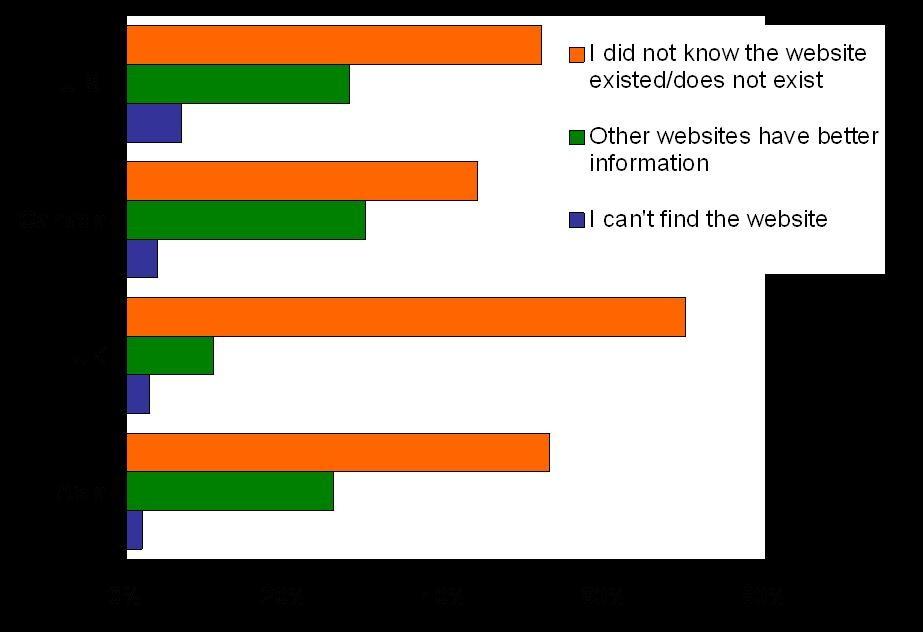
And (foreshadowing drumroll, please) a trend whose bones we decided to put some flesh on. In the OCLC report (not published yet but soon, really soon) of the survey we commissioned one of the major areas we asked the 3300+ responders was about their familiarity with libaries' e-resources. When the report is released (late October we hope) you will see many questions probing for peoples' awareness and perceptions of, and usage of library-provided e-resources. But, here's a teaser: one question we asked was:

"Why haven’t you ever used the online library website?" (This was a follow-up to a question asking if people had used a library website...which is where most if not all libraries provide access to various e-resources). Here's the answers, by country of respondent....and I apologize that the x and y axes have somehow disappeared. This was grabbed from one of our drafts of the report and I have no idea why the format changed. But, for the purposes of making a point, I don't think the values are necessary--the 4 groups represent the geographic groupings, US, Canada, UK, and Asia, top to bottom. The data will be in the report.

Oh. My. Good. Grief. Yes, folks.....3348 Internet-savvy people in 6 countries do not know libraries even have web sites, can't find such an animal, or prefer other websites. Hmmm, and here in the United States ALA has been running the @your library campaign for a couple of years. It'll be interesting to see what before and after measurements ALA will use to determine the effectiveness of the campaign.

One of the open-ended questions we asked in the survey was: what is the first thing you think of when you think of the library? 3,785 comments were documented and the answers were varied but more than half (57%) included books in their response. Here's how one 41 year old Canadian responder put it.
"Books, books, books, rows and rows of books, stacks of books, tables filled with books, people holding books, people checking out books. Libraries are all about books. That is what I think and that is what I will always think.”

Wednesday, September 28, 2005

Being Included is So Important

As long as it's on the right list.

Lists I am not happy to be included on:
1. Not-yet-included-in-our-service-area
2. Customer-prone-to-return-items
3. Fines for overdue materials

Lists I am happy about:
3. Newest customer for the local plumber (we can now use our gas stove!)
2. Sales of existing homes for September (bubble, schmubble)
1. IAG on Technorati Blog finder under "library" and "libraries" (okay, so I got the metadata wrong, but at least it demonstrates the absolute power of metadata!)

Whoo Hoo!
Plus, 288 links from 100 blogs.

Monday, September 26, 2005

At the NWILL Conference


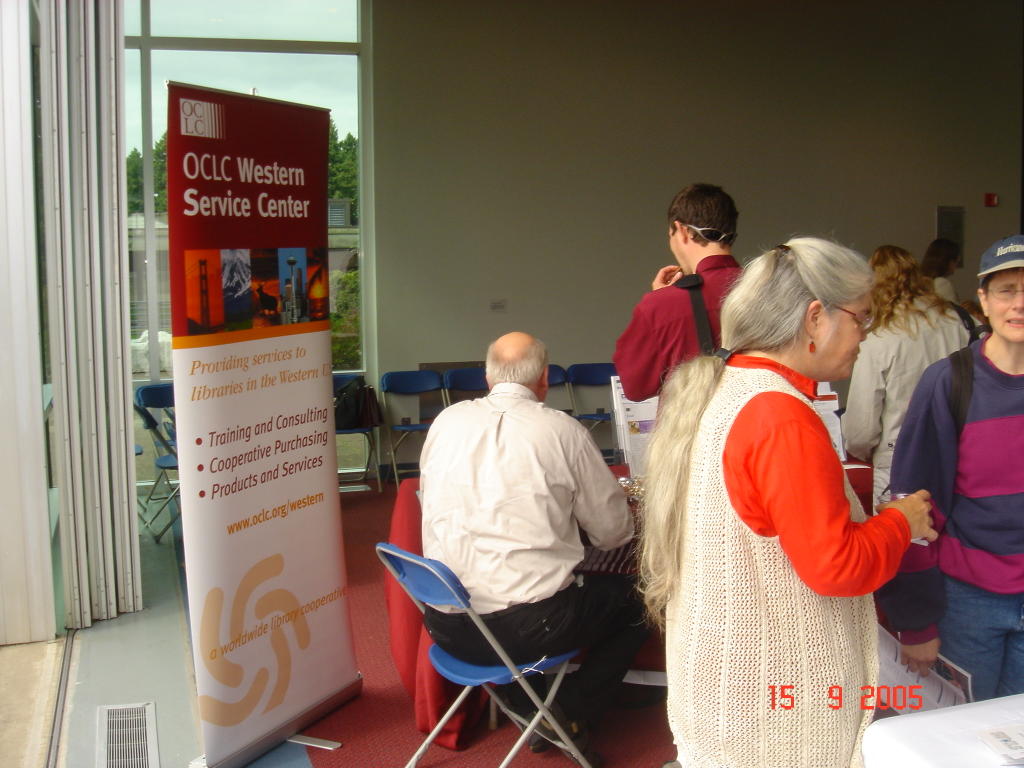
Not a brilliant shot, I admit, but behind me were some floor to ceiling windows that made it impossible to take the picture from the preferred angle. The guy in the white shirt, sitting down, is Sam Sayre of OCLC Western and I hope he was talking to the fellow standing beside him about OCLC ILL services. I'm sure he was.

Sunday, September 25, 2005

Managing the Small World

I can't manage Iran or Afghanistan. I can't even manage ARL or CNI. All I can manage is a pretty small sphere at OCLC. OK, a really small sphere.

What are our spheres of influence? Where can we effectively orchestrate change?

I think blunt answers to these questions are needed. There are many Really Big Issues related to librarianship but as I mull them over (pushed this way by debating with George over the digital divide) I am not sure how many we can operate in.

It seems clear that the message of what a public good the library can be has kinda sunk.....golly, folks would rather pay for the fire department?

So, where else can we live as public entities and how do we garner public support?

Alane's Back

I have been on a work trip and then on to a lovely vacation. But first...George, I never said the digital divide was not a big topic here, so I am not at all surprised it came up at your CA gig. It comes up at every single US presentation I do. In a nutshell, and hugely oversimplified, my opinion on the DD is that it is itself hugely oversimplified here in the US, that the DD is different outside the US, that libraries will not be able to "fix" the DD (because it has it roots in things libraries can do little about--they have no funding nor a mandate from voters) and that the whole discussion as it is currently constituted for us in librarianship is a waste of energy.

OK, on that combatative note...! I started my vacation week by going to Portland OR for a work trip. I was invited to close the Northwest ILL conference with my bud Stephen Abram, . He did the opening keynote and we mulled over what to do for a closer. We were fortunate to be "performing" in the theater at Portland Community College so the very efficient staff found us a bar, fake drinks and bar stools, and we called our talk "From the Bar Stool". Our premise was that most of the interesting conversations at conferences happen outside of the sessions, often in the bar. (Well, that's our experience)

We had fun. We decided we would riff off key points that were on our Powerpoint(less) slides and luckily, both of us are never at a loss for words nor are shy about leaping into the fray. It would not work for all. It's always a pleasure hanging with Stephen, and we also got to hang with some very bright people. Also a great pleasure.

Then, we (my husband and me, not Stephen and me) were off to Penticton for a week.

I read many things I was on the verge of blogging about during my time in "Napa North" but I gave myself the gift of disconnectedness. Which I really enjoyed.

Another disconnectedness observation. Canadian news was not 24/7 about Rita and Katrina. Not surprising at one level because the events were not in Canada. But regardless, here's my take. The much lower level of coverage (both in volume and VOLUME) was a relief. We flew from Vancouver to Chicago and as soon as we entered O'Hare were bombarded with TV images and thoughts about the latest weather event. I felt anxious after 3 minutes. Perhaps we don't need these minute by minute analyses. Perhaps we don't need every single minute filled with images of potential disaster accompanied by the Greek Chorus of newcasters telling us what we should be afraid--very afraid--of. I, for one, am very tired of any kind of media hype about disasters, natural or not. I don't think my quality of life is enhanced at all by a deluge of nothing about the latest Event.

Which reminds me of our own profession. We've been prone, I suggest, to the 24/7 disaster channel. There's a well established Greek Chorus. But, we haven't been very good at coming up with solutions to the flooding of our libraries with Hurricane Google.

And you know? The "Digital Divide" post-Katrina is about access to computers, the web and the Internet. Hasn't got a thing to do with the characteristics of communities that we normally ascribe to these.

Scan Season

To quote the ever-quotable Willie Nelson, I'm on the road again.

Thursday, we had a WebJunction Advisory Committee meeting at the archives of the State Library in Hartford, Connecticut. Part of the meeting was an abbreviated version of my scan presentation. Jim Welbourne, the director of the New Haven Free Public Library, related a very interesting point when we were discussing the concept of self-service. He said that the most frequent type of information sought at their unstaffed kiosk libraries is health information. Despite a consumer health information center in their main library, some people would rather seek information about health questions anonymously.

Friday, Joan Frye Williams and I did a presentation called "The Future of Libraries" at the San Francisco Public Library. We did a tag team presentation, throwing the lead back and forth as we covered the scan and many of Joan's intriguing ideas on the future of public services in libraries. Susan Hildreth, California's State Librarian, followed us, discussing what the State Library is doing in various areas to help build capacity in the libraries there. After lunch, the audience broke into three smaller groups. Joan, Susan and I moved among the groups for three separate but equally lively question and answer sessions. And I hate to tell you, Alane, but the digital divide was one of the hot topics in these small groups! We're repeating this presentation on November 16 in the Los Angeles area.

I'll also be doing scan presentation in October in Columbus (Ohio Library Council); Mesa, Arizona (Arizona Library Association); Williamsburg, Virginia (Virginia Library Association); and Hartford, Connecticut (Connecticut Library Consortium). If you happen to attend any of these events, stop by and say hello!

Wednesday, September 21, 2005

Chicken and Egg

Funny story happened to me the other night.

I told you we've moving house, right? So we're trying to get everything set up: the cable, the refrigerator delivery, the plumber to run the gas line for the gas stove (because yes I AM that impatient to wait for the electric stove to warm up), and the list goes on.

So there had been a Best Buy flier we'd seen, about a special on cable internet access. We go in, because I'm a sucker for specials. I order it. We're going along great until we hit the local phone number question.

Problem one: we don't have a local phone number yet at the house, because we want to do VoIP phone service--which requires an internet connection. Chicken.

So the Geek Squad guy (their name, not mine) behind the counter overrides it and we eventually get to the credit card payment part. I hand him the plastic, dreaming of my "blazing fast" connection.

Problem two: the billing address to my credit card doesn't match up to the service address where the cable is meant to be installed. Right, because we haven't moved in yet. Egg.

And then when I called to activate my account, once I was home, customer service had no record of my Best Buy interaction taking place!

Luckily, it is not nearly so hard to issue a library card. Or is it? Are there tales out there of distributed systems, when you had to send the would-be new cardholder on a mission to get 2 forms of ID and a letter from their neighbor down to the main library--because your branch couldn't process a special circumstance?

It couldn't be much more comical than my experience the other night!

Thursday, September 15, 2005

¡Ola!

WebJunction has developed a pilot program for the Gates Foundation to help "train the trainers" in state libraries and other library agencies in how to serve Spanish-speaking library users. The pilot went so well that Gates has awarded a grant to WebJunction to spread the training to all 50 states.

The only problem with this project is its acronym. We refer to it as Spanish Language Outreach, SLO, but there's nothing slow about it. My friends at the State Library of Ohio have the same unfortunate combination of letters.

Laura Staley, who is managing the project, writes about the new grant and describes the project on WebJunction's BlogJunction.

¡Muchas gracias!

World Usability Day: Nov. 3

World Usability Day: "Making it Easy" November 3, 2005.

The goal of World Usability Day is to promote the fields of usability engineering and user-centered design.

There are more than 70 local World Usability Day events at local chapters across the globe. Hosting your own Usability Day soiree at your library could be a good vehicle to put your name out in the tech community. And they even have logos to promote the day on your site.

Or send a staff contingent out, to attend a local WUD event in your area. Either way, sounds like time well spent in Usability visibility.

I Insulted Them All

On this past Sunday afternoon, I flew to Toronto (on a Dash 8 turboprop that was completely full...although that doesn't take much.) to be the after dinner speaker for a meeting of OCUL directors (the Ontario Council of University Libraries). The setting was bucolic--Eaton Hall, the summer home of Sir John and Lady Flora Eaton in the late 30s and 40s. Eaton Hall is now part of Seneca College and Eaton's the department store is no more. That was a sad day in Canadian retailing when one of the two stalwart Canadian department stores closed (the other being the Hudson's Bay Company which has been operating for almost 400 years) and was bought by Sears.

So, how did I insult all these good people? The main focus of my talk was on generational differences and I began by saying, I am almost 49. Who is younger? No one was. But--as I went on to say--tender psyches or not--we have to figure out how we're going to engage people who inhabit a universe that lies very close to ours and who share many of our attributes, but who are sufficiently different from us that many of their pastimes are quite alien to us baby boomers.

Wednesday, September 14, 2005

I just joined M5, Coca-cola and libraries

Coke just launched some cool work. Check out the M5 project, launched today.
They commissioned some high-end designers to wrap some old-school bottles in hip new designs, and then the new designs will only be available at exclusive clubs.

Now, I have to say, (with a straight face, I might add) I understand that I will be drinking the same old coke from a fancy-schmancy can. Yes. And I am willing to pay triple to have "the experience" of a hip lounge, fancy bottle, aura of coolness.

And I think there are a lot of other people who will, too.

Now, here's where it relates to libraries.
We all thought we knew Coke. I mean, Coca-cola is an uber-stable, globally known and understood brand, right?
Of course. But they've taken the nostalgia that a lot of us associate with coke: the curvy bottle and the color red, and given it a whole new raison d'etre.

Is it going to stop people from buying plain old coke in the grocery stores? Not at all. But is it going to encourage people to think of Coke as a viable alternative when they're out on the town, in the evening? Absolutely. Those bottles are cool, and design does matter.

So if Coke can make the inky-black fizzy stuff that we all know rots our teeth and our insides...and make us think about it in a whole new fresh way (i.e., change the category, for your marketing types)...can't we as library workers start to think of ways we can do the same for our libraries?

The other piece of the coke experience: I just joined M5, an organization that I willingly signed up for, so I would know what the cool clubs are--where they would have the hip bottles. It's a great push from both sides: It gets the clubs to ask if they can sell the product--and it gets the customers to ask to be notified when/where the product will appear. And coke is right in the middle, making the cool experience happen, bringing the people together.

Sounds eerily like one of the scenarios that has been floating in my head: a way for libraries to make the cool experience happen, to bring the people together.

Monday, September 12, 2005

Oracle agrees to buy Siebel

I tell you this because it's news, but also because WorldCat was one of the largest Oracle installations, if I recall correctly--and well worth it because now it can do Cool Things like FRBR views, a wiki in the works and more...

So one more giant tech merger. Scoop is on the Oracle site.

The Giant Tech Merger made personal: My AT&T Wireless phone, now owned by Cingular, has been giving me fits and the Cingular store representative told me my best bet was to wait the 227 more days until my contract expired. Ugh. Giant tech merger that someday result in better service for all of us.

In the meantime, I feel sidelined as a customer.

(Of course, I did hear that Cingular was scrambling to get temporary phone towers up after Katrina, so that people could call their families. So...I should cut them some slack.)

Saturday, September 10, 2005

Given the state of the States, one reason for the quietude here--at least from my point of view--is there's not much to be said that wouldn't be angry, sad, frustrated and disgusted. And because It's All Good operates loosely under the umbrella of OCLC, none of those personal reactions are appropriate. But, my goodness, what a mess.

Relevant to what we do here is to report that OCLC is working on a pretty comprehensive disaster plan for affected libraries--and I wish we could have been a bit faster in getting this done and publicized, but we haven't been able to--there's a lot of details to iron out.

And thanks to Karen Schneider's request for action, I can report that in about 2 hours flat, WebJunction put up a Jobs Needed open site (as in, no registration needed) in the general Katrina discussion area. It's here, and has a link to the Solinet Jobs site. These are intended to assist displaced library staff from the affected states in finding temp or premanent positions. Thank you, Karen, for the suggestion, and Betha and Chrystie at WJ, and Libbie at OCLC for working fast and getting this up.

And the WJ staff have gathered a bunch more useful links related to disasters.

One thing that emerges is that libraries have been "first responders" in a way...where else have displaced people known they could have access to computers to file FEMA applications? Or have access to their email to to try and reconnect with family? Electricity, health care, water and food are essentials. But what is very clear is that free access to information and the carriers of information are likewise crucial in emergencies.

Starving the infrastructure in the United States is not just about ignoring rebuilding levees. It is also about closing libraries.

Wednesday, September 07, 2005

State Library of Louisiana Needs Computers

Here's a very real digital divide. People need access to computers and printers to do all manner of things...look for people, fill out applications and endless forms.

This was posted to the Solinet listserv and sent on to an internal OCLC one. Solinet is the network that serves libraries in all the Katrina-affected states.

The State library of Louisiana has sent out this call for computer equipment...
If you are interested and able to send computers, here is the request from the Louisiana State Librarian, Rebecca Hamilton.
"To all--we are in desperate need of computers/printers. We are being inundated with evacuees needing to file FEMA applications, unemployment, search for loved ones, etc. and are coming into our public libraries to use the computers. Our libraries have greatly extended their hours to accommodate the people but they need additional computers and printers.
If you can please put the word out that if anyone wants to help immediately, this is our greatest need."
The specs for the computers:
* Pentium 3
* Windows 2000, prefer XP
* Laser printers if you can still get toner for them

Computers may be sent to:
State Library of Louisiana
701 North 4th Street
Baton Rouge, La. 70802-5232

If you are able to assist them by sending computers, please let Rebecca know via email: Rebecca Hamilton [rhamilton@crt.state.la.us] just to help them plan. This will help her know what to expect and also help us to know (if necessary) when to stop sending them there. I am sure that we will hear from other states about similar needs."

24 countries

In our ever-shrinking, flat world, I should not be surprised by this figure. But of course I am. I was nosing around for statistics this week on the various projects we've been working on lately--OCLC Member reports, Advocacy Advertising efforts, the redesigned newsletter, the OCLC Symposiums--all of these, good things--but the statistic that stopped me in my tracks this morning?

Almost 4,000 people in 24 countries have acquired the Environmental Scan.


Okay, I admit it: I am easily impressed. But it makes me wonder now, almost two years out from the initial discussions about the document-->what bold decisions are being made in libraries today? What improvements? What trials? What tests?

Or is your library stuck in task force land? Consensus land? Pulled in too many directions and so can't get going in any one direction-land?

The Quorum of Two
It reminds me of the condo agreement my husband and I were reading last night. We're trying to buy 1/2 a big house that has been split in two condo units. So we were wading through the condo association agreements, covenants, bylaws and rules. Lots of important details about 10 business days of notice by registered mail of the annual meeting, etc.

And this is all for a condo association of essentially 2 parties: our half (we hope)and the other guy's half. Finally you read through the whole 14 pages of legalese to see, all decisions made will require a quorum of two. And then the whole thing seemed a bit silly.

I know, I know. It's important to have structure and process to guide an organization. But sometimes it makes just as much sense to knock on the other person's door (you do, after all, share the same house) and say hey, can we meet next week?

A small library, I would guess, is roughly the same: some things are important to have structure about, and some things you can be a little looser, a little freer about. (Is freer a word? Oh, Walt you'll have to correct me...)

How many of those 4,000 people in 24 countries are essentially operating with a quorum of two? Go knock on each other's doors...

Tuesday, September 06, 2005

Far Away

Last week I flew north to Regina, the provincial capital of Saskatchewan. It's a long way from New Orleans and any body of water of a significant size--although a river runs through it, the South Saskatchewan. It is place that many Canadians hate to drive across because of the sameness of the southern landscape and the straight Trans-Canada highway (one curve, I think). I've driven across the province several times and I find the landscape beautiful and the light, particularly at dawn and dusk, often pearly and luminous. The sky...there is a lot of it, even more than in Alberta, because there's little to obstruct the eye. Sometimes the view is so open you can see the curvature of the earth. The population density, according to Wikipedia, is 1.7 people per kilometre. It is the birthplace and home to the labour movement in Canada as well as the training school and museum for the Royal Canadian Mounted Police. Ironic, no?

But this visit, I stayed in Regina, and visited at the Regina Public Library and the Education Centre of the Regina Public Schools, with my colleague Nigel Long of OCLC Canada. On Thursday I did "Libraries and Their Communities: digital immigrants and digital natives" for library staff at the U of Regina at the invitation of Bill Sgrazzutti, the AUL for Research, formerly a colleague of mine at the U of Calgary.

The library system at the University of Regina is one of the few I'm aware of headed up by a non-librarian. Bill Howard has been an English professor and administrator and now administrates the library. I was impressed by his grasp of the library world....among other things, I don't think I've ever heard the phrase "net lender" leave the lips of another library director.

So, on Dr. Howard's watch, the library is undertaking an extensive review of itself and its services. To assist in the review of service quality, it will participate in LibQual+(TM) under the guidance of Julie McKenna whose major responsibility is being the Queen of Assessment, like her colleague Pam Ryan at the University of Alberta. There was no such position when I worked in academic libraries, but this is a trend I celebrate wholeheartedly. When I used Yahoo! to search for the term "assessment librarian" most of the returned items on the first couple of pages were job ads. "Ongoing assessment of all library services" What a concept.

So I was out of the US for most of the awfulness unfolding in the South, particularly the 7th Circle of Hell that the Superdome and Convention Center quickly became in New Orleans. And I was also away shortly after September 11, 2001 when my husband and I were on one of the first international flights to leave Newark, bound for Italy. I must say the reactions from people were different--2001 there was a great deal of support and expressions of solidarity. This time, people were not at all complimentary about relief efforts by the official agencies and would ask me questions I couldn't answer about readiness and planning and race.

And if anyone knows where Mary Holt of the Tulane University's Rudolph Matas Medical Library is, I'd appreciate knowing she's OK. Mary was for many years involved in the now disbanded Health Sciences OCLC Users Group and is known to many OCLC staff.

Monday, August 29, 2005


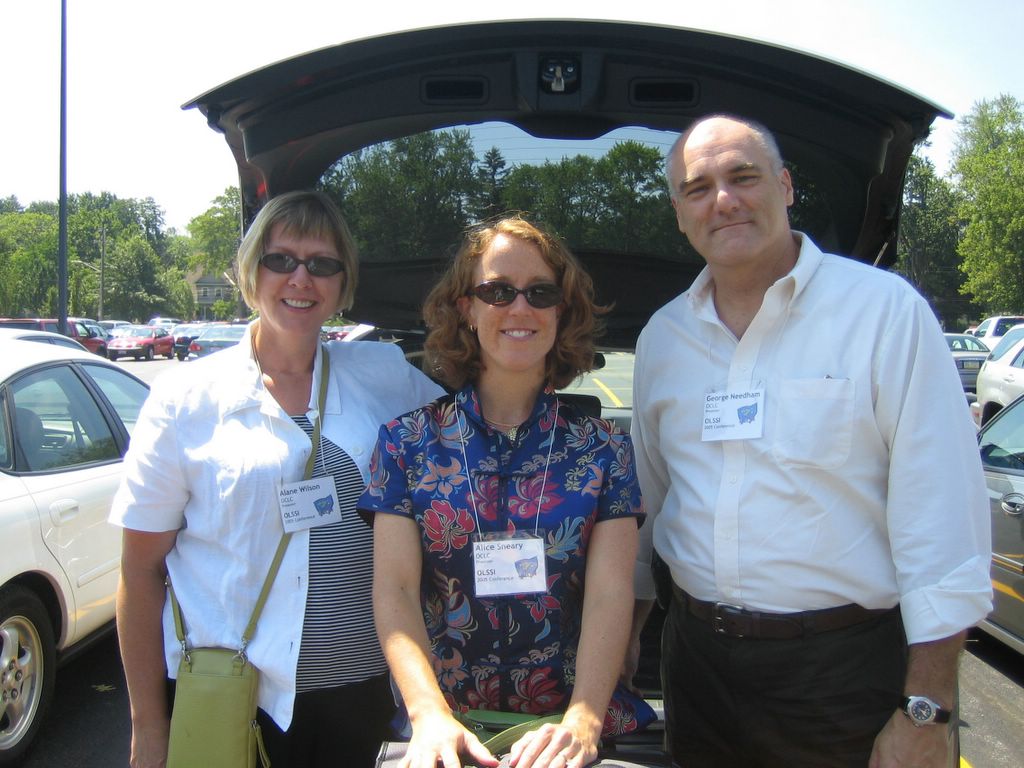
The It's All Good Bloggers, at our recent outing to Cleveland, Ohio. L-R is Alane Wilson, Alice Sneary and George Needham. Posted by Picasa

Entitlement Management Systems

I wasn't familiar with the phrase or the innards of Entitlement Management Systems (perhaps because I am so far removed from the day-to-day backroom operations of libraries) but as a way of bundling a lot of stuff together it's both a useful phrase and what appears to be helpful technology. Digital rights management would be only one part of the whole entitlement process, according to the article I am referring to, from Telephony Online.
Entitlement is the process of authorizing a service (a music or broadcast TV channel, pay per view, etc.) or content (a movie, program, game or special event) to a customer. Entitlement also includes the assignment of rights, which are the rules that govern how services and content can be used.
The article is written from the point of view of for-profit telcos but there's interesting tidbits to be gleaned if you read the article from the point of view of the task of providing disparate content to library patrons.

I found this is in Hot Bytes, a bi-weekly newsletter from the e-Content Institute.

Sunday, August 28, 2005

Evacuation from Hurricane Katrina

To our U.S. colleagues in Louisiana, Mississippi, Alabama and especially New Orleans: I hope you have found safe shelter from the storm.

My husband's parents live right outside New Orleans, so it was a relief to hear that they made it out.

As a librarian/library worker, aren't you glad you've done the hard work of digitizing all your special collections at times like these? And I know SOLINET has preservation programs to assist librarians in the aftermath of natural disasters such as these, to help you know how to dry out your books safely, how to put a disaster plan in place and more. Small solace, I know...

The immediate resource that stands out is "Hurricane: Are You Ready for the Big One? A Primer for Libraries, Museums, and Archives, 1998" By Dr. Michael Trinkley, Director of Chicora Foundation. For $15, you get comprehensive guide to assist libraries, museums and archives in protecting their staff, collections and facilities from the ravage of hurricanes. Covers disaster planning; "storm proofing" your facility (both new construction and retrofitting); recovery efforts; sources for hurricane assistance and consulting; and weather definitions.

For those of us who are land-locked and can't begin to imagine what to do, here are excerpts on:
1. How to prepare for a hurricane
2. What to after it's over

Thanks to SOLINET for making these resources available.

Thursday, August 25, 2005

Public Good on a Small Scale

Thought I'd shoot you guys a Q&A with Chris Maher, a prominent e-mail marketer from Austin, TX. Wanted to share it with you because he's wondering how to connect work with the larger purposes of life, and how he can use his business to promote the Public Good and create a value chain. (His words, not mine.)

Have a look. He had a particular part that caught my attention:

Government has been characterized as the enemy. The enemy. The government that built the highways and bridges; that stepped forward for civil rights (albeit under the flag of interstate commerce); that defends our liberties; that, when all is said and done, can be a voice for the voiceless: This is not my enemy. The question becomes, How do we bring such dead institutions back to life? But, that's not for this discussion.

So, with governments largely irrelevant and with a new breed of public servants who seem conflicted about the role of government to begin with, who can belly up to the bar and look at social problems in new ways? Who can make a useful analogy between core business processes and core civic processes, and start rethinking access to health care, food distribution, provision of shelter, affordable housing, literacy, etc.?

If not business people and other citizens, then who?


Of course, I would substitute "Library staff members" for business people and other citizens there!

Get the whole story through Sept. 2 on MarketingProfs.com.

And once again, the breach wins...

Alane, I hate to burst your bubble, but public libraries have been in the business of teaching for a lot of years.

They've helped immigrants learn the materials they need for a citizenship test, or English as a second (or third, fourth, or fifth in some cases...) language. They've provided space, materials, and often tutors for adults who needed to gain or improve literacy skills. And beyond that, they've offered a wealth of continuing education, personal development, and training courses, from discussions of current events, to awareness of health issues, to how to use a microwave oven. (These are just offerings from public libraries I worked in during the 1970s and 1980s. Heaven knows there are many more examples than this since my salad days.)

So if a public library offers a chance for someone who can't afford it to use a PC, or maybe to learn a few new skills to improve their opportunities at work, that's a tight fit with its traditional mission.

What I can't accept is the idea that people must clear a hurdle before they should be allowed to use the library's services. We don't say, these books are only here if you can read them. Neither should we say these computers are only here if you already know how to use them.

AP story about eAudiobooks

Libraries got good coverage in the news today, with a story squarely about how hip they are with the times and technology, serving people's needs where and when they are. "Libraries Offering Audiobook Downloads."

So far, I've seen the AP story run in the New York Times, the ABC news site and the San Jose Mercury News. I'm sure there are others...but thanks to Brad and Bob for pointing these out. Rock on. Just wish the photos would have shown our cool new in-library posters for eAudiobooks...that yours truly and a slew of additional people worked on. They're free for the asking, so come one, come all and get some fun stuff to help promote your eCollection.

Make some local hay with this national story
As my farming father used to say, "We've got to make hay when the sun shines." And a national library story is some great sunshine to help the local haybaleing effort.

Send it to your local elected officials
You can even be so bold as to send the link to your mayor, city councilpeople, etc. with a short proposal of why eAudiobooks in YOUR LIBRARY would improve literacy rates, boost access to educational materials in rural areas currently underserved by your physical library and increase citizen awareness of local issues. (Because after all, people download the eAudiobooks from the library Web site. What a great place for a message from these same elected officials about their strong support of electronic empowerment initiatives to the voting public!)

I'm all fired up now. Anyone have a city council person I can write to?

Montana Justice Notes Orwell's 1984 Is Now

Here's a fascinating evaluation of the state of privacy in the US today from a Montana Supreme Court justice. Do yourself a favor, and take the time to read the whole opinion.

I don't know if this guy is a Democrat, a Republican, or a Whig, but he has a better understanding of what's going on in America and the world today than nearly anyone else in public life right now. I'd feel just a little more comfortable if I thought someone like this had a chance of being nominated for the US Supreme Court.

Wednesday, August 24, 2005

500th post as a Stepping Stone

It's a red-letter day: it's the 500th post here at IAG. I know you're as excited about it as I am...but there was something quite magnanimous and completely unexpected that came across my inbox today. Worthy of 500 postedness.

Someone is giving away free library shelving in Michigan.


Now before you cry out, "Egad! This eContent thing has really taken off!," know that there is a bit more to the story.

The Stepping Stone school, a gifted school for K-6 in Farmington Hills, MI has bought a vacant college campus--complete with library--and would like to see the shelves find new life in another library. In classic "Save This Old House" style, the business manager, Matt Berg, is willing to offer these good condition shelves out to any library who needs them. For free. Available for the asking.

Spread the word around. Contact number is 248-473-1808.

Conversation, not Content?

Jeff Jarvis, at BuzzMachine, has an interesting post called "Who wants to own content?" This is one of those referrals that I want you to read wearing your "library lens". Jarvis is discussing content owners in the for-profit arena but libraries are in the content ownership and distribution game too. And the shifting ground is beneath our feet as well as the feet of publishers of content and traditional distribution channels like newspapers.

The whole post is "quote-worthy" but here's a few tidbits. Jarvis says, "the value is no longer in maintaining an exclusive hold on things. The value is no longer in owning content or distribution. The value is in relationships. The value is in trust."

Why? Because "There is no scarcity of good stuff. And when there is no scarcity, the value of owning a once-scarce commodity diminishes and then disappears."

"[I]n this new age, you don’t want to own the content or the pipe that delivers it. You want to participate in what people want to do on their own. You don’t want to extract value. You want to add value. You don’t want to build walls or fences or gardens to keep people from doing what they want to do without you. You want to enable them to do it. You want to join in."

So, one thing this suggests is that the parts of the content industry that have experience with relationships and trust--like libraries--should be in the ascendancy. Are we dismantling the fences and walls and expanding our trust circles? Slowly.

A puzzlement to me--and something Jarvis doesn't address much--is how trust, relationships and conversation become monetized. In other words, libraries receive funding to be--for the most part--the content owners and the distribution pipes. How would they be funded for such ephemeralities as trust and conversation?

Tuesday, August 23, 2005

Once More, Into the Breach

Although I think Will Shakespeare was writing about a real divide....

OK, study this. A book by a fellow called Mark Warschauer. Title is Technology and Social Inclusion: Rethinking the Digital Divide. The front flap (according to my Amazon view) says: "Much of the discussion about new technologies and social equality has focused on the oversimplified notion of a 'digital divide' [...] What is most important is not so much the physical availibility of computers and the Internet but rather people's ability to make use of those technologies to engage in meaningful social practices."

Exactly.

Libraries did not teach people how to read and write in the olden days when these skills were less ubiquitous than they are now. They did provide grist for the mill once those skills were acquired. Why now does George think it's the job of libraries to teach another form of literacy? And if he says it's because no one else is doing it and libraries have a social obligation, I'll suggest that there are a lot of hungry, ill-clad, ill-housed, unhealthy people visiting libraries. and that we will need a lot more money in order to become the umbrella social services agency in our communities, and librarians will need a lot more training.

So, what is the social purpose of a library?

Monday, August 22, 2005

Back from holiday

Hey guys. I'm now officially back from jury duty, summer holidays, moving house and more. It's been a wild August, to say the least.

But it seems as though George and Alane have been stirring things up sufficiently, even without me chiming in to egg them on.

I'm packing up the laptop now, to leave on a library adventure to Connecticut. A group of us are heading to Fairfield University to learn a bit more about what electronic resources they have, how they're marketing them to the students and faculty and to see if we can think up some good ideas on additional ways to reach those audiences.

Will send a dispatch from the road! Good to be back. I've missed you, IAG readers.

Friday, August 19, 2005

Book Vending Machines

In the name of 24/7 library service, I present this piece from today's Forbes.com. It seems that a publisher in France has developed machinery to sell books around the clock to literature-starved Parisians. Of course here in the US, we just slip down to the all-night supermarket or, if you happen to live in Arlen, Texas, the Megalomart, for that post-midnight classic. In France, where the stores are generally open on a human schedule, that's not an option.

But couldn't libraries do something like this? Maybe it would be just a small collection of your popular materials, like bestsellers, DVDs, and CDs perhaps. Go online, order up what you want from this limited collection, a robot goes out to the shelf, retrieves the item, places it in a lock box, you use your card and a PIN to open the lock box, and voila: You'll have your copy of À la recherche du temps perdu with your morning tea and madeleines. Just a little Friday afternoon mental meandering...

Thanks to OCLC's Jane Dishong for pointing me toward this story.

Thursday, August 18, 2005

Swedish library 'lends' out gays, minorities

Take this idea for a test drive. Talk about disaggregation (which we do in the scan, which is why this article is at least tangentially related to "It's All Good")...this library is moving from auditorium programs on diverse cultures to one-on-one discussions facilitated by the library.

Wednesday, August 17, 2005

Not Convinced Yet

Sorry, Alane, your comments just doesn't wash for me. I still can't bring myself to equate helping someone use technology with colonialism or paternalism.

Public libraries in the US have traditionally (that is, for the last century or so) seen that giving people access to the intellectual tools they need to improve their lives is part of their mission. That's not colonialism, it's self-help. It may be a very old-fashioned ideal, but there it is.

If it's paternalism or colonialism to try to offer any sort of patch to the economic, social, ethnic, or demographic issues in this country, we might as well close all the public libraries now. Most of us know we can't change the world, we're just going to try to help a few people along the way. That's why we got into this field. To give up because we can't change it all is a cop out, IMHO.

More on the Digital Divide

This is a good topic, isn't it? Lots of room for discussion and opinions....there is a discussion underway attached as comments to my previous post, and Rochelle and Jessamyn commented too. I thought I'd add another entry on the digital divide because I came across a quote in a paper [pdf] that captured an element of my unease--what might be called the "colonialism" factor.

The author, Brian Shoesmith, wrote specifically about the "digital divide" as it was perceived between developed and developing economies. The paper is called "Mapping the Digital Divide" and was presented at the Euricom Colloquium: Electronic Networks & Democracy, 9-12 October 2002 in Nijmegen, The Netherlands.
The term digital divide is open to a number of interpretations. At its worst it is a continuation of the asymmetrical modelling of communication that characterised much of the writing on development from the 1950s through to the 1970s. In a more benign form it refers objectively to the lack of access to technology. The word divide also implies that the gap may be bridged, in this case through the provision of computers. In both instances we are talking about top down models of communication where the active donor gives to a passive and grateful recipient. (my italics)
Interesting too when research intersects: I was using Google Scholar to look for articles on Harold Innis and his idea of the "monopolies of knowledge" but was enticed down this bunny hole again. Here's some more thought-provoking material on the "digitally disposessed" (a term from this next paper).

#1. Unfortunately, most efforts to address the `digital divide' have taken a decidedly technical approach to what is essentially a social and political problem, focusing on hardware and engineering concerns rather than the politics of information. [pdf]

#2. But this traditional understanding of the digital divide fails to capture the full picture of inequity and alienation recycled by these gaps and the resulting educational, social, cultural, and economic ramifications, primarily for groups of people already educationally, socially, culturally, and economically oppressed. Meanwhile, such a limited view of the digital divide serves the interests of privileged groups and individuals, who can continue critiquing and working to dissolve gaps in physical access and use rates while failing to think critically and reflectively about their personal and collective roles in recycling old inequities in a new cyber-form. [pdf]


If you want to investigate this yourself, I used the phrase "digital divide" and added terms like "colonialism", and "inequality" or any of the gaps identified such as racial, social, educational and so on. If you do this search on Google "plain" I find good results in limiting to pdf.

And this quote has not much to do with the subject of this post, but my goodness, it grabbed my attention! It's from the Harold Innis site linked above.

When fascism comes to America, it will come in the form of democracy.--Huey Long

Don't Buy the Hype

David Leslie, who works on QuestionPoint here at OCLC and was a blogger long before "It's All Good" got off the ground, shared a very interesting piece called "Secrets of Product Development and What Journalists Write: Some random bits scribbled by Jeremy Zawodny." Zawodny's point is that the media tend to hype the constantly overlapping product developments of competing tech companies. The media make it appear that developments that have been in the pipeline for months or even years are instantaneous reactions to the moves of their competitors. If you stop to think about this for even a minute, you realize how absurd this concept of instant product development is. However, Zawodny is a Yahoo insider who really makes you understand the full absurdity.

The blog entry itself is interesting enough, but the exchange that follows is both surprising and heartening. The entries reveal a lot about how those big, fast-moving technology companies we all wish we could emulate really aren't all that nimble. One quote, from Charles Eicher, is actually quite inspiring. He describes a mid-1980s talk he'd heard given by somebody from Apple. The speaker said that Apple had teams of people who tried to imagine what their competitors would be doing two years out so they could build products to compete with them. Charles writes, "You can't compete with the future. You have to compete with yourself, you have to produce the best products you can make today and hope that nobody else can compete with YOU." Words a forward-thinking librarian could learn to live by, don't you think?

Tuesday, August 16, 2005

2005 National Personalization Survey

I am a squeaky (and no doubt annoying) wheel on the matter of the the vanilla OPAC interface, devoid of personality, personalization, any hint of the community it supposedly represents and as exciting and friendly to use as an online parts catalogue.

One reason, I think, is librarians' collective belief that patrons' privacy is being protected from the potential plundering of their identities. Bull-pucky, is what I retort to that...because as a profession we've done little or no research into what amount of privacy our communities expect from library OPACs.

So, I point our attention to the 2005 National Personalization Survey [press release pdf] which is, "the second in a series of national surveys designed to provide insight into consumer interest in, and perceptions of, online personalization."

Now, I've said many times that the data show people will give up privacy for personalization features, and this survey says I am wrong:

Based on the fear of losing personal information, fewer consumers are willing to provide personal preference and demographic information in exchange for personalized content than last year. In 2005, 59 percent of respondents indicated a willingness to provide preference information, down six percent from 2004. Additionally, 46 percent of respondents are willing to provide demographic data in 2005, down 11 percent from 2004.

So that's that, I hear some of you saying as you cross "personalization" off your to-do list. Not so fast, not so fast...

The Personalization Survey also finds that retailers are leaving significant dollars on the table by not making it easier for consumers to find merchandise that interests them. Thirty seven percent of respondents indicated that the last time they went shopping for DVDs/videos, they would have bought more if they had found more that they liked. The same was true of consumers shopping for music, with 34 percent indicating that they would have bought more if they had found additional titles that they liked.


Substitute "libraries" for retailers, and "patrons" for consumers, and "use" for dollars, and I think we see here evidence of The Long Tail in action. People will consume (buy, use) more content if they are shown more of what they are interested in. And the pr piece goes on to quote Esther Dyson, "Specifically, they want personalization, even as they are concerned about the safety of their data. Those sites that offer a rich, uniquely personal experience to each consumer while visibly ensuring the safety and security of consumers' information will take the lead in the years ahead."

An 11 page Research Brief is available [pdf] from the surveyor's site (and yes, I do recognize that the company is in the personalization business and so isn't neutral on the topic) and includes this: "Among older respondents, particularly those in the 50+ category, personalized news is of the greatest interest (28%), followed by Web search (26%), and books(22%)."

So, librarians, the challenge is to provide a rich, uniquely personal experience while visibly ensuring the safety and security of peoples' identities. This sounds like the sort of challenge librarians should accept.

"This tape will self-destruct in five seconds. Good luck, Jim."

Monday, August 15, 2005

Tired, but Not Gone

The term "digital divide" may be a tired old cliche for some, but I get asked about what libraries can do to help people who don't have access to technology more than any other single question when I'm on the road talking about the scan. For many library workers I've spoken to, the digital divide is ongoing reality. They see people who've been defeated by many factors---the poverty and racism and lack of equal opportunity that Alane points out---and they see computers as just one more place where this defeat plays out. For these folks, the digital divide isn't an abstraction, it's a daily experience.

Digital Divide - Tired Old Cliche

In the post previous to this one, George reports on comments from the HBCU event he spoke at. One of the comments was why OCLC did not reflect on the "digital divide" in the Scan seeing this is one of libraries' most pressing problems (in the opinions of the participants).

Here's why. Because the term "digital divide" is a tired old cliche, stripped of any meaning by overuse, that gets tossed around as shorthand for a host of complex issues. Ask a librarians what they mean by "digital divide" and it's likely the answers will revolve around access to the Internet/Web, computers, and broadband. Or, I should clarify, that is what I hear and have read.

But this isn't it at all. It isn't about the technology at all. It's about poverty, education, cultural values and literacy.

Those are the divides. What American librarians seem to forget when the red flag of the digital divide is waved around is that ownership and use of Internet-capable computing devices is much larger in many countries than it is here, that even very poor communities elsewhere are pooling resources to buy smart phones to share among a whole village so that farmers can check on the price of crops before selling them.

Unfortunately, the digital divide in America will not be fixed by any amount of computers in libraries. Just as is the case with most technology "problems" the root is sociocultural. The abilities to be resourceful and to learn do not come from having access to machines and bytes. So, please, as a community, let's steer clear of cliches, look on the bright side, jump with both feet into the storm before the calm and consult our inner children before we utter such bromides again.

Sadly, it will take a lot more than access to the Internet to span this divide and perhaps libraries can do a great deal to address the problems manifested as the "digital divide" by providing more literacy programs not more computers.

Sunday, August 14, 2005

HBCU Library Alliance

Yesterday (Saturday, August 13), I had the opportunity to speak at the opening session of the Leadership Institute of the Historically Black Colleges and Universities (HBCU) Library Alliance. The theme of the institute, which will go on through this coming Wednesday, is "Redefining Library Leadership for the 21st Century." The agenda features a number of discussions on understanding one's environment, working with your stakeholders, and moving from campus utility to campus player (although it isn't described exactly this way in the agenda!)

After doing my spiel on the OCLC E-Scan, we broke into small group discussions, and the questions that came out of the small groups seemed to crystalize the key issues for libraries in the coming years:
  • Why doesn't the OCLC report deal with the digital divide? This is a key issue facing libraries of all types.
  • What about the digital divide between and among generations, especially as represented by the gamers vs. the non-gamers?
  • What is the role of the library when information becomes a commodity?
  • How will disaggregation of information sources and delivery affect libraries?
  • How can libraries make their special collections available in a way that allows them to reap some benefit from them (as opposed to commercial vendors getting the benefit)?
  • How can libraries integrate more closely with the academic units on their campuses?
  • How do we develop lifelong information literacy in our students?
All great questions. It's times like this that I wish I really were some sort of library guru who could provide great answers. But the best answers are the ones we develop and agree to as a community, right? As Bob Dylan would say, "Don't follow leaders, watch the parking meters..." (At least I think that's what he said. Who can understand him?)

Friday, August 12, 2005

Google Print takes a breather

Google has apparently decided to suspend its Print program for a few months while it tries to sort out the legalities of the massive scanning project.

I guess all those poor benighted people who need print are going to have to look elsewhere. Hmm...

Thursday, August 11, 2005

Parsing the Biblioblogosphere

Walt Crawford, where do you find the time?

Walt has published his analysis of library related blogs in his latest Cites & Insights (Sept 2005) and I read it in the same way I might read obituaries...a sort of anxious fascination. Where was It's All Good in his analysis? Did IAG beat Lorcan's blog? (Not that we have any rivalry at all you understand).

All kidding aside, I did find Walt's number crunching and gloss interesting....how to quantify the reach and impact (all those citation factors) of library blogs? And I would think that for those bloggers who have a need to justify and display worth to administrators Walt's work will provide both fodder and model. And my gut agreed...the blogs I must read were most of the same high impact ones Walt identifies...and I read many of the blogs with smaller readership because I like the topics, and/or the voice, and/or I know the author...

My personal view is that blogging has brought to life a whole range of voices to our profession and that we are all richer for that. I've been working in libraries since 1975 and many of the names attached to articles or books were just that, names only. In the past few years, blogging and podcasting has given us all the platforms to broadcast widely, informally, and in the true voices of ourselves, the authors.

One Billion...

About 40 minutes ago, a library somewhere in the 96 countries and territories in which OCLC has members added the billionth holding to WorldCat! A billion things that OCLC and its members know the whereabouts of, in public libraries, academic libraries, theological libraries, law libraries, medical libraries, historical society libraries and all the other kinds of libraries that are represented in the OCLC family of over 53,500 libraries. A billion holdings added to over 60 million records over a span of about 34 years by at least three generations of librarians working collectively to build WorldCat from the small, local database it began as to the stellar international resource it is today.

Congratulations to every single librarian and library staff member who has ever entered a record, added a holding symbol, and corrected or upgraded a record.

And thank you.

And that's all I know right now! My internal sources indicate there will be plenty of information forthcoming.

Update: in a fitting closing of the circle, it was a local Ohio library that entered the billionth holding, the Worthington Libraries, at 2.21.34.28pm EDT. The previous and following records were entered at 2.21.34.16 and 2.21.34.29. Seriously. That's how close the race was.

Tuesday, August 09, 2005

Another OCLCer Blogging

Another OCLC colleague has joined the blogosphere. Stu Weibel is the third member of our Research staff to start an identifiably OCLC blog, along with Thom and Lorcan, which is great. There are very smart people working in OCLC Research and the more exposure they get, the better off libraryland is, I think.

Even though I work on the same campus as Lorcan, Stu and Thom, I rarely spend any time with them which means I have had no better access to their ideas and comments than you had...but now, we can all keep up.

Welcome Weibel Lines!

Sunday, August 07, 2005

"High Strung" Michigan Libraries

Did you happen to catch "This American Life" on public radio this weekend? There was a wonderful story about a group of public libraries in Michigan that put together a concert tour of libraries by a rock band called The High Strung to draw teens to their summer reading programs. The story was wildly upbeat and managed to stand a lot of stereotypes on their heads.

If your local public radio station doesn't carry "This American Life," you can either buy a CD of the show immediately for $13, or wait a few weeks and it will be available free through their archive. (To find the archive, click on this link, and then click on the "Complete Archives" link in the left column.)

Friday, August 05, 2005

Yahoo's Audio Search in Beta

Here's one to check out: Yahoo's new beta of Audio Search. Yahoo claims to have 50 million music, spoken word, and other audio files available. The search function can be a little unpredictable, but the treasures you'll find are worth the effort. My favorites so far: Groucho Marx and Margaret Dumont singing "Hurray for Captain Spalding" and a recording by one of my favorite folk singer/songwriters, Lew London, who seemed to disappear after doing one terrific album, Swingtime in Springtime.

My iPod is going to be busy this weekend!

(Found on Slashdot, courtesy of CowboyNeal)

Have Blackberry, Will Blirt

Alice and I don't have Blackberries. But George does along with the rest of the senior management team at OCLC, no doubt so they can keep track of how close WorldCat is getting to the billionth holding (as of 3pm EST it's 997,196,329). It definitely wouldn't be for Blirting, not that team. That would be a different bunch of Crackberry Addicts. Mind you, I have observed some assuming the Blackberry Prayer pose, that bowing of the head to sneak a peek at the Blackberry screen during meetings and presentations. But I am not naming names.

Translation here.

"I am big. It's the pictures that got small..."

I thought of Norma Desmond today as I was working out. The current issues of Newsweek and the New Yorker feature articles on the future of the movie industry, and I happened to read them back to back. Both stories reached essentially the same conclusion, that there are two camps in today's movie industry. The optimists think that the current decline in ticket sales is just a blip, and that movie theaters will continue to draw audiences. The pessimists think that the movie industry, at least as it is reflected in watching movies in a large group in a big auditorium, is dying. Both camps, though, know that the real money is in making their product available on DVD. Some estimates are that the box office take only represents about 20% of an average movie's revenue, and the studios have found gold in their libraries of old titles.

Home video has been the most disruptive technology in the history of the movies. Back when I was in high school (pre-cable TV, if you can believe it), I remember thinking how wonderful it would be if there were some way to watch movies whenever you wanted to, in the comfort of your own home. No more parking hassles at the theater, no more overpriced popcorn and watered down Coke, no more sticky floors (unless you're a lousy housekeeper...), no more shows starting at 7:45 when you want to watch at 8:15. Now, I have three VHS recorders, two DVD players, digital cable with movies on demand in three rooms, and a broadband connection to the web that allows me to watch movies on my PC. And I'm not even close to being as wired as many of my colleagues.

So now the producers, distributors and exhibitors are desperate to find new ways to get seats in the seats. One idea is to turn theaters into shopping malls with a movie theme, selling movie kitsch and DVDs of the first run movies to circumvent the pirates and featuring food courts for kids and bars for adults. Another is to show extremely high definition TV on extremely large screens (especially useful for sports events like the Super Bowl or NASCAR) in the theaters. Another suggestion was talk back sessions, via two-way video connections, with directors and actors. One producer actually had the temerity to suggest that the studios might want to make better movies, but he has been drummed out of the MPAA.

All this sounds familiar. How do we in the library world offer a service that's relevant where people could function without us? Please don't get offended---many people have been living happy, fulfilled lives without libraries for many years. But it's easier than ever now.

In our world, the optimists are saying that libraries will always have a role, that books and learning and the need for the information that hasn't been digitized yet will continue unabated. The pessimists point to declining reference statistics, the undertakings of Google and the other search engines, and draconian budget cuts and say the end is near.

We need to find a third way, one that builds on our traditional strengths, but recognizes that the playing field has changed. I keep mulling over Bruce Newell's insight, "Convenience will always trump quality in this world. It's our job to make quality convenient."

This requires a different level of commitment from libraries and other cultural heritage organizations in delivering quality. We have to stop thinking exclusively about "our" patrons, even though we are frequently bound by institutional and governmental funding intended for a circumscribed audience. By considering a wider library audience as we make our decisions, we will serve everyone better. Less duplication means more resources for other services.

We need to focus on the services that we can offer that no one else can, and be willing to let go of the things that can be done elsewhere. We do this by bringing different offerings to the web than anyone else can. And we do it while protecting the public's interest in these materials. This is why "hangingtogether" the name of the new RLG blog, resonates so strongly with me.

Norma Desmond couldn't adapt to sound in the movies, and it drove her to obscurity and irrelevance. The movie industry has adapted to the home video revolution by making a ton of money exploiting the resources they already have more effectively. Which way are we going as a profession?

The Public Good

Some interesting pieces, loosely joined by the notion of the public good.

In the Scan, we wrote about the decline of support for the public good, as is evidenced by declining tax-based support to publically funded programs and institutions. And somehow, I missed a relevant book that must have come out right around the time I was reading and researching for the Scan: relevant not only because its subject is exactly this topic, but even more so because the author is a librarian at Rider University in Lawrenceville, New Jersey.

Dismantling the Public Sphere: Situating and Sustaining Librarianship in the Age of the New Public Philosophy is by John E. Buschman, and (from the back cover) "presents a thorough examination of librarianship and the social and economic contexts in which the profession and its institutions operate. As a basis of analysis, Buschman employs critical education scholarship and the research of Jurgen Habermas, whose seminal work on the public sphere--the arena in which the public organizes itself and formulates public opinion--serves as the meta-framework..."

And it is indeed a scholarly work which is perhaps why it has not been more widely discussed among librarians. Habermas is enough to daunt hardy souls, not because of what he says but how he writes--at least how he is translated from German. But from my quick scan before I started reading, and from reading so far, I'd say this book should be more widely read among the profession. Which of course could be because Buschman's very first chapter comments on the "crisis culture" in librarianship, something I mentioned too, in the last chapter of the Scan, more indirectly, mind you, than Buschman.

[T]he crisis stems from the simple fact that we have been declaring crises in the field for thirty years. Further, we seem unable to clearly identify what we mean or effectively address the problems we identify. [Buschman, p.3]
One trend that was evident in this scan was that for at least ten years, all those bright people have been writing and speaking eloquently about possible futures. Yet,not much has fundamentally changed. [Scan, last page of final chapter....the web version's pages are unnumbered!]

And in related posts, first David Weinberger and then Mark Federman discuss ubiquitous connectivity as a public good, here and here which fits right in with Habermas' ideas about the development of the public sphere--which, interestingly introduces (IMO) the concept of "the third place" without calling it that. And is also related to the rise of blogging as a form of public discourse!

Isn't it great when you come across works that Explain Everything!

Wednesday, August 03, 2005

Welcome to the Blogosphere, RLG!

It's a pleasure to welcome our friends and occasional rivals at RLG to the blogosphere. They've kicked off a new blog this week called hangingtogether.org. The three bloggers from RLG include Günter Waibel, Merrilee Proffitt, and Jim Michalko, the president of RLG. (Hey, Jay---always room for one more here on "It's All Good!")

Dr Robert Martin - Special Advisor to Jay Jordan

We quoted Dr Robert Martin in the Scan because he says sensible things.

His four year term at IMLS ended July 12 and he'll return to Texas Women's University to an endowed Chair, the Lillian Bradshaw Distinguished Professor of Library Science in the School of Library and Information Studies, on Sept 1.

But on August 1, he joined OCLC as Special Advisor to the President for Cultural Heritage Institutions.

From our press release:
“Bob Martin is an internationally renowned librarian and archivist who will bring his unique vision, insight and acumen to OCLC to benefit libraries, museums and archives worldwide,” said Jay Jordan, OCLC President and CEO.
“I have followed the work of OCLC closely over the past four years, and I am optimistic that I can help OCLC extend the value of its services to even more cultural heritage institutions around the world,” said Dr. Martin. “I am excited by the potential of empowering the ability of these institutions to better serve their communities through enhancing awareness of and access to their rich resources through OCLC’s programs and services.” (And I'd link to the press release but it's not up yet....it will be here when it is)

Apparently, Dr. Martin will be attending IFLA in Oslo in his first advisory role for us.

This is the paper I quoted from several times in the Scan:

Martin, Robert S. "Reaching Across Library Boundaries." In Emerging Visions for Access in the Twenty-First Century Library. Council on Library and Information Resources and the California Digital Library. Washington, DC: CLIR, August 2003: 3-16 [pdf]

Tuesday, August 02, 2005

Synecdoche - The D.C. Southeast Neighborhood Library

"Shelf Life" is a compelling article from The Washington Post Magazine this past weekend. The author, Eric L. Wee, writes about the staff, the building, the community and the people who do and don't use this 82 year old branch of the D.C. library system.

I found it particularly interesting because Alice and I had a stimulating yak fest last week about whether there was such a thing as "The public library" in the sense of the general representing the specific, and whether public libraries will have to be way different from one another depending on their home communities. More on this as we muddle through the thinking.

Perhaps this is an unconsciously suitable touch but the Post has several articles in the same edition of the magazine as "Shelf Life" is in but it seems to be the only article accessible without registration.

Link to this courtesy of the Teleread blog (which is, if you're not aware, a good place to stay up on ebook stuff) . The post this link is in talks about the LibraryCity initiative. Haven't decided what to say about this, so I haven't.

The Bruce Springsteen Special Collection

How fortuitous...I was wondering how I could sneak in a mention about the Springsteen concert my husband and I went to on Sunday evening here in Columbus. I am a longtime Bruce fan and have been to 3 concerts in the past 26+ years but this was the first solo one. And I loved it...many of the songs were from his acoustic or solo albums but some of the songs were from the "big sound" albums done with the E Street Band. I didn't reconize "The Promised Land" until the chorus because it sounded so different--really good, but different.

I was rummaging around the Web last night looking for some info on the last song Mr S. performed in a 3 song encore...I'd never heard it before, I didn't think it was his work but he just about never does covers, and it was an amazing piece called Dream Baby Dream--hypnotic, hymn-like or a meditation.

And there, on a good site called Point Blank covering all the concerts in the Devils and Dust tour was this library-related nugget posted July 28.

Greetings from the Asbury Park Public Library, home to the world's largest public collection of Bruce Springsteen books and magazines. In just four years, thanks to the generosity and passion of fans worldwide, The Springsteen Special Collection has grown to over 3,800 publications from 35 countries. Now, for the first time, you can get more involved by becoming a member of the organization that is in charge of this treasure trove, The Friends of the Bruce Springsteen Special Collection. The Collection came about because fans around the globe donated publications from their private collections to the Special Collection. In that same spirit, The Friends invites you to visit our website at www.friendsofthespringsteencollection.org for details on becoming either a charter or an annual member. Members will receive Collection newsletters, a membership card, bumper sticker, and other benefits.


Makes sense that the Ashbury Park Public Library, in Springsteen's home town, would have this collection.

Forrester Reports on RSS for Marketers

Unfortunately, these Forrester reports cost big bucks but perhaps there are libraries which have some elasticity in their budgets. (It's really too bad libraries have no budgets for this kind of research because Forrester and Gartner both publish many reports that track trends that impact libraries.)

Charlene Li, one of the authors of these reports, is a good resource herself on institutional blogging -- and not all links lead to content that must be paid for. Even if I can't read all the reports, I find it valuable just to know what the big research companies are tracking. And there are often summaries and some numbers that give a few details.

RSS 101 For Bloggers: "This report introduces who uses RSS in North America and the implications of RSS adoption."

Using RSS as a Marketing Tool: "Even if it's something as simple as putting press releases in an RSS feed, marketers will benefit from early exposure to distributing information via RSS — and receive valuable feedback from key constituents on what types of content they would like to have."

A tip for academic librarians: check to see if your institution has a subscription to Forrester or Gartner. The IT group may subscribe, or institutional analysis, or whatever your PR/Marketing group is called.

Technorati's "State of the Blogosphere" report

David Sifry, the founder and CEO, of Technorati has a blog (well of course he does!), and yesterday he posted Part 1 of the most recent "State of the Blogosphere" report. He's been doing these every six months. The growth numbers are pretty stunning.
  • the blogosphere is doubling in size every five and a half months
  • 80,000 blogs are created every day
  • about 55% of blogs are active, a number that has stayed consistent for a year (which means more blogs are active)

He promises to post Part 2 today, commenting on posting volume which he says is a better statistic for tracking the growth of blogging.

Monday, August 01, 2005

She Ain't Heavy, She's my Blogger

The title comes from George...the 3 of us are together (at last! again!) for a Blogging 101 class, as part of the OLSSI institute atBaldwin-Wallace College in Berea, Ohio.

OK, first time we've done this I think....this is Alane, hopping into Alice's posting. She made this post from the OLSSI session we were doing to show our attendees how easy it was to create a blog post. Which of course it is but we didn't get a chance to finish before we were on the road back home.

We joked that the reason we were doing a 101 class was because none of us would know enough to teach 201. So, given this skill level we focused on "whys" more that "whats". Why would library staff blog? Why is this a PR tool to add to the others already in use? We talked a little bit about podcasting as another way to get information out to people and we rah-rahed the egalitarian nature of these new forms of communication and publishing.

And the title of the post? Alice plays co-ed soccer and she got charged by a big fellow on the weekend. She went one way and a knee went the other. Her knee doesn't look nasty but it hurts and so stairs posed Alice a challenge. As she was gimping her way down a set of stairs, George said, why don't I just carry you? And inevitably, Neil Diamond came to mind. But maybe that's only inevitable to people over 45?