I mentioned in my last post that I'm speaking next week at the Ohio Library Council's Technical Services Retreat. My topic is one I've never spoken on before: "Getting to the On Ramp." The description of my program is:
Working in a small library, or in a small department of a large institution, it's possible to feel pretty isolated from the rest of the field. This program will introduce several ways to stay on top of what's happening in the library and information community: across Ohio, across the Midwest, across the United States, and even internationally. The tools and techniques discussed are freely available, free or inexpensive, will slide neatly into your regular workflow, and can help you reconnect with the larger world.
So, how do you keep up? Do you have anything you'd want to share with my audience? Thanks for your input!
Wednesday, April 19, 2006


Home Again (briefly)
It's been nearly four weeks since I signed off "It's All Good." I didn't intend for it to be that long, but a vacation, a Board meeting, a couple of speeches, and a cold I just couldn't shake, I didn't get back to the old soap box as quickly as I hoped I would.
One question: how can you go on vacation for 10 days and end up six weeks behind in your work?
Tomorrow, I'm going to be talking on WebJunction to the OHIONET Annual Users Meeting, and on Friday, I'll be talking at the OCLC Reference Services Advisory Committee meeting here in Dublin.
Next week, I'll be talking at the Ohio Library Council's Technical Services Retreat, and on Wednesday, it's off to Colorado for the 37th Annual Interlibrary Loan Conference.
Tuesday, April 18, 2006
Carolina On My Mind
"In my mind I’m goin’ to Carolina.
Can’t you see the sunshine?
Can’t you just feel the moonshine?
...
Yes I’m goin’ to Carolina in my mind."
(“Carolina in my Mind” – James Taylor) [Wikipedia entry ; web site]
As I mentioned in a prior post, I was recently in North Carolina. My trip closed with a very pleasant visit to Chapel Hill, “The Southern Part of Heaven,” where I enjoyed the warm hospitality of friends and spent a sunny Monday in the stimulating company of UNC Libraries staff and UNC SILS faculty and students. These good folks also politely endured several presentations from me:
Presentation 1: Sarah Michalak, University Librarian, graciously granted me time for a brief presentation about selected OCLC Research projects at the UNC all-libraries-staff meeting in the beautiful Louis Round Wilson Library. And the occasion provided me the good fortune to hear UNC Libraries’ Diane Strauss’ entertaining and informative summation of the best research and thinking about what library spaces will be tasked to support over the next few decades. According to Strauss, the good news is that libraries as place will still be around in the next few decades – even thriving – if libraries prove ready and willing to deliver a lot more people space and lot less book warehouse. Building flexible, adaptable spaces is going to be the key to library physical space investments from this point forward.
Presentation 2: Jane Greenberg, Associate Professor, UNC SILS, invited me to address a SILS “Organizing Materials” class (plus such fellow faculty members and members of the UNC Libraries staff as wished to attend) in a session sponsored by the Metadata Research Center. My presentation [ppt] covered FRBR (Functional Requirements of Bibliographic Records) basics and some brief information about the following OCLC activities that are leveraging FRBR:
As one would expect from a top-ranked academic program and library staff from a world-class institution, the questions and discussion were excellent. I was delighted to be part of a group photo at the close of the session (when all the students become famous I can point to it, and say I knew them when...).
Presentation/discussion 3: Margaretta Yarborough, Interim Head of Technical Services, kindly arranged for a special session at Davis Library with staff interested in authorities issues (a gathering which included a good cross-section of divisions and a few, especially enduring folks who were encountering me for the third presentation of the day, God bless ‘em! ;-) My topic was a bit more technical, the VIAF (Virtual International Authority File) project, an exploration of the requirements for linking identical entities in multiple national authority files. The discussion and questions were insightful, and suggested that the project has significant potential to aid authority work and more.
All-in-all a busy, but wonderful trip to my home state. My special thanks to Sarah Michalak, Margaretta Yarborough, Jane Greenberg for helping to arrange all the meetings and to everyone at UNC for allowing me to spend some quality time there. It was especially nice to make new acquaintances such as Diane Strauss, Jerry Saye, Cal Lee, Rebecca Vargha, and to catch up with friends like Jane Greenberg, Margaretta Yarborough, visiting scholar Eva Méndez, Celine Noel, and Janis Holder.
I’m still goin’ to Carolina in my mind...
Can’t you see the sunshine?
Can’t you just feel the moonshine?
...
Yes I’m goin’ to Carolina in my mind."
(“Carolina in my Mind” – James Taylor) [Wikipedia entry ; web site]
As I mentioned in a prior post, I was recently in North Carolina. My trip closed with a very pleasant visit to Chapel Hill, “The Southern Part of Heaven,” where I enjoyed the warm hospitality of friends and spent a sunny Monday in the stimulating company of UNC Libraries staff and UNC SILS faculty and students. These good folks also politely endured several presentations from me:
Presentation 1: Sarah Michalak, University Librarian, graciously granted me time for a brief presentation about selected OCLC Research projects at the UNC all-libraries-staff meeting in the beautiful Louis Round Wilson Library. And the occasion provided me the good fortune to hear UNC Libraries’ Diane Strauss’ entertaining and informative summation of the best research and thinking about what library spaces will be tasked to support over the next few decades. According to Strauss, the good news is that libraries as place will still be around in the next few decades – even thriving – if libraries prove ready and willing to deliver a lot more people space and lot less book warehouse. Building flexible, adaptable spaces is going to be the key to library physical space investments from this point forward.
Presentation 2: Jane Greenberg, Associate Professor, UNC SILS, invited me to address a SILS “Organizing Materials” class (plus such fellow faculty members and members of the UNC Libraries staff as wished to attend) in a session sponsored by the Metadata Research Center. My presentation [ppt] covered FRBR (Functional Requirements of Bibliographic Records) basics and some brief information about the following OCLC activities that are leveraging FRBR:
- Audience Level (OCLC Research) – A service that returns an approximate “audience level” using a combination of FRBR and either harvested target audience information or inferred “audience level” information calculated from WorldCat holdings
- FictionFinder (OCLC Research) – A search interface to works of fiction cataloged in WorldCat
- Dewey Browser (OCLC Research) – A DDC-inspired, visual interface to various files
- Live Search (OCLC Research) – A search interface that leverages FRBR, WorldCat holdings, and DDC (in a slightly clandestine manner) to offer a very fast, one-search-box discovery experience
- FirstSearch WorldCat FRBR pilot (OCLC FirstSearch) – A FRBR-inspired view of WorldCat on the OCLC FirstSearch platform currently in pilot and slated to be released later in 2006.
As one would expect from a top-ranked academic program and library staff from a world-class institution, the questions and discussion were excellent. I was delighted to be part of a group photo at the close of the session (when all the students become famous I can point to it, and say I knew them when...).
Presentation/discussion 3: Margaretta Yarborough, Interim Head of Technical Services, kindly arranged for a special session at Davis Library with staff interested in authorities issues (a gathering which included a good cross-section of divisions and a few, especially enduring folks who were encountering me for the third presentation of the day, God bless ‘em! ;-) My topic was a bit more technical, the VIAF (Virtual International Authority File) project, an exploration of the requirements for linking identical entities in multiple national authority files. The discussion and questions were insightful, and suggested that the project has significant potential to aid authority work and more.
All-in-all a busy, but wonderful trip to my home state. My special thanks to Sarah Michalak, Margaretta Yarborough, Jane Greenberg for helping to arrange all the meetings and to everyone at UNC for allowing me to spend some quality time there. It was especially nice to make new acquaintances such as Diane Strauss, Jerry Saye, Cal Lee, Rebecca Vargha, and to catch up with friends like Jane Greenberg, Margaretta Yarborough, visiting scholar Eva Méndez, Celine Noel, and Janis Holder.
I’m still goin’ to Carolina in my mind...
Monday, April 17, 2006
Southern Dreams
"I was the one who let you know,
I was your sorry-ever-after. '74-'75.
Giving me more and I'll defy,
'Cause you're really only after '74-'75."
(“’74-‘75” by The Connells ; composed by Michael Connell) [web site ; Wikipedia entry]
I suspect a few IAG readers may remember Raleigh’s best known band, a darling of the college radio airwaves in the 80’s and 90’s, a band I reference because I was recently in the “City of Oaks” (and Chapel Hill and Greensboro, but those are added tales – read on).
SEAALL
The SEAALL (Southeastern Chapter of the AALL) very kindly invited me to be part of their 2006 annual meeting in Raleigh, North Carolina, relocated from Baton Rouge (which is now designated as the site of SEAALL’s 2007 event). And what a fine meeting it was – an pleasantly-sized, flawlessly-executed conference that progressed each day from breakfast-with-all-conference-presentations by the likes of entrepreneur Bob Young (Lulu.com), legal-themed mysteries writer Margaret Maron (author of Uncommon Clay), and greetings from AALL president Claire M. Germain (Cornell Law Library, formerly of Duke Law Library), to excellent break-out sessions and first-rate social events (a reception at the North Carolina Museum of Natural Sciences one evening, and a barbeque & bluegrass picnic the next.)
The SEAALL break-out sessions I attended:
My sincere thanks to Sally Wambold and Tim Coggins of the University of Richmond Law Library for arranging for me to be part of this wonderful SEAALL conference. It was great to see several folks at SEAALL that I hadn’t seen in sooo long. And I’m grateful to all the wonderful SEAALL attendees who made me feel welcome (a special thanks to Christine, a loyal IAG reader, for her kind words about this blog).
NCSU
Though the chief cause of my trip to Raleigh was to participate in SEAALL, I just couldn’t drop in to Raleigh and not stop by to see the good folks at North Carolina State University (NCSU), especially given their very cool work on the NCSU catalog interface. So, at my request, Andrew Pace kindly arranged for some quality time with several staff who are involved in building and improving the system. I’m very impressed by what’s been done and even more so by their plans for the future. I also used the occasion to drop by and pay a casual visit to Karen Letarte, Bao-Chu Chang, and the other NCSU technical services staff at their temporary digs near campus, and they surprised me with a chocolate cake and refreshments (delicious!). Between the visit to NCSU and the SEAALL technical services breakout, it was a much-needed technical services fix for this fallen cataloger!
UNCG
My trip also provided the opportunity to attend my MLS alumni association annual luncheon at UNC Greensboro where I met the new (well, new to me anyway) chair of the department, Lee Shiflett, renewed acquaintance with some of my favorite faculty including Bea Kovacs, and James Carmichael, and caught up on news with my fellow alums. The after-luncheon Cora Paul Bomar Lecture was presented by Charlotte Ross (Appalachian State University) who charmed us with Appalachian folk tales. I also took a few post-lunch hours to tour campus and visit Jackson Library and by happenstance bumped into my former colleague, Mark Schumacher who showed me the work he’s been doing to catalog the oeuvre of book designer Amy Sacker.
There was nothing sorry about this dreamy trip back home. And I also had a very pleasant visit in Chapel Hill on this same trip, but that’s for another post...
I was your sorry-ever-after. '74-'75.
Giving me more and I'll defy,
'Cause you're really only after '74-'75."
(“’74-‘75” by The Connells ; composed by Michael Connell) [web site ; Wikipedia entry]
I suspect a few IAG readers may remember Raleigh’s best known band, a darling of the college radio airwaves in the 80’s and 90’s, a band I reference because I was recently in the “City of Oaks” (and Chapel Hill and Greensboro, but those are added tales – read on).
SEAALL
The SEAALL (Southeastern Chapter of the AALL) very kindly invited me to be part of their 2006 annual meeting in Raleigh, North Carolina, relocated from Baton Rouge (which is now designated as the site of SEAALL’s 2007 event). And what a fine meeting it was – an pleasantly-sized, flawlessly-executed conference that progressed each day from breakfast-with-all-conference-presentations by the likes of entrepreneur Bob Young (Lulu.com), legal-themed mysteries writer Margaret Maron (author of Uncommon Clay), and greetings from AALL president Claire M. Germain (Cornell Law Library, formerly of Duke Law Library), to excellent break-out sessions and first-rate social events (a reception at the North Carolina Museum of Natural Sciences one evening, and a barbeque & bluegrass picnic the next.)
The SEAALL break-out sessions I attended:
- “What's Cookin' in Library School?” – I unfortunately only caught part of this including José-Marie Griffiths’ amazing inventory of initiatives at UNC SILS, and a report that law information literacy may soon be added to the U.S. bar exam requirements.
- “Technical Services for Management” – with strong audience participation, a good refresher for librarians on the value of technical services to the library and a confirmation of how more than a few administrators may not fully grasp the value technical services brings to library operations. (Tip to library directors – stop reading this, go buy chocolates (the good stuff), deliver same to technical services and park yourself a spell and just talk to ‘em. You’re going to be impressed by the specialized expertise available at your library and a lot better informed about the world. Oh, and offer a heartfelt “thank you for the good work,” or even better, kneel and utter “I’m not worthy...” before you depart.)
- "Preservation of Legal Materials Born Digital" – an active area for AALL (American Association of Law Libraries ) with a 50 state survey on categories of court and other state legal e-documents underway, and an inquiry into whether online representations are “official” (seems to be mostly “no” at the moment).
- “Retrieval That Works: FRBR (Functional Requirements of Bibliographic Records) and OCLC” – My raison d’etre to be at the conference – I presented [ppt] the basics of FRBR and showed several of OCLC Research’s FRBR-related activities. I was flattered to have the session graced by a pleasing number of attendees, an audience that was engaged and curious about FRBR. (Note to self: lawyer-catalogers don’t ask questions, they cross-examine – gently, and smartly of course. I’ve got more questions myself about FRBR now than I did before SEAALL!).
My sincere thanks to Sally Wambold and Tim Coggins of the University of Richmond Law Library for arranging for me to be part of this wonderful SEAALL conference. It was great to see several folks at SEAALL that I hadn’t seen in sooo long. And I’m grateful to all the wonderful SEAALL attendees who made me feel welcome (a special thanks to Christine, a loyal IAG reader, for her kind words about this blog).
NCSU
Though the chief cause of my trip to Raleigh was to participate in SEAALL, I just couldn’t drop in to Raleigh and not stop by to see the good folks at North Carolina State University (NCSU), especially given their very cool work on the NCSU catalog interface. So, at my request, Andrew Pace kindly arranged for some quality time with several staff who are involved in building and improving the system. I’m very impressed by what’s been done and even more so by their plans for the future. I also used the occasion to drop by and pay a casual visit to Karen Letarte, Bao-Chu Chang, and the other NCSU technical services staff at their temporary digs near campus, and they surprised me with a chocolate cake and refreshments (delicious!). Between the visit to NCSU and the SEAALL technical services breakout, it was a much-needed technical services fix for this fallen cataloger!
UNCG
My trip also provided the opportunity to attend my MLS alumni association annual luncheon at UNC Greensboro where I met the new (well, new to me anyway) chair of the department, Lee Shiflett, renewed acquaintance with some of my favorite faculty including Bea Kovacs, and James Carmichael, and caught up on news with my fellow alums. The after-luncheon Cora Paul Bomar Lecture was presented by Charlotte Ross (Appalachian State University) who charmed us with Appalachian folk tales. I also took a few post-lunch hours to tour campus and visit Jackson Library and by happenstance bumped into my former colleague, Mark Schumacher who showed me the work he’s been doing to catalog the oeuvre of book designer Amy Sacker.
There was nothing sorry about this dreamy trip back home. And I also had a very pleasant visit in Chapel Hill on this same trip, but that’s for another post...
Self-service, except when I'm lazy
I have a confession:
I just used the bank teller.
Now sit back down, I didn't actually go INTO the bank. I used the drive-up window. And I should caveat: normally I do everything--absolutely everything--by Web, mail and phone with banking. I am totally happy with self-service and never want to go back.
So today as I was out returning books (on time for once!), I passed the bank parking lot. I remembered I had a check in my bag, still waiting to be deposited. I pulled in, on a whim and the teller line was empty. So I went for it.
True confessions time: I felt completely spoiled. I didn't have to fill anything out, remember any pin numbers, lick anything...I just handed over my card and the teller did the rest.
So in the midst of our push to self-service, remember to build in a few indulgent moments now and then. Your customers will be charmed. (Or at least, I was...)
Anyone else have this experience?
Friday, April 14, 2006

Quinnipiac University
Back in February, I had the opportunity to visit the campus at Quinnipiac University and meet the Connecticut librarians who had braved rain and traffic to participate in a discussion of library marketing and branding, led by yours truly.
While I can't say much for the soggy weather, the setting was beautiful, spirits were high and dialogue was lively. Ann DeVeaux of the Law Library was our host, and she graciously agreed to take me on a tour of the building in the afternoon.
I wanted to share a few photos and a few insights from the visit:
The integral architecture
The library wing is an integral part of the Law School’s physical building, and this fact underscores the entire ethos of the library and its role in students’ lives. Designed by Centerbrook Architects—a well-known design group in the region—the library’s physical building is well-thought out and takes advantage of natural sunlight in all parts of the space (even the below-ground floors). It utilizes brick and wood primarily, with neat extras like wall-washer lighting in the shape of books with inscriptions on them.
Sometimes rebirth involves death--and a lot of planning
The library was actually part of another institution that closed in the ‘90s. Ann was telling me about the frenetic year of planning for the new space, adapting for technology, arranging for moves of the current collection, weeding and selection of the collection as it was being moved into the new space, etc. She oversaw the building design and has been the Library Director ever since.
Microform as a hot commodity
A few of the things that surprised me about the Quinnipiac Law School Library was its volume of microfilm and microfiche. I wondered why they would want to devote such a significant space to their microforms, until Ann reminded me that U.S. Law is based on precedent. And some many times, students must look up precedents from centuries before. These materials have not yet been digitized and the cost/value for doing so, when microform is such a stable media, isn’t yet worth the marginal increase in (off-campus) convenient access. The Library has also served as a government depository (GPO) institution as well, which contributes to its overall microform holdings.
The Grand Courtroom
One of the neatest parts of the building is their Grand Courtroom. The Grand Courtroom is designed as a place where students can conduct a mock trial before a judge and jury and make appellate arguments to a panel of judges. On several occasions, it also hosts sessions of the Connecticut Supreme and Appellate Courts…so it is definitely a place where the library, the students and the public life come together.
Ann was a wonderful host, with what appears to be a fabulously working library.
************
Turning back to today, I can't ever make it through this day without reflecting on my beloved Freshman English professor, Dr. Ted Stirling. He read literary works with such passion, with dog in tow. It was in his class that I woke up to literature as a medium to carry emotional expression. And of course, it was his class that drove me to discover the riches of our campus library.
Thursday, April 13, 2006
Colouring the World
Andy Havens, marketing maven here at the Mothership passed along the url to a colour finder for photos, called colr pickr. Krazydad made the tool that collects flikr photos that are part of a pool called Color Fields. It's a very interesting wordless way to search for colours using a spectrum to "name" the colour. Notice the sliding bar on the left to change the hue of the colour.
Very distracting. Also very interesting. Indexing pictures is hard and this would be one cool way to allow people to search for images. "I need a picture of a dandelion." Dandelions are really yellow so going to the "very yellow" part of the spectrum would be one way to scope such a search.
Very distracting. Also very interesting. Indexing pictures is hard and this would be one cool way to allow people to search for images. "I need a picture of a dandelion." Dandelions are really yellow so going to the "very yellow" part of the spectrum would be one way to scope such a search.
Wednesday, April 12, 2006
Chunka chunka chunka
That's the sound of massive monolithic application systems getting divided into smaller Web services.
There was an interesting presentation by the people in charge (scroll all the way down) of product architecture and global solutions group today. It seems like someone has turned up the heat in the kitchen, because we've got stuff cooking all over the place these days. That's great to hear for libraries, of course, and it seems to all be made possible by chunking bits and pieces of user needs into flexible, reusable, mash-up-able units. That's all cool, of course.
What was so refreshing to hear in the talk--was a sense of the possible. The presenter stressed that in today's environment, we need to be willing to make mistakes and use them. That there are multiple paths to the correct answer(s). I am excited to hear that sort of language coming through and look forward to it continuing to seep in...
Related note on the chunka chunka sound. Mark Hurst has a nice post about technology going bit-sized in his blog that is all about improving customer experiences.
I challenge us all to embrace the chunka chunka sound with enthusiasm, energy and a sense of the possible. I tell you, it's infectious!
Tuesday, April 11, 2006
Wi-Fi in San Fran
Just saw from the UB Daily that EarthLink and Google will collaborate to spread a blanket of free wi-fi across San Francisco. I also read yesterday that Philadelphia was working on city-wide wi-fi, too. Get the whole story on CNET.
Conversations happening in most major cities, I presume? Can your library help push the envelope? Can you raise the tech-savvy profile of your library by joining in with a city-wide initiative like this?
Or will privacy concerns keep us all struggling to find a reasonable solution? (Even though we've heard plenty that people are sometimes willing to give up a little privacy to gain some convenience. Or pay to maintain their privacy...)
File Under: "Hmmmm"
Some things that have made me go "hmmm" in the past few days:
iSpots project at MIT: "aims at describing changes in living and working at MIT by mapping the dynamics of the wireless network in real-time. Thus, the complex and dispersed individual movement patterns that make up the daily life of the campus can be revealed, helping to answer many questions:Which physical spaces are preferred for work in the MIT community? How could future physical planning of the campus suit the community's changing needs? Which location-based services would be most helpful for students and academics?"
A post called "Designing Information" by blogger David Galipeau: " is it possible to 'design' information that changes our social dimension? Structured content, micro-formats, ambient findability and new models of information delivery let me do what I want, when I want, how I want. They let me manage how I fulfill my desires; how I accomplish my goals."
A report called The Internet of Things from the International Telecommunication Union (this is not new as it was published Nov 2005. New to me). The whole report costs money, but the 28 page summary is free as a pdf: "the report takes a look at the next step in 'always on' communications, in which new technologies like RFID and smart computing promise a world of networked and interconnected devices that provide relevant content and information whatever the location of the user. Everything from tires to toothbrushes will be in communications range, heralding the dawn of a new era, one in which today’s Internet (of data and people) gives way to tomorrow’s Internet of Things."
An essay on Web 2.0 co-authored by O'Reilly author Robbie Allen (also not new, published December 2005): "This paper will seek to define, clarify, and illustrate the definition of Web 2.0 on three levels. First, we will look at several of the key technologies used in Web 2.0 applications. Next we will examine the different business models that are currently or will be employed by those using the technology. We will then look at several case studies in some depth. We will close by offering some conclusions and by looking at the future of Web 2.0."
The latest trend briefing from trendwatching.com, called "Infolust": "So forget information overload: this desire for relevant information is insatiable and will soon move from the online world to the 'real' world to achieve true ubiquity [...] Now that...millions of consumers have had a taste of the new, transparent world of information distribution, expectations about access to information have been raised. In fact, traditional power centers are exposed for what they really are: entities that survived because of an unequal distribution of information, not because of their brilliance or skill or because they did something unique with this possession."
Monday, April 10, 2006
Crowded decision-making
For all the Malcolm Gladwell and James Surowiecki fans, a friend forwarded this e-mail conversation between the two writers from Slate's Book Club.
Blink vs. The Wisdom of Crowds?
Actually, Malcolm points out that at the core, they both want to promote alternates to the Standard Model of decision-making. The Standard Model says that an expert with years of experience will deliver the best, well considered, rational decision on a subject.
Gladwell's alternative, as outlined in Blink, is that rapid, "thin-sliced" decisions can be every bit as valid--or at least acted upon--as the well-researched ones.
Surowiecki proposes there is a wisdom to crowds that cannot be ignored--that decision-making can be dispersed to non-experts and still come up with a surprising degree of accuracy.
So their conversation gets to the heart of how we make decisions, given different circumstances...and whether one method over another produces *better results.*
Here's what makes it interesting for us library people:
Do people ask you (the expert) for advice on what to read?
Or do they go to del.icio.us, MySpace, reader reviews, socially-constructed metadata?
It seems lately that we are quite willing to trust the wisdom of the crowd as much as--if not more so--than the lone expert.
At least for our consumptive habits: reading materials, sundry household purchases, restaurants to visit.
Where does it stop? Medical decisions? Educational decisions?
Something else cool I saw this morning: Malcolm Gladwell blogs about Freakonomics. And Freakonomics writers blog back...
And I have finally picked up The Rise of the Creative Class...anyone else read it already?
Friday, April 07, 2006
You Gotta Have Friends...and Poetry
Tomorrow is the birthday of one of my favourite people, my friend Rosemary Griebel. Rosie works at the Calgary Public Library--until very recently she was the Manager of Diversity Services and although their web site doesn't say, she tells me she is now involved with the planning for a new central library in Calgary.
I've know her since I went to library school and noticed this woman with impeccable taste in shoes: we were wearing the same style. Destined to be friends. And we have stayed friends for twenty years, for which I am thankful. My glass of memories is full and deep when I think of Rosemary and her wine guy husband Richard.
Aside from being a published librarian, Rosemary is a published poet. One of the coolest places she's been published is in buses in Edmonton, Alberta. Since 1999, the Edmonton Transit System has displayed poems on the interior ad panels of buses and the light rapid transit cars, calling it "Take the Poetry Route". Edmonton is not alone in this. Several other Canadian cities participate in the poetry-in-transit program.
Here's the poem that was published.
Gone
This is the world
without you:
the decanted light
of winter.
a rented house
on the riverbank.
your apple preserves
in the pantry.
holding
autumn in a glass jar.
Happy birthday, Rosemary. This really is all about you!*
*A joke about those born under the sign of Aries: An Aries actress met a friend and just talked and talked and talked. Finally she said, 'Well, enough about me. Now let's talk about you. What did you think of my last performance?'
What's In a Name?
Yesterday I drove to and back from Harrisburg, PA to speak to the attendees of the Keystone Library Network annual meeting. (Yes, I know...that's a crazy number of miles to cover in one day but there were good reasons for doing so. None of them is related to getting enough sleep as I set out at 3am) Perhaps I can blame the following on the 6+ hour drive preceding my talk to over 100 people: the zipper on my pants was undone the whole time. Fortunately, my jacket covered that part of me--I think. So, if you are like most of us and find yourself a little bit intimidated by speakers now and then--how thought-provoking! how fluent!--just remember, they too might have forgotten to zip up.
Continuing in the meaning musings and slippery semantics theme...social media and user generated content (very Webby 2.0 topics). Or authentic media, or participatory media [pdf]or a barrel of herring.
Tom Coates (he works at Yahoo!) at plasticbag.org reproduces a talk he gave at the Guardian Changing Media Summit and admits he doesn't know what people are referring to when they talk about "social media". But then he deconstructs the term pretty thoroughly: "...It seems to me that the other main feature of social media is that they're looking at how each individual contribution can become part of something that's greater than the sum of its parts, and to feed that back to the individuals using the service so that - fundamentally - everyone gets back more than they're putting in. These new services are about creating frameworks and spaces, containers and supports that help users create and publish and use all kinds of data from the smallest comment to the best produced video clip which in aggregate create something of fascinating utility to all." (spotted on Susan Mernit's Blog)
So, one of the hallmarks of Web 2.0 would seem to be ambiguity. Probably more than seven kinds.
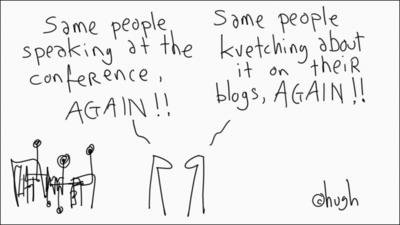
From gapingvoid
Continuing in the meaning musings and slippery semantics theme...social media and user generated content (very Webby 2.0 topics). Or authentic media, or participatory media [pdf]or a barrel of herring.
Tom Coates (he works at Yahoo!) at plasticbag.org reproduces a talk he gave at the Guardian Changing Media Summit and admits he doesn't know what people are referring to when they talk about "social media". But then he deconstructs the term pretty thoroughly: "...It seems to me that the other main feature of social media is that they're looking at how each individual contribution can become part of something that's greater than the sum of its parts, and to feed that back to the individuals using the service so that - fundamentally - everyone gets back more than they're putting in. These new services are about creating frameworks and spaces, containers and supports that help users create and publish and use all kinds of data from the smallest comment to the best produced video clip which in aggregate create something of fascinating utility to all." (spotted on Susan Mernit's Blog)
So, one of the hallmarks of Web 2.0 would seem to be ambiguity. Probably more than seven kinds.
From gapingvoid
Thursday, April 06, 2006

Reading, by any other name, doth smell as sweet?
Philosophical discussion we were having yesterday, just to kick off your morning (if you live in the U.S., that is): What is considered "reading," anymore?
A few examples:
*If you are looking at a graphic novel--that does not have any text on the page--are you still "reading"?
*If you are listening to an eAudiobook, are you "reading"?
*If you find yourself in a digital collection of photos, a museum or historical society and you visually absorb "realia" items, would you consider it "reading"? (Passively) "Looking"? Do you become a "looker"!?!
Alane thinks this conversation has the sound of one hand clapping, robots dreaming of electric sheep...but the conversation started out at the language level.
It's really a matter of precision, I guess. Can we still call our information consumers "readers," in good conscience? I know the terms go in and out of style (should we call them "Two-point-oh'ers"?) and surely Walt will do a comprehensive study someday--but the verb to read and the act of reading, to me, can take on a much larger definition in libraries than the mere act of looking at squiggley black things on a page or screen. Anyone have an OED Online subscription?
Readers, Researchers, Users, Patrons, Consumers, Customers, Clients...
[ingest image here]
Tuesday, April 04, 2006
Trends and Fads
Futurist Update is a monthly email newsletter I get from the World Future Society. This month included a useful piece on trends and fads, with many links that I'll reproduce here, along with some I use.
First, definitions.
Fad: A fashion that is taken up with great enthusiasm for a brief period of time; a craze.
Trend: The general direction in which something tends to move. Trends are the momentum of society--we’re heading in that direction.
Fads can be very short and usually are not indicators of major change, themselves. But, a fad may turn out to be part of a trend. For example, when many women began bobbing their long hair in the 1920s, this was considered a fad. We know now that it was one element in the trend of the emancipation of women. But, the distinction is a bit blurred.
The "coolhunter" of William Gibson's book Pattern Recognition (why, yes, that is one reason the OCLC Environmental Scan had that as its title) is spotting ideas, behaviors and fashions that can translate into products, within a short time span. So, platform and wedge shoes....faddish trend.
Trend spotting, as practiced by futurists, has a longer horizon. Nanotechnology, for example. Macrotrend.
I think when you look at some of the sites I've added here, you'll see the difference between the "coolhunters" and the futurists. Some of the macrotrends are going to look pretty flakey, like those identified by Ray Kurzweil or Barbara Marx Hubbard. No flakier perhaps than some of these trendy fads...at least these ones will be gone soon. Mind you, I link all the frou-frou and impracticality to a conservative trend...but that's me.
Coolhunting
http://www.ubercool.com/
http://www.psfk.com/
http://www.trendspotting.com/
http://www.trendhunter.com/
http://www.treehugger.com/index.php
http://www.we-make-money-not-art.com/
Trends
http://www.shapingtomorrow.com/
http://www.josephcoates.com/
http://karlalbrecht.com/
http://www.davinciinstitute.com/
http://www.worldwatch.org/features/vsow/
http://www.emcc.eurofound.eu.int/sector_futures.htm
If you're interested in the community of futurists, the annual conference of the World Future Society is July 28-30 in Toronto (pdf program here). There are excellent pre-conference courses offered as well. And don't you want to hear what two non-librarians have to say about the future of libraries? William Crossman and Thomas Frey will analyze and forecast the trends, roles and functions of libraries on Saturday, July 29. Hint: Mr Crossman says this in the FAQ at his institute's site: "That deep attachment that some people have to reading and writing will, in most cases, be supplanted by a new appreciation of, and attachment to, listening and speaking--the type of love affair with speech that existed/exists in oral cultures of the past and present."
Well, that would explain the success of audiobooks, right?
Web 2.0, Web 2.0, and Yes, More Web 2.0
valleywag points to ZDNet columnist Dion Hinchcliffe's "The State of Web 2.0" essay, calling it "monstrous, graph-choked" and provides a funny "translation" : 'You'll get attention by saying "Web 2.0." Yep, lots of attention from saying "Web 2.0" a lot. What I mean to say: Saying "Web 2.0" gets attention, because people love to hate or hate to love or love to write italics around the phrase "Web 2.0." Um, Web 2.0, Web 2.0, Web 2.0.'
I don't think I'd describe Hinchcliffe's essay as monstrous. It is a long post...but perhaps valleywag was referring to some of the rather odd notions (well, odd to me, at the moment, in that they're so vague or open as to be unhelpful), like "Web 2.0 is made of people." One commenter also found this vague: 'You know, "made of people" is not a defining expression. Crowds, armies and cannibals' dinners can be "defined" exactly like that.'
But there is expansion on this squishyness.
"Key Aspects of Web 2.0
-The Web and all its connected devices as one global platform of reusable services and data
-Data consumption and remixing from all sources, particularly user generated data
-Continuous and seamless update of software and data, often very rapidly
-Rich and interactive user interfaces
-Architecture of participation that encourages user contribution"
OK, that's a bit more helpful.
Read the whole essay as well as the comments. And Hinchcliffe has a blogroll for lots of Web 2.0 blogs (left-hand side). Comments range from "THERE IS NO SUCH THING AS WEB 2.0!!" to "Thank you for providing some semi-structured analysis around this technological and sociological phenomenon."
Monday, April 03, 2006
Happy National Library Week!
In the spirit of Jenny's joining ALA once again, thought I'd point out ALA's National Library Week materials. What are YOU doing to celebrate National Library Week? Or put another way, what is your library doing?
A few possible ideas:
1. Stage a readathon outside your library, if the springtime weather cooperates. eBook, eAudiobook or print materials qualify...
2. Invite a friendly local journalist on a tour...of the amazing technology in your library. The RFID system, the self-check out, how the local catalog shows possibilities in every branch, how easy it is to download eAudiobooks from the library's Web site...
3. Hand out coupons for "Free home/dorm delivery" of reserved materials to every Xth user who walks in the door/places a hold online.
(The surprise and delight you create from this action will far outweigh the petrol expense.)
4. Better yet, team up with a local pizza delivery service and stage a highly-publicized "Dinner and a Movie" night--where anyone who places their order for a pizza can also get a (free) library DVD delivered alongside their pizza!
Okay so the Dinner and a Movie idea would involve some prior planning. But on each pizza box delivered that night, you attach a flier that explains how easy it is to find great movie titles online, at the library branch closest to you. And of course remind them how easy it is to become a Friend of the Library, too.
This could work and could be really fun, too. The trick, I think, is to surprise and delight your customers in new and unexpected ways.
Oh and BTW, tomorrow (Apr. 4) is National Library Workers' Day. Be sure to celebrate all the staffers in your library!
Thursday, March 30, 2006
Nabaztag, the Wi-Fi Rabbit
 These aren't new but I might have to have Nabaztag: "I'm a newborn bunny, one of a unique species of intelligent, smart objects. I'm 23 cm tall, I wriggle my ears, I sing, I talk and my body lights up and pulsates with hundreds of colours. Thanks to Wi-Fi technology, I'm always connected to the Internet." Things it does:
Talking Clock, Wake Up Rabbit (music), News Headlines, Weather Forecast, Stock Market, "See" other Rabbits and let you know by moving its ears, speaking or playing music, E-Mail Alerts--and apparently RSS feeds.
It's not really a blogjet or a spime...but it's closer than my laptop is.
They're not available from any place here in the U.S....yet.
UPDATE April 4: Nicholas Nova (pasta&vinegar) has just bought a Nabaztag and he says, "it’s a first step in the world of communicating artifacts."
Web 2.0 is [pick one]
Slate writer Paul Boutin hones in on the semantic ambiguity of the term Web 2.0 (well, is it semantic or literal ambiguity?) in a short piece, reflecting the "checkout stand placement" Web 2.0 has acquired with the Newsweek April 3 cover story. He identifies three--maybe four--definitions that may be or may not be compatible. "...people use Web 2.0 to mean different, often conflicting things."
1. Web 2.0 is a mishmash of tools and sites that foster collaboration and participation.
2. Web 2.0 is the software and languages used to build the gee-whiz features of sites like YouTube, Flikr and Wikipedia.
3. A "Web 2.0 play" is a bid to make money by funding a bring-your-own-content site.
4. Publicists and self-promoters invoke Web 2.0 whenever they want to tag something as new, cool, and undiscovered.
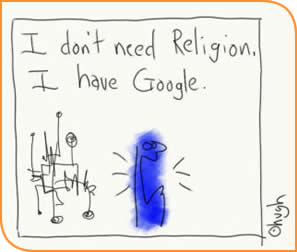 Image from gapingvoid.com (warning: Hugh uses swear words in many of his cartoons, so maybe don't look at his blog in a public place)
1. Web 2.0 is a mishmash of tools and sites that foster collaboration and participation.
2. Web 2.0 is the software and languages used to build the gee-whiz features of sites like YouTube, Flikr and Wikipedia.
3. A "Web 2.0 play" is a bid to make money by funding a bring-your-own-content site.
4. Publicists and self-promoters invoke Web 2.0 whenever they want to tag something as new, cool, and undiscovered.
 Image from gapingvoid.com (warning: Hugh uses swear words in many of his cartoons, so maybe don't look at his blog in a public place)
Wednesday, March 29, 2006
Ashless art

“My father sits at night with no lights on,
His cigarette glows in the dark,
The living room is still,
I walk by, no remark.”
(“That’s The Way I've Always Heard It Should Be” – Carly Simon) [Web site ; Wikipedia entry]
Although I wasn’t on the road with my fellow IAGers and colleagues from OCLC Research at either CIL or PLA last week, I’ve been away in the last two weeks, having but recently returned from Charlotte, North Carolina. This particular trip to NC was a fun trip, not business related, but alas like so many of my travels, it too gave rise to an episode of my chronic case of librarian’s wandering disease – i.e. when I’m anywhere near a library, I tend to wander in.
So, on that recent promise-of-Spring-in-the-air Saturday in Charlotte I spent several pleasant hours wandering around the Main Library of the Public Library of Charlotte & Mecklenburg County. Now I might wax poetic about the fabulous historical materials collection in the Carolina Room on the top floor, or the very cool Virtual Village on the lowest floor, but on passing the coffee shop I was really drawn to the media space in the center – DVDs, CDs, and gaming (live gaming being enthusiastically pursued by a slightly-more-players-than-consoles crowd of very contented-looking patrons). And I also noticed something pretty interesting nearby – a cigarette machine that dispenses art, PLCMC’s own Artomat installation.
I resisted the coffee and didn’t have time to queue for a game, but the Artomat machine was just too tempting. So I went to the main desk, traded my $5 for a token, and the token for a pull of the lever on the Artomat, and out came my prize -- a handcrafted book (blank pages for one to write in) in cigarette pack-sized box. Very cool – a book in a box (see photo) in a recycled cigarette vending machine in the library. Public access computing, coffee, gaming, art vending – what will these public librarians think of next?
The User-Centered Universe Comes Closer
You know, we've all yakked on and on about how all our libraries need to be user-centric.
I could go on and on. You could go on and on, and fill in the blanks for what you're dreaming of, for the perfect library in your mind. Or the im-perfect library that you currrently work in....or in my case, the library I imagine as a conjuration of multiple libraries I've used and dreamed of.
Where am I going with this? As I've been reading through the recent conference posts and rants (her word, not mine!), it looks like we are ready to "eat our own dog food," as the saying goes. We want our meta-conversations to be just as gracious as our libraries are.
I'm talking about presentations at library conferences. WE are the users in this case. Center your presentation around ME the audience member, here.
Now this is no big revelation--we're taught to consider your audience in High School Speech class...but I think the recent spate of blogsation (that's my new word of the day--blog conversation) shows that as an industry, we've internalized the message and now demand it of each other.
All I can say is,
Rock on.
You?
*Our physical architecture and furniture set-up should be arranged for the user's world, not ours.
*Our directional signage and way-finding aids (posters) point out helpful pieces of information at just the right moment of a user's journey.
*Our physical materials ought to be displayed with a friendly, welcoming and (frankly) retail-oriented appeal.
*Our Web sites need to use labels/tags that make sense to our spouses, significant others and friends.
*Our RSS feeds/blogs for library users need to add value to their day, not noise.
*Our electronic and digital collections need to translate immediately into benefits for the user's world: they're not here to find as many resources as possible on global warming--they're here to find three good articles from which they can substantively draw for a report that is due tomorrow.
I could go on and on. You could go on and on, and fill in the blanks for what you're dreaming of, for the perfect library in your mind. Or the im-perfect library that you currrently work in....or in my case, the library I imagine as a conjuration of multiple libraries I've used and dreamed of.
Where am I going with this? As I've been reading through the recent conference posts and rants (her word, not mine!), it looks like we are ready to "eat our own dog food," as the saying goes. We want our meta-conversations to be just as gracious as our libraries are.
I'm talking about presentations at library conferences. WE are the users in this case. Center your presentation around ME the audience member, here.
Now this is no big revelation--we're taught to consider your audience in High School Speech class...but I think the recent spate of blogsation (that's my new word of the day--blog conversation) shows that as an industry, we've internalized the message and now demand it of each other.
All I can say is,
Rock on.
You?
Monday, March 27, 2006
Springtime and renewal

It is a beautiful day here in my little office. Today is one of those days when you start to believe that Spring may indeed come, even though it seems highly unlikely.
After such a wonderful but crazy week in Boston at PLA last week, I did take a couple of hours yesterday to reconfirm a commitment to Spring, to life and to continued zest for doing the things we Love, Especially when we don't Think we have Time to do them: I bought new running shoes.
New Running Shoes
Now this is not an endeavor I do every day. (Buying new running shoes.) In fact, the sales person at the shoe store was incredulous at the state of my 5-year-old shoes. "You've been running in THESE?," she exclaims.
Well...yes I have. But not running as much as I'd like. I've just been letting a lot of other things get in the way lately.
Let me explain: It feels like I am behind on just about everything lately--behind on work, behind on life, behind on self-improvement...behind, behind, behind. Do you ever feel like that? Do you ever feel like that, at your library? Of course you do. We all do.
And yet, when I went on the maiden voyage in my brand new running shoes, it brought me exactly the perspective a conference is meant to: a chance to breathe, to reflect on what's happened lately, and a time to ponder what it all means.
*What direction should our library go next? Do we hire that new staff person? Can we increase our outreach to the community? How can we create an environment for GenX leaders to spread their wings?" (Because we do have wings, I assure you...)
So even if you didn't attend CIL or PLA, Spring will come to you and your library, too. Work will Get Done Eventually and remember, we are meant to enjoy life!
Now. I'm off for another run.

Books books books

This shot is for all you Perceptions fans and the famous quotation about what one woman thinks of, when she thinks of a library:
"Books books books, rows of books, stacks of books, tables filled with books, people holding books, people checking out books. Libraries are all about books. That is what I think and that is what I will always think."
Thanks to the Boston Public Library for letting me snap as many photos as I could!
Boston Public Library

Speaking of hip spaces, the Boston Public (Copley Square) was a great place to hang out when you wanted a break from all the conference hoopla.
Don't get me wrong--I worked hard at a lot of behind-the-scenes hoopla at this show--but it was such a refreshing jolt to wander through the stacks and remember what an urban public library IS and DOES and who uses it on 2:30 pm on a random Thursday afternoon. There were young entrepreneurs writing business plans, retirees, high school students, and a good chunk of English-as-a-second-language speakers in between.
Coolest Exhibit Booth in all of PLA

The Coolest Exhibit Booth in all of PLA 2006 (IMHO) was the one from Creative Arts Unlimited, Inc. Their signage was smart, to the point and visually arresting. And when I started talking with Bruce, the Design Director, it made sense why: they are a company that specializes in transforming library interiors into spaces that feel alive, engaging and (dare I say) hip!
OCLC Update Breakfast at PLA 2006

7:30 AM was not too early for these Update Breakfast attendees. Held in the Huntington Ballroom of the Colonnade Hotel (which I can now wholeheartedly recommend), there were more than 250 librarians to provide feedback and recommendations for what they'd like to see the world's largest library coooperative do next! These two librarians look like they've just thought up something controversial for the IAG bloggers to talk about! (Or perhaps a really cool new thing to do with WorldCat?)
Small Library of the Year reception

A few WebJunction and OCLC staff attended the LJ Celebration of the Small Library at PLA. The Haines Public Library in Haines, Alaska won the award, with an inspiring story to boot. Pictured L-R are Jenny, Florence, Betha and George.
George meets famous WJ columnist

George's doppelganger. This was the life-sized foam cut-out of the famous "I'm Curious, George" columnist. Our George II graced the OCLC exhibit booth at PLA, and made a special guest appearance at the WebJunction reception.
Friday, March 24, 2006
So long, and thanks for all the fish
Nothing personal, but I'm out of here for a while. The long-suffering Joyce and I are taking a little break for a few days, so it will have to be all good without me, at least temporarily.
PLA Wrap Up
My official role at PLA is over now (such as it was). I was the host/greeter at the OCLC exhibit booth for a couple of hours this afternoon, and got to meet a lot of old and new friends. I also got teased incessantly about a life-size foam board mounted picture of me that had been installed in the exhibit space as an ad for WebJunction, and the Curious George column in particular. Lorcan Dempsey may have fangirls, but I have a doppelganger!
Earlier, I had facilitated a discussion of e-learning that featured Sarah Chesemore, the Learning Manager for WebJunction, Phil Turner, the Vice Provost for Learning Enhancement at the University of North Texas, and Celisa Steele, Vice President of Operations for LearnSomething (which merged with Isoph in 2005). Celisa gave a very good basic introduction to e-learning, Phil talked about how to implement e-learning effectively, and Sarah talked about the findings a survey WebJunction has done on e-learning, and how to find out what's available. The questions and discussions that followed were lively and challenging.
The morning started with the OCLC Update Breakfast, which always seems to start in the middle of the flipping night. I arrived at the hotel banquet room at 6:00 a.m., and several intrepid OCLC staffers, including IAG's own Alice Sneary, Sonya Oliver, and Stephen Leonard, had already started setting up the room. Jay Jordan gave the update, and had the audience both laughing and fascinated by all OCLC is doing.
As a former PLA director, I can't get over how big this conference has gotten. As of yesterday, over 9800 people were registered (compared to maybe 4000 when I was doing that gig). Greta Southard, Linda Bostrom, Barb Macikas, and the whole PLA crew have put together what I think of as the best all around library conference. Of course, I'm a public librarian at heart, and that's what this is all about!
The Internet of Things: Spimes and Blogjets
I mentioned the Internet of Things yesterday at the very end of my session as an example of newish stuff I'm following--part of the dumpster diving I do to spot trends. And as I had no time to describe or explain, here's links to the two pieces that will make all clear to you about the Internet of Things. And if not clear, I assure you, your little gray cells will be given a workout.
Bruce Sterling, the science-fiction writer, coined the term "spime" (SPace and tIME) and Julian Bleeker, of the University of Southern California's Annenburg Center for Communication, coined the term "blogjet".
They are similar concepts...Bleeker says Sterling's spime is a more sci-fi-ish object. Here's his description of the Internet of Things from his paper [pdf] "A Manifesto for Networked Objects--Co-habiting with Pigeons, Arphids and Aibos in the Internet of Things": "The Internet of Things has evolved into a nascent conceptual framework for understanding how physical objects, once networked and imbued with informatic capabilities will occupy space and will occupy themselves in a world where things were once quite passive."
Sterling's paper is actually a transcript of a talk he gave recently at eTech 2006: "Spimes are manufactured objects whose informational support is so overwhelmingly extensive and rich that they are regarded as material instantiations of an immaterial system. Spimes begin and end as data. They're virtual objects first and actual objects second."
This stuff is what Web 2.0 is really about...
CIL: Alane's Necklace & Lorcan's Fans
That would be human fans not the feathered kind.
Lorcan and I were both on the program at CIL, yesterday morning, at the same time. This caused some consternation as some people fretted to me whether to attend my session or Lorcan's. I told them to go to Lorcan's. And thankfully, many people blogged his talk about metadata in a Web 2.0 world(on Technorati, use the tag CIL2006 and "Lorcan" and you'll find all the mentions) so now I know what he said. Dorothea of Caveat Lector, though, wins hands down, for her remarks. "Fangirly" has been added to my vocabulary.
My session, "Scanning for Planning" was blogged by Jenica at Thinking Out Loud who makes me sound a lot more coherent that I thought I was, and in a later post she mentions the silver necklace I was wearing, approvingly. Thank goodness. Perhaps I am exposing my Digital Immigrantness, but it is just odd to read little bits and pieces about yourself all over the blogosphere. And it is a reminder that the Panopticon is here and that our words and actions become part of the observed world very quickly.
Thursday, March 23, 2006
PLA Update
Ginny is a blogging machine, isn't she? I almost feel like I'm there in DC with her. Way to go!
I'm in Boston at PLA. Yesterday, I said a few words at the closing of a preconference on programming in public libraries, sponsored by the Public Programs Office at ALA. (You can make a gift to the Cultural Communities Fund here.)
Afterwards, I saw some amazing things in the exhibit hall. There are some real advances being made in materials handling, in handling audio materials, and even some cool new furniture. Since this isn't a space for advertising, I won't link to those companies, but the point is there is palpable excitement at the conference about the future of libraries. The librarians here (and Boston seems positively overrun!) are full of excitement about new ways to offer service.
This afternoon I met with some public librarians about using our collaborative experience to improve the acquisition of non-English materials. The ideas flew fast and furious, and there may be more to come on this one soon.
Next, it's on to the WebJunction reception and the LJ reception to honor outstanding small public libraries. Tomorrow, the OCLC Update breakfast, a WebJunction program on e-learning, and several hours at the exhibit booth. If you're here in Boston reading this, make sure to stop by! (That link is for Jay, by the way.)
Wednesday, March 22, 2006
CIL continued
After that morning I needed lunch and a nap. And then I wandered around the exhibits for a while. It's always interesting to see who's there and what's new in their worlds. I managed to stop by for a few minutes at the SLA booth - I was surprised to see them there until I remembered that Tom Hogan had mentioned in his introduction that SLA is an Association Sponsor of this conference. So I stopped to thank them!!
I didn't write in detail about the wonderful workshop I attended on Tuesday called Web Managers Academy. In that workshop and just the 3 sessions I went to this morning I learned enough for a whole conference! And I have 2 1/2 days to go! My brain is definitely full, and pretty soon I'm going to crash for the night. Tomorrow morning is the Update Breakfast that I want to go to.
I didn't write in detail about the wonderful workshop I attended on Tuesday called Web Managers Academy. In that workshop and just the 3 sessions I went to this morning I learned enough for a whole conference! And I have 2 1/2 days to go! My brain is definitely full, and pretty soon I'm going to crash for the night. Tomorrow morning is the Update Breakfast that I want to go to.
CIL - New web site tools & technologies
This session was presented in two parts, the first by Jason Clark on Building Usable Library Interfaces with AJAX and the second by Karen Coombs on Open Source Applications for Library Web Site Management. They both managed to present a tremendous amount of information in very little time, and without making us feel totally stupid. So much of this was new to me and I have no idea whether any of it is even possible in the web systems I work with, but boy am I going to try. It is incredibly cool, and they make it sound easy. Jason even mentioned some work by OCLC Research that I was completely unaware of! I need to keep up better!!
CIL - Basics of Web-Based experience planning
David King presented a well organized outline of "how-to" design a web site that made me want to go back home and get started! He used concepts from Jesse James Garrett to outline the process. The 5 steps are: strategy, scope, structure, skeleton, surface. He emphasized that you have to remember at every stage that the user of the site is the most important element. Users should have a feeling of control and interactivity in all parts of the site. We need to keep the focus on the user rather than on the resources we have to offer to the user.
At the end of the presentation someone asked about the cluttered (to her) look of many award winning websites. David pointed out that what looks cluttered to us does not necessarily look cluttered to our users - - if these are people who regularly use CNN or Amazon or Yahoo they probably have come to like what we consider cluttered.
The bottom line is: It's all about the user!! And it's hard for us to remember.
CIL - Keynote by Chris Sherman of SearchEngineWatch
Chris Sherman, recently back from China, talked about developments in the search engine world - and compared the present time to 1995 - a time of much excitement and innovation, along with one-upmanship and me-tooism. Things are changing a lot in the search engine world and some search engines are becoming things other than search engines. Jeeves has been fired, but Ask is going strong. Google is be coming everything web. MSN is giving off confusing brand messages, and Yahoo innovation seems to be slowing down while their research arm is ramping up. Personalization is becoming pervasive in very exciting ways, but it has a dark side as privacy issues crop up. And lawsuits are crowding the horizon. It feels like 1995 again! And it's fun.
CIL - opening session
Tom Hogan, President of Information Today opened the 21st Computers in Libraries Conference. He reminded us all that National Online made it to 24, but it is "all gone" now!! As of Saturday attendance is a record 2386 and we expect another 100 or so to register during the week. 49 states are represented, plus the District of Columbia & Puerto Rico. The only US state not represented is Mississippi. And we all hope Mississippi will be able to send representatives next year. 17 other countries are also represented including: Canada, Denmark, Egypt, Germany, The Netherlands, Portugal, Qatar, Slovakia, Slovenia, South Africa, Sweden, Taiwan, Thailand, Vietnam, and The West Indies. (Marshall Breeding claims to have been to all 21!) The attenance figures include 150 speakers & moderators, and .60 companies represented in the exhibit hall.
All in all avery exciting place to be!!
All in all avery exciting place to be!!
Tuesday, March 21, 2006
PLA Boston
Hello PLA!
We've been busy today setting up the exhibit booth (3101) and looking at sessions. I am so excited to hear Susan Susanka of the Not-So-Big-House, the writer of the Stinky Cheese Man and of course, Paco Underhill as the closing session speaker. And lots of interesting stuff in between!
Tonight we went to a great restaurant that was also profiled in the PLA conference guidebook: Via Matta. Excellent food, and even better service. We loved it...and can't wait for the conference to start!
Computers In Libraries
Well, I got here after a wonderful day Monday visiting with friends in Maryland. Instead of flying, my husband and I drove for the visit, then came here to the hotel Monday evening and he drove back home early this morning. I will fly back to Columbus on Friday evening when this is all over.
The hustle is amazing - - yesterday the hotel seemed nearly deserted even though I knew people were getting ready for the meetings. (I was going to say maybe that was because it was Sunday - but it wasn't - it just felt like Sunday to me!) Anyway, the place is full of Librarians and computer folk today. The bar is crowded with folk listening to the marvelous piano playing, working on their laptops as I am - the wireless reception is better here than most other places, and talking in various groups.
One group of us, after a long day of learning to be more competent web masters or to do better searching, or a number of other workshops, went to Bombay Palace for dinner and to discuss training - - it was a fun time, and will appear on at least one other blog in more detail - one person was taking actual notes about our conversation. Interesting talk going around the table comparing notes - we found that the issues and the joys are the same no matter what setting we work in - academic, public, school, special - we all face the same difficulties and use the same "tricks of the trade" - though I did learn a few new ones!
Tomorrow the conference starts in earnest - - and so good night!!
Ubiquitous Computing and Everyday Life
Three items that caught my attention today on the topic of ubiquitous computing and everyday life.
First, spotted on a blog I've just started reading, pasta and vinegar, a paper [pdf] called "Interweaving Mobile Games with Everyday Life" and a big pdf of a presentation done by Julian Bleeker at the recent eTech Conference, called "Pervasive Electronic Games Theory Objects for Social Play." pasta and vinegar has a summary and links to other comments.
Second, a book by Adam Greenfield, Everyware: The Dawning Age of Ubiqutous Computing. I haven't read this but I've added it to the list. (I am reading Seeing What's Next by Clayton Christensen, and The Art of Innovation by Tom Kelley.)
It's a theme, a meme, a trend...
Web 2.0 - Too Much Sharing?
Kathy Sierra at Creating Passionate Users has a tongue-in-cheek (maybe) post titled "Web 2.0 is like Group Therapy". Scroll down for the funny chart she's made lining up the similarities between group therapy and Web 2.0. Example: Group therapy= self-esteem issues. Web 2.0 = Technorati rank issues.
(Link from Publishing 2.0)
(Link from Publishing 2.0)
Monday, March 20, 2006
We are BoingBoing'ed
BoingBoing is a blog that is, as it bills itself, a directory of wonderful things. I read it not just because of the posts about Fat Albert, rat-cats, TV-bars, roasted alligator, barf bags, and Chinese gangster fiction (all this in the last 24 hours) but because of the gems that relate to my day-job.
Just today I was alerted to an article in The Guardian newspaper on the abundance of cheap consumer goods that got me thinking about a notion I've tossed around a good few times (and which of course does not originate with me): that libraries were constituted in times of scarcity and that times of abundance such as we are in (here in an economically priviledged country) have blurred the original purpose of libraries when content and information is as adundant as cheap t-shirts.
So, here's the sentence that caught me. "Unashamedly 'disposable' cheap goods, you could argue, are turning us into traders rather than curators of our posessions."
Well, there you go....the library dilemma in a sentence.
You're underwhelmed by this? Then perhaps you'll prefer the link to the blog maintained by "Geoffrey Chaucer"..."Yowre care maken myne eyes to watre with teres..."
Oh. The title of this post? Yes, OCLC was actually mentioned in this mega-A list blog. A short squib noting our list of the 1000 top books held by OCLC libraries. The work was done by OCLC Research staff at least a year ago but has seen new interest because Lorcan mentioned it recently at the Reading 2.0 conference (available talks here), and Tim O'Reilly blogged about it and so on and so on.
Cool.
March Madness 2
I'm back in the office for two days before I leave for the PLA shindig in Boston. Last week was a blur, and this one's not much better!
Monday night, I guest lectured for a wonderful group of LIS students about the Environmental Scan and the Perceptions Report.
Tuesday afternoon, I talked about the Perceptions Report with directors from the Association for Southeastern Research Libraries (ASERL).
Thursday, it was a gaming presentation at the Greene County District Library in Xenia, Ohio.
Saturday, I was in Utica, New York, at the Mid-York Library System, talking about library futures.
At the ASERL meeting, one of the issues that emerged was how we expand the library brand to start penetrating public consciousness about what libraries have to offer in this world.
In the other three programs, one of the biggest topics of discussion was "Google versus books" as a reference tool. How can (or perhaps the question is should we...) get students to go deeper into the literature to use all the resources the library owns or licenses, when all they seem to want to do is use Google?
One librarian in Xenia expressed frustration that she could answer a question for a student from books that are readily available,but all they want to use is the web. She said that by the time she referred the student to the public computers on the second floor, and the student repeated the question for the librarian there, she could have easily found the answer for him. One of the other librarians in the room suggested that perhaps the computers are on the wrong floor.
In Utica, the discussion was framed around "instant gratification" in public libraries. Do we give students and other library users answers, or do we try to teach them how to become independent, lifelong searchers? This is a question that can roil nearly any gathering of librarians.
Charles Robinson, one of my personal heroes in libraryland, drove a stake into the ground in this argument by summarizing his philosophy of library service as "give 'em what they want." I definitely come down on that side of the argument; I was inoculated with his way of thinking many years ago. When we view the world through our library prism, we try to slot users into our preferences for printed materials and thorough research. We try to make little librarians out of people who only need enough material to do a one page theme on frogs. Today's kids have so much to do that I have no moral or professional compunctions about providing instant gratification from our publicly funded institutions. If the student wants to learn a couple of quick tips about how to make her own searching faster and more effective, fine---but it's the student's call, not mine.
Your 22 Minutes of Fame
According to a recent post on PUBLIB, the great TV game show Jeopardy! is looking for librarians to audition as contestants for the show. Tryouts will be held in the coming months in these cities: Boston, MA, Chicago, IL, Indianapolis, IN, Los Angeles, CA, Minneapolis, MN, New York, NY, Orlando, FL, Portland, OR, Philadelphia, PA, San Francisco, CA, St. Louis, MO, Washington, DC.
To register, or for more information, go here. And if you pass the test and get on the list, call me for some inside scoop!
To register, or for more information, go here. And if you pass the test and get on the list, call me for some inside scoop!

Friday, March 17, 2006
Luck of the Ancestry, or Something...
So one day a couple of months ago, my friends Tim, Barbara, Val and I were chatting. This is a post about St. Patrick's Day, ancestry, bloodlines and genealogy. REALLY.... I'm just starting with a story.
Ancestry
Tim is Irish, born and raised in Ireland.
Barbara is South African, born and raised in Nebraska, USA.
Val is American, grew up American but his family ancestry/bloodline is clear cut: his father's parents were German and his mother's parents were Italian.
I, on the other hand, am all over the place. People look at me and immediately exclaim (especially if I am wearing my favorite green sweater), "oh, you must be Irish!"
Likely it's the sweater, because all we really know is that we were descended from horse thieves in Pennsylvania, may claim the Maxwell clan in Scotland and that we are related to the famous Comanche chief, Quanah Parker.
But I digress.
Tim, Barbara, Val and I started talking about what it means (in America), when someone asks you where your family is from. Because Americans tend to think that means somewhere *not the U.S.* --a question of ancestry and not of place.
Bloodline
And this drives Barbara and Tim bonkers, and this all came up because there was a guy they met who says, "Hey, I'm Irish, too!" as if he and Tim are suddenly going to be best mates. So Tim asks what part of Ireland he's from, to which he replies "oh, you know, that was 4 or 5 generations ago. But my family is from Ireland."
Which, from Tim's point of view, he isn't Irish at all. He's American and at some point in his lineage, his family lived in Ireland. But all he's ever known or his parents have known is America. I guess it's all a matter of perspective, really. Which brings me to my next question:
Do countries outside the U.S. have as high a demand to do genealogical research? We USonions all want to know where we're from. Even if Tim doesn't want to hear about it. But do other, less melting-pot societies experience the same yearning/nostalgia for roots? For a sense of place? A groundedness?
I have read enough Faulkner to know that it really all gets back to the land, which is a nice way of saying you become where you live. Which brings me to genealogy.
Genealogy
There was a great conference this week at BYU that one of our OCLC colleagues attended. She was there talking about WorldCat and how it can assist genealogists. I dare say, with digital image libraries and the right metadata, just tonight as I write this post, I stared at Quanah Parker's image, thinking "Wow, I guess I didn't get Parker cheekbones."
Maybe I just got the fighting spirit. Or make that the fighting Irish spirit. Well whatever/wherever you are, enjoy your ancestry and raise a toast to those who came before you. Happy St. Patrick's Day!
Thursday, March 16, 2006
From the Ocean's Edge
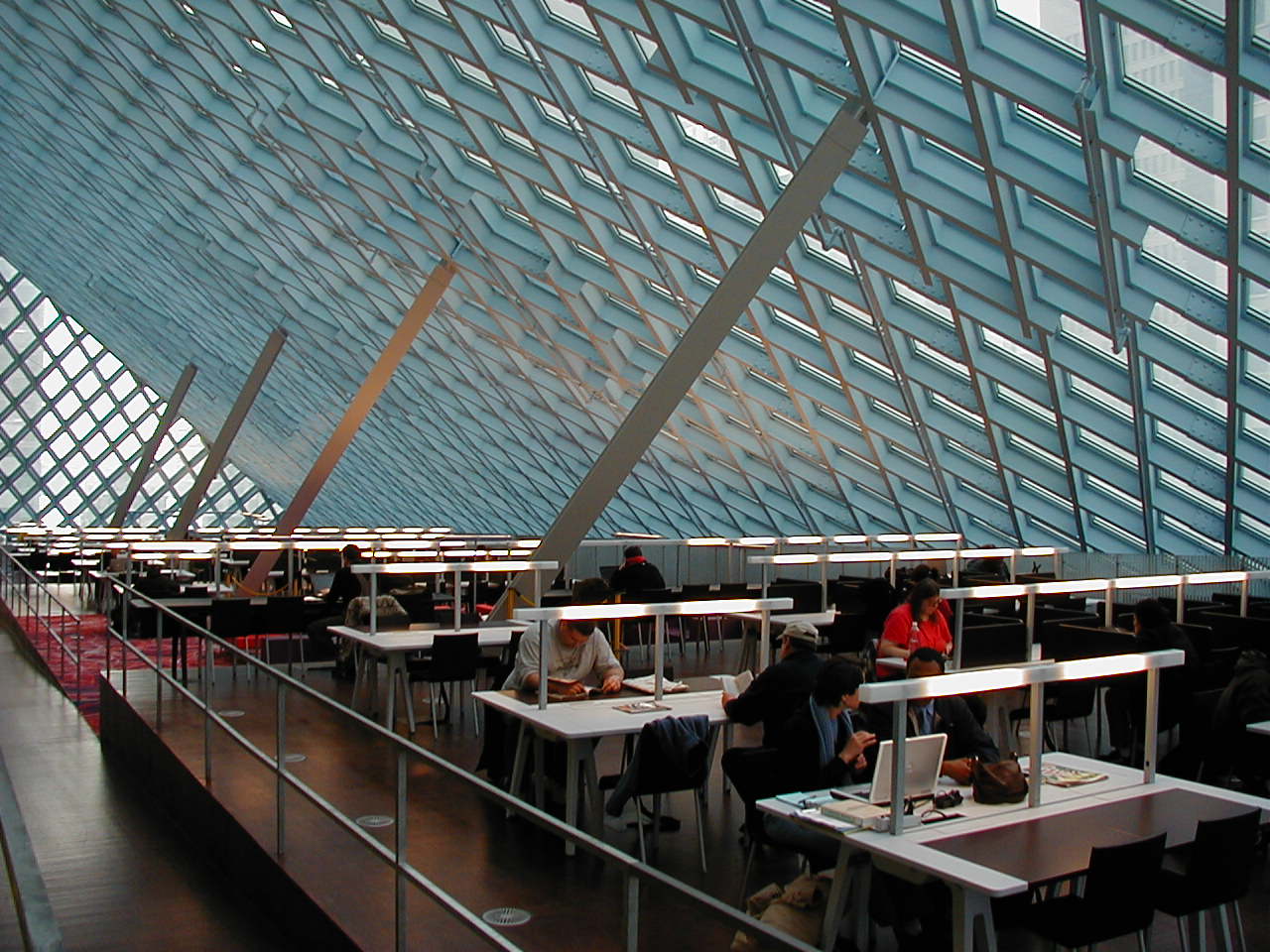
“There's a world I've always known,
Somewhere far away from home,
...
At the edge of the ocean,
We can start over again.”
("Edge of the Ocean" - Ivy) [Wikipedia entry web site]
This is definitely on-the-road season for IAG. In fact, no small portion of my time recently has been devoted to travel, arrangements for future travel, and planning for visitors. It’s all good, of course, but I am of late much reminded of both the perils (like when the layover for my in-bound connection through O’Hare was extended from 2 to 14 hours Sunday due to the weather) and rewards of travel.
Delayed flights aside, my time out west was enjoyable and fruitful. I was in the Pacific Northwest last week on OCLC business, and I also had the chance to catch up with colleagues and spend some time with a favorite cousin. The business I can’t share details about just yet, save that the discussion was important, engaging, and libraries and library users will be much the better for this collaboration. Keep your eyes open for news from OCLC in coming weeks.
I can, however, share my great pleasure at having a chance to visit with my colleague, Stu Weibel, who is temporarily ensconced in Seattle and very much enjoying the place and his extended contact with the University of Washington iSchool. Weather intervened the first night he, I, and several other OCLC colleagues hoped to rendezvous for a dinner, so no Stu and much sitting in traffic later, we dined Italian without him. But on the day following, Stu and I met and together explored the absolutely fabulous Seattle Public Library (see Stu’s blog entry & pictures). I also took a few photos (and Michael Porter took kind notice of one I contributed to the flickr Libraries and Librarians Group – thanks, Michael!). We capped off the evening with an excellent dinner at a local pub, and a stimulating discussion of many things, especially the matter of the use and care of identifiers. Stu has kindly loaned me his copy of Linked by Albert-Laszló Barabási which I am enjoying and finding every bit as readable and stimulating as Stu promised.
The trip also allowed time for a brief, unannounced (OK, well in truth I did call Leslie Dillon in our OCLC Information Center to find Chrystie Hill’s phone number and called Chrystie while in route), and all too brief visit to WebJunction’s offices in Seattle. They received me like I was a long lost relative and even treated me to delicious homemade goodies (yum!). It was great to finally meet so many of the wonderful folks at WebJunction in person. And I’m rather jealous of the marvelous view from their offices. (Very nice – the Gates Foundation offices overlook the same area. And -- not that IAG does recruiting -- but FYI, gentle readers, WJ has jobs open!)
And last, but not least I took some time off to see the sights including two excellent museums, the Science Fiction Museum and Hall of Fame, and the Museum of Flight. All in all, a great trip. My special thanks to Stu Weibel and the WebJunction folks for their kind hospitality. [Oh, and BTW...George, did I mention I’m available to travel to Seattle?]
Wednesday, March 15, 2006
CIL, PLA blogging
We're preparing for two upcoming conferences here at IAG: CIL and PLA.
If you remember from last year, Ginny Browne was our guest blogger from the conference. It turns out, she plans to attend again and has graciously agreed to post again this year. We look forward to her insights and photos; welcome aboard Ginny!
OCLC and OCLC CAPCON events promise to be fun. I do believe Alane might be there as well, doing a presentation on the Perceptions report? So we'll have multiple perspectives from D.C., coming up.
Further north, George and I will be carousing with lots of public librarians in Boston for PLA. I hope to see lots of you at events, the booth (#3101) and WebJunction reception.
Side note: We had toyed with the idea of having a very unofficial official "Blogger Meet-up" at a local watering hole one night...and then schedules got very, very complicated. So I'm inviting you instead, to breakfast on Friday at the Colonnade hotel, Huntington Ballroom at 7:30 AM. We do ask you to register, so we'll have enough muffins and pastries for everyone.
Readers, bloggers, friends: see you soon!
"Solutions for Our Future" campaign
George is hosting his own personal "March Madness" with travel this week. I have just gotten back from a week of illness and then some traveling, myself. I have a ton of photos to post. I'll flickr 'em and let you know...but here's some news on advertising during the *real* March Madness:
Colleges and Universities in the U.S. will get an image boost during the NCAA basketball tournament that begins tomorrow night, with the "Solutions for Our Future" campaign. Here's a blip from UB Daily and Chronicle articles on the project:
Read more in the Chicago Tribune and on the official site. From here, you can even send pre-populated messages to your elected officials. They have a bibliography and further white paper reading, as well.
Now does this project sound familiar to you, IAG readers? Of course it does. OCLC has been doing library advocacy to policymakers for a couple of years now. We're working on a school library advocacy ad now. It's a great idea and I am excited to see the NCAA ads tomorrow.
Maybe it's reason enough to even watch the game?
Colleges and Universities in the U.S. will get an image boost during the NCAA basketball tournament that begins tomorrow night, with the "Solutions for Our Future" campaign. Here's a blip from UB Daily and Chronicle articles on the project:
The campaign will include efforts by nearly 400 colleges to reach out to local communities and policymakers and explain their contributions to society. They hope to convince the public that higher education remains essential to the country's future and that it should be a state and national funding priority as government support has lagged during the past few years.
Read more in the Chicago Tribune and on the official site. From here, you can even send pre-populated messages to your elected officials. They have a bibliography and further white paper reading, as well.
Now does this project sound familiar to you, IAG readers? Of course it does. OCLC has been doing library advocacy to policymakers for a couple of years now. We're working on a school library advocacy ad now. It's a great idea and I am excited to see the NCAA ads tomorrow.
Maybe it's reason enough to even watch the game?
Tuesday, March 14, 2006
Amazon S3 - Storage Web Service
Interesting...Amazon has just announced a web service (no customer interface) called Simple Storage Solution. It looks like any data format can be stored at low costs per gigabyte, with no limit to the amount of data stored. Commentators speculate this will be very attractive to developers who haven't adequate storage capacity for their projects. Spotted on tech.memeorandum with links to other discussions.
From Amazon: "Amazon S3 provides a simple web services interface that can be used to store and retrieve any amount of data, at any time, from anywhere on the web. It gives any developer access to the same highly scalable, reliable, fast, inexpensive data storage infrastructure that Amazon uses to run its own global network of web sites. The service aims to maximize benefits of scale and to pass those benefits on to developers."
From the Business Week blog Tech Watch: 'So what's Amazon turning into? "They want to be seen as a platform for Web 2.0 applications," says Schmelzer. That still may take awhile. But it's clearer than ever that Amazon intends to keep pace with the big guns on the Web.'
Amazon S3? Why not WorldCat S3?
Google Selling Online Books
Danny Sullivan at SearchEngineWatch.com has a write-up of this recently announced extension of Google's Book Search service. A semantic curiosity: everything I read about this used the term "online books", not "e-books". I wonder why?
Subscribe to:
Posts (Atom)


