As promised in an earlier post, here's the link to the Chicago Public Library's new strategy, Chicago Public Library 2010: A Vision for Our Future. It will be valuable reading for anyone who thinking about where libraries, especially public libraries, could be going in the next few years.
Thanks to CPL's Amy Eshleman for the tip that this was ready!
Tuesday, May 16, 2006


Friday, May 12, 2006
Changes in the Zeitgeist?
Yesterday, I did a 45-minute version of the Perceptions Report presentation titled "The User Driven Library" at the SOLINET Annual Members Meeting in Atlanta. The second last slide in the presentation made some suggestions of what a "user driven library" might look like:
When we first started talking about the environmental scan and then the Perceptions report, there was a lot of pushback about some of the ideas, especially the ones around self-service and rethinking user expectations. Have we started to reach a tipping point? Have enough libraries started to go down this path that we can start to see some real progress? What's your experience in this?
- Clean, uncluttered, well-lit facilities
- Self-directed service
- "Free range" learning
- Education, not just information
- Listening, not just hearing
- Acting, not just planning
When we first started talking about the environmental scan and then the Perceptions report, there was a lot of pushback about some of the ideas, especially the ones around self-service and rethinking user expectations. Have we started to reach a tipping point? Have enough libraries started to go down this path that we can start to see some real progress? What's your experience in this?
Trendwatching.com
I've mentioned the newsletter/web site trendwatching.com several times in this blog, but the May 2006 issue deserves special notice for anyone who is thinking about the future of libraries.
This newsletter is written from a world view of consumerism, about how cutting edge companies think about marketing and selling their products today. Many of the references are to products in Asia and Europe, that will make their ways across the oceans in the months or years to come. But if you make the translation from a retail online environment, to an information online environment, you can mine this source for some pretty impressive nuggets. Is it all gold? No. But there's enough there to make it more than worth your investment of time.
This issue is an update of a previous study called "Customer-Made." Their theme is that it's time "to tap into the GLOBAL BRAIN." The report features stories of consumer products and services that have taken consumer input to create a whole new level. Honda sponsors a blog, "2TalkAboutHonda," that lets people who are interested in cars share their ideas not only about Honda autos, but about all things automotive. But it also can be used to create any "2TalkAbout" topics. Why not a "2TalkAboutMyLibrary" blog?
The Lego Factory is a way for people who are enthralled with the little interlocking toys that have lacerated millions of unsuspecting bare feet in the middle of the night share ideas for creating massive, Lego-based structures. And Lego used the most prolific contributors to that blog as a super secret focus group for the next generation of toys. (If you haven't seen this article in February's Wired about the Lego Factory, "Geeks in Toyland," check it out.) Have you ever considered using the library's most exacting and frequent users to be a focus group when you want to make changes? Or do you write them off as the whiners and constant complainers?
And the ultimate in open source: Vores Øl, or "Our Beer," is the first commercial beer to be brewed and sold under a Creative Commons license. You can download their recipe and create a duplicate or a derivative and do whatever you want with it. Somehow, I can't see the folks in St. Louis or Golden, Colorado, jumping on that idea, but the folks in Copenhagen seem to have gotten it!
Anyway, you get a sense for the kinds of ideas that come out in each issue of trendwatching.com. The subscription is free, and it's a great tool for keeping up and maybe even getting just slightly out ahead of the curve.
This newsletter is written from a world view of consumerism, about how cutting edge companies think about marketing and selling their products today. Many of the references are to products in Asia and Europe, that will make their ways across the oceans in the months or years to come. But if you make the translation from a retail online environment, to an information online environment, you can mine this source for some pretty impressive nuggets. Is it all gold? No. But there's enough there to make it more than worth your investment of time.
This issue is an update of a previous study called "Customer-Made." Their theme is that it's time "to tap into the GLOBAL BRAIN." The report features stories of consumer products and services that have taken consumer input to create a whole new level. Honda sponsors a blog, "2TalkAboutHonda," that lets people who are interested in cars share their ideas not only about Honda autos, but about all things automotive. But it also can be used to create any "2TalkAbout" topics. Why not a "2TalkAboutMyLibrary" blog?
The Lego Factory is a way for people who are enthralled with the little interlocking toys that have lacerated millions of unsuspecting bare feet in the middle of the night share ideas for creating massive, Lego-based structures. And Lego used the most prolific contributors to that blog as a super secret focus group for the next generation of toys. (If you haven't seen this article in February's Wired about the Lego Factory, "Geeks in Toyland," check it out.) Have you ever considered using the library's most exacting and frequent users to be a focus group when you want to make changes? Or do you write them off as the whiners and constant complainers?
And the ultimate in open source: Vores Øl, or "Our Beer," is the first commercial beer to be brewed and sold under a Creative Commons license. You can download their recipe and create a duplicate or a derivative and do whatever you want with it. Somehow, I can't see the folks in St. Louis or Golden, Colorado, jumping on that idea, but the folks in Copenhagen seem to have gotten it!
Anyway, you get a sense for the kinds of ideas that come out in each issue of trendwatching.com. The subscription is free, and it's a great tool for keeping up and maybe even getting just slightly out ahead of the curve.
Thursday, May 11, 2006
Great Read in the Park
I saw this in the NYT Sunday paper...the 2nd annual Great Read in the Park. Heralded as "an extraordinary literary celebration for book lovers of all ages."
Sunday, October 15 in Bryant Park.
There will be well-known and new writers, a children's area, panel discussions, book signings, and a used book sale with net proceeds donated to the Brooklyn Public, New York Public, Queens Library and the Fund for Public Schools.
I'd love to see more open-air celebrations that include libraries. Something about having green grass underfoot intuitively makes me think the event will be refreshing, authentic and charming. That it is something I could pack a picnic for...
Sunday, October 15 in Bryant Park.
There will be well-known and new writers, a children's area, panel discussions, book signings, and a used book sale with net proceeds donated to the Brooklyn Public, New York Public, Queens Library and the Fund for Public Schools.
I'd love to see more open-air celebrations that include libraries. Something about having green grass underfoot intuitively makes me think the event will be refreshing, authentic and charming. That it is something I could pack a picnic for...
Wednesday, May 10, 2006
Google movie
Submit stories of how you used Google tools in your library and you may be in the Google movie, premiered at ALA Annual! Only 500 words stand between you and your library staff's stardom...
My Kind of Town...and Library
As mentioned earlier, the IFLA/OCLC Fellows visited the Chicago Public Library for its All Staff Institute Day last week. The Fellows joined the Mortenson Center for International Librarianship's Associates from East and West Africa to do a breakout session presentation called "The World Comes to Chicago."
I had the good fortune to attend a breakout session on "Chicago Public Library 2010 - A Vision for the Future," led by Amy Eshleman, the Assistant Commissioner for Planning (I may have mangled that title beyond recognition, and if so, I apologize). The Chicago Public Library really seems to get it!
The plan is the result of a fairly quick project coordinated by the Boston Consulting Group through a steering committee and a working group, each of which had staff, consultants, board members, and CPL Foundation members. From the outside, this is a process that seemed remarkably free of "analysis paralysis."
The plan lays out a plethora of goals, but the owners of those goals had already been identified by the time the plan was released. Someone is already responsible for nearly all of the ambitious goals that have been laid out. This avoids a lot of "pie in the sky" planning.
This is one of the first public library plans that I've ever seen that recognizes that in our networked world, there are stakeholders beyond the political borders of the community. The second stakeholder of the Chicago Public Library listed is "Global users of the ... Library." How refreshing is that?
The Chicago Public Library is a sterling example of what can happen when intelligent leadership, strong political support (Mayor Daley and Board President Jayne Carr Thompson in particular), and a willing community come together to create future-looking services. In the 15 years since the Harold Washington Library Center opened in the South Loop, CPL has built or renovated 52 branch libraries around the city. Their circulation is solid, their programming is outstanding, and their facilities are busy. This is a library that takes the digital divide very seriously, and works to address this gap in the city.
We can all learn from the City of the Broad Shoulders! As soon as the Library puts the plan on its website, I'll post the URL here.
I had the good fortune to attend a breakout session on "Chicago Public Library 2010 - A Vision for the Future," led by Amy Eshleman, the Assistant Commissioner for Planning (I may have mangled that title beyond recognition, and if so, I apologize). The Chicago Public Library really seems to get it!
The plan is the result of a fairly quick project coordinated by the Boston Consulting Group through a steering committee and a working group, each of which had staff, consultants, board members, and CPL Foundation members. From the outside, this is a process that seemed remarkably free of "analysis paralysis."
The plan lays out a plethora of goals, but the owners of those goals had already been identified by the time the plan was released. Someone is already responsible for nearly all of the ambitious goals that have been laid out. This avoids a lot of "pie in the sky" planning.
This is one of the first public library plans that I've ever seen that recognizes that in our networked world, there are stakeholders beyond the political borders of the community. The second stakeholder of the Chicago Public Library listed is "Global users of the ... Library." How refreshing is that?
The Chicago Public Library is a sterling example of what can happen when intelligent leadership, strong political support (Mayor Daley and Board President Jayne Carr Thompson in particular), and a willing community come together to create future-looking services. In the 15 years since the Harold Washington Library Center opened in the South Loop, CPL has built or renovated 52 branch libraries around the city. Their circulation is solid, their programming is outstanding, and their facilities are busy. This is a library that takes the digital divide very seriously, and works to address this gap in the city.
We can all learn from the City of the Broad Shoulders! As soon as the Library puts the plan on its website, I'll post the URL here.
Plans Behind Me, Patterns Ahead
“The middle of the road is trying to find me.
I'm standing in the middle of life with my plans behind me.”
(“Middle of the Road” – The Pretenders ; composed by Chrissie Hynde) [Wikipedia entry ; web site]
I was very pleased to have had the opportunity recently to reprise my presentation of “Pattern Recognition for Technical Services” that I originally presented [ppt] during the 2005 Ohio Library Council Annual Conference & Exposition (October 2005, Columbus, Ohio). The OLC organized the Ohio Library Council 2006 Technical Services Retreat (April 2006, Mohican State Park Lodge, Loundonville, OH) and sessions included several OCLC staff members (myself, George Needham, Glenn Patton, and Chris Grabenstatter) as speakers on varied topics.
Sheila Intner opened the Retreat as keynote speaker with her always insightful, always engaging vantage on libraries – with a special focus on technical services, of course – and had so much of interest to say that her opening presentation alone was worth the price of admission. I’ll mention in passing only one insight from Sheila – something that’s stuck with me, and I’ve shared with colleagues – to wit: when libraries discovered that users were not finding our catalogs useful, we didn’t change our catalogs, we invented bibliographic instruction (i.e. we decided our products were obviously without fault so therefore the users must be defective). Pogo was right (“We have met...”)!
George spoke about strategies for keeping up (see his post), Glenn about FRBR, and Chris joined me as co-presenter for a much improved revisit of the “Pattern Recognition for Technical Services” session I’d done solo in October.
My portion [ppt] of the session was similar to my previous offering, and once again I tried to touch at least briefly on trends in domains-of-interest for technical services including:
Chris Grabenstatter was tasked to talk about OCLC product and service directions in light of these various trends and developments, and her presentation [ppt] was a great update for me and of keen interest to the very attentive audience of librarians at the session. Things OCLC is doing/pursuing [see also OCLC ProductWorks]:
Thanks to the good folks at OLC for inviting us and allowing us be part of yet another wonderful OLC conference. And a special thanks to my colleague and former boss, Chris Grabenstatter, for letting me enlist her for our session. Hopefully, those attending are no longer mulling the plans left behind, but rather pondering the patterns before them.
I'm standing in the middle of life with my plans behind me.”
(“Middle of the Road” – The Pretenders ; composed by Chrissie Hynde) [Wikipedia entry ; web site]
I was very pleased to have had the opportunity recently to reprise my presentation of “Pattern Recognition for Technical Services” that I originally presented [ppt] during the 2005 Ohio Library Council Annual Conference & Exposition (October 2005, Columbus, Ohio). The OLC organized the Ohio Library Council 2006 Technical Services Retreat (April 2006, Mohican State Park Lodge, Loundonville, OH) and sessions included several OCLC staff members (myself, George Needham, Glenn Patton, and Chris Grabenstatter) as speakers on varied topics.
Sheila Intner opened the Retreat as keynote speaker with her always insightful, always engaging vantage on libraries – with a special focus on technical services, of course – and had so much of interest to say that her opening presentation alone was worth the price of admission. I’ll mention in passing only one insight from Sheila – something that’s stuck with me, and I’ve shared with colleagues – to wit: when libraries discovered that users were not finding our catalogs useful, we didn’t change our catalogs, we invented bibliographic instruction (i.e. we decided our products were obviously without fault so therefore the users must be defective). Pogo was right (“We have met...”)!
George spoke about strategies for keeping up (see his post), Glenn about FRBR, and Chris joined me as co-presenter for a much improved revisit of the “Pattern Recognition for Technical Services” session I’d done solo in October.
My portion [ppt] of the session was similar to my previous offering, and once again I tried to touch at least briefly on trends in domains-of-interest for technical services including:
- Publishing (mega publishers, media giants, digital everything, the decline of old media, and there’s money in the long tail)
- Consumption (disaggregation is in, and consumers love their portable devices)
- Copyright (“permission needed” - corporations want more control and maximum billing vs. “permission granted” – the building open content/source movement).
- Collections (physical, “First Sale Doctrine” library vs. the digital, “who-knows?-we’re-leasing” virtual collection. And libraries need to explore systematically cataloging and stewarding that “other” stuff – research files, web resources, etc. These classes of resources present great opportunities for libraries to enhance their roles as the institutional repository of choice for the communities they serve)
- Cataloging (we build great metadata, but we’ve got to do it faster, better, cheaper, and take advantage of new tools like FRBR to fully leverage our good work in library resource discovery tools)
- Terminologies (controlled vocabularies are “out” ; controlled vocabularies are “in”)
- Library systems (monolithic systems are gonna make like Legos – i.e. get modular – or be at risk of fading away)
Chris Grabenstatter was tasked to talk about OCLC product and service directions in light of these various trends and developments, and her presentation [ppt] was a great update for me and of keen interest to the very attentive audience of librarians at the session. Things OCLC is doing/pursuing [see also OCLC ProductWorks]:
- Automating processes (PromptCat & Cataloging Partners; working on integrating selection/acquisition processes and cataloging)
- More scripts, more languages, more OCLC members, more records in WorldCat
- Supporting e-content: a re-engineered metadata extractor (to be a Web Service as well as a part of Connexion), building support for new metadata schemes, enriching WorldCat with e-serials records and holdings (OCLC’s e-serials holdings pilot), and adding support for a new catalog-and-submit-digital-content feature (OCLC’s Content Cooperative pilot)
- Terminologies Service: an it-came-from-Research, now soon-to-be-production service that will provide access to selected, highly-used controlled vocabularies in a sidebar that can be conveniently used alongside Connexion when creating/enhancing bibliographic records.
Thanks to the good folks at OLC for inviting us and allowing us be part of yet another wonderful OLC conference. And a special thanks to my colleague and former boss, Chris Grabenstatter, for letting me enlist her for our session. Hopefully, those attending are no longer mulling the plans left behind, but rather pondering the patterns before them.
Tuesday, May 09, 2006
Lucky Me Too
(Cross posted at Libraries Build Communities and elsewhere...)
In the morning I'm headed out for a ten day trip to Estonia where my sister is studying jewelry design on her Fulbright scholarship. Yes, she is fancy! I am hoping to visit libraries, museums, galleries, and shopping districts during my time there, but mostly want to spend time simply relaxing, reading, and wandering the streets of Eastern Europe for my first time.
[overstatement] The entire country of Estonia is apparently a wireless hotspot [/overstatement] and so I do plan to take my computer with me - we'll see if I actually turn it on. If not, see you all in a coupla weeks!!
In the morning I'm headed out for a ten day trip to Estonia where my sister is studying jewelry design on her Fulbright scholarship. Yes, she is fancy! I am hoping to visit libraries, museums, galleries, and shopping districts during my time there, but mostly want to spend time simply relaxing, reading, and wandering the streets of Eastern Europe for my first time.
[overstatement] The entire country of Estonia is apparently a wireless hotspot [/overstatement] and so I do plan to take my computer with me - we'll see if I actually turn it on. If not, see you all in a coupla weeks!!
Sunday, May 07, 2006
What Would You Say? Re-engineering?
“Rip away the tears,
Drink a hope to happy years,
And you may find,
A lifetime's passed you by.
...What would you say?”
(“What Would You Say?” – Dave Matthews) [Wikipedia entry ; web site]
It was a great pleasure to have Cyril Oberlander, Director of Interlibrary Services, University of Virginia, visit with OCLC Research in conjunction with his attendance at the recent meeting of the OCLC Resource Sharing Advisory Committee. Alane and Cyril met at a conference this past Fall, and Alane put Cyril in touch with me to arrange for some quality time with OCLC Research while he was in Dublin.
(As an aside, OCLC is very fortunate to have several advisory committees. Three of the committees are composed of respected experts in various operational areas of library services and are selected through a process of nomination/consultation with OCLC’s Regional Service Providers, and a fourth, the Research Advisory Committee, is composed of invited scholars and researchers. These advisory committees provide valuable input into OCLC products, services, OCLC community guidelines, and research directions.)
Between Cyril’s own research, his innovative ideas about how libraries should leverage technology to enhance operational efficiency and better meet the needs of users, his interest in work underway at OCLC, and our interest in return in his work, we built a very full days’ itinerary for him. The day also included a rich and thought-provoking, wide-ranging presentation [ppt or speaker notes] from Cyril that merits a more capable distillation than yours truly has managed to do, but with due apologies, here are the high points in more my words than Cyril’s:
Our thanks to Cyril for the excellent presentation and for his various conversations with various OCLC staff – it was a very engaging visit for all concerned. If you have a chance to hear Cyril speak, do so (BTW he’ll be speaking at the PALINET ILL Conference 2006 May 11-12, 2006).
So, gentle readers, what library processes would you re-engineer?
(P.S. A special note of thanks to Matt Goldner and his staff for helping to arrange an extended trip for Cyril, and also to Bob Bolander for working to make the PowerPoint and speaker notes available. And my thanks as always to my colleagues in OCLC Research who trustingly assent to meetings-with-visitors I volunteer them to attend.)
Drink a hope to happy years,
And you may find,
A lifetime's passed you by.
...What would you say?”
(“What Would You Say?” – Dave Matthews) [Wikipedia entry ; web site]
It was a great pleasure to have Cyril Oberlander, Director of Interlibrary Services, University of Virginia, visit with OCLC Research in conjunction with his attendance at the recent meeting of the OCLC Resource Sharing Advisory Committee. Alane and Cyril met at a conference this past Fall, and Alane put Cyril in touch with me to arrange for some quality time with OCLC Research while he was in Dublin.
(As an aside, OCLC is very fortunate to have several advisory committees. Three of the committees are composed of respected experts in various operational areas of library services and are selected through a process of nomination/consultation with OCLC’s Regional Service Providers, and a fourth, the Research Advisory Committee, is composed of invited scholars and researchers. These advisory committees provide valuable input into OCLC products, services, OCLC community guidelines, and research directions.)
Between Cyril’s own research, his innovative ideas about how libraries should leverage technology to enhance operational efficiency and better meet the needs of users, his interest in work underway at OCLC, and our interest in return in his work, we built a very full days’ itinerary for him. The day also included a rich and thought-provoking, wide-ranging presentation [ppt or speaker notes] from Cyril that merits a more capable distillation than yours truly has managed to do, but with due apologies, here are the high points in more my words than Cyril’s:
- Surface to succeed: Users will naturally seek to save their own time – the library is frequently only one option among many for discovering and acquiring satisfactory content. Our services need to visible and desirable vis-à-vis alternatives like iTunes, etc.
- Harness non-library sources: ILL traditionally networks the existing stock of library collections, but the Web makes extending the ILL network’s resource base to include the stock in online bookstores, online music vendors, etc. very feasible and desirable.
- Streamline delivery: Library approaches to delivering sought content must evolve. Often it’s cheaper – and faster – to buy used rather than borrow. We can significantly re-engineer the “delivery” piece of the discovery-to-delivery chain to automatically identify multiple options (e.g., buy e-book, buy physical book, borrow) and then based on cost, desired delivery window, etc. automatically supply via the cheapest, acceptable option.
- Sweat the small stuff later: While our traditional just-in-case inventorying processes made a choose-acquire-catalog workflow libraries’ approach of choice, just-in-time delivery patterns are better served by an acquire-choose-catalog workflow. Collection decisions can be made post-fulfillment for most lower-cost items – if the library doesn’t want to keep the item, buying and then selling or discarding is still faster and less expensive overall than traditional roundtrip ILL for a significant part of ILL traffic. It means some process adjustments for libraries, but the benefits can be large.
- Bend to win: Referencing a post by Lorcan, Cyril concurs with Lorcan that libraries must move from our longstanding expectation that users will modify their work-/learn-flows to interface with libraries’ delivery mechanisms. Rather libraries must meet the user where the user is by building library services that interface gracefully with users’ preferred discover-to-delivery patterns. This may well require reshaping traditional library operational boundaries and processes.
- Collaborate, educate, and innovate: Libraries in concert are powerful change agents and form impressive delivery networks, but they must evolve. We must invest in continuous improvement of staff skills, expanding and updating our own and our colleagues’ professional knowledge, and be willing to try the new and unfamiliar. Innovation is often best accomplished by empowering the many to make a few changes on a frequent basis. In short, encourage experimentation by staff. And be willing to throw some money at trials of promising but unproven technology that your staff is championing.
- Intelligent business requires business intelligence: Although not an explicit point in Cyril’s presentation, his extensive use of carefully compiled and analyzed data point up the value of good data to building evidence-based cases for change. So my observations from his observations: good numbers yield truth, and truth can drive constructive change.
Our thanks to Cyril for the excellent presentation and for his various conversations with various OCLC staff – it was a very engaging visit for all concerned. If you have a chance to hear Cyril speak, do so (BTW he’ll be speaking at the PALINET ILL Conference 2006 May 11-12, 2006).
So, gentle readers, what library processes would you re-engineer?
(P.S. A special note of thanks to Matt Goldner and his staff for helping to arrange an extended trip for Cyril, and also to Bob Bolander for working to make the PowerPoint and speaker notes available. And my thanks as always to my colleagues in OCLC Research who trustingly assent to meetings-with-visitors I volunteer them to attend.)
Friday, May 05, 2006



Thursday, May 04, 2006
Tagophobic
David Sifry (CEO Technorati) just published a two-part "State of the Blogosphere: April 2006." Part one is all about growth.
Don't get me wrong - I do appreciate how "easy" it is, technically speaking, to now add a tag to my blog post. I have marveled at how tagging has changed the way we think about organizing & retrieving information over the last few years, not to mention its obvious connection to my favorite subject: online community. Seriously, some of my best friends are taggers. Strangely, being a librarian seems (so far) to prevent me from actually becoming one.
Any tips for the tagophobic?
- The blogosphere is doubling in size every 6 months.
- On average, a new blog is created every second.
- 55% of new bloggers are blogging three months later.
- Technorati now tracks more than 100 Million author-created tags and categories on blog posts.
- The rel-tag microformat has been adopted by a number of the large tool makers, making it easy for people to tag their posts. About 47% of all blog posts have non-default tags or categories associated with them.
Don't get me wrong - I do appreciate how "easy" it is, technically speaking, to now add a tag to my blog post. I have marveled at how tagging has changed the way we think about organizing & retrieving information over the last few years, not to mention its obvious connection to my favorite subject: online community. Seriously, some of my best friends are taggers. Strangely, being a librarian seems (so far) to prevent me from actually becoming one.
Any tips for the tagophobic?
Lucky Me
IAG readers, I am off on vacation beginning tomorrow--and I am not taking a computer. I know you'll miss me...actually it's more likely you won't notice I'm gone now that we are rich in IAGers. Five of us means five voices telling stories.
On the drive home yesterday, Alice remarked to me that she thought my presentation about the Perceptions report was better than it was the last time she'd seen me make the presentation, about two months ago. Well, good, I said...how come? She replied that I'd made it a story this time. This was great to hear. Talking about the results of our survey means talking about a lot of data, a lot of numbers, and I had a tough time finding the story in this data the first few times I gave presentations on the report. I had said as much to Jane Dysart after she'd listened to me speak at the SirsiDynix SuperConference as I felt I should have done a better job of presenting.
Story-telling is powerful, much more so than presenting facts, and yet, in business settings--libraries, offices--we rarely weave a "story cloth" out of facts as a way of helping people find meaning in those bare and cold facts. "Circulation rose by 27% last year." "Reference questions dropped by 8% last semester." OK....but what does this mean? Is there a story behind the numbers?
Stephen Abram's Personas project is interesting for many reasons, but one good reason is the story-making potential of the personas as you'll see towards the end of this presentation Stephen gave at CIL in March--the link to the slides is in the post. Much more powerful and useful to make a story about people using libraries than reducing them to percentages. Jane Dysart has some additional resources on personas here.
See you around May 16th. Oh, no secret decoder rings here either.
On the drive home yesterday, Alice remarked to me that she thought my presentation about the Perceptions report was better than it was the last time she'd seen me make the presentation, about two months ago. Well, good, I said...how come? She replied that I'd made it a story this time. This was great to hear. Talking about the results of our survey means talking about a lot of data, a lot of numbers, and I had a tough time finding the story in this data the first few times I gave presentations on the report. I had said as much to Jane Dysart after she'd listened to me speak at the SirsiDynix SuperConference as I felt I should have done a better job of presenting.
Story-telling is powerful, much more so than presenting facts, and yet, in business settings--libraries, offices--we rarely weave a "story cloth" out of facts as a way of helping people find meaning in those bare and cold facts. "Circulation rose by 27% last year." "Reference questions dropped by 8% last semester." OK....but what does this mean? Is there a story behind the numbers?
Stephen Abram's Personas project is interesting for many reasons, but one good reason is the story-making potential of the personas as you'll see towards the end of this presentation Stephen gave at CIL in March--the link to the slides is in the post. Much more powerful and useful to make a story about people using libraries than reducing them to percentages. Jane Dysart has some additional resources on personas here.
See you around May 16th. Oh, no secret decoder rings here either.
Wednesday, May 03, 2006
Hello from NOLA
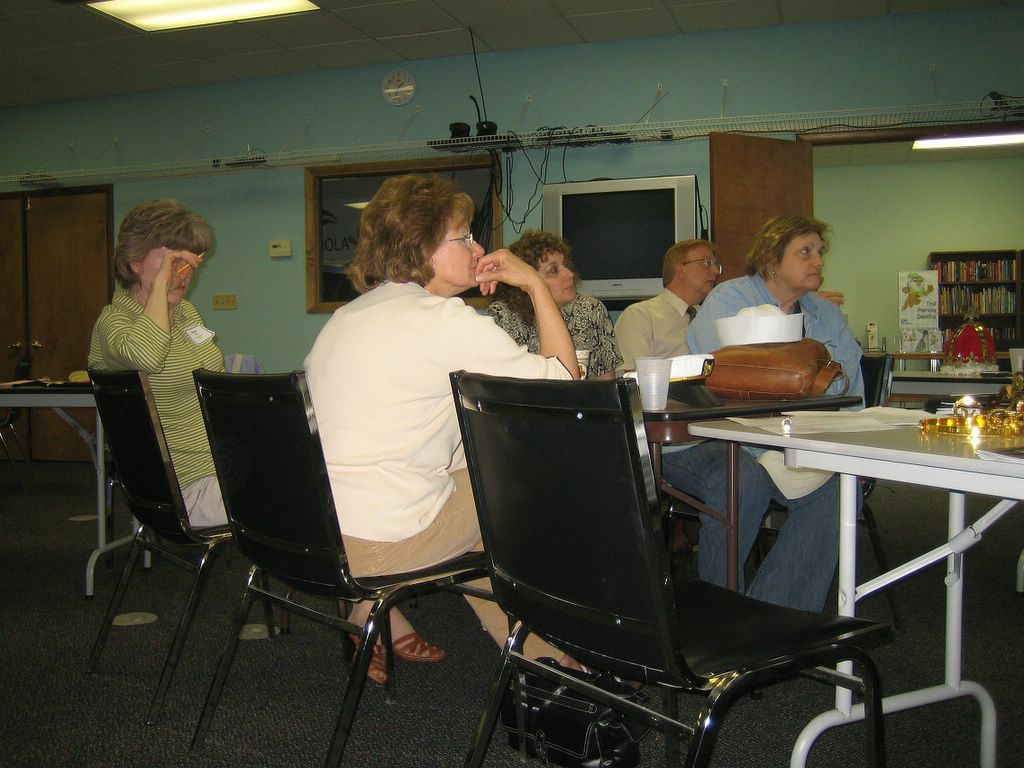
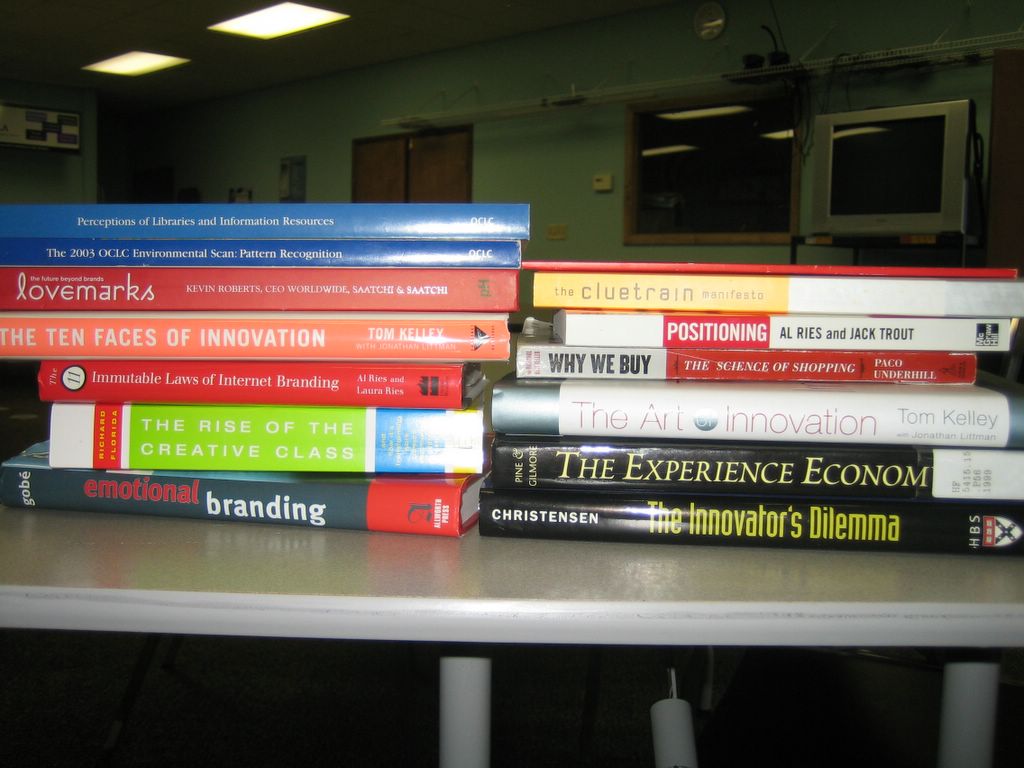
Alane and I are here in Warren, Ohio...celebrating libraries, branding, marketing and funny hats at NOLA.
Full report later...
Full report later...
Tuesday, May 02, 2006
Better Late than Never? Or, sorry, Chrystie...
I should have welcomed Chrystie Hill to the blog last week. Somehow, it didn't happen and Alice picked up the ball. But I do want to add my two cents.
Chrystie was one of the first people hired to work on WebJunction, and she helped create the wonderful sense of community that permeates the site. She's funny, irreverent, smart, and she wears the coolest glasses you'll ever see. As a relatively new member of the library profession, her outlook is "can do" rather than "been there, done that," and this attitude shines through everything she does.
She's a wonderful writer, with articles published in Library Journal, American Libraries, Computers in Libraries, First Monday, and Public Libraries. (For links, go to her personal site.) She also contributes regularly to WebJunction's BlogJunction.
Chrystie is passionate about libraries, community, and technology, but most of all, people. She pursues what she does with focused intensity while maintaining a sense of balance and proportion. And over a couple of beers after a WebJunction Advisory Council meeting, she can passionately debate the nature of reality. And win.
Welcome, Chrystie, and thanks for being part of the "It's All Good" team!
Chrystie was one of the first people hired to work on WebJunction, and she helped create the wonderful sense of community that permeates the site. She's funny, irreverent, smart, and she wears the coolest glasses you'll ever see. As a relatively new member of the library profession, her outlook is "can do" rather than "been there, done that," and this attitude shines through everything she does.
She's a wonderful writer, with articles published in Library Journal, American Libraries, Computers in Libraries, First Monday, and Public Libraries. (For links, go to her personal site.) She also contributes regularly to WebJunction's BlogJunction.
Chrystie is passionate about libraries, community, and technology, but most of all, people. She pursues what she does with focused intensity while maintaining a sense of balance and proportion. And over a couple of beers after a WebJunction Advisory Council meeting, she can passionately debate the nature of reality. And win.
Welcome, Chrystie, and thanks for being part of the "It's All Good" team!
IFLA/OCLC Fellows
The 2006 Class of IFLA/OCLC Early Career Development Fellows began their residency yesterday (May 1) at OCLC. We have five librarians from five continents this year, and I can already tell that we're in for a spirited month. The Fellows this year are:
Ms. Maria Cherrie
Librarian
Trinidad & Tobago National Library and Information System Authority
Port-of-Spain, Trinidad & Tobago
Mrs. Janete Estevão
Head Librarian
O Boticário Franchising S/A
Sao José dos Pinhais, Paraná, Brazil
Mr. Festus Ng'etich
Librarian
Kenya Institute of Management
Nairobi, Kenya
Mr. Roman Purici
Director
Information Resource Center, U.S. Embassy
Chisinau, Moldova
Mr. Salmubi
Head of Library
The State Polytechnic of Ujung Pandang
Makassar, Indonesia
In a few minutes, we leave for Chicago. We will participate in the Chicago Public Library's All Staff Institute Day and visit ALA's headquarters on Wednesday; tour the city on Thursday; and spend a day at the University of Illinois's Mortenson Center in Urbana-Champaign on Friday. We also have trips to several Columbus area libraries, an Ohio Library Council conference, a day at the Library of Congress, the Members Council meeting, and a few parties, picnics, and bull sessions planned. Pictures will be forthcoming soon!
Ms. Maria Cherrie
Librarian
Trinidad & Tobago National Library and Information System Authority
Port-of-Spain, Trinidad & Tobago
Mrs. Janete Estevão
Head Librarian
O Boticário Franchising S/A
Sao José dos Pinhais, Paraná, Brazil
Mr. Festus Ng'etich
Librarian
Kenya Institute of Management
Nairobi, Kenya
Mr. Roman Purici
Director
Information Resource Center, U.S. Embassy
Chisinau, Moldova
Mr. Salmubi
Head of Library
The State Polytechnic of Ujung Pandang
Makassar, Indonesia
In a few minutes, we leave for Chicago. We will participate in the Chicago Public Library's All Staff Institute Day and visit ALA's headquarters on Wednesday; tour the city on Thursday; and spend a day at the University of Illinois's Mortenson Center in Urbana-Champaign on Friday. We also have trips to several Columbus area libraries, an Ohio Library Council conference, a day at the Library of Congress, the Members Council meeting, and a few parties, picnics, and bull sessions planned. Pictures will be forthcoming soon!
How Do You Keep Up, Part 2
Last week, I gave a presentation called "Getting to the On Ramp" at the Ohio Library Council's Technical Services Retreat. The talk focused on how librarians, especially those in small libraries and remote areas, could stay connected with what's happening in the library world and beyond. I posted about this, and asked for advice on how you keep up. I got some great suggestions, and I want to thank Judith Siess, Steve Bell, and Genevieve Foskett for their most valuable input.
The talk was pretty well received, and if you'd like a copy of the PowerPoint slides and/or my one page handout, drop me a line at needhamg@oclc.org, or in the comments below.
The talk was pretty well received, and if you'd like a copy of the PowerPoint slides and/or my one page handout, drop me a line at needhamg@oclc.org, or in the comments below.
Monday, May 01, 2006
Friendshop at SPL

Once again, I fawn over the Seattle Public Library. Yet one more example of smart thinking, good design and a culture of creative innovation...
As they explain on their site, the Friendshop is
"the public face of the Friends and represents our longstanding commitment to serve The Seattle Public Library. Shop revenue supports programs, services, events, and special initiatives of The Seattle Public Library."
Who knew the Friendshop slid open and closed? Cool!
Watch the animation.
This will be my design inspiration for the day. If even the shop can be engaging at the library, just think what they've done to the experience of actually using the library!?!
Sunday, April 30, 2006
Friends with Money
Last night I went to see Friends with Money and (you're not going to believe this) Bill & Melinda were there. They came in late, milled about trying to find a seat, and then had to sit in the front row. Strangers were whispering to each other: Oh. My. God. I'm at Friends with Money - with the richest man in the world. Isn't it funny?
I love spectacle.
Just the day before, Mr. Gates lost three billion on paper. (I wonder if that made it a little easier for him to relate to the characters in the film:) ) The loss was in part due to Microsoft's announcement on Thursday that they intend to pour a bunch of money into R&D, including some social software ventures. Apparently they're getting further into this community-based software development stuff. The microsoft community for flight simulator another interesting example.
As for me and my friends (without money) this all had us pondering a few questions: is it unethical to try and figure out how to turn customers into evangelists in order to turn a long-term profit, and at the expense of current investors? Is profit the only difference between, say, evangelist customers and engaged patrons? What if we said it like this: is it unethical to try and turn tech-savvy eenagers into library users in order to develop our own long-term sustainability, and at the expense of our traditional patrons? And is it just some kind of happy happenstance (or sad coincidence, depending on how you look at it) that the world's wealthiest is also largely responsible for the fact that US libraries are still open at all? What would we have done without that $250M? And where do we go from here?
I love spectacle.
Just the day before, Mr. Gates lost three billion on paper. (I wonder if that made it a little easier for him to relate to the characters in the film:) ) The loss was in part due to Microsoft's announcement on Thursday that they intend to pour a bunch of money into R&D, including some social software ventures. Apparently they're getting further into this community-based software development stuff. The microsoft community for flight simulator another interesting example.
As for me and my friends (without money) this all had us pondering a few questions: is it unethical to try and figure out how to turn customers into evangelists in order to turn a long-term profit, and at the expense of current investors? Is profit the only difference between, say, evangelist customers and engaged patrons? What if we said it like this: is it unethical to try and turn tech-savvy eenagers into library users in order to develop our own long-term sustainability, and at the expense of our traditional patrons? And is it just some kind of happy happenstance (or sad coincidence, depending on how you look at it) that the world's wealthiest is also largely responsible for the fact that US libraries are still open at all? What would we have done without that $250M? And where do we go from here?
Friday, April 28, 2006
Microsoft sponsors social software spin-off
So you know it's here to stay...Wallop. Check out the bouncing jello jiggler cube.
Cute.
Read what people are saying.
Cute.
Read what people are saying.
Thursday, April 27, 2006
Nuts About Good Organizational Blogging
Southwest Airlines has started blogging. They are doing Nuts About Southwest like we do It's All Good: several authors and the individual voices of the contributors are clear. And (at least right now) commenting is open...no passwords or registration required.
I am biased but I think this is how institutions and companies and libraries need to connect with current and potential customers. The Southwest blog started just a week ago...check out the number of comments on the posts. Lots. I was interested to see several comments on the initial post on April 21 were from current and past employees.
It's all about telling stories--and being willing to hear reactions to those stories.
I am biased but I think this is how institutions and companies and libraries need to connect with current and potential customers. The Southwest blog started just a week ago...check out the number of comments on the posts. Lots. I was interested to see several comments on the initial post on April 21 were from current and past employees.
It's all about telling stories--and being willing to hear reactions to those stories.
Killer Snails
"...they're screaming that they're being pursued by a snail and yet they cannot get away! 'The snail! The snail!', they cry. 'How can we possibly escape!?. The problem being that the snail's been moving closer for the last twenty years one way or another and they just weren't paying attention."
This is from a post by Tom Coates (now with Yahoo! formerly with the BBC) at plasticbag.org in reaction to the BBC's blueprint for the future that I wrote about yesterday. Made me laugh. It's titled "Is the pace of change really such a shock?" And it resonated too because way too often I hear librarians bemoan the pace of change and offer up the excuse that it's all just too much to stay up on....so they won't.
Tom again: "Shock revelation! A new set of technologies has started to displace older technologies and will continue to do so at a fairly slow rate over the next ten to thirty years!"
Change is a shock and disruptive if we stay in the warm and familiar water of a small pond. Venture outside the local and the familiar and then when change comes to our pond....we'll recognize it and be ready for it.
This is from a post by Tom Coates (now with Yahoo! formerly with the BBC) at plasticbag.org in reaction to the BBC's blueprint for the future that I wrote about yesterday. Made me laugh. It's titled "Is the pace of change really such a shock?" And it resonated too because way too often I hear librarians bemoan the pace of change and offer up the excuse that it's all just too much to stay up on....so they won't.
Tom again: "Shock revelation! A new set of technologies has started to displace older technologies and will continue to do so at a fairly slow rate over the next ten to thirty years!"
Change is a shock and disruptive if we stay in the warm and familiar water of a small pond. Venture outside the local and the familiar and then when change comes to our pond....we'll recognize it and be ready for it.
Welcome Chrystie
I've got a special post today, because I get to introduce a new voice to the IAG you know and (possibly) love.
If you haven't met Chrystie Hill through WebJunction, BlogJunction, the Libraries Build Communities project, her company It Girl Consulting, or at any number of conferences she attends as the Community Manager of WebJunction--then you are in for a treat.
Chrystie is passionate about community-building, technology, libraries and the intersection of the three, and so of course we think she fits right in. Plus, since she's based in Seattle, she balances out our somewhat myopic Birds' Eye view from Dublin, Ohio. Welcome Chrystie!
If you haven't met Chrystie Hill through WebJunction, BlogJunction, the Libraries Build Communities project, her company It Girl Consulting, or at any number of conferences she attends as the Community Manager of WebJunction--then you are in for a treat.
Chrystie is passionate about community-building, technology, libraries and the intersection of the three, and so of course we think she fits right in. Plus, since she's based in Seattle, she balances out our somewhat myopic Birds' Eye view from Dublin, Ohio. Welcome Chrystie!
Hello. My name is...
Aw. Thanks Alice. What a nice introduction. I had just composed this happy little intro of myself, which I was feeling sort of weird about because of the "self-promotion" discussion flying around the last week or so. You saved me! Thanks!
I like to call myself a "librarian, writer, and tech-advocate," mostly because I haven't figured out how to pull it all into a catchy phrase. My main professional interest is in building communities, full stop. As Alice mentioned, my role at OCLC is as WebJunction Community Manager. I consider myself the luckiest girl in library-land precisely because OCLC employs me (can you believe it?) to build community for librarians. Better yet, I get to do it online. I can't imagine a dreamier job. They also let me do cool stuff in my off-time - a bonus.
Since I joined OCLC I have near-idolized Alane, Alice, Eric, and George. It is an honor to be invited to join them on It's All Good. Thanks to you all for having me.
I like to call myself a "librarian, writer, and tech-advocate," mostly because I haven't figured out how to pull it all into a catchy phrase. My main professional interest is in building communities, full stop. As Alice mentioned, my role at OCLC is as WebJunction Community Manager. I consider myself the luckiest girl in library-land precisely because OCLC employs me (can you believe it?) to build community for librarians. Better yet, I get to do it online. I can't imagine a dreamier job. They also let me do cool stuff in my off-time - a bonus.
Since I joined OCLC I have near-idolized Alane, Alice, Eric, and George. It is an honor to be invited to join them on It's All Good. Thanks to you all for having me.
Wednesday, April 26, 2006
BBC 2.0
Alice is right....we're all scurrying around hither and yon ("hither" is here around OCLC, and "yon" is the big old world). I have to get myself to the airport in a bit...leaving myself far more time than certain people. But I wanted to draw your attention to the "blueprint" for the future that the venerable "Beeb", revealed yesterday with its Creative Future plan.
Very Web 2.0ish. Highly relevant to libraries as many of the challenges of publically funded radio are the same as they are for libraries, and that the proposed changes would fit well in our world too.
-take entertainment seriously
-enable people to record and share their memories
-create a teen brand
-have more personalisation, user-generated content and richer AV in the website
-be better at engaging audiences and reflecting their lives better
-develop better tools to help people find content
The Director-General Mark Thompson says this: "The second wave of digital will be far more disruptive that the first and the foundations of traditional media will be swept away, taking us beyond broadcasting...On-demand changes everything. It means we need to rethink the way we conceive, commission, produce, package and distribute our content. This isn't about new services it's about doing what we already do differently...We should aim to deliver public service content to our audiences in whatever media and on whatever device makes sense for them, whether they are at home or on the move."
BBC links here, here and here. Comments from bloggers here, here, here and here.
Very Web 2.0ish. Highly relevant to libraries as many of the challenges of publically funded radio are the same as they are for libraries, and that the proposed changes would fit well in our world too.
-take entertainment seriously
-enable people to record and share their memories
-create a teen brand
-have more personalisation, user-generated content and richer AV in the website
-be better at engaging audiences and reflecting their lives better
-develop better tools to help people find content
The Director-General Mark Thompson says this: "The second wave of digital will be far more disruptive that the first and the foundations of traditional media will be swept away, taking us beyond broadcasting...On-demand changes everything. It means we need to rethink the way we conceive, commission, produce, package and distribute our content. This isn't about new services it's about doing what we already do differently...We should aim to deliver public service content to our audiences in whatever media and on whatever device makes sense for them, whether they are at home or on the move."
BBC links here, here and here. Comments from bloggers here, here, here and here.
What's Next after MySpace?
Lee Gnomes from the Wall Street Journal explores three of the possible next social software networking spaces, after MySpace:
TagWorld
Imeem
Tagged
VarsityWorld
Read his commentary. All of this gets very interesting, as we recall some of the stats for 14-17 year olds, from the Perceptions report...which Alane and I are munching on, for our team presentation with the funny hats.
TagWorld
Imeem
Tagged
VarsityWorld
Read his commentary. All of this gets very interesting, as we recall some of the stats for 14-17 year olds, from the Perceptions report...which Alane and I are munching on, for our team presentation with the funny hats.
Podcasting at OHIONET
This week has been a crazy one. Last week was even crazier, as I was traveling back and forth and missing flights and all the rest of it.
Flight times
It turns out, Continental is getting serious about the check in 30 minutes prior to departure. I like to arrive with just enough time to leisurely walk through security and up to my gate, just as they are calling my row...
I missed both flights this way, even though I had a good 25 minutes from eCheck-in, before departure. So, word of warning: they're cracking down and making us all wait ...but in the name of setting customer expectations, check out the cool wait times feature for security screening. This is cool--I wish they would post some information about this AT the actual airport security gates.
Podcasting with Walking Paper
But security gates notwithstanding, what I really wanted to talk about was Podcasting. Alane and I got to sit in on Aaron Schmidt's presentation last week for OHIONET. He cleverly described it as TiVo for radio. And just when we all start to think that this stuff is mainstream, everyone knows it, I'll give you a quick run-down of some of the questions asked:
Now this is not to make anyone feel bad, here. But it brought into sharp focus for me, the fact that not everyone swims in the technology waters and can just *absorb* from their surroundings. The information is out there for the taking, sure, and it's not really a matter of building another portal, another blog, another somewhere for people to go to find up-to-date information easily pre-digested.
Afraid to play?
To me, it's more about the approach to learning. It seemed that a good many people in the room were afraid to play. Afraid to get things wrong. Afraid to make a mistake, afraid to look silly by exposing their ignorance...but I tell you, you're not going to break your computer and you're not going to embarass yourself by trying things like podcasts or blogs or myspace--any more than you will be by NOT trying them! So, I will now faithfully repeat Aaron Schmidt's foolproof plan for podcasting:
And that's it! He also mentioned Podcasting 101 as a good resource. I also used Odeo, which is browser-based, when I was first skulking around with it.
So all of us, we need to Get to Playing!
Flight times
It turns out, Continental is getting serious about the check in 30 minutes prior to departure. I like to arrive with just enough time to leisurely walk through security and up to my gate, just as they are calling my row...
I missed both flights this way, even though I had a good 25 minutes from eCheck-in, before departure. So, word of warning: they're cracking down and making us all wait ...but in the name of setting customer expectations, check out the cool wait times feature for security screening. This is cool--I wish they would post some information about this AT the actual airport security gates.
Podcasting with Walking Paper
But security gates notwithstanding, what I really wanted to talk about was Podcasting. Alane and I got to sit in on Aaron Schmidt's presentation last week for OHIONET. He cleverly described it as TiVo for radio. And just when we all start to think that this stuff is mainstream, everyone knows it, I'll give you a quick run-down of some of the questions asked:
*Is this like Napster?
*What's the difference between iTunes, iPod and Podcast?
*Do I need to load iPod software on all the campus computers?
Now this is not to make anyone feel bad, here. But it brought into sharp focus for me, the fact that not everyone swims in the technology waters and can just *absorb* from their surroundings. The information is out there for the taking, sure, and it's not really a matter of building another portal, another blog, another somewhere for people to go to find up-to-date information easily pre-digested.
Afraid to play?
To me, it's more about the approach to learning. It seemed that a good many people in the room were afraid to play. Afraid to get things wrong. Afraid to make a mistake, afraid to look silly by exposing their ignorance...but I tell you, you're not going to break your computer and you're not going to embarass yourself by trying things like podcasts or blogs or myspace--any more than you will be by NOT trying them! So, I will now faithfully repeat Aaron Schmidt's foolproof plan for podcasting:
Recipe for Podcast
1. Get a Blog
2. Do RSS 2.0 on Feedburner
3. Record MP3
4. Upload MP3
5. Write post with MP3 enclosure--link to MP3 file
And that's it! He also mentioned Podcasting 101 as a good resource. I also used Odeo, which is browser-based, when I was first skulking around with it.
So all of us, we need to Get to Playing!
Thursday, April 20, 2006
A Cup o' Cold Tea
George is disconcerted by turkey vultures outside his window....he, at least, has a window. Luxury! ("Luxury. We used to have to get out of the lake at six o'clock in the morning, clean the lake, eat a handful of 'ot gravel, work twenty hour day at mill for tuppence a month..." Monty Python)
I have a Dilbert cubicle. But, as cubicles go, it's a nice one. It's not orange and I have two metal "It's All Good" signs. I have a little closet/filing cabinet and I am strategically located so that I know the whereabouts of five vice-presidents and one CEO. Often, though, I am not in my cubicle. I work at home and I travel a fair bit, promoting myself, OCLC and/or critical thinking.
This afternoon I, like George, will be speaking to attendees of the OHIONET Annual Users' Meeting. Not surprisingly, my topic is the Perceptions report. Next Tuesday, I head to Cleveland to talk to CAMLS members and on Wednesday, I'm off to St. Louis, MO, for a Thursday presentation at the Army Library Training Institute, a five day conference. Luckily, the fact that I am an immigrant does not prevent me from speaking to federal employees. Then it's off to Chicago Sunday night to participate in a day-long event on Monday that Jenny Levine has organized for the Metropolitan Library System, called "Who Are These People and What Do they Want?". My co-presenters are Stephen Abram and Ed Vielmetti. After that, it's back to Cleveland on Wednesday to do a full day workshop with Alice, for NOLA. Alice and I are having fun preparing for this event which will be part lecture and part workshop....there may be silly hats involved.
And then I'm going on holiday for a week. Luxury.

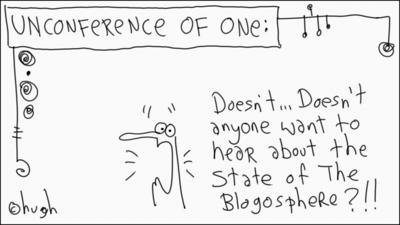
gapingvoid.com
I have a Dilbert cubicle. But, as cubicles go, it's a nice one. It's not orange and I have two metal "It's All Good" signs. I have a little closet/filing cabinet and I am strategically located so that I know the whereabouts of five vice-presidents and one CEO. Often, though, I am not in my cubicle. I work at home and I travel a fair bit, promoting myself, OCLC and/or critical thinking.
This afternoon I, like George, will be speaking to attendees of the OHIONET Annual Users' Meeting. Not surprisingly, my topic is the Perceptions report. Next Tuesday, I head to Cleveland to talk to CAMLS members and on Wednesday, I'm off to St. Louis, MO, for a Thursday presentation at the Army Library Training Institute, a five day conference. Luckily, the fact that I am an immigrant does not prevent me from speaking to federal employees. Then it's off to Chicago Sunday night to participate in a day-long event on Monday that Jenny Levine has organized for the Metropolitan Library System, called "Who Are These People and What Do they Want?". My co-presenters are Stephen Abram and Ed Vielmetti. After that, it's back to Cleveland on Wednesday to do a full day workshop with Alice, for NOLA. Alice and I are having fun preparing for this event which will be part lecture and part workshop....there may be silly hats involved.
And then I'm going on holiday for a week. Luxury.
gapingvoid.com
Wednesday, April 19, 2006
Omens
It's about 7:00 p.m. in Columbus as I write this. I'm trying to get a leg up on some work that's due very soon, but there are six turkey vultures pacing in front of my office window. They are very distracting, and they make me nervous. As a city boy, I've always bought into Katharine Hepburn's line from The African Queen: "Nature, Mr. Allnut, is what we were placed in this world to rise above."
The bottom of my window is nearly at ground level, and my floor is slightly lower than that, so I'm at eye level with these large, and apparently none-too-bright, birds. Every now and then, one of them bashes his (her? I'm no ornithologist) head into my window, scaring the bejeesus out of me. Then, another one will do a full plumage display, spreading out her (his?) wings to show how tough she (he?) is. Their scrawny yellow talons sink into the freshly-spread fertilizer in the flower bed with each step. But I guess when you're used to eating road kill, nothing really bothers you.
A stupid joke: Seems there was a buzzard getting on an airplane with two dead squirrels. The flight attendant stopped him at the door and said, "I'm sorry, sir. You're only allowed one carrion."
The bottom of my window is nearly at ground level, and my floor is slightly lower than that, so I'm at eye level with these large, and apparently none-too-bright, birds. Every now and then, one of them bashes his (her? I'm no ornithologist) head into my window, scaring the bejeesus out of me. Then, another one will do a full plumage display, spreading out her (his?) wings to show how tough she (he?) is. Their scrawny yellow talons sink into the freshly-spread fertilizer in the flower bed with each step. But I guess when you're used to eating road kill, nothing really bothers you.
A stupid joke: Seems there was a buzzard getting on an airplane with two dead squirrels. The flight attendant stopped him at the door and said, "I'm sorry, sir. You're only allowed one carrion."
How do you keep up?
I mentioned in my last post that I'm speaking next week at the Ohio Library Council's Technical Services Retreat. My topic is one I've never spoken on before: "Getting to the On Ramp." The description of my program is:
Working in a small library, or in a small department of a large institution, it's possible to feel pretty isolated from the rest of the field. This program will introduce several ways to stay on top of what's happening in the library and information community: across Ohio, across the Midwest, across the United States, and even internationally. The tools and techniques discussed are freely available, free or inexpensive, will slide neatly into your regular workflow, and can help you reconnect with the larger world.
So, how do you keep up? Do you have anything you'd want to share with my audience? Thanks for your input!
Working in a small library, or in a small department of a large institution, it's possible to feel pretty isolated from the rest of the field. This program will introduce several ways to stay on top of what's happening in the library and information community: across Ohio, across the Midwest, across the United States, and even internationally. The tools and techniques discussed are freely available, free or inexpensive, will slide neatly into your regular workflow, and can help you reconnect with the larger world.
So, how do you keep up? Do you have anything you'd want to share with my audience? Thanks for your input!
Home Again (briefly)
It's been nearly four weeks since I signed off "It's All Good." I didn't intend for it to be that long, but a vacation, a Board meeting, a couple of speeches, and a cold I just couldn't shake, I didn't get back to the old soap box as quickly as I hoped I would.
One question: how can you go on vacation for 10 days and end up six weeks behind in your work?
Tomorrow, I'm going to be talking on WebJunction to the OHIONET Annual Users Meeting, and on Friday, I'll be talking at the OCLC Reference Services Advisory Committee meeting here in Dublin.
Next week, I'll be talking at the Ohio Library Council's Technical Services Retreat, and on Wednesday, it's off to Colorado for the 37th Annual Interlibrary Loan Conference.
One question: how can you go on vacation for 10 days and end up six weeks behind in your work?
Tomorrow, I'm going to be talking on WebJunction to the OHIONET Annual Users Meeting, and on Friday, I'll be talking at the OCLC Reference Services Advisory Committee meeting here in Dublin.
Next week, I'll be talking at the Ohio Library Council's Technical Services Retreat, and on Wednesday, it's off to Colorado for the 37th Annual Interlibrary Loan Conference.
Tuesday, April 18, 2006
Carolina On My Mind
"In my mind I’m goin’ to Carolina.
Can’t you see the sunshine?
Can’t you just feel the moonshine?
...
Yes I’m goin’ to Carolina in my mind."
(“Carolina in my Mind” – James Taylor) [Wikipedia entry ; web site]
As I mentioned in a prior post, I was recently in North Carolina. My trip closed with a very pleasant visit to Chapel Hill, “The Southern Part of Heaven,” where I enjoyed the warm hospitality of friends and spent a sunny Monday in the stimulating company of UNC Libraries staff and UNC SILS faculty and students. These good folks also politely endured several presentations from me:
Presentation 1: Sarah Michalak, University Librarian, graciously granted me time for a brief presentation about selected OCLC Research projects at the UNC all-libraries-staff meeting in the beautiful Louis Round Wilson Library. And the occasion provided me the good fortune to hear UNC Libraries’ Diane Strauss’ entertaining and informative summation of the best research and thinking about what library spaces will be tasked to support over the next few decades. According to Strauss, the good news is that libraries as place will still be around in the next few decades – even thriving – if libraries prove ready and willing to deliver a lot more people space and lot less book warehouse. Building flexible, adaptable spaces is going to be the key to library physical space investments from this point forward.
Presentation 2: Jane Greenberg, Associate Professor, UNC SILS, invited me to address a SILS “Organizing Materials” class (plus such fellow faculty members and members of the UNC Libraries staff as wished to attend) in a session sponsored by the Metadata Research Center. My presentation [ppt] covered FRBR (Functional Requirements of Bibliographic Records) basics and some brief information about the following OCLC activities that are leveraging FRBR:
As one would expect from a top-ranked academic program and library staff from a world-class institution, the questions and discussion were excellent. I was delighted to be part of a group photo at the close of the session (when all the students become famous I can point to it, and say I knew them when...).
Presentation/discussion 3: Margaretta Yarborough, Interim Head of Technical Services, kindly arranged for a special session at Davis Library with staff interested in authorities issues (a gathering which included a good cross-section of divisions and a few, especially enduring folks who were encountering me for the third presentation of the day, God bless ‘em! ;-) My topic was a bit more technical, the VIAF (Virtual International Authority File) project, an exploration of the requirements for linking identical entities in multiple national authority files. The discussion and questions were insightful, and suggested that the project has significant potential to aid authority work and more.
All-in-all a busy, but wonderful trip to my home state. My special thanks to Sarah Michalak, Margaretta Yarborough, Jane Greenberg for helping to arrange all the meetings and to everyone at UNC for allowing me to spend some quality time there. It was especially nice to make new acquaintances such as Diane Strauss, Jerry Saye, Cal Lee, Rebecca Vargha, and to catch up with friends like Jane Greenberg, Margaretta Yarborough, visiting scholar Eva Méndez, Celine Noel, and Janis Holder.
I’m still goin’ to Carolina in my mind...
Can’t you see the sunshine?
Can’t you just feel the moonshine?
...
Yes I’m goin’ to Carolina in my mind."
(“Carolina in my Mind” – James Taylor) [Wikipedia entry ; web site]
As I mentioned in a prior post, I was recently in North Carolina. My trip closed with a very pleasant visit to Chapel Hill, “The Southern Part of Heaven,” where I enjoyed the warm hospitality of friends and spent a sunny Monday in the stimulating company of UNC Libraries staff and UNC SILS faculty and students. These good folks also politely endured several presentations from me:
Presentation 1: Sarah Michalak, University Librarian, graciously granted me time for a brief presentation about selected OCLC Research projects at the UNC all-libraries-staff meeting in the beautiful Louis Round Wilson Library. And the occasion provided me the good fortune to hear UNC Libraries’ Diane Strauss’ entertaining and informative summation of the best research and thinking about what library spaces will be tasked to support over the next few decades. According to Strauss, the good news is that libraries as place will still be around in the next few decades – even thriving – if libraries prove ready and willing to deliver a lot more people space and lot less book warehouse. Building flexible, adaptable spaces is going to be the key to library physical space investments from this point forward.
Presentation 2: Jane Greenberg, Associate Professor, UNC SILS, invited me to address a SILS “Organizing Materials” class (plus such fellow faculty members and members of the UNC Libraries staff as wished to attend) in a session sponsored by the Metadata Research Center. My presentation [ppt] covered FRBR (Functional Requirements of Bibliographic Records) basics and some brief information about the following OCLC activities that are leveraging FRBR:
- Audience Level (OCLC Research) – A service that returns an approximate “audience level” using a combination of FRBR and either harvested target audience information or inferred “audience level” information calculated from WorldCat holdings
- FictionFinder (OCLC Research) – A search interface to works of fiction cataloged in WorldCat
- Dewey Browser (OCLC Research) – A DDC-inspired, visual interface to various files
- Live Search (OCLC Research) – A search interface that leverages FRBR, WorldCat holdings, and DDC (in a slightly clandestine manner) to offer a very fast, one-search-box discovery experience
- FirstSearch WorldCat FRBR pilot (OCLC FirstSearch) – A FRBR-inspired view of WorldCat on the OCLC FirstSearch platform currently in pilot and slated to be released later in 2006.
As one would expect from a top-ranked academic program and library staff from a world-class institution, the questions and discussion were excellent. I was delighted to be part of a group photo at the close of the session (when all the students become famous I can point to it, and say I knew them when...).
Presentation/discussion 3: Margaretta Yarborough, Interim Head of Technical Services, kindly arranged for a special session at Davis Library with staff interested in authorities issues (a gathering which included a good cross-section of divisions and a few, especially enduring folks who were encountering me for the third presentation of the day, God bless ‘em! ;-) My topic was a bit more technical, the VIAF (Virtual International Authority File) project, an exploration of the requirements for linking identical entities in multiple national authority files. The discussion and questions were insightful, and suggested that the project has significant potential to aid authority work and more.
All-in-all a busy, but wonderful trip to my home state. My special thanks to Sarah Michalak, Margaretta Yarborough, Jane Greenberg for helping to arrange all the meetings and to everyone at UNC for allowing me to spend some quality time there. It was especially nice to make new acquaintances such as Diane Strauss, Jerry Saye, Cal Lee, Rebecca Vargha, and to catch up with friends like Jane Greenberg, Margaretta Yarborough, visiting scholar Eva Méndez, Celine Noel, and Janis Holder.
I’m still goin’ to Carolina in my mind...
Monday, April 17, 2006
Southern Dreams
"I was the one who let you know,
I was your sorry-ever-after. '74-'75.
Giving me more and I'll defy,
'Cause you're really only after '74-'75."
(“’74-‘75” by The Connells ; composed by Michael Connell) [web site ; Wikipedia entry]
I suspect a few IAG readers may remember Raleigh’s best known band, a darling of the college radio airwaves in the 80’s and 90’s, a band I reference because I was recently in the “City of Oaks” (and Chapel Hill and Greensboro, but those are added tales – read on).
SEAALL
The SEAALL (Southeastern Chapter of the AALL) very kindly invited me to be part of their 2006 annual meeting in Raleigh, North Carolina, relocated from Baton Rouge (which is now designated as the site of SEAALL’s 2007 event). And what a fine meeting it was – an pleasantly-sized, flawlessly-executed conference that progressed each day from breakfast-with-all-conference-presentations by the likes of entrepreneur Bob Young (Lulu.com), legal-themed mysteries writer Margaret Maron (author of Uncommon Clay), and greetings from AALL president Claire M. Germain (Cornell Law Library, formerly of Duke Law Library), to excellent break-out sessions and first-rate social events (a reception at the North Carolina Museum of Natural Sciences one evening, and a barbeque & bluegrass picnic the next.)
The SEAALL break-out sessions I attended:
My sincere thanks to Sally Wambold and Tim Coggins of the University of Richmond Law Library for arranging for me to be part of this wonderful SEAALL conference. It was great to see several folks at SEAALL that I hadn’t seen in sooo long. And I’m grateful to all the wonderful SEAALL attendees who made me feel welcome (a special thanks to Christine, a loyal IAG reader, for her kind words about this blog).
NCSU
Though the chief cause of my trip to Raleigh was to participate in SEAALL, I just couldn’t drop in to Raleigh and not stop by to see the good folks at North Carolina State University (NCSU), especially given their very cool work on the NCSU catalog interface. So, at my request, Andrew Pace kindly arranged for some quality time with several staff who are involved in building and improving the system. I’m very impressed by what’s been done and even more so by their plans for the future. I also used the occasion to drop by and pay a casual visit to Karen Letarte, Bao-Chu Chang, and the other NCSU technical services staff at their temporary digs near campus, and they surprised me with a chocolate cake and refreshments (delicious!). Between the visit to NCSU and the SEAALL technical services breakout, it was a much-needed technical services fix for this fallen cataloger!
UNCG
My trip also provided the opportunity to attend my MLS alumni association annual luncheon at UNC Greensboro where I met the new (well, new to me anyway) chair of the department, Lee Shiflett, renewed acquaintance with some of my favorite faculty including Bea Kovacs, and James Carmichael, and caught up on news with my fellow alums. The after-luncheon Cora Paul Bomar Lecture was presented by Charlotte Ross (Appalachian State University) who charmed us with Appalachian folk tales. I also took a few post-lunch hours to tour campus and visit Jackson Library and by happenstance bumped into my former colleague, Mark Schumacher who showed me the work he’s been doing to catalog the oeuvre of book designer Amy Sacker.
There was nothing sorry about this dreamy trip back home. And I also had a very pleasant visit in Chapel Hill on this same trip, but that’s for another post...
I was your sorry-ever-after. '74-'75.
Giving me more and I'll defy,
'Cause you're really only after '74-'75."
(“’74-‘75” by The Connells ; composed by Michael Connell) [web site ; Wikipedia entry]
I suspect a few IAG readers may remember Raleigh’s best known band, a darling of the college radio airwaves in the 80’s and 90’s, a band I reference because I was recently in the “City of Oaks” (and Chapel Hill and Greensboro, but those are added tales – read on).
SEAALL
The SEAALL (Southeastern Chapter of the AALL) very kindly invited me to be part of their 2006 annual meeting in Raleigh, North Carolina, relocated from Baton Rouge (which is now designated as the site of SEAALL’s 2007 event). And what a fine meeting it was – an pleasantly-sized, flawlessly-executed conference that progressed each day from breakfast-with-all-conference-presentations by the likes of entrepreneur Bob Young (Lulu.com), legal-themed mysteries writer Margaret Maron (author of Uncommon Clay), and greetings from AALL president Claire M. Germain (Cornell Law Library, formerly of Duke Law Library), to excellent break-out sessions and first-rate social events (a reception at the North Carolina Museum of Natural Sciences one evening, and a barbeque & bluegrass picnic the next.)
The SEAALL break-out sessions I attended:
- “What's Cookin' in Library School?” – I unfortunately only caught part of this including José-Marie Griffiths’ amazing inventory of initiatives at UNC SILS, and a report that law information literacy may soon be added to the U.S. bar exam requirements.
- “Technical Services for Management” – with strong audience participation, a good refresher for librarians on the value of technical services to the library and a confirmation of how more than a few administrators may not fully grasp the value technical services brings to library operations. (Tip to library directors – stop reading this, go buy chocolates (the good stuff), deliver same to technical services and park yourself a spell and just talk to ‘em. You’re going to be impressed by the specialized expertise available at your library and a lot better informed about the world. Oh, and offer a heartfelt “thank you for the good work,” or even better, kneel and utter “I’m not worthy...” before you depart.)
- "Preservation of Legal Materials Born Digital" – an active area for AALL (American Association of Law Libraries ) with a 50 state survey on categories of court and other state legal e-documents underway, and an inquiry into whether online representations are “official” (seems to be mostly “no” at the moment).
- “Retrieval That Works: FRBR (Functional Requirements of Bibliographic Records) and OCLC” – My raison d’etre to be at the conference – I presented [ppt] the basics of FRBR and showed several of OCLC Research’s FRBR-related activities. I was flattered to have the session graced by a pleasing number of attendees, an audience that was engaged and curious about FRBR. (Note to self: lawyer-catalogers don’t ask questions, they cross-examine – gently, and smartly of course. I’ve got more questions myself about FRBR now than I did before SEAALL!).
My sincere thanks to Sally Wambold and Tim Coggins of the University of Richmond Law Library for arranging for me to be part of this wonderful SEAALL conference. It was great to see several folks at SEAALL that I hadn’t seen in sooo long. And I’m grateful to all the wonderful SEAALL attendees who made me feel welcome (a special thanks to Christine, a loyal IAG reader, for her kind words about this blog).
NCSU
Though the chief cause of my trip to Raleigh was to participate in SEAALL, I just couldn’t drop in to Raleigh and not stop by to see the good folks at North Carolina State University (NCSU), especially given their very cool work on the NCSU catalog interface. So, at my request, Andrew Pace kindly arranged for some quality time with several staff who are involved in building and improving the system. I’m very impressed by what’s been done and even more so by their plans for the future. I also used the occasion to drop by and pay a casual visit to Karen Letarte, Bao-Chu Chang, and the other NCSU technical services staff at their temporary digs near campus, and they surprised me with a chocolate cake and refreshments (delicious!). Between the visit to NCSU and the SEAALL technical services breakout, it was a much-needed technical services fix for this fallen cataloger!
UNCG
My trip also provided the opportunity to attend my MLS alumni association annual luncheon at UNC Greensboro where I met the new (well, new to me anyway) chair of the department, Lee Shiflett, renewed acquaintance with some of my favorite faculty including Bea Kovacs, and James Carmichael, and caught up on news with my fellow alums. The after-luncheon Cora Paul Bomar Lecture was presented by Charlotte Ross (Appalachian State University) who charmed us with Appalachian folk tales. I also took a few post-lunch hours to tour campus and visit Jackson Library and by happenstance bumped into my former colleague, Mark Schumacher who showed me the work he’s been doing to catalog the oeuvre of book designer Amy Sacker.
There was nothing sorry about this dreamy trip back home. And I also had a very pleasant visit in Chapel Hill on this same trip, but that’s for another post...
Self-service, except when I'm lazy
I have a confession:
I just used the bank teller.
Now sit back down, I didn't actually go INTO the bank. I used the drive-up window. And I should caveat: normally I do everything--absolutely everything--by Web, mail and phone with banking. I am totally happy with self-service and never want to go back.
So today as I was out returning books (on time for once!), I passed the bank parking lot. I remembered I had a check in my bag, still waiting to be deposited. I pulled in, on a whim and the teller line was empty. So I went for it.
True confessions time: I felt completely spoiled. I didn't have to fill anything out, remember any pin numbers, lick anything...I just handed over my card and the teller did the rest.
So in the midst of our push to self-service, remember to build in a few indulgent moments now and then. Your customers will be charmed. (Or at least, I was...)
Anyone else have this experience?
I just used the bank teller.
Now sit back down, I didn't actually go INTO the bank. I used the drive-up window. And I should caveat: normally I do everything--absolutely everything--by Web, mail and phone with banking. I am totally happy with self-service and never want to go back.
So today as I was out returning books (on time for once!), I passed the bank parking lot. I remembered I had a check in my bag, still waiting to be deposited. I pulled in, on a whim and the teller line was empty. So I went for it.
True confessions time: I felt completely spoiled. I didn't have to fill anything out, remember any pin numbers, lick anything...I just handed over my card and the teller did the rest.
So in the midst of our push to self-service, remember to build in a few indulgent moments now and then. Your customers will be charmed. (Or at least, I was...)
Anyone else have this experience?
Friday, April 14, 2006

Quinnipiac University
Back in February, I had the opportunity to visit the campus at Quinnipiac University and meet the Connecticut librarians who had braved rain and traffic to participate in a discussion of library marketing and branding, led by yours truly.
While I can't say much for the soggy weather, the setting was beautiful, spirits were high and dialogue was lively. Ann DeVeaux of the Law Library was our host, and she graciously agreed to take me on a tour of the building in the afternoon.
I wanted to share a few photos and a few insights from the visit:
The integral architecture
The library wing is an integral part of the Law School’s physical building, and this fact underscores the entire ethos of the library and its role in students’ lives. Designed by Centerbrook Architects—a well-known design group in the region—the library’s physical building is well-thought out and takes advantage of natural sunlight in all parts of the space (even the below-ground floors). It utilizes brick and wood primarily, with neat extras like wall-washer lighting in the shape of books with inscriptions on them.
Sometimes rebirth involves death--and a lot of planning
The library was actually part of another institution that closed in the ‘90s. Ann was telling me about the frenetic year of planning for the new space, adapting for technology, arranging for moves of the current collection, weeding and selection of the collection as it was being moved into the new space, etc. She oversaw the building design and has been the Library Director ever since.
Microform as a hot commodity
A few of the things that surprised me about the Quinnipiac Law School Library was its volume of microfilm and microfiche. I wondered why they would want to devote such a significant space to their microforms, until Ann reminded me that U.S. Law is based on precedent. And some many times, students must look up precedents from centuries before. These materials have not yet been digitized and the cost/value for doing so, when microform is such a stable media, isn’t yet worth the marginal increase in (off-campus) convenient access. The Library has also served as a government depository (GPO) institution as well, which contributes to its overall microform holdings.
The Grand Courtroom
One of the neatest parts of the building is their Grand Courtroom. The Grand Courtroom is designed as a place where students can conduct a mock trial before a judge and jury and make appellate arguments to a panel of judges. On several occasions, it also hosts sessions of the Connecticut Supreme and Appellate Courts…so it is definitely a place where the library, the students and the public life come together.
Ann was a wonderful host, with what appears to be a fabulously working library.
************
Turning back to today, I can't ever make it through this day without reflecting on my beloved Freshman English professor, Dr. Ted Stirling. He read literary works with such passion, with dog in tow. It was in his class that I woke up to literature as a medium to carry emotional expression. And of course, it was his class that drove me to discover the riches of our campus library.
While I can't say much for the soggy weather, the setting was beautiful, spirits were high and dialogue was lively. Ann DeVeaux of the Law Library was our host, and she graciously agreed to take me on a tour of the building in the afternoon.
I wanted to share a few photos and a few insights from the visit:
The integral architecture
The library wing is an integral part of the Law School’s physical building, and this fact underscores the entire ethos of the library and its role in students’ lives. Designed by Centerbrook Architects—a well-known design group in the region—the library’s physical building is well-thought out and takes advantage of natural sunlight in all parts of the space (even the below-ground floors). It utilizes brick and wood primarily, with neat extras like wall-washer lighting in the shape of books with inscriptions on them.
Sometimes rebirth involves death--and a lot of planning
The library was actually part of another institution that closed in the ‘90s. Ann was telling me about the frenetic year of planning for the new space, adapting for technology, arranging for moves of the current collection, weeding and selection of the collection as it was being moved into the new space, etc. She oversaw the building design and has been the Library Director ever since.
Microform as a hot commodity
A few of the things that surprised me about the Quinnipiac Law School Library was its volume of microfilm and microfiche. I wondered why they would want to devote such a significant space to their microforms, until Ann reminded me that U.S. Law is based on precedent. And some many times, students must look up precedents from centuries before. These materials have not yet been digitized and the cost/value for doing so, when microform is such a stable media, isn’t yet worth the marginal increase in (off-campus) convenient access. The Library has also served as a government depository (GPO) institution as well, which contributes to its overall microform holdings.
The Grand Courtroom
One of the neatest parts of the building is their Grand Courtroom. The Grand Courtroom is designed as a place where students can conduct a mock trial before a judge and jury and make appellate arguments to a panel of judges. On several occasions, it also hosts sessions of the Connecticut Supreme and Appellate Courts…so it is definitely a place where the library, the students and the public life come together.
Ann was a wonderful host, with what appears to be a fabulously working library.
************
Turning back to today, I can't ever make it through this day without reflecting on my beloved Freshman English professor, Dr. Ted Stirling. He read literary works with such passion, with dog in tow. It was in his class that I woke up to literature as a medium to carry emotional expression. And of course, it was his class that drove me to discover the riches of our campus library.
Thursday, April 13, 2006
Colouring the World
Andy Havens, marketing maven here at the Mothership passed along the url to a colour finder for photos, called colr pickr. Krazydad made the tool that collects flikr photos that are part of a pool called Color Fields. It's a very interesting wordless way to search for colours using a spectrum to "name" the colour. Notice the sliding bar on the left to change the hue of the colour.
Very distracting. Also very interesting. Indexing pictures is hard and this would be one cool way to allow people to search for images. "I need a picture of a dandelion." Dandelions are really yellow so going to the "very yellow" part of the spectrum would be one way to scope such a search.
Very distracting. Also very interesting. Indexing pictures is hard and this would be one cool way to allow people to search for images. "I need a picture of a dandelion." Dandelions are really yellow so going to the "very yellow" part of the spectrum would be one way to scope such a search.
Wednesday, April 12, 2006
Chunka chunka chunka
That's the sound of massive monolithic application systems getting divided into smaller Web services.
There was an interesting presentation by the people in charge (scroll all the way down) of product architecture and global solutions group today. It seems like someone has turned up the heat in the kitchen, because we've got stuff cooking all over the place these days. That's great to hear for libraries, of course, and it seems to all be made possible by chunking bits and pieces of user needs into flexible, reusable, mash-up-able units. That's all cool, of course.
What was so refreshing to hear in the talk--was a sense of the possible. The presenter stressed that in today's environment, we need to be willing to make mistakes and use them. That there are multiple paths to the correct answer(s). I am excited to hear that sort of language coming through and look forward to it continuing to seep in...
Related note on the chunka chunka sound. Mark Hurst has a nice post about technology going bit-sized in his blog that is all about improving customer experiences.
I challenge us all to embrace the chunka chunka sound with enthusiasm, energy and a sense of the possible. I tell you, it's infectious!
There was an interesting presentation by the people in charge (scroll all the way down) of product architecture and global solutions group today. It seems like someone has turned up the heat in the kitchen, because we've got stuff cooking all over the place these days. That's great to hear for libraries, of course, and it seems to all be made possible by chunking bits and pieces of user needs into flexible, reusable, mash-up-able units. That's all cool, of course.
What was so refreshing to hear in the talk--was a sense of the possible. The presenter stressed that in today's environment, we need to be willing to make mistakes and use them. That there are multiple paths to the correct answer(s). I am excited to hear that sort of language coming through and look forward to it continuing to seep in...
Related note on the chunka chunka sound. Mark Hurst has a nice post about technology going bit-sized in his blog that is all about improving customer experiences.
I challenge us all to embrace the chunka chunka sound with enthusiasm, energy and a sense of the possible. I tell you, it's infectious!
Tuesday, April 11, 2006
Wi-Fi in San Fran
Just saw from the UB Daily that EarthLink and Google will collaborate to spread a blanket of free wi-fi across San Francisco. I also read yesterday that Philadelphia was working on city-wide wi-fi, too. Get the whole story on CNET.
Conversations happening in most major cities, I presume? Can your library help push the envelope? Can you raise the tech-savvy profile of your library by joining in with a city-wide initiative like this?
Or will privacy concerns keep us all struggling to find a reasonable solution? (Even though we've heard plenty that people are sometimes willing to give up a little privacy to gain some convenience. Or pay to maintain their privacy...)
Conversations happening in most major cities, I presume? Can your library help push the envelope? Can you raise the tech-savvy profile of your library by joining in with a city-wide initiative like this?
Or will privacy concerns keep us all struggling to find a reasonable solution? (Even though we've heard plenty that people are sometimes willing to give up a little privacy to gain some convenience. Or pay to maintain their privacy...)
File Under: "Hmmmm"
Some things that have made me go "hmmm" in the past few days:
iSpots project at MIT: "aims at describing changes in living and working at MIT by mapping the dynamics of the wireless network in real-time. Thus, the complex and dispersed individual movement patterns that make up the daily life of the campus can be revealed, helping to answer many questions:Which physical spaces are preferred for work in the MIT community? How could future physical planning of the campus suit the community's changing needs? Which location-based services would be most helpful for students and academics?"
A post called "Designing Information" by blogger David Galipeau: " is it possible to 'design' information that changes our social dimension? Structured content, micro-formats, ambient findability and new models of information delivery let me do what I want, when I want, how I want. They let me manage how I fulfill my desires; how I accomplish my goals."
A report called The Internet of Things from the International Telecommunication Union (this is not new as it was published Nov 2005. New to me). The whole report costs money, but the 28 page summary is free as a pdf: "the report takes a look at the next step in 'always on' communications, in which new technologies like RFID and smart computing promise a world of networked and interconnected devices that provide relevant content and information whatever the location of the user. Everything from tires to toothbrushes will be in communications range, heralding the dawn of a new era, one in which today’s Internet (of data and people) gives way to tomorrow’s Internet of Things."
An essay on Web 2.0 co-authored by O'Reilly author Robbie Allen (also not new, published December 2005): "This paper will seek to define, clarify, and illustrate the definition of Web 2.0 on three levels. First, we will look at several of the key technologies used in Web 2.0 applications. Next we will examine the different business models that are currently or will be employed by those using the technology. We will then look at several case studies in some depth. We will close by offering some conclusions and by looking at the future of Web 2.0."
The latest trend briefing from trendwatching.com, called "Infolust": "So forget information overload: this desire for relevant information is insatiable and will soon move from the online world to the 'real' world to achieve true ubiquity [...] Now that...millions of consumers have had a taste of the new, transparent world of information distribution, expectations about access to information have been raised. In fact, traditional power centers are exposed for what they really are: entities that survived because of an unequal distribution of information, not because of their brilliance or skill or because they did something unique with this possession."
iSpots project at MIT: "aims at describing changes in living and working at MIT by mapping the dynamics of the wireless network in real-time. Thus, the complex and dispersed individual movement patterns that make up the daily life of the campus can be revealed, helping to answer many questions:Which physical spaces are preferred for work in the MIT community? How could future physical planning of the campus suit the community's changing needs? Which location-based services would be most helpful for students and academics?"
A post called "Designing Information" by blogger David Galipeau: " is it possible to 'design' information that changes our social dimension? Structured content, micro-formats, ambient findability and new models of information delivery let me do what I want, when I want, how I want. They let me manage how I fulfill my desires; how I accomplish my goals."
A report called The Internet of Things from the International Telecommunication Union (this is not new as it was published Nov 2005. New to me). The whole report costs money, but the 28 page summary is free as a pdf: "the report takes a look at the next step in 'always on' communications, in which new technologies like RFID and smart computing promise a world of networked and interconnected devices that provide relevant content and information whatever the location of the user. Everything from tires to toothbrushes will be in communications range, heralding the dawn of a new era, one in which today’s Internet (of data and people) gives way to tomorrow’s Internet of Things."
An essay on Web 2.0 co-authored by O'Reilly author Robbie Allen (also not new, published December 2005): "This paper will seek to define, clarify, and illustrate the definition of Web 2.0 on three levels. First, we will look at several of the key technologies used in Web 2.0 applications. Next we will examine the different business models that are currently or will be employed by those using the technology. We will then look at several case studies in some depth. We will close by offering some conclusions and by looking at the future of Web 2.0."
The latest trend briefing from trendwatching.com, called "Infolust": "So forget information overload: this desire for relevant information is insatiable and will soon move from the online world to the 'real' world to achieve true ubiquity [...] Now that...millions of consumers have had a taste of the new, transparent world of information distribution, expectations about access to information have been raised. In fact, traditional power centers are exposed for what they really are: entities that survived because of an unequal distribution of information, not because of their brilliance or skill or because they did something unique with this possession."
Monday, April 10, 2006
Crowded decision-making
For all the Malcolm Gladwell and James Surowiecki fans, a friend forwarded this e-mail conversation between the two writers from Slate's Book Club.
Blink vs. The Wisdom of Crowds?
Actually, Malcolm points out that at the core, they both want to promote alternates to the Standard Model of decision-making. The Standard Model says that an expert with years of experience will deliver the best, well considered, rational decision on a subject.
Gladwell's alternative, as outlined in Blink, is that rapid, "thin-sliced" decisions can be every bit as valid--or at least acted upon--as the well-researched ones.
Surowiecki proposes there is a wisdom to crowds that cannot be ignored--that decision-making can be dispersed to non-experts and still come up with a surprising degree of accuracy.
So their conversation gets to the heart of how we make decisions, given different circumstances...and whether one method over another produces *better results.*
Here's what makes it interesting for us library people:
Do people ask you (the expert) for advice on what to read?
Or do they go to del.icio.us, MySpace, reader reviews, socially-constructed metadata?
It seems lately that we are quite willing to trust the wisdom of the crowd as much as--if not more so--than the lone expert.
At least for our consumptive habits: reading materials, sundry household purchases, restaurants to visit.
Where does it stop? Medical decisions? Educational decisions?
Something else cool I saw this morning: Malcolm Gladwell blogs about Freakonomics. And Freakonomics writers blog back...
And I have finally picked up The Rise of the Creative Class...anyone else read it already?
Blink vs. The Wisdom of Crowds?
Actually, Malcolm points out that at the core, they both want to promote alternates to the Standard Model of decision-making. The Standard Model says that an expert with years of experience will deliver the best, well considered, rational decision on a subject.
Gladwell's alternative, as outlined in Blink, is that rapid, "thin-sliced" decisions can be every bit as valid--or at least acted upon--as the well-researched ones.
Surowiecki proposes there is a wisdom to crowds that cannot be ignored--that decision-making can be dispersed to non-experts and still come up with a surprising degree of accuracy.
So their conversation gets to the heart of how we make decisions, given different circumstances...and whether one method over another produces *better results.*
Here's what makes it interesting for us library people:
Do people ask you (the expert) for advice on what to read?
Or do they go to del.icio.us, MySpace, reader reviews, socially-constructed metadata?
It seems lately that we are quite willing to trust the wisdom of the crowd as much as--if not more so--than the lone expert.
At least for our consumptive habits: reading materials, sundry household purchases, restaurants to visit.
Where does it stop? Medical decisions? Educational decisions?
Something else cool I saw this morning: Malcolm Gladwell blogs about Freakonomics. And Freakonomics writers blog back...
And I have finally picked up The Rise of the Creative Class...anyone else read it already?
Friday, April 07, 2006
You Gotta Have Friends...and Poetry
Tomorrow is the birthday of one of my favourite people, my friend Rosemary Griebel. Rosie works at the Calgary Public Library--until very recently she was the Manager of Diversity Services and although their web site doesn't say, she tells me she is now involved with the planning for a new central library in Calgary.
I've know her since I went to library school and noticed this woman with impeccable taste in shoes: we were wearing the same style. Destined to be friends. And we have stayed friends for twenty years, for which I am thankful. My glass of memories is full and deep when I think of Rosemary and her wine guy husband Richard.
Aside from being a published librarian, Rosemary is a published poet. One of the coolest places she's been published is in buses in Edmonton, Alberta. Since 1999, the Edmonton Transit System has displayed poems on the interior ad panels of buses and the light rapid transit cars, calling it "Take the Poetry Route". Edmonton is not alone in this. Several other Canadian cities participate in the poetry-in-transit program.
Here's the poem that was published.
Gone
This is the world
without you:
the decanted light
of winter.
a rented house
on the riverbank.
your apple preserves
in the pantry.
holding
autumn in a glass jar.
Happy birthday, Rosemary. This really is all about you!*
*A joke about those born under the sign of Aries: An Aries actress met a friend and just talked and talked and talked. Finally she said, 'Well, enough about me. Now let's talk about you. What did you think of my last performance?'
I've know her since I went to library school and noticed this woman with impeccable taste in shoes: we were wearing the same style. Destined to be friends. And we have stayed friends for twenty years, for which I am thankful. My glass of memories is full and deep when I think of Rosemary and her wine guy husband Richard.
Aside from being a published librarian, Rosemary is a published poet. One of the coolest places she's been published is in buses in Edmonton, Alberta. Since 1999, the Edmonton Transit System has displayed poems on the interior ad panels of buses and the light rapid transit cars, calling it "Take the Poetry Route". Edmonton is not alone in this. Several other Canadian cities participate in the poetry-in-transit program.
Here's the poem that was published.
Gone
This is the world
without you:
the decanted light
of winter.
a rented house
on the riverbank.
your apple preserves
in the pantry.
holding
autumn in a glass jar.
Happy birthday, Rosemary. This really is all about you!*
*A joke about those born under the sign of Aries: An Aries actress met a friend and just talked and talked and talked. Finally she said, 'Well, enough about me. Now let's talk about you. What did you think of my last performance?'
What's In a Name?
Yesterday I drove to and back from Harrisburg, PA to speak to the attendees of the Keystone Library Network annual meeting. (Yes, I know...that's a crazy number of miles to cover in one day but there were good reasons for doing so. None of them is related to getting enough sleep as I set out at 3am) Perhaps I can blame the following on the 6+ hour drive preceding my talk to over 100 people: the zipper on my pants was undone the whole time. Fortunately, my jacket covered that part of me--I think. So, if you are like most of us and find yourself a little bit intimidated by speakers now and then--how thought-provoking! how fluent!--just remember, they too might have forgotten to zip up.
Continuing in the meaning musings and slippery semantics theme...social media and user generated content (very Webby 2.0 topics). Or authentic media, or participatory media [pdf]or a barrel of herring.
Tom Coates (he works at Yahoo!) at plasticbag.org reproduces a talk he gave at the Guardian Changing Media Summit and admits he doesn't know what people are referring to when they talk about "social media". But then he deconstructs the term pretty thoroughly: "...It seems to me that the other main feature of social media is that they're looking at how each individual contribution can become part of something that's greater than the sum of its parts, and to feed that back to the individuals using the service so that - fundamentally - everyone gets back more than they're putting in. These new services are about creating frameworks and spaces, containers and supports that help users create and publish and use all kinds of data from the smallest comment to the best produced video clip which in aggregate create something of fascinating utility to all." (spotted on Susan Mernit's Blog)
So, one of the hallmarks of Web 2.0 would seem to be ambiguity. Probably more than seven kinds.
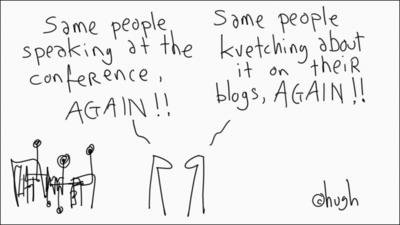
From gapingvoid
Continuing in the meaning musings and slippery semantics theme...social media and user generated content (very Webby 2.0 topics). Or authentic media, or participatory media [pdf]or a barrel of herring.
Tom Coates (he works at Yahoo!) at plasticbag.org reproduces a talk he gave at the Guardian Changing Media Summit and admits he doesn't know what people are referring to when they talk about "social media". But then he deconstructs the term pretty thoroughly: "...It seems to me that the other main feature of social media is that they're looking at how each individual contribution can become part of something that's greater than the sum of its parts, and to feed that back to the individuals using the service so that - fundamentally - everyone gets back more than they're putting in. These new services are about creating frameworks and spaces, containers and supports that help users create and publish and use all kinds of data from the smallest comment to the best produced video clip which in aggregate create something of fascinating utility to all." (spotted on Susan Mernit's Blog)
So, one of the hallmarks of Web 2.0 would seem to be ambiguity. Probably more than seven kinds.
From gapingvoid
Thursday, April 06, 2006

Reading, by any other name, doth smell as sweet?
Philosophical discussion we were having yesterday, just to kick off your morning (if you live in the U.S., that is): What is considered "reading," anymore?
A few examples:
*If you are looking at a graphic novel--that does not have any text on the page--are you still "reading"?
*If you are listening to an eAudiobook, are you "reading"?
*If you find yourself in a digital collection of photos, a museum or historical society and you visually absorb "realia" items, would you consider it "reading"? (Passively) "Looking"? Do you become a "looker"!?!
Alane thinks this conversation has the sound of one hand clapping, robots dreaming of electric sheep...but the conversation started out at the language level.
It's really a matter of precision, I guess. Can we still call our information consumers "readers," in good conscience? I know the terms go in and out of style (should we call them "Two-point-oh'ers"?) and surely Walt will do a comprehensive study someday--but the verb to read and the act of reading, to me, can take on a much larger definition in libraries than the mere act of looking at squiggley black things on a page or screen. Anyone have an OED Online subscription?
Readers, Researchers, Users, Patrons, Consumers, Customers, Clients...
[ingest image here]
A few examples:
*If you are looking at a graphic novel--that does not have any text on the page--are you still "reading"?
*If you are listening to an eAudiobook, are you "reading"?
*If you find yourself in a digital collection of photos, a museum or historical society and you visually absorb "realia" items, would you consider it "reading"? (Passively) "Looking"? Do you become a "looker"!?!
Alane thinks this conversation has the sound of one hand clapping, robots dreaming of electric sheep...but the conversation started out at the language level.
It's really a matter of precision, I guess. Can we still call our information consumers "readers," in good conscience? I know the terms go in and out of style (should we call them "Two-point-oh'ers"?) and surely Walt will do a comprehensive study someday--but the verb to read and the act of reading, to me, can take on a much larger definition in libraries than the mere act of looking at squiggley black things on a page or screen. Anyone have an OED Online subscription?
Readers, Researchers, Users, Patrons, Consumers, Customers, Clients...
[ingest image here]
Tuesday, April 04, 2006
Trends and Fads
Futurist Update is a monthly email newsletter I get from the World Future Society. This month included a useful piece on trends and fads, with many links that I'll reproduce here, along with some I use.
First, definitions.
Fad: A fashion that is taken up with great enthusiasm for a brief period of time; a craze.
Trend: The general direction in which something tends to move. Trends are the momentum of society--we’re heading in that direction.
Fads can be very short and usually are not indicators of major change, themselves. But, a fad may turn out to be part of a trend. For example, when many women began bobbing their long hair in the 1920s, this was considered a fad. We know now that it was one element in the trend of the emancipation of women. But, the distinction is a bit blurred.
The "coolhunter" of William Gibson's book Pattern Recognition (why, yes, that is one reason the OCLC Environmental Scan had that as its title) is spotting ideas, behaviors and fashions that can translate into products, within a short time span. So, platform and wedge shoes....faddish trend.
Trend spotting, as practiced by futurists, has a longer horizon. Nanotechnology, for example. Macrotrend.
I think when you look at some of the sites I've added here, you'll see the difference between the "coolhunters" and the futurists. Some of the macrotrends are going to look pretty flakey, like those identified by Ray Kurzweil or Barbara Marx Hubbard. No flakier perhaps than some of these trendy fads...at least these ones will be gone soon. Mind you, I link all the frou-frou and impracticality to a conservative trend...but that's me.
Coolhunting
http://www.ubercool.com/
http://www.psfk.com/
http://www.trendspotting.com/
http://www.trendhunter.com/
http://www.treehugger.com/index.php
http://www.we-make-money-not-art.com/
Trends
http://www.shapingtomorrow.com/
http://www.josephcoates.com/
http://karlalbrecht.com/
http://www.davinciinstitute.com/
http://www.worldwatch.org/features/vsow/
http://www.emcc.eurofound.eu.int/sector_futures.htm
If you're interested in the community of futurists, the annual conference of the World Future Society is July 28-30 in Toronto (pdf program here). There are excellent pre-conference courses offered as well. And don't you want to hear what two non-librarians have to say about the future of libraries? William Crossman and Thomas Frey will analyze and forecast the trends, roles and functions of libraries on Saturday, July 29. Hint: Mr Crossman says this in the FAQ at his institute's site: "That deep attachment that some people have to reading and writing will, in most cases, be supplanted by a new appreciation of, and attachment to, listening and speaking--the type of love affair with speech that existed/exists in oral cultures of the past and present."
Well, that would explain the success of audiobooks, right?
First, definitions.
Fad: A fashion that is taken up with great enthusiasm for a brief period of time; a craze.
Trend: The general direction in which something tends to move. Trends are the momentum of society--we’re heading in that direction.
Fads can be very short and usually are not indicators of major change, themselves. But, a fad may turn out to be part of a trend. For example, when many women began bobbing their long hair in the 1920s, this was considered a fad. We know now that it was one element in the trend of the emancipation of women. But, the distinction is a bit blurred.
The "coolhunter" of William Gibson's book Pattern Recognition (why, yes, that is one reason the OCLC Environmental Scan had that as its title) is spotting ideas, behaviors and fashions that can translate into products, within a short time span. So, platform and wedge shoes....faddish trend.
Trend spotting, as practiced by futurists, has a longer horizon. Nanotechnology, for example. Macrotrend.
I think when you look at some of the sites I've added here, you'll see the difference between the "coolhunters" and the futurists. Some of the macrotrends are going to look pretty flakey, like those identified by Ray Kurzweil or Barbara Marx Hubbard. No flakier perhaps than some of these trendy fads...at least these ones will be gone soon. Mind you, I link all the frou-frou and impracticality to a conservative trend...but that's me.
Coolhunting
http://www.ubercool.com/
http://www.psfk.com/
http://www.trendspotting.com/
http://www.trendhunter.com/
http://www.treehugger.com/index.php
http://www.we-make-money-not-art.com/
Trends
http://www.shapingtomorrow.com/
http://www.josephcoates.com/
http://karlalbrecht.com/
http://www.davinciinstitute.com/
http://www.worldwatch.org/features/vsow/
http://www.emcc.eurofound.eu.int/sector_futures.htm
If you're interested in the community of futurists, the annual conference of the World Future Society is July 28-30 in Toronto (pdf program here). There are excellent pre-conference courses offered as well. And don't you want to hear what two non-librarians have to say about the future of libraries? William Crossman and Thomas Frey will analyze and forecast the trends, roles and functions of libraries on Saturday, July 29. Hint: Mr Crossman says this in the FAQ at his institute's site: "That deep attachment that some people have to reading and writing will, in most cases, be supplanted by a new appreciation of, and attachment to, listening and speaking--the type of love affair with speech that existed/exists in oral cultures of the past and present."
Well, that would explain the success of audiobooks, right?
Web 2.0, Web 2.0, and Yes, More Web 2.0
valleywag points to ZDNet columnist Dion Hinchcliffe's "The State of Web 2.0" essay, calling it "monstrous, graph-choked" and provides a funny "translation" : 'You'll get attention by saying "Web 2.0." Yep, lots of attention from saying "Web 2.0" a lot. What I mean to say: Saying "Web 2.0" gets attention, because people love to hate or hate to love or love to write italics around the phrase "Web 2.0." Um, Web 2.0, Web 2.0, Web 2.0.'
I don't think I'd describe Hinchcliffe's essay as monstrous. It is a long post...but perhaps valleywag was referring to some of the rather odd notions (well, odd to me, at the moment, in that they're so vague or open as to be unhelpful), like "Web 2.0 is made of people." One commenter also found this vague: 'You know, "made of people" is not a defining expression. Crowds, armies and cannibals' dinners can be "defined" exactly like that.'
But there is expansion on this squishyness.
"Key Aspects of Web 2.0
I don't think I'd describe Hinchcliffe's essay as monstrous. It is a long post...but perhaps valleywag was referring to some of the rather odd notions (well, odd to me, at the moment, in that they're so vague or open as to be unhelpful), like "Web 2.0 is made of people." One commenter also found this vague: 'You know, "made of people" is not a defining expression. Crowds, armies and cannibals' dinners can be "defined" exactly like that.'
But there is expansion on this squishyness.
"Key Aspects of Web 2.0
-The Web and all its connected devices as one global platform of reusable services and data
-Data consumption and remixing from all sources, particularly user generated data
-Continuous and seamless update of software and data, often very rapidly
-Rich and interactive user interfaces
-Architecture of participation that encourages user contribution"
OK, that's a bit more helpful.
Read the whole essay as well as the comments. And Hinchcliffe has a blogroll for lots of Web 2.0 blogs (left-hand side). Comments range from "THERE IS NO SUCH THING AS WEB 2.0!!" to "Thank you for providing some semi-structured analysis around this technological and sociological phenomenon."
Monday, April 03, 2006
Happy National Library Week!
In the spirit of Jenny's joining ALA once again, thought I'd point out ALA's National Library Week materials. What are YOU doing to celebrate National Library Week? Or put another way, what is your library doing?
A few possible ideas:
1. Stage a readathon outside your library, if the springtime weather cooperates. eBook, eAudiobook or print materials qualify...
2. Invite a friendly local journalist on a tour...of the amazing technology in your library. The RFID system, the self-check out, how the local catalog shows possibilities in every branch, how easy it is to download eAudiobooks from the library's Web site...
3. Hand out coupons for "Free home/dorm delivery" of reserved materials to every Xth user who walks in the door/places a hold online.
(The surprise and delight you create from this action will far outweigh the petrol expense.)
4. Better yet, team up with a local pizza delivery service and stage a highly-publicized "Dinner and a Movie" night--where anyone who places their order for a pizza can also get a (free) library DVD delivered alongside their pizza!
Okay so the Dinner and a Movie idea would involve some prior planning. But on each pizza box delivered that night, you attach a flier that explains how easy it is to find great movie titles online, at the library branch closest to you. And of course remind them how easy it is to become a Friend of the Library, too.
This could work and could be really fun, too. The trick, I think, is to surprise and delight your customers in new and unexpected ways.
Oh and BTW, tomorrow (Apr. 4) is National Library Workers' Day. Be sure to celebrate all the staffers in your library!
A few possible ideas:
1. Stage a readathon outside your library, if the springtime weather cooperates. eBook, eAudiobook or print materials qualify...
2. Invite a friendly local journalist on a tour...of the amazing technology in your library. The RFID system, the self-check out, how the local catalog shows possibilities in every branch, how easy it is to download eAudiobooks from the library's Web site...
3. Hand out coupons for "Free home/dorm delivery" of reserved materials to every Xth user who walks in the door/places a hold online.
(The surprise and delight you create from this action will far outweigh the petrol expense.)
4. Better yet, team up with a local pizza delivery service and stage a highly-publicized "Dinner and a Movie" night--where anyone who places their order for a pizza can also get a (free) library DVD delivered alongside their pizza!
Okay so the Dinner and a Movie idea would involve some prior planning. But on each pizza box delivered that night, you attach a flier that explains how easy it is to find great movie titles online, at the library branch closest to you. And of course remind them how easy it is to become a Friend of the Library, too.
This could work and could be really fun, too. The trick, I think, is to surprise and delight your customers in new and unexpected ways.
Oh and BTW, tomorrow (Apr. 4) is National Library Workers' Day. Be sure to celebrate all the staffers in your library!
Subscribe to:
Posts (Atom)


.jpg)

