Thursday, June 30, 2005

(Almost) All Digital by 2020?

By 2020, only 10% of published material will be print-only, according to the press release issued yesterday by the British Library, announcing the release of their three year strategic plan. I haven't had time to read the plan (post ALA housekeeping) but it looks interesting. Their six strategic priorities:

Strategic Priority 1 - Enrich the user’s experience.
Strategic Priority 2 - Build the digital research environment.
Strategic Priority 3 - Transform search and navigation.
Strategic Priority 4 - Grow and manage the national collection.
Strategic Priority 5 - Develop our people.
Strategic Priority 6 - Guarantee financial sustainability.

I think the BL has redone its web site since the last time I visited. It's way less stuffy.

Thanks to Rafat at paidContent.org for the info.

Addendum at 8pm: Bad, bad Alane. How shaming to have to do this twice in one day. As Walt Crawford pointed out in a comment to this post, I made this error:

The press release doesn't say " By 2020, only 10% of published material will be print-only." It says something much narrower: 10% of UK research monographs will be print-only.

Last time I try blogging at the same time I am trying to recall where the heck I was going on what day for the "taxi" part of my expense report. Chicago must be the only ALA destination that my taxi receipts exceed my food receipts.

Real World Library Gaming Experience

Here's an excellent article on one public librarian's experience in circulating PS2 games from his library. The brisk business he describes reminds me of the early days of offering VHS and Beta videocassettes in the public library world. It didn't matter what kind of junk we were offering, if it was a video, it circulated. (That link should cause me some trouble...)

Podcasting is Mainstream

Well, it must be if Apple iTunes introduces a service to download any of 3000 podcasts, subject divided into 20 categories, to your iPod. Jenny blogged about this at the Shifted Librarian yesterday.

From the ad email I received:
The biggest thing in radio isn't on the radio. Podcasting makes it possible to hear thousands of free shows covering music, sports, politics, comedy, health, science, and just about anything imaginable. Best of all, you can enjoy podcasts whenever you want, on your computer or iPod.

Apple is offering this as a free subscription service so that you'll automagically get new podcasts for the ones you selected.

For sure, when you look at the names of the entities/people podcasting (ABC News, ESPN, WGBH, Disney, CBC Radio in Canada), the conclusion is that, very very quickly, many mainstream organizations have seen the value in this simple way to get messages out to people interested in hearing these messages. And of course, there are loads of not-so-mainstream podcasts.

In Jenny's post, she commented that she's not sure librarians have time to create podcasts. Maybe they don't but podcasting seems to me to be a no-brainer for libraries.

Here's a few things I think would make for useful podcasts for libraries, both academic and public: "how to" for all sorts of things such as renewing books, getting a library card, upcoming events, story of the week, interesting history fact of the week, news from the library, "did you know?" stories, any library information for people with low vision, any library information in languages other than English, anything at all that gives a human voice to the library! And I'd find staff members, regardless of their titles who wanted to be involved in podcasting and let them do it--they'd make the time to podcast.

Any readers know of libraries podcasting? Let us know!

Addendum at noon: I deleted this sentence "Like iTunes, the cost is 99 cents. Yep, people are paying for these little bits of atomized content." because an astute commenter asked why I thought there was a cost. Incomplete ferreting, Chad. I hovered over the images on the directory page and saw "99 cents" so made the incorrect leap that there was a cost. Thanks for pointing that out.

And I had a thought...I wonder if reading a published story as a podcast would violate copyright? Perhaps, as it is a public performance. Anyone know?

Wednesday, June 29, 2005

Symposium follow up: John Blossom's post

I had been feeling rotten about my very good post that got lost during the Symposium last Friday, due to my power cord snafu. Especially because I lost my notes about John Blossom's presentation.

Lucky for all of us, he's blogged his thoughts here.

Very Clever

Joe Anderson of WebJunction has written a lovely ditty in honour of the Blogger Salon and posted it on BlogJunction.

Sung to the tune of the Beach Boys'"Sloop John B" there are 4 verses and a chorus....here's the first verse.

We come to the Blog Party
(thanks to OCLC)
And post to “It’s All Good” coop’ratively.
Blogging all day
Schmoozing with Jay
This is the hippest
Party at ALA.

Very Quirky

The Lonely Wombat , Elizabeth, is a knitting library paraprofessional. And she has been making knitted critters with a library theme for a display.

Here's OCLC. And MARC. And Furber.

I really like how "OCLC" has rays just like our WorldCat logo has.

(Amended based on Elizabeth's comment...and Elizabeth? Library paraprofessionals are not "lowly" in my mind at all!! Some of the library assistants I've worked with were as professional and competent as the degreed librarians--just minus the degree.)

Tuesday, June 28, 2005

United Nations Cyberschoolbus

This is a fun place to spend a few or more minutes.

Compare country statistics side-by-side with the UN's Cyberschoolbus tool, InfoNation. Search for statistics on health, education, economics, technology, and more to find out how the nations of the world compare....the data is presented in bar charts.

"The Cyberschoolbus also offers curricula on hunger, poverty, cities, women's rights, indigenous peoples, space, oceans, peace, and saving tomorrow's world."

Info courtesy of the July issue of futuristUpdate, a monthly supplement to The Futurist, the magazine of the World Future Society.

Wasn't That a Party?

Oh boy that was fun! The first Bloggers' Salon was a big noisy success. To me it was great to see so many young librarians and almost-librarians. They tend to get lost in the large crowds of boomer librarians, but at this soiree, boomers were the minority. And it was also great to talk with so many people who are passionate about their work and librarianship--and who write! Really rejuventating. Thanks to all of you who attended.

It looks like we'll be hosting another Salon...Cathy De Rosa, my boss, committed to having a second one.

Maybe we'll wait until ALA Annual because Midwinter doesn't have as many people attending.

Sunday, June 26, 2005


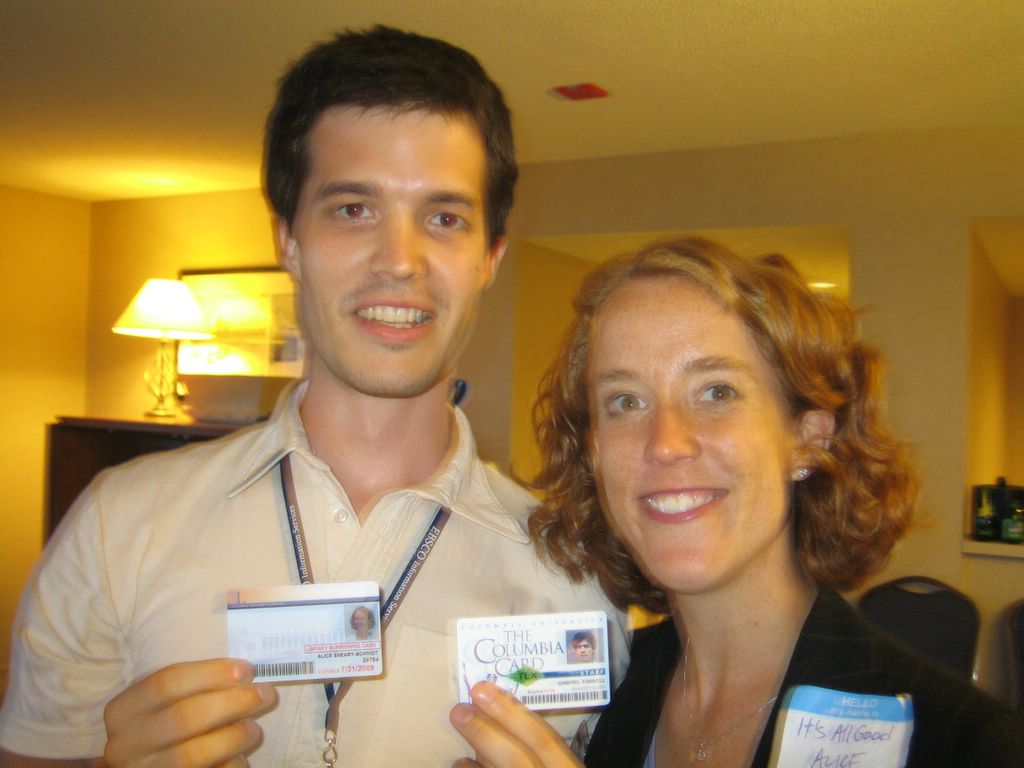
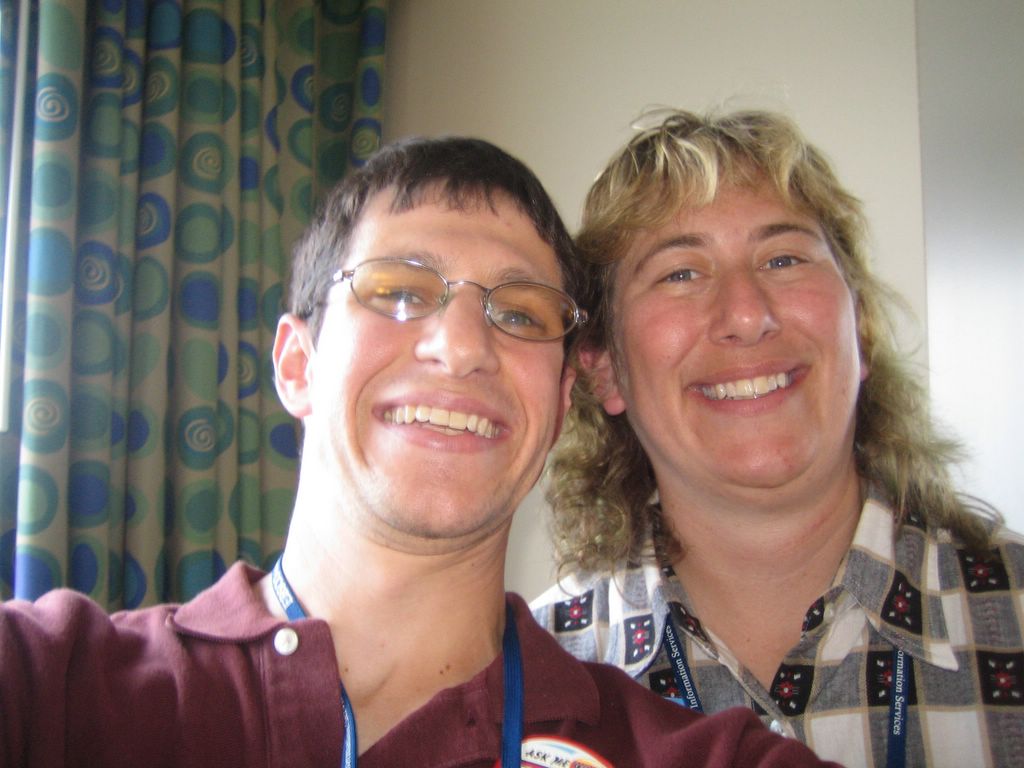
Hail Columbia University! Gabriel and Alice compare notes: Gabriel has a staff card; Alice has a borrower card! Posted by Hello

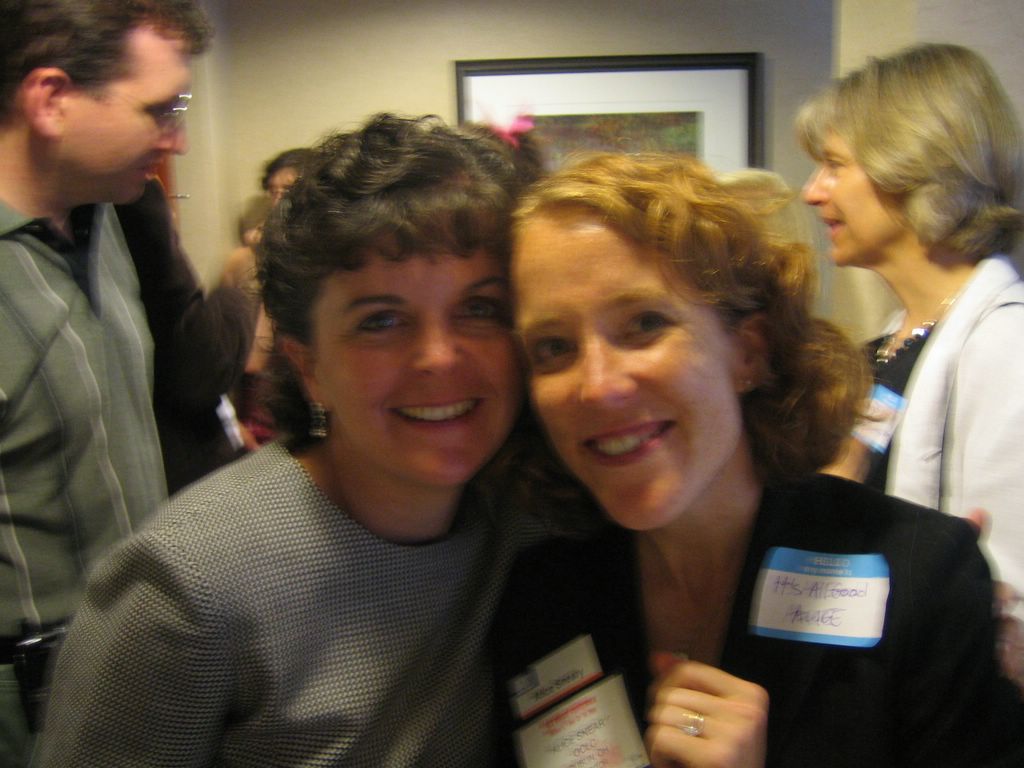
Cathy and Alice. Posted by Hello

Alice, Alane and George: the It's All Good bloggers. Posted by Hello

Joe Anderson, blogger and editor of WebJunction. Posted by Hello

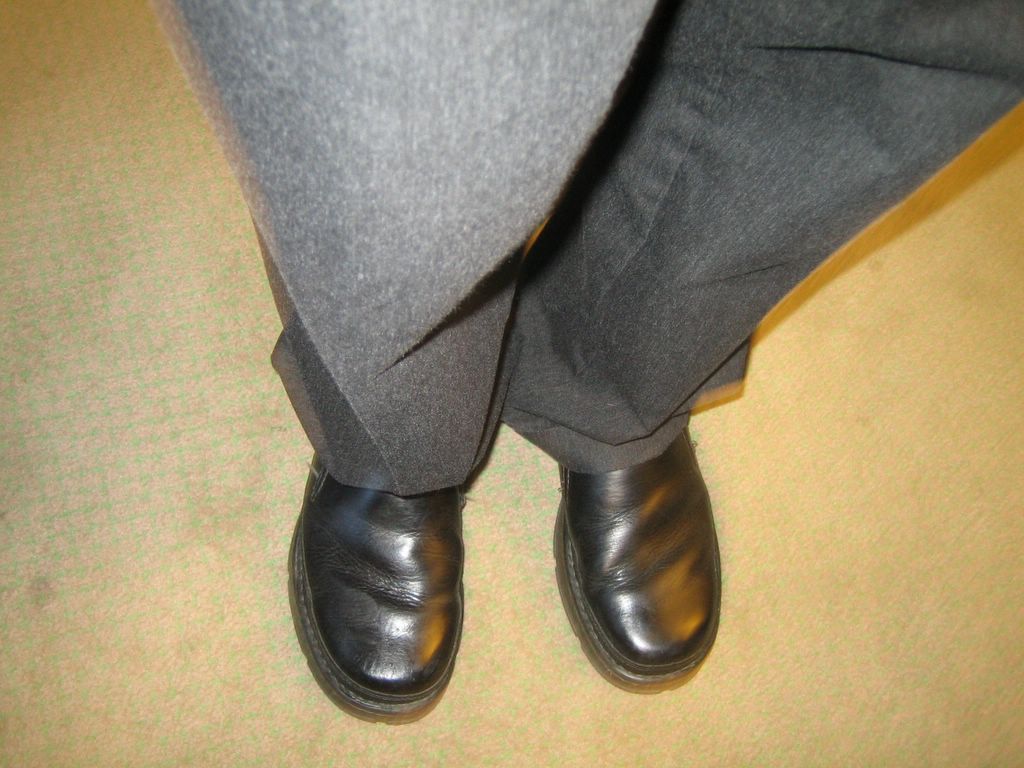
Joe's sensible shoes that have been recently shined. Posted by Hello

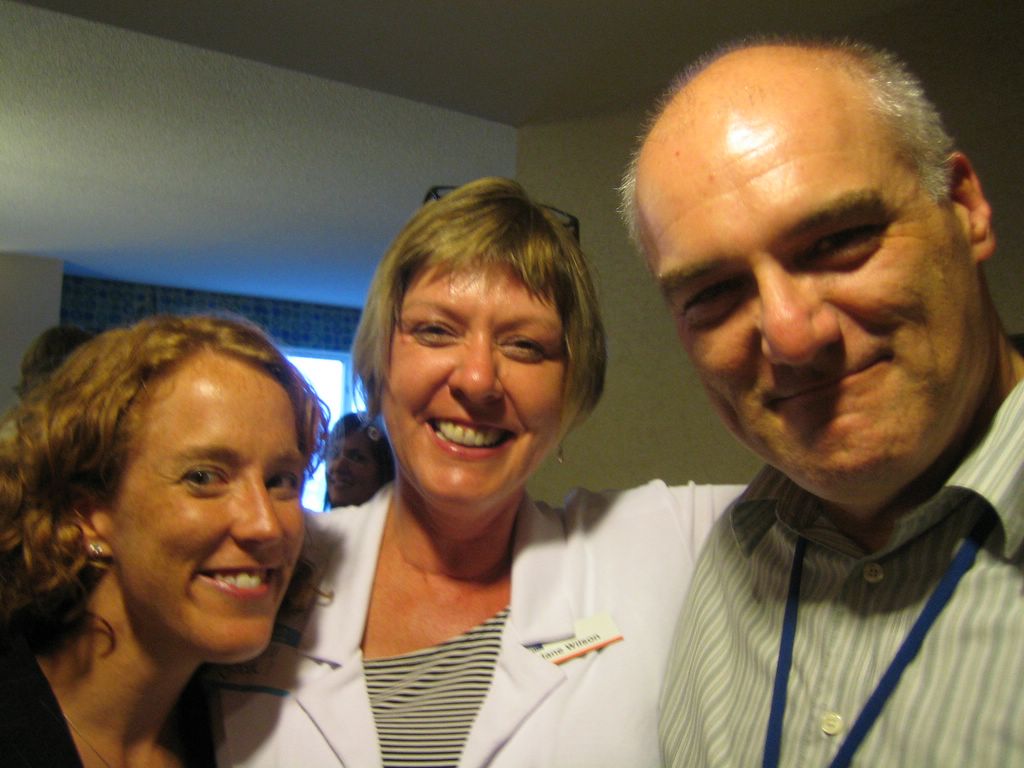
Alice, Jenny and Alane. We love the Shifted Librarian! Posted by Hello

Steven and Jenny. Posted by Hello

Steven and George. Posted by Hello

Chrystie and Steven. Posted by Hello

Steven and Heidi. Posted by Hello

Steven and Sherri. Posted by Hello

Meredith and Steven. Posted by Hello

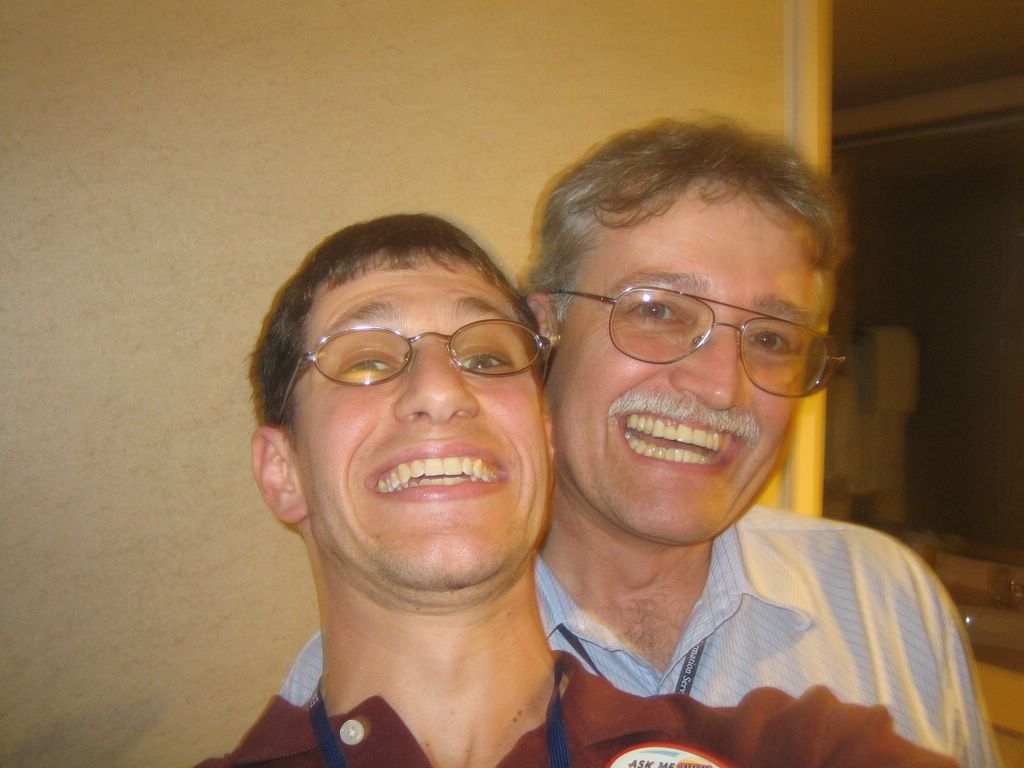
Steven and Roy. Posted by Hello

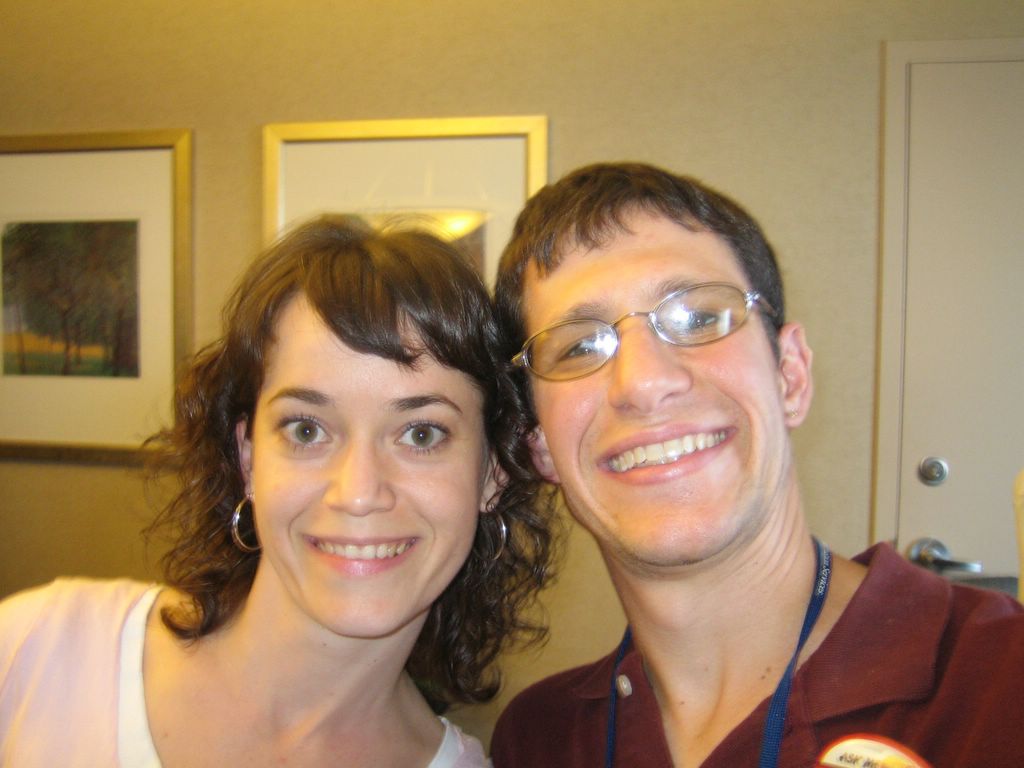
Steven and Michelle. She's going to be either a cool librarian or a cool English Lit. Ph.D. Posted by Hello

Steven and Gina. Posted by Hello

Steven and Aaron Schmidt. Posted by Hello

Michael (private investigator and libraryduster) and Steven. Michael can identify us by our shoes and tell if we were born premature. Posted by Hello

Rochelle and Steven. Posted by Hello

Laura and Steven. Posted by Hello

Alice and Steven. Posted by Hello

Steven and Cathy. Posted by Hello

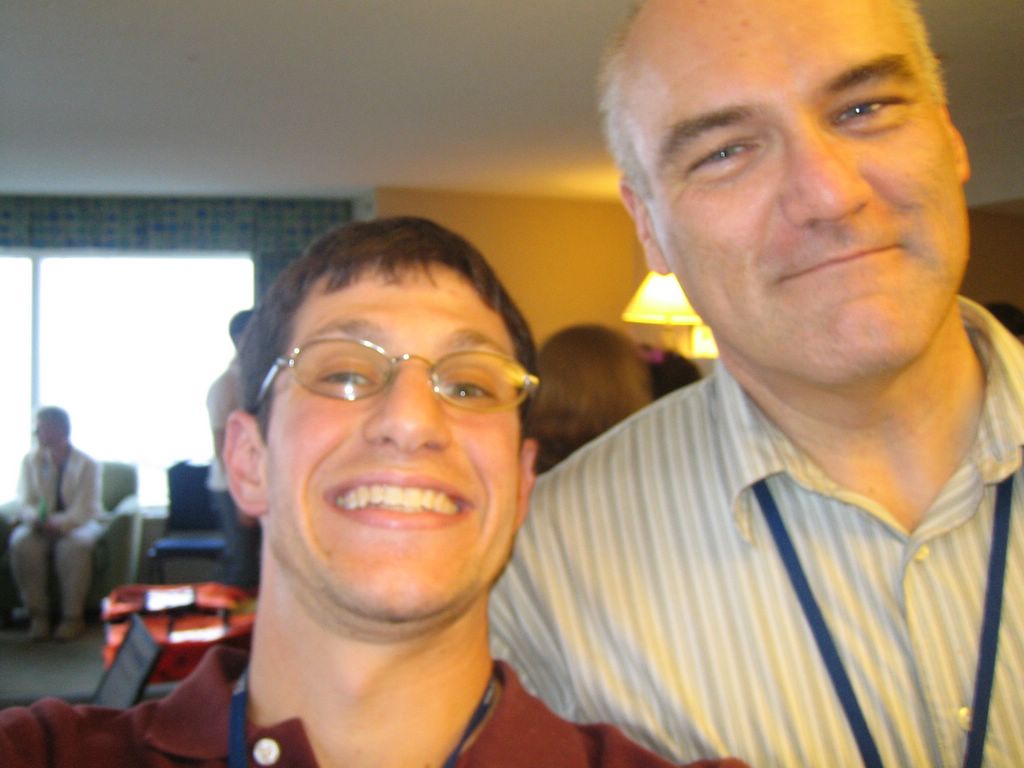
Walt and Steven. Posted by Hello

Steven and Brian. Posted by Hello

Steven and Jessamyn. Posted by Hello

Steven and Alane. Posted by Hello

Steven Cohen of LibraryStuff.com Posted by Hello

Alice and Micheal of TametheWeb.com Posted by Hello

Library blogger salon

The conveyed wisdom of the librrary blogger salon:
(entered by their own hands):
Quite dangerous to leave this laptop sitting out with all these librarians sloshing around with glasses of free wine. Mwahahahahaha!!!

Greeting to all of you in library land. Peace be with you! --Christopher the Curmudgeon

Despite the fact that we are in Chicago, and not Wisconsin, there are no little cocktail weenies, only cheese. Plenty of yummy veggies, though.

OCLC is providing lovely orange vinyl bags that will hold many bottles of beer.

Yes, I think I'm inspired now to start a blog entitled libraryswag.net ...

schwag? did someone say schwag? : ) - - sherri from ::schwagbag::

The library bags are ideal for holding swimsuits, as they have a net bag on the side. I haven't seen a group of librarians having this much fun ever--usually, one wants to pump laughing gas into the room to ease one's own discomfort, and to see the old sourpusses smile. sharkbiskit@yahoo.com

Library bloggers are loud peeps. It figures they'd have a lot to say. Thanks to It's All Good for the fun times --- Laura from libraryrfid..net

this is a landmark event! the energy and camraderie in this room is unbelievable. it's been so awesome to watch connections being made and offline friendships forged. it's all very collegial--and spirited! i hope that we can make this an annual event, sponsored or not. thanks george, alane, alice and OCLC. w00t!--rochelle/lisnews.com/tinfoil + raccoon

Everyone still seems to be having fun. It looks like a golden night for the I-don't-get-out-much crowd. Puzzingly, not a lot of the cheese has been eaten. When I noticed this, I took the better stuff. sharkbiskit@yahoo.com

Great party. Lots of booze. Lots of bloggers. When worlds collide....

Yippeeeee!!!!!!!!!!!!! [says Laura, of http://lisdom.blogspot.com]


These people won't shut up long enough to stuff the complimentary veggies and cheese into their talk holes!! Who would have guessed???
-jenel LoC.

About 85 people here have cameras, so be sure to check Flickr for pics.

OCLC just announced they're going to do this every year, only more alcohol next time! :-)

Yay, OCLC. Thanks for the pretzels!

This has been awesome! Thanks OCLC! Really incredible meeting so many people I read everyday and sometimes correspond with--absolutely amazing! Mark

Wow. What a fine evening.

Overheard: "This must have been a good party...I found a bookmark in my shirt."

OKay this is Alice and "It's All Good!"

And I'd just like to document: this was Alane's idea!

Bloggers rule!

Good day for a sail, or a blog salon


Lake Michigan! Posted by Hello

View 2


Another view from the blogger salon... Posted by Hello

Come see the view


The view from the OCLC Blue Suite, where we're setting up for the library blogger salon. Posted by Hello

Gymnastics in the stacks


The library staff member pictured has just done 2 backhandsprings and the worm, during this Book Drill Olympic team routine. Posted by Hello

Sunday afternoon in McCormick Center


Book Drill Olympics at McCormick Center. Posted by Hello

Putting some money where the scan is

I sit on the committee that works with ALA's Office of Public Programs. Last year, the National Endowment for the Humanities awarded the Office a challenge grant to build the Cultural Communities Fund (CCF), which would allow the Office to continue funding great programs like "Let's Talk About It, Writers Live @ the Library, and Forever Free: Abraham Lincoln's Journey to Emancipation. In other words, the Office is the main center of ALA activity for making libraries a Third Place.

The fundraising for this challenge grant is going pretty slowly, and in order to qualify for the next release of funds, we need to raise $266,000 by July 31. This is a three-to-one challenge grant, which mean NEH gives the Office $1 for every $3 it raises. ALA divisions and offices cannot donate to match this money, unfortunately, because NEH does not consider this new money. PLA has already given $50,000 to the CCF, for example.

If you are in a position to contribute anything, please go to the ALA donation web site. Even if you don't like some of the other directions ALA takes, my guess is that if you're reading this blog, you probably like the idea of making programs available for public and academic libraries to spark discussions within their communities.

Deb Jacobs, the simply fabulous director of Seattle Public Library and chair of the Public Programs Committee, Deborah Robertson, the director of the Office, and the rest of the staff and the committee are making the full court press here at the ALA conference, but most of this support is going top need to come from the community. So please consider making a donation.

And if you are also a blogger, please consider reposting this request to your blog.

Thanks for considering this!

Conversation cranks up


Jay Jordan, OCLC President and CEO, enjoys the opportunity for one-on-one dialogue with an OCLC Member. Posted by Hello

Lively discussions abound at the general tables


Rick Schwieterman, OCLC Vice President for Finance and Human Resources, is always happy to talk about the ways OCLC efficiently stewards the resources of the cooperative on behalf of libraries everywhere.  Posted by Hello

Research announces additional new projects


Eric Childress of OCLC Research listens to questions about the latest projects they are working on, such as Curiouser, MetaWiki and Data MiningPosted by Hello

WorldCat wikis from a Mover and Shaker


Chip Nilges of OCLC--also named this year as a "Change maker" and "Mover and Shaker" from Library Journal-- explains many of the recent updates/enhancements to Open WorldCat, such as the Reference Services pilotPosted by Hello

Popular topics: Cataloging


Cataloging was a popular topic this year--we had at least 200 people register for the cataloging table. I overheard someone praise the soon-to-be-installed CJK and Arabic functionality into Connexion. Posted by Hello

Sunday starts off right


More than 650 librarians and library staff members joined us for the OCLC Update Breakfast this morning. Posted by Hello

Update Breakfast

Yes it's 4:43 am and I am up, dressed and ready to head out the door to help set up for the OCLC Update Breakfast. Only 5 short hours ago, I was a wedding guest at Tony and Tina's wedding--along with a good number of fellow OCLC staff.

I'll save you some coffee at the Chicago Hilton and Towers. Breakfast starts at 7.

David Levin of Rich Central High School, Olympia Fields, IL was the Grand Prize winner of 2 tickets to see the award-winning musical, Wicked. Susan Berntson of OCLC congratulates him by the new advocacy ad that promotes the library as a place for career inspiration. (Gregory Maguire, the author of Wicked, attributes his success to his childhood time spent in the library.) Posted by Hello

Saturday, June 25, 2005

Caleb and Bronze Bob


Caleb takes a moment to chat with the Bob Newhart statue off Navy Pier. The whole installation is made of bronze--but doesn't it look upholstered? Posted by Hello

Segway Centaur


Demonstration of the Segway Centaur. No motor, up to 20 mph and pops wheelies with ease. Wish we had one for McCormick PlacePosted by Hello

Replacement cataloger to WorldCat?


Robonaut. He's got opposable thumbs and is dexterous enough to use cordless machinery like a drill and can operate it without supervision.  Posted by Hello
I'll bet we could teach him Connexion...

Alice the Astronaut?


My next blogging gig: from space. (They forgot to sew the OCLC logo on the sleeve...) Posted by Hello

NextFest at Navy Pier


Wired NextFest. The entrance sign reads, "Welcome to the Future." Supercool exhibits on a hot hot day. Posted by Hello

The view from here


A solitary rower on the river this morning. Posted by Hello

WebJunction awards


Jay Jordan presents the 2005 WebJunction awards at the WebJunction reception last night. Posted by Hello

More Symposium shots: John and Alane


John Blossom of Shore Communications and Alane Wilson of OCLC. Posted by Hello

The Meeting of Good and Evil?


The meeting of good vs. evil? Chris made a comment that "Dewey was evil"--because it represents of world of predefined order instead of a folksonomy-based one--and Joan Mitchell, Editor-in-Chief of the Dewey Decimal Classification system, came and introduced herself as "evil incarnate." It was a classic moment! (And actually, Joan receives the prestigious Melvil Dewey award at ALA this year!) Posted by Hello

Chris Anderson at the Symposium


Chris Anderson, Editor in Chief of Wired Magazine and OCLC Symposium speaker. Posted by Hello

New eJournal in libraryland

At the WebJunction reception last night (pictures forthcoming), I ran into my friend and former OCLC VP, Frank Hermes. Frank has just launched a new organization, the Library Leadership Network, where he will serve as lead editor and publisher of the LLN Commons.

Judging from the June preview issue, it is set to be a great publication. I mean, he tees it off with an article by Glen Holt. I am one of Glen's biggest fans, because his research at St. Louis Public helped give us the statistical bedrock for our Advocacy campaign.

Here's Glen's article for Frank's new publication: Asking the Right, but Hard Questions.

Off to NextFest!

Red Scare worth the fright

A group of us went to Second City last night and I can highly recommend the Red Scare performance. Maybe it was geared right at my demographic--but the jokes were spot-on and the troupe was tight.

Worth the $19.50.

Have bagel, will blog

The Sheraton buzzes this morning, with fresh-faced conference-goers. I ducked out in my "surely I will see no one I know" disguise to get some quick breakfast.

I found out my 10:30 meeting this morning is actually scheduled for tomorrow at 10:30, so I have an unexpected block of time that has just opened up. This looks like my opportunity for NextFest.

My friends Elizabeth and Caleb have recently moved to Chicago and Caleb was jonesin' for NextFest last night on the phone. The 11:00 Vehicles of the Future presentation sounds right up his alley. (Concept cars he designed.)

I have lots of photos to upload--perhaps I can do that before I take off for Navy Pier.

OCLC Blue Suite

For all of you attending the Blogger Salon tomorrow, at ALA, the number of the suite is 2833 at the Hyatt McCormack Place. Hope that high number means we have a room with a view.

We had a bit of a blogger gathering yesterday at the WebJunction Reception. Rochelle, Karen, and Walt attended as did Alice, George and I. Proto-blogger Roy Tennant was there too...come to think of it, perhaps Roy can be called a blogger now he's blogging at the LITA blog.

If you missed this soiree, the other WJ ALA events are here.

And thanks to Beth Gallaway who once again (she did at ALA Midwinter too)has done a write up on second half the OCLC Symposium yesterday, posted on the PLA blog.

Friday, June 24, 2005

The Water-Cooler Effect

With the rise of cable TV and TiVo, we're becoming a very fragmented society.
Chris is saying one rock radio station a week is closing.
And he's saying that each of us now creates our own radio station on our iPods...(which I am guilty of doing...but I do not want to give up NPR in the morning.)

What are the incentives to keep creating in the long tail environment?
Top of tail: Money making (pros) --Copyright
Middle: Moonlighting (marketing) -- No Copyright
Bottom of Tail: Freedom of Expression (amateurs) --Creative Commons License

Books
1/4 of Amazon's business are titles that are not available in bricks and mortar bookstores.

Prediction: Our children will never know the meaning of the phrase "out of print."

Amazon bought Booksurge: a Print-on-Demand company.

What about Used Books on the Long Tail?

New Technology
Firefox, Grease Monkey, Bookplug-in on Grease Monkey.
Credit to John Udell, Infoworld.
(He's describing something quite similar to Open WorldCat...)

Tragically Neglected Economics of Abundance
Moving forward--the world is moving to an era of abundance.

Traveling down the tail with confidence

Recommendations are key.

3 Broad Opportunities
1. Aggregator (reach both the head and tail)
2. Suppliers (
3. Filters (get the good stuff going: bloggers, PR)

And without filters, the long tail is just noise.

Signal to noise ratio: you need a good filter. Chris's wife likes Top 40 music, he likes house/techno, and his friend likes surf and rockabilly. The Long Tail has something for everyone.

Most of us are niche in some way or another--and so what you realize is, with good filters, you will find brilliant work at the end of the tail that delights you. And you will also find a lot of abysmal work.

Now we've moved to an era of post-filtering past release to market--rather than pre-filter before release. Now we can throw everything out there, and let the market/word-of-mouth/bloggers decide what's cool.

Chris is describing a DVD-burning kiosk vs. Blockbuster: In a kiosk environment, you have an infinite selection and the ability to burn an infinite number of them. So the hits don't sell as well on the kiosk, but the sheer quantity of random materials that people want will outsell the hits by XX%. (Sorry, I missed the percentage).

Long Tail in information space

Google: Long Tail advertisers
eBay: Long Tail hard goods
CapitalOne: Long Tail customers

Treat individuals as individuals, mass customization.

Precursors to long tail:
Sears Catalog
800 number
Supermarket shelves

But then you're faced with "The Tyranny of Choice" --which leads to buyer's remorse and even not buying things. Chris used a funny example about jam selections. If I have 3 choices, I select one and am happy. If I have 30 choices, I realize I have too many choices and then I feel oppressed to pick the right one.

In Amazon-land, I could have reviews, strong placement, noted "if you like this, you may like that..." and you'd pick the jam of "50 million jam eaters can't be wrong."

Economics of the Long Tail

Economics of Atoms
To justify their shelf space and distribution costs, products must appeal to lots of people where they're offered.

You'll need concentrated geographic demand to justify the product taking up space on the shelf. It's the tyranny of geography. The consequence is: lowest common denominator.

BY COMPARISON

The economics of bits
Virtually unlimited capacity
Virtually free distribution
You go for a very customized model: niches can be niches, and people can be addressed as individuals.

Chris was saying he's done so much data-crunching, he ran out of the Excel table rows!

OCLC Symposium

So I'm here at the Chicago Hilton and Towers, ready to hear some great stuff about The Long Tail from Chris Anderson of Wired Magazine.

I have 60 minutes of wireless access here in the Grand Ballroom, for which I paid $6.95.

Chris is saying he doesn't spend a lot of time in libraries--but he does admire the Seattle Public's architecture.

He's describing general economic principles: A Powerlaw. It's the organic shape of demand.
Mass media is based on scarcity distribution--but the long tail keeps going way past that. See the graph.

Thursday, June 23, 2005

1stReads

You may not read our comments so I am making a separate posting. Roy Tennant left a comment (thanks!) on my previous post "Chicago and Buying Books" about the 1stReads beta program...different in details from the OCLC 'buy books' feature but close in spirit.

Here's Steve Coffman's posting to Web4Lib and here's the 1stReads site. There's a lot of detail so I am not summarizing here.

Anything that conflates library content with The Rest Of It is all good, to me. More to the point, it's good for libraries and their communities too.

And Roy? I may need a loan before the conference is over...

Chicago and Buying Books

I am arrived in Chicago -- I can see the lake off to the left here on the 18th floor of the Sheraton. My taxi ride from O'Hare took longer than the flight from Columbus for two reasons. The traffic was very heavy--stop and go just about the whole way. I began thinking I'd need to use a credit card to pay because my cash supply was low--when, blink! The meter in the taxi went offline. Well, that's all good I thought...until the cab itself began coughing until it eventually had to pull over. Did I mention it's 96F here?

Luckily the fraternity (let's face it, most cab drivers are men) pulled through and as soon as my beleaguered cabbie pulled over and waved his arm, a cab from another company magically appeared. I transferred and, voila, I am here.

But, the low cash....I realized I did not bring my bank card and I now have four bucks (I gave the first cabbie a bunch of dollars that might have approximated the fare). And I discover that neither my own personal Amex card nor my corporate Amex card do cash advances. Swell.

So I call my boss, Cathy De Rosa, and ask her to spot me some cash which she agrees to after she stops laughing. It's all good again.

OK, what about the books. In my last blog about OCLC Beta, I said we'd be announcing another pilot....got the terminology wrong. This is a new feature in Open WorldCat.

Well, in a press release today, OCLC announced that that the newest feature in Open WorldCat will allow users an option to buy books through Baker & Taylor. This will be available soon through the Open WorldCat program and will allow searchers in the United States to buy books online that they find using Open WorldCat through Baker & Taylor.

Here's the really cool part, IMO. OCLC will pursue the best prices and discounts available for people wanting to buy content who will identify their library as part of the transaction. A portion of the proceeds from the book sales will be shared with the named libraries through credits on their OCLC invoices. Our press release says that we hope to expand this feature to libraries outside the United States, to other content formats and to additional vendors in the future.

Everyone wins. We are all part of a big content ocean and library content has to be where other content is, not sequestered away. Sometimes people will buy content, sometimes they'll borrow it...it's their choice, not ours.

Wednesday, June 22, 2005

Office Space

While I was packing to leave for Chicago and ALA this evening, I was watching one of the funniest comedies of the last twenty years, Office Space. If you've never seen it, hie yourself down to the local library and borrow it or put it on your Netflix list or use it as one of your 12 initial free selections when you join your DVD club. Mike Judge, the creator King of the Hill (motto: "We ain't the Simpsons but we're dang good in our own right"), directed this amazingly subversive look at life in a high tech company at the fin de siecle. If you have seen it, and you happen to be in management wherever you work, do you ever sometimes get the creepy feeling that you are behaving like Bill Lumbergh, Gary Cole's deliciously slimy character in this movie?

The movie reminded me again that the media take a dim view of bosses. Think of Mr. Dithers. Or Dilbert's pointy haired boss. Or Gale Gordon's "Mr. Mooney" on the old Lucy Show. Sometimes I hear myself saying things that would make a motivational poster blush. Other times, I'm absolutely thunderstruck by the brilliance of the people I work with, and wonder why they let a palooka like me sit in on their meetings. It make me think that sometimes the media are really over-generous to bosses (present company excluded, of course, Jay...)

OCLC Beta

One piece of advice George, Cathy and I pass along to people when we do presentations is "go beta." By this we mean do what Google does, and try new things out, in public, live, with real people. Instead, many libraries still appear to be keeping things under wraps, waiting until everything is Perfect, planning for the "Rare Event" (as Marshall Keyes called it at a presentation I attended a while back).

Luckily, no one has had the chutzpah to counter our advice with a well-placed barb: "so where's OCLC's beta projects?" Because OCLC is much like many large organizations--libraries included. Nimbleness is not our middle name and the last big beta we did was the Open WorldCat Pilot last summer (we call our betas "pilots").

So I am very happy to report that we have some pilots we've just announced--and I realize we don't often use this space to talk about specific OCLC projects, products or services, but all these pilots most definitely fit with the IAG goal of covering all things present and future that impact libraries and library users.

Here's a list (and if I've left any out I hope OCLC colleagues will leave comments).

1. Jenny Levine mentioned the WorldCat Wiki on her blog, as well as a couple of the others. The idea is to have a Wiki that complements WorldCat, It will be released later this summer. People will be able to add reviews, cover art, comments to bibliographic records (maybe at the FRBR work-level). We're using the Metawiki software to build the Wiki part of it.

2. 'Ask a Librarian' pilot in Open WorldCat: OCLC has implemented a pilot project within the Open WorldCat program that allows Web searchers to submit questions to librarians through online reference services of OCLC member libraries.

3. OCLC will begin a pilot project later this month that will make it easy for library staff and patrons to find and use full-text electronic journals in library collections. The pilot will involve 20 libraries and four partners—TDNet, EBSCO, Serials Solutions and Ex Libris.

4. Terminologies pilot. OCLC is exploring a service that provides access to multiple controlled vocabularies for libraries, museums, and archives to create consistent metadata for their collections. Selected mappings between vocabularies are provided to assist in relating terminology. The service would provide one-stop access to terminology resources and would be accessible through any web-based metadata editor.

Here's a link to a presentation Lorcan Dempsey did for the May meeting of the OCLC Members Council that covers many of the topics listed above, as well as other cool things the staff in Research are working on, like FictionFinder, Curiouser, data mining, and a lot of other interesting and useful services.

And there's one other pilot coming up really soon that I can't give details on yet but it's one that will definitely help libraries and library users. We're hoping to announce that during ALA so watch this space!

(Smart) Dumb Questions

Passing along good snippets, especially with a shout out to the virtual reference library staff members:
Fortune magazine has written a brief article that praises the wisdom of asking dumb questions. Of course it's geared for employees within organizations. But helpful nonetheless.

We can look at it two ways that relate to us in libraries:
1. Smart people e-mail/chat/walk into your library, potentially embarrassed to ask their (smart) dumb question.

2. Smart young staffers ask (smart) dumb questions, like, "What business are we in?"

For example, you could be in the Knowledge Management, Quality Assurance of Content, Community Intellectual Watering Hole, Web Services Facilitator and a whole lot of other businesses, in your library. But sometimes it takes someone bold enough to ask what the main business is. What is the one thing we should be doing, above all else? (aka brand presence)

Any (Smart) dumb questions out there, lurking in your library?

Tuesday, June 21, 2005

Blogs R Us

This is probably the depths of self-congratulatory linking ("blogrolling in our time"), but Jenny Levine wrote a most kind and detailed post at The Shifted Librarian about the OCLC bloggers and what impact, in her opinion, blogging has for OCLC. We're going to make sure all OCLC staff are encouraged to read it--not because it says nice things about George, Alice, me, Thom and Lorcan--but because here's a knowledgable person commenting on projects that many, many OCLC staff have worked on and supported in various ways. So, everyone deserves the credit.

And remember, if you're a library blogger and are able to attend, It's All Good is hosting a Blogger's Salon at ALA. George, Alice and I will be there; Thom Hickey is going to try and be there; and Cathy De Rosa and Jay Jordan will stop by as well. Lorcan is unfortunately not attending ALA...welll, he doesn't think it's so unfortunate! We do.

Sunday, June 26, 5:30-7pm. Hyatt McCormick Hotel (adjacent to the convention center). OCLC Blue Suite number will be posted here as soon as we know the room number. Or you can ask at the OCLC booth, 2201, Hall A1, just inside the main entrance to the hall.

ALA and AccessMyLibrary

Just back at my desk after the pre-ALA briefing session here at OCLC, where we go over everything that's happening around the company, that we'll be talking about at the conference.

I am here to tell you-->there is a LOT going on! When do people sleep around here?

Seriously, in almost every arena of OCLC: community/advocacy/WebJunction, Products and Services, Professional Development, Research--there are cool new things going on and I'm excited to blog more about them from the show.

Open WorldCat is getting seriously cool.

Along those lines, Thomson Gales has something neat I just saw, called AccessMyLibrary.com. The eContent Xtra newsletter explains it like this:

Thomson Gale, a publisher of library reference information and part of The Thomson Corporation, has announced AccessMyLibrary.com, which is its library advocacy initiative designed to help libraries capitalize on Internet search engines as a means of connecting library users with authoritative content.


Can't wait to hear more about it in Chicago!

Monday, June 20, 2005

A Canon Shot

Now, here's a thoughtful essay, titled, Beyond Gatekeeping: Publishing in an Era of Information Overload, from The Book and The Computer. The author, Jenny Lee, a lecturer at the University of Melbourne, says this towards the end of her piece:

To build and sustain new readerships, the book industry needs to engage with a younger, media-savvy generation for whom books are only one element in the media panoply. It will not achieve this kind of engagement by adopting a reactive, self-regarding stance.

To cite just one example of such a stance, for decades now the publishing community (including authors and literary journalists as well as publishers and editors) has been awash with complaints about the "ignorance" of the younger generation. If we take a broader view of the processes of cultural change, it becomes clear that this complaint is driven by an unreflective attachment to a limited canon of book-centered knowledge, a canon that has increasingly lost its purchase in the intellectual sphere as well as in the broader culture.

I wonder if some of the criticism leveled at the Google digitization of library content is "driven by an unreflective attachment to a limited canon of book-centered knowledge?"

Just very well might be.

Talis: Project Silkworm

"Currently, users of Internet services such as Google, Amazon, eBay and Yahoo are enjoying fantastic, participative experiences. Unfortunately, the same can't be said of traditional library and information systems."

The Silkworm project "is a collaborative undertaking to emulate this positive experience in the Library domain."

Read the entire White Paper here [pdf].

Talis is a UK library services company, based in Birmingham. Talis staff blog at Panlibus.

And there's a site for the Silkworm project as well as a Silkworm blog.

Our colleague Lorcan Dempsey has a post about Silkworm, greasemonkey and the OCLC service, xISBN. And there are a couple of other good posts on Silkworm here and here.

Transparency in Ann Arbor: Google bits and pieces

Just saw this on my daily report from The Chronicle:

The University of Michigan at Ann Arbor released its GooglePrint contract details on Friday. Check out the PDF.

Searchenginewatch has some scoop on the story, too.

My Creative Services manager, Mr. H, just sent me a Wall Street Journal article about Google's plans to move into the PayPal business. Hmmm, interesting...

CNET reports on GooglePrint privacy issues from Friday.

ALA Annual got a mention in the CNET story, too.

Happy Monday!

Friday, June 17, 2005

Juneteenth

Yeah, yeah, yeah...I know it's not until June 19, but since that's a Sunday, I thought I'd prep us for weekend celebration!

Juneteenth

Thursday, June 16, 2005

Open Access Haiku

I've been meaning to post a link to Peter Suber's "A haiku introduction to open access." He calls it a "mercifully small sampling." I think they're delightful.

One of my favourites:

The current system
evolved over centuries.
So did dinosaurs.

Wednesday, June 15, 2005

A Long Tail Service

Registration for the OCLC Symposium at ALA was 239 this morning. I have been working with our four speakers, and I am really looking forward to their presentations. You can get some foreshadowing of Chris Anderson's remarks from this May 5th article from The Economist (thanks to my next-door-cubby-neighbour, Arthur Smith for the link).

If you have read Chris's original article, you'll know that one of his main points about The Long Tail is that providing access to all content (or goods) in a tail--not just popular material--shifts demand by consumers from that popular material further down the tail, to "niche content."

The Economist
article asks: "But how can people find content they want when it is buried far down the tail? Already, a number of mechanisms have emerged, based on user recommendations. Perhaps the best known is 'collaborative filtering', in which purchase histories are analysed to work out what else is likely to interest the buyer of a particular product ('Customers who bought this item also bought...' as Amazon puts it). This approach allows users to navigate from hits that they know they like to more obscure titles further down the tail."

I now mount one of my favourite soapboxes: why, oh why, have librarians not been busy building recommender systems for their collections? Can't some clever people build one that sits on top of the silo known as the OPAC? Wouldn't it be a very good thing to suggest other, less popular, books to all those Da Vinci Code readers that may provide them with other views? Wouldn't this drive library users further down The Long Tails of libraries' extremely valuable but underused collections?

And why wasn't it one of our bookish tribe who came up with this?

"There can be few things more gratifying in life than finding a kindred spirit; someone who sees the world as we do, who enjoys the same intellectual challenges, who smiles at the same funny side of life. It’s something we all yearn for and yet, as we tunnel between work and family commitments, it’s often difficult to meet people beyond our immediate circle, let alone someone with whom we can have a meaningful conversation.

The days of such intellectual isolation may be over thanks to ConnectViaBooks, a brand new Web site which allows people to meet kindred spirits in the safe and culturally neutral setting of cyberspace. As the name implies, these encounters are forged through a shared love of books."

This came to my attention thanks to Ivan Chew, The Rambling Librarian, who has posted a lengthy review today. Ivan signed up so he has information about the process and what the service does. Not so very surprisingly, Amazon appears to be providing the book information. And ConnectViaBooks is a division of Onalytica Ltd, a UK company offering services in "Social Network Analysis, and Stakeholder mapping and analysis."

OCLC will be venturing into recommendation later this summer when we introduce a pilot project that will add Wiki features to Open Worldcat. We want to capture user input in structured ways and so people will be able to enter reviews, comments, and recommendations. About time!

Tuesday, June 14, 2005

Strategy Guides

George has mentioned the IAG team spending some time with Jenny "The Shifted Librarian" Levine. Jenny revealed to us that her new business card will identify her as a "strategy guide".

We loved this because it is the term that John Beck suggested librarians should adopt, during his presentation for OCLC at ALA MidWinter 2004. The context was his discussion about characteristics of young people--the millenials--and that one was a dislike and mistrust of the "level boss" in video games--a person to be avoided. Translated into workspeak, this means many millennials look for guidance and assistance outside the hierarchy and may view the anointed managers as barriers to success. "Strategy guide" is, I think, a lovely way to describe the role of librarians. For those of you who have memorized every word of the Environmental Scan, you will recall that we quote Jenny in the final chapter: "The key is to always be next to the user wherever the user is, invisible when things are working, magically materializing when they are not.” In other words, a strategy guide. I think it most fitting that Jenny gets to be the first official Strategy Guide in Libraryland.

No need for martyrdom

If you live in North America, chances are that it was unseasonably HOT and HUMID last week. And I had my 3rd mother (some people would call her my mother-in-law) visiting, in from New Orleans. Boy, was she in for a treat.

She thought she was escaping the hot, humid, Cresent City. But no, she came right to the Ohio sauna. And immediately upon arriving, she says to me,

Mom: "Alice, WHY do you not have Air Conditioning yet?"
Alice: "Because we are waiting for the furnace to wear out, so we can replace it and add a super-efficient HVAC and central A/C at the same time."

Smart thinking, right? I'm a big fan of Richard Tretheway. Long-term vision--being willing to do the right thing, even though it's harder. It will be worth it in the end, right?

Wrong.
The rest of the conversation:

Mom: "Okay. But it's hot NOW. Let's get an estimate and see if there is something we can install that is not too terribly expensive. You (and I) will be a whole lot more comfortable as we wait to fulfill your long-term strategy."

And as I sit here in the glorious, newly air-conditioned, comfortable, bug-free 1929 beauty of a house, I now totally appreciate the joy of a short-term fix. And realize that it, too, can be just as smart a decision to make--without the need for extreme martyrdom.

How does this relate to libraries? Well,
*How many libraries are waiting to do the cataloging on a special collection--because they didn't have an expert in *that* realia type?
*How many librarians are reluctant to try a new technology--RSS, eAudiobooks, wikis, etc--because s/he hadn't read the entire book on the subject yet? (But it's on the list...)
*How many libraries put off doing remote patron authentication, because they're not supported to do secure-referring URL, and it's the *best* RPA system?

In all of these cases, a short-term fix would give a lot of joy to end-users--and it buys you time until the time is right for your long-term strategy to kick in.

Let me check the thermostat: ah, 74 degrees farenheit. Joie de vivre.

Monday, June 13, 2005

The Elisabeth Kübler-Ross Memorial Library

Yesterday I was reading a report on the slow acceptance of new technology in libraries and it suddenly occurred to me: some libraries face new technologies in exactly the way that Elisabeth Kübler-Ross said we face death. In her most famous book, On Death and Dying, Dr. Kübler-Ross said there are five stages in the acceptance of death: denial, anger, bargaining, depression, and acceptance. So let us consider one of these libraries as they ponder, say, RSS technology.

Denial: My users don't want this. It's just a fad, like the way people thought public TV and ultrafiche were going to supersede the need for a library. This will never be needed here.

Anger: Why on earth are you asking me for this? I don't have time for this nonsense. If you want to know what's happening at the library, just check the %+#^!* web site! (Or...just read the %!*$#@% newsletter!)

Bargaining: OK, we can do RSS if we don't have to offer the summer reading program or cancel this major public program.

Depression: Why are people treating me like this? Don't I have a master's degree in library science? This isn't why I went into library work. Where oh where will I ever find the money to do this? I should have listened to my mother and become a bank robber...

Acceptance: The Board President/Provost/major donor/CEO/City Council Chair wants to know when we're offering an RSS feed? Tell her it will be in place by next Wednesday.

My thanks to Alane, Alice, and The Shifted Librarian herself, Jenny Levine, who humored me as I spun this idea out over a couple of beers at Max & Erma's in Dublin this evening!

Top Ten Ringtones

I take this as evidence that I really am middle-aged and that many trends will just swim on by me in the vast ocean of life, noted but not followed.

As reported in MoCoNews, the "top selling ringtones compiled from internet reports collected and provided by Nielsen Mobile, via BillboardPostPlay". I recognize 2 of the names and am reasonably sure one of the others is a rapper. The rest? Terra incognito as are all the tunes, er, ringtones. I realize I am not even sure if the things listed are tunes or exist only as ringtones.

And I am not the least bit bothered by my lack of knowledge. I just need to know that this type of microcontent is significant enough that there's a weekly "top ten" list for it.

I took a few days off and instead of working my brain, as I do for pay, I worked outside (even though it was very hot and humid here), weeding and planting and trimming--and doing a fair bit of just gazing at plants and birds.

Sunday, June 12, 2005

Good Attitude Rules - Revised

One of the subtexts of the OCLC Environmental Scan is the need for change. And, as a friend of mine once remarked, the only person who truly welcomes change is a baby with a wet diaper.

But this week, I came across a post on OCLC-CAT from Fred Reenstjerna. His library is about to move to the newest release of Connexion, our cataloging interface. (In the first version of this post, I mistakenly said they were transitioning from Passport to Connexion, but Fred tells me they did that years ago.) Here is Fred's invitation to the party to celebrate the move, posted here with his permission.

The Douglas County Library System’s [OOP] Technical Services Department will celebrate a WELCOME OCLC CONNEXION CLIENT UPGRADE party, with food and beverages, on Thursday next, 16 June 2005, in the Department, 1409 NE Diamond Lake Boulevard, Roseburg, Oregon USA. Readers of OCLC-CAT are invited to visit, especially if they bring a covered dish. Homemade mozzarella, an excellent salsa, and a dazzling array of other foodstuffs will probably be provided [the menu is at this writing undecided].


In OOP Technical Services, our motto is [with apologies to Alfonso Bedoya]: “Passports? We don’t need no stinkin’ Passports!” Believing firmly that Century 21 is a time and a place in librarianship, not just a real estate agency, we will celebrate the latest version of Connexion Client by singing the old cataloging standards, including “CatME and My Shadow”, “MARC Field Tags” [to the tune of the ‘Goldfinger’ theme], “OCLC Here We Come (right back where we started from)”, “Connexion” [to ‘Maria’ from ‘West Side Story’—“Connexion…I really like using Connexion…”&c.], and my personal favorite, “Constant Data” [to the tune of the ‘Hallelujah Chorus’—as in the line, “Now we type gift notes faster, and faster (Constant data, constant data)”&c.].


We’re gonna party like it’s no longer 1999—that is SO last century, dudes and dudeettes. Join us in welcoming the 21st century to our professional practice!


/s/

Fred Reenstjerna

Frederick R. Reenstjerna, M.L.S., Ed.D.
Cataloging Librarian
Douglas County Library System
Roseburg, Oregon USA

This is a great example of how to make change welcome and fun. Thanks, Fred. I only wish I could attend this party, because it really sounds like a pleasure!

Wednesday, June 08, 2005

Yahoo's Mindset

Yahoo Research has introduced a beta version of a new search function called Mindset. What makes Mindset different? The user has some control over the results based on why she is using the site. Are you interested in microwaves? Well, if you are doing research on microwaves for a high school science project, move the slider bar to the far right ("researching"), and all the top entries are about microwaves as a scientifc concept or applied engineering (such as the Wikipedia entry on microwaves, a guided tour of an IEEE virtual museum tour on the subject, or a biography of one of the first people to apply microwaves in the 19th century). But if you want to buy a new microwave oven, move the slider bar to the far left ("shopping") and your first entries will be about how to buy an appliance.

Interesting to see how the seach engines are trying to bring more context to search.

Today's Google logo

Today's Google logo celebrates my favorite architect, Frank Llyod Wright.
And here's the bio of Dennis Hwang, the 23-year-old who captures our attention for 2 seconds every time there's a holiday on Google!

Tuesday, June 07, 2005

This, That and the Other Thing

Going through my piles of interesting stuff I've gathered recently.

From the Spring 2005 Carnegie Reporter, two well written articles.

"Do Libraries Still Matter," is by Dan Akst, journalist and novelist. I loved this paragraph that to me did a wonderful job of summing up the essence of libraries. He's commenting on the Google digitization project that may make millions of books available on the Web.
"Can that really be possible? If so, where exactly does it leave libraries? More important, where does it leave culture? On the one hand, the digital revolution represents ultinmate democratization of knowledge and information, of which [Andrew] Carnegie likely would have approved wholeheartedly. On the other hand, libraries perform an essential function in preserving, organizing and to some extent validating our collective existence. They are traditionally seen as a pillar of democracy. And they provide a place to go--the crucial "third place," other than home and work or school (and as early library advocates liked to point out, other than the saloon as well). Unlike Starbucks, you don't have to buy anything, and their wares are as intoxicating in their way as any at a neighbourhood bar--except they don't impair driving."

From the same issue of the Carnegie Reporter, an article on the future of the news business, "Abandoning the News" by Merrill Brown. As always I read this through a libraryland lens.
"The dramatic shift in how young people access the news raises a question about how democracy and the flow of information will interact in the years ahead. Not only is a large segment of the population moving away from traditional news institutions, but there has also been an explosion of alternative news sources. Some have been assembled by traditional news organizations delivering information in print, on television and on the radio as well as via the Internet and mobile devices. Others include the thousands of blogs created by journalists, activists and citizens at large."

From the IATUL Proceedings 2004, Library Management in Changing Environment, a provocative paper by Henryk Hollender, Warsaw University Library, Poland titled: "Radical Management and the Modern Information World."
"We often say that the library — be it an independent institution or be at an outlet of a far-flung, invisible coalition or corporation — makes a place, which provides a direct interpersonal contact, without which there is no communication. Yes, our added value is very much in library premises that we layout and maintain.[...]So providing the opportunity for people to meet one another and to find information in a mediated way will continue to be important. But people are becoming picky and their occasional need to consult a printed book they can satisfy in a big bookstore. In a bookstore, too,sipping coffee, they can discuss a project with friends. Generally, libraries are uglier and less friendly."


And from today's issue of the Chicago Tribune, "Library opens its door to hip-hop." "Public libraries open windows to the world in fields as diverse as Persian poetry and how to be a carpenter. So why not rap and hip-hop?"

Why not indeed?

Monday, June 06, 2005

Wicked in New York

So I'm back in town after having spent most of last week in New York for a Wicked photo shoot. Wicked meaning the Broadway musical, Wicked.

Gregory Maguire, the writer of the book, Wicked, upon which the musical was based, attributes much of his success to the time he spent in a library when he was young.

So we're making some hay about his great story. We got to meet Gregory and see the show, and meet a wonderful PR staffer, Jennifer, from the New York Public Library. And take in a few sights, of course. I'll upload them if there's anything of interest to loyal IAG readers.

All in all, a fantastic trip and now I'm behind on ALA deadlines!

"Stupid White Men...and Other Sorry Excuses for the State of the Nation."

I haven't read Michael Moore's book Stupid White Men...and Other Sorry Excuses for the State of the Nation. I think I will put this on my list of summer reading.

On another topic, Mr. Gorman, soon-to-be-President of the ALA, shows up in print in the June 2005 issue of Update, the magazine of the CILIP (Chartered Institute of Library and Information Professionals) in the UK. If you've enjoyed reading other recent writings by Gorman, you will no doubt like this one too. "Today, [Gorman] says, the mission of the library and the broad tasks of the librarian ‘have far more in common with the libraries and librarians of the 19th century than they do with a computer centre’."

Computer centre? Isn't this a phrase from the 80s?

Hmmm, and this is the same person who was quoted thusly in The Chronicle of Higher Education? "That does not mean that everything can be dumbed down to some kind of hip-hop or bells-and-whistles kind of stuff."

Dumbed down to hip-hop? 'Scuse me? Isn't this using a racial stereotype and in really bad taste?

Whether you agree with any or all or none of Gorman's views on anything in Libraryland is, to me, neither here nor there...the level of discourse to which he stoops troubles me a great deal.

Google's Summer of Code

Check out Google's offer of $4,500 to any student who completes a workable open source software project this summer. You have to register by June 14, and work with a sponsoring organization. Here in Ohio, OhioLink is one of the sponsors.

This looks like a great way for Google to put some of its treasure chest of capital to work. If only I were a student. And smart enough to come up with an idea...

EPIC 2015

There's a revised version of the EPIC video available here. The update includes podcasting and (gasp) libraries, albeit briefly.

If you haven't see this yet, you owe it to yourself to do so. It's only about eight minutes long, but it will get you thinking about our collective information future, and especially the future of what we consider "news" today, in a whole new way.

Sunday, June 05, 2005

Stickin' in Michigan

I had a chance to speak at the Michigan Library Consortium's annual OCLC Users Day event last week. Having been Michigan's state librarian for several years in the 1990s, it was a pleasure to see what has evolved there.

Randy Dykhuis, MLC's executive director, has been a dynamic force in library cooperation in the state for about a decade now (although he probably wouldn't want to be reminded how long he's been there!) Michigan's governance is very decentralized; for example, there's no central board of regents for the state's public colleges and universities, and state aid to public libraries is minimal. According to the Library of Michigan, there are 383 public library jurisdictions in the state.

Randy's success can be summed up by one word: persistence. Over the years, he's kept focused on providing the services that library users really need their libraries to provide. He has used that focus to avoid side issues, for the most part, and find common ground on which the disparate factions can stand.

If you are frustrated by your state's lack of progress in this area, take a look at the link above, and see that none of these initiatives happened overnight. It reminds me of the title of James Carville's book, Stickin'. Randy has shown an impressive ability to be loyal to the libraries of Michigan, even when that loyalty was not always unanimously returned. (He, Marianne Hartzell [then the director of Michigan Library Association, now a consultant specializing in library placement], and I remember well one particularly unpleasant meeting in my office at the Library when several public librarians expressed their extreme displeasure with us for the way we'd put AccessMichigan together without their blessing.)

As a fallen away Michigander, I salute your efforts, Randy, and wish you and the rest of the state every success in pushing library cooperation to its highest level!

Thursday, June 02, 2005

Opinions on Google and Libraries Sought

Lots of you have strong opinions on Google Print, Google Scholar and Google's deals with the G5--those libraries participating in the Google digitization of some/all of their materials. Well, here's your chance to tell someone from outside Libraryland what you think.

Siva Vaidhyanathan, has a blog I read, SIVACRACY.NET, and yesterday he wrote: "I am writing a paper/talk about the Google deal with libraries. I could use your help. What are the major questions/issues that this deal raise for the public? For libraries? For publishers? Overall, good for humans or bad?"

So, leave a comment on the posting or email Siva at sivav at pobox dot com

Siva is a cultural historian and media scholar and among other works wrote The Anarchist in the Library: How the Clash between Freedom and Control is Hacking the Real World and Crashing the System (Basic Books, 2004). He's currently an assistant professor of Culture and Communication at New York University.

Where I Was - Quebec City

I have no idea where my blogger pals George and Alice are. Their out-of-office messages contain no info as to their physical locations.

But, I am back from a brief sojourn in a beautiful place, Quebec City. It's the oldest city in Canada (1608) although Jacques Cartier came up the St Lawrence River and landed at Quebec in the mid 1500s. From the mid 1600s until 1760, Quebec City was an outpost of France. In 1759, officially at least, control changed from the French to the British after a battle that took place on the Plains of Abraham, outside of the protection of the walls of the city. The battle was part of the Seven Years' War (the North American part of that war is know as the French and Indian War in the United States) and resulted in the deaths of General Wolfe on the English side and General Montcalm on the French.

The Plains of Abraham is still an open place, a beautiful park now, and so one can still stand out there on the edge of the escarpment, as I did, and imagine the blue and red uniforms of the troops and the many ships below on the St Lawrence. My imagination was assisted by several groups of school kids who were evidently participating in some kind of recreation of the event, complete with flags and standards and loud yells.

And despite this official ceding of Quebec City to the English 260 years ago, the city is a French city. The old part of the city still looks much like it has for hundreds of years--lovely stone buildings, steep roofs, colourful wooden signs advertising hotels, stores and restaurants, and narrow streets. I highly recommend a visit here. And although it is predominantly a French-speaking city, most people speak some English and are much more willing to attempt English than most of us are to attempt French.

I was in Quebec to participate in a panel presentation at the 26th IATUL conference (the International Association of Technical University Libraries). My co-panelists were Ernie Ingles whom I blogged about recently here, and Brian Cantwell Smith, the Dean of the Faculty of Information Studies at the University of Toronto.

Ernie presented a high level view of The 8Rs Canadian Library Human Resource Study , a national research project that examined important facets of library human resources from both organizational and individual perspectives. The final report has just been published and will be up on the web site soon.

Brian, who is not a librarian but is a distinguished scholar in computer science and philosophy, gave a thought-provoking presentation on the nature of "information studies" and on the challenges of educating future librarians.

C'est tout bon.