Sunday, August 14, 2005

HBCU Library Alliance

Yesterday (Saturday, August 13), I had the opportunity to speak at the opening session of the Leadership Institute of the Historically Black Colleges and Universities (HBCU) Library Alliance. The theme of the institute, which will go on through this coming Wednesday, is "Redefining Library Leadership for the 21st Century." The agenda features a number of discussions on understanding one's environment, working with your stakeholders, and moving from campus utility to campus player (although it isn't described exactly this way in the agenda!)

After doing my spiel on the OCLC E-Scan, we broke into small group discussions, and the questions that came out of the small groups seemed to crystalize the key issues for libraries in the coming years:
  • Why doesn't the OCLC report deal with the digital divide? This is a key issue facing libraries of all types.
  • What about the digital divide between and among generations, especially as represented by the gamers vs. the non-gamers?
  • What is the role of the library when information becomes a commodity?
  • How will disaggregation of information sources and delivery affect libraries?
  • How can libraries make their special collections available in a way that allows them to reap some benefit from them (as opposed to commercial vendors getting the benefit)?
  • How can libraries integrate more closely with the academic units on their campuses?
  • How do we develop lifelong information literacy in our students?
All great questions. It's times like this that I wish I really were some sort of library guru who could provide great answers. But the best answers are the ones we develop and agree to as a community, right? As Bob Dylan would say, "Don't follow leaders, watch the parking meters..." (At least I think that's what he said. Who can understand him?)

Friday, August 12, 2005

Google Print takes a breather

Google has apparently decided to suspend its Print program for a few months while it tries to sort out the legalities of the massive scanning project.

I guess all those poor benighted people who need print are going to have to look elsewhere. Hmm...

Thursday, August 11, 2005

Parsing the Biblioblogosphere

Walt Crawford, where do you find the time?

Walt has published his analysis of library related blogs in his latest Cites & Insights (Sept 2005) and I read it in the same way I might read obituaries...a sort of anxious fascination. Where was It's All Good in his analysis? Did IAG beat Lorcan's blog? (Not that we have any rivalry at all you understand).

All kidding aside, I did find Walt's number crunching and gloss interesting....how to quantify the reach and impact (all those citation factors) of library blogs? And I would think that for those bloggers who have a need to justify and display worth to administrators Walt's work will provide both fodder and model. And my gut agreed...the blogs I must read were most of the same high impact ones Walt identifies...and I read many of the blogs with smaller readership because I like the topics, and/or the voice, and/or I know the author...

My personal view is that blogging has brought to life a whole range of voices to our profession and that we are all richer for that. I've been working in libraries since 1975 and many of the names attached to articles or books were just that, names only. In the past few years, blogging and podcasting has given us all the platforms to broadcast widely, informally, and in the true voices of ourselves, the authors.

One Billion...

About 40 minutes ago, a library somewhere in the 96 countries and territories in which OCLC has members added the billionth holding to WorldCat! A billion things that OCLC and its members know the whereabouts of, in public libraries, academic libraries, theological libraries, law libraries, medical libraries, historical society libraries and all the other kinds of libraries that are represented in the OCLC family of over 53,500 libraries. A billion holdings added to over 60 million records over a span of about 34 years by at least three generations of librarians working collectively to build WorldCat from the small, local database it began as to the stellar international resource it is today.

Congratulations to every single librarian and library staff member who has ever entered a record, added a holding symbol, and corrected or upgraded a record.

And thank you.

And that's all I know right now! My internal sources indicate there will be plenty of information forthcoming.

Update: in a fitting closing of the circle, it was a local Ohio library that entered the billionth holding, the Worthington Libraries, at 2.21.34.28pm EDT. The previous and following records were entered at 2.21.34.16 and 2.21.34.29. Seriously. That's how close the race was.

Tuesday, August 09, 2005

Another OCLCer Blogging

Another OCLC colleague has joined the blogosphere. Stu Weibel is the third member of our Research staff to start an identifiably OCLC blog, along with Thom and Lorcan, which is great. There are very smart people working in OCLC Research and the more exposure they get, the better off libraryland is, I think.

Even though I work on the same campus as Lorcan, Stu and Thom, I rarely spend any time with them which means I have had no better access to their ideas and comments than you had...but now, we can all keep up.

Welcome Weibel Lines!

Sunday, August 07, 2005

"High Strung" Michigan Libraries

Did you happen to catch "This American Life" on public radio this weekend? There was a wonderful story about a group of public libraries in Michigan that put together a concert tour of libraries by a rock band called The High Strung to draw teens to their summer reading programs. The story was wildly upbeat and managed to stand a lot of stereotypes on their heads.

If your local public radio station doesn't carry "This American Life," you can either buy a CD of the show immediately for $13, or wait a few weeks and it will be available free through their archive. (To find the archive, click on this link, and then click on the "Complete Archives" link in the left column.)

Friday, August 05, 2005

Yahoo's Audio Search in Beta

Here's one to check out: Yahoo's new beta of Audio Search. Yahoo claims to have 50 million music, spoken word, and other audio files available. The search function can be a little unpredictable, but the treasures you'll find are worth the effort. My favorites so far: Groucho Marx and Margaret Dumont singing "Hurray for Captain Spalding" and a recording by one of my favorite folk singer/songwriters, Lew London, who seemed to disappear after doing one terrific album, Swingtime in Springtime.

My iPod is going to be busy this weekend!

(Found on Slashdot, courtesy of CowboyNeal)

Have Blackberry, Will Blirt

Alice and I don't have Blackberries. But George does along with the rest of the senior management team at OCLC, no doubt so they can keep track of how close WorldCat is getting to the billionth holding (as of 3pm EST it's 997,196,329). It definitely wouldn't be for Blirting, not that team. That would be a different bunch of Crackberry Addicts. Mind you, I have observed some assuming the Blackberry Prayer pose, that bowing of the head to sneak a peek at the Blackberry screen during meetings and presentations. But I am not naming names.

Translation here.

"I am big. It's the pictures that got small..."

I thought of Norma Desmond today as I was working out. The current issues of Newsweek and the New Yorker feature articles on the future of the movie industry, and I happened to read them back to back. Both stories reached essentially the same conclusion, that there are two camps in today's movie industry. The optimists think that the current decline in ticket sales is just a blip, and that movie theaters will continue to draw audiences. The pessimists think that the movie industry, at least as it is reflected in watching movies in a large group in a big auditorium, is dying. Both camps, though, know that the real money is in making their product available on DVD. Some estimates are that the box office take only represents about 20% of an average movie's revenue, and the studios have found gold in their libraries of old titles.

Home video has been the most disruptive technology in the history of the movies. Back when I was in high school (pre-cable TV, if you can believe it), I remember thinking how wonderful it would be if there were some way to watch movies whenever you wanted to, in the comfort of your own home. No more parking hassles at the theater, no more overpriced popcorn and watered down Coke, no more sticky floors (unless you're a lousy housekeeper...), no more shows starting at 7:45 when you want to watch at 8:15. Now, I have three VHS recorders, two DVD players, digital cable with movies on demand in three rooms, and a broadband connection to the web that allows me to watch movies on my PC. And I'm not even close to being as wired as many of my colleagues.

So now the producers, distributors and exhibitors are desperate to find new ways to get seats in the seats. One idea is to turn theaters into shopping malls with a movie theme, selling movie kitsch and DVDs of the first run movies to circumvent the pirates and featuring food courts for kids and bars for adults. Another is to show extremely high definition TV on extremely large screens (especially useful for sports events like the Super Bowl or NASCAR) in the theaters. Another suggestion was talk back sessions, via two-way video connections, with directors and actors. One producer actually had the temerity to suggest that the studios might want to make better movies, but he has been drummed out of the MPAA.

All this sounds familiar. How do we in the library world offer a service that's relevant where people could function without us? Please don't get offended---many people have been living happy, fulfilled lives without libraries for many years. But it's easier than ever now.

In our world, the optimists are saying that libraries will always have a role, that books and learning and the need for the information that hasn't been digitized yet will continue unabated. The pessimists point to declining reference statistics, the undertakings of Google and the other search engines, and draconian budget cuts and say the end is near.

We need to find a third way, one that builds on our traditional strengths, but recognizes that the playing field has changed. I keep mulling over Bruce Newell's insight, "Convenience will always trump quality in this world. It's our job to make quality convenient."

This requires a different level of commitment from libraries and other cultural heritage organizations in delivering quality. We have to stop thinking exclusively about "our" patrons, even though we are frequently bound by institutional and governmental funding intended for a circumscribed audience. By considering a wider library audience as we make our decisions, we will serve everyone better. Less duplication means more resources for other services.

We need to focus on the services that we can offer that no one else can, and be willing to let go of the things that can be done elsewhere. We do this by bringing different offerings to the web than anyone else can. And we do it while protecting the public's interest in these materials. This is why "hangingtogether" the name of the new RLG blog, resonates so strongly with me.

Norma Desmond couldn't adapt to sound in the movies, and it drove her to obscurity and irrelevance. The movie industry has adapted to the home video revolution by making a ton of money exploiting the resources they already have more effectively. Which way are we going as a profession?

The Public Good

Some interesting pieces, loosely joined by the notion of the public good.

In the Scan, we wrote about the decline of support for the public good, as is evidenced by declining tax-based support to publically funded programs and institutions. And somehow, I missed a relevant book that must have come out right around the time I was reading and researching for the Scan: relevant not only because its subject is exactly this topic, but even more so because the author is a librarian at Rider University in Lawrenceville, New Jersey.

Dismantling the Public Sphere: Situating and Sustaining Librarianship in the Age of the New Public Philosophy is by John E. Buschman, and (from the back cover) "presents a thorough examination of librarianship and the social and economic contexts in which the profession and its institutions operate. As a basis of analysis, Buschman employs critical education scholarship and the research of Jurgen Habermas, whose seminal work on the public sphere--the arena in which the public organizes itself and formulates public opinion--serves as the meta-framework..."

And it is indeed a scholarly work which is perhaps why it has not been more widely discussed among librarians. Habermas is enough to daunt hardy souls, not because of what he says but how he writes--at least how he is translated from German. But from my quick scan before I started reading, and from reading so far, I'd say this book should be more widely read among the profession. Which of course could be because Buschman's very first chapter comments on the "crisis culture" in librarianship, something I mentioned too, in the last chapter of the Scan, more indirectly, mind you, than Buschman.

[T]he crisis stems from the simple fact that we have been declaring crises in the field for thirty years. Further, we seem unable to clearly identify what we mean or effectively address the problems we identify. [Buschman, p.3]
One trend that was evident in this scan was that for at least ten years, all those bright people have been writing and speaking eloquently about possible futures. Yet,not much has fundamentally changed. [Scan, last page of final chapter....the web version's pages are unnumbered!]

And in related posts, first David Weinberger and then Mark Federman discuss ubiquitous connectivity as a public good, here and here which fits right in with Habermas' ideas about the development of the public sphere--which, interestingly introduces (IMO) the concept of "the third place" without calling it that. And is also related to the rise of blogging as a form of public discourse!

Isn't it great when you come across works that Explain Everything!

Wednesday, August 03, 2005

Welcome to the Blogosphere, RLG!

It's a pleasure to welcome our friends and occasional rivals at RLG to the blogosphere. They've kicked off a new blog this week called hangingtogether.org. The three bloggers from RLG include Günter Waibel, Merrilee Proffitt, and Jim Michalko, the president of RLG. (Hey, Jay---always room for one more here on "It's All Good!")

Dr Robert Martin - Special Advisor to Jay Jordan

We quoted Dr Robert Martin in the Scan because he says sensible things.

His four year term at IMLS ended July 12 and he'll return to Texas Women's University to an endowed Chair, the Lillian Bradshaw Distinguished Professor of Library Science in the School of Library and Information Studies, on Sept 1.

But on August 1, he joined OCLC as Special Advisor to the President for Cultural Heritage Institutions.

From our press release:
“Bob Martin is an internationally renowned librarian and archivist who will bring his unique vision, insight and acumen to OCLC to benefit libraries, museums and archives worldwide,” said Jay Jordan, OCLC President and CEO.
“I have followed the work of OCLC closely over the past four years, and I am optimistic that I can help OCLC extend the value of its services to even more cultural heritage institutions around the world,” said Dr. Martin. “I am excited by the potential of empowering the ability of these institutions to better serve their communities through enhancing awareness of and access to their rich resources through OCLC’s programs and services.” (And I'd link to the press release but it's not up yet....it will be here when it is)

Apparently, Dr. Martin will be attending IFLA in Oslo in his first advisory role for us.

This is the paper I quoted from several times in the Scan:

Martin, Robert S. "Reaching Across Library Boundaries." In Emerging Visions for Access in the Twenty-First Century Library. Council on Library and Information Resources and the California Digital Library. Washington, DC: CLIR, August 2003: 3-16 [pdf]

Tuesday, August 02, 2005

Synecdoche - The D.C. Southeast Neighborhood Library

"Shelf Life" is a compelling article from The Washington Post Magazine this past weekend. The author, Eric L. Wee, writes about the staff, the building, the community and the people who do and don't use this 82 year old branch of the D.C. library system.

I found it particularly interesting because Alice and I had a stimulating yak fest last week about whether there was such a thing as "The public library" in the sense of the general representing the specific, and whether public libraries will have to be way different from one another depending on their home communities. More on this as we muddle through the thinking.

Perhaps this is an unconsciously suitable touch but the Post has several articles in the same edition of the magazine as "Shelf Life" is in but it seems to be the only article accessible without registration.

Link to this courtesy of the Teleread blog (which is, if you're not aware, a good place to stay up on ebook stuff) . The post this link is in talks about the LibraryCity initiative. Haven't decided what to say about this, so I haven't.

The Bruce Springsteen Special Collection

How fortuitous...I was wondering how I could sneak in a mention about the Springsteen concert my husband and I went to on Sunday evening here in Columbus. I am a longtime Bruce fan and have been to 3 concerts in the past 26+ years but this was the first solo one. And I loved it...many of the songs were from his acoustic or solo albums but some of the songs were from the "big sound" albums done with the E Street Band. I didn't reconize "The Promised Land" until the chorus because it sounded so different--really good, but different.

I was rummaging around the Web last night looking for some info on the last song Mr S. performed in a 3 song encore...I'd never heard it before, I didn't think it was his work but he just about never does covers, and it was an amazing piece called Dream Baby Dream--hypnotic, hymn-like or a meditation.

And there, on a good site called Point Blank covering all the concerts in the Devils and Dust tour was this library-related nugget posted July 28.

Greetings from the Asbury Park Public Library, home to the world's largest public collection of Bruce Springsteen books and magazines. In just four years, thanks to the generosity and passion of fans worldwide, The Springsteen Special Collection has grown to over 3,800 publications from 35 countries. Now, for the first time, you can get more involved by becoming a member of the organization that is in charge of this treasure trove, The Friends of the Bruce Springsteen Special Collection. The Collection came about because fans around the globe donated publications from their private collections to the Special Collection. In that same spirit, The Friends invites you to visit our website at www.friendsofthespringsteencollection.org for details on becoming either a charter or an annual member. Members will receive Collection newsletters, a membership card, bumper sticker, and other benefits.


Makes sense that the Ashbury Park Public Library, in Springsteen's home town, would have this collection.

Forrester Reports on RSS for Marketers

Unfortunately, these Forrester reports cost big bucks but perhaps there are libraries which have some elasticity in their budgets. (It's really too bad libraries have no budgets for this kind of research because Forrester and Gartner both publish many reports that track trends that impact libraries.)

Charlene Li, one of the authors of these reports, is a good resource herself on institutional blogging -- and not all links lead to content that must be paid for. Even if I can't read all the reports, I find it valuable just to know what the big research companies are tracking. And there are often summaries and some numbers that give a few details.

RSS 101 For Bloggers: "This report introduces who uses RSS in North America and the implications of RSS adoption."

Using RSS as a Marketing Tool: "Even if it's something as simple as putting press releases in an RSS feed, marketers will benefit from early exposure to distributing information via RSS — and receive valuable feedback from key constituents on what types of content they would like to have."

A tip for academic librarians: check to see if your institution has a subscription to Forrester or Gartner. The IT group may subscribe, or institutional analysis, or whatever your PR/Marketing group is called.

Technorati's "State of the Blogosphere" report

David Sifry, the founder and CEO, of Technorati has a blog (well of course he does!), and yesterday he posted Part 1 of the most recent "State of the Blogosphere" report. He's been doing these every six months. The growth numbers are pretty stunning.
  • the blogosphere is doubling in size every five and a half months
  • 80,000 blogs are created every day
  • about 55% of blogs are active, a number that has stayed consistent for a year (which means more blogs are active)

He promises to post Part 2 today, commenting on posting volume which he says is a better statistic for tracking the growth of blogging.

Monday, August 01, 2005

She Ain't Heavy, She's my Blogger

The title comes from George...the 3 of us are together (at last! again!) for a Blogging 101 class, as part of the OLSSI institute atBaldwin-Wallace College in Berea, Ohio.

OK, first time we've done this I think....this is Alane, hopping into Alice's posting. She made this post from the OLSSI session we were doing to show our attendees how easy it was to create a blog post. Which of course it is but we didn't get a chance to finish before we were on the road back home.

We joked that the reason we were doing a 101 class was because none of us would know enough to teach 201. So, given this skill level we focused on "whys" more that "whats". Why would library staff blog? Why is this a PR tool to add to the others already in use? We talked a little bit about podcasting as another way to get information out to people and we rah-rahed the egalitarian nature of these new forms of communication and publishing.

And the title of the post? Alice plays co-ed soccer and she got charged by a big fellow on the weekend. She went one way and a knee went the other. Her knee doesn't look nasty but it hurts and so stairs posed Alice a challenge. As she was gimping her way down a set of stairs, George said, why don't I just carry you? And inevitably, Neil Diamond came to mind. But maybe that's only inevitable to people over 45?

Saturday, July 30, 2005

It's All Good

This blog does not own the phrase "It's All Good". If you "google" it you'll see it has origins in a music genre that is as far away from your faithful bloggers as modeling on a runway is from walking down the corridor to get coffee. You're both walking but that's where the resemblence ends.

Miguel pointed out in comments recently that "It's All Good" has been adopted by a restaurant, Max and Erma's. Oh well...no channel confusion here.. I doubt there's a soul on the planet who would expect to get a hamburger from the Dublin Public Library or a serving of bib records (with gravy?) at a restaurant.

Friday, July 29, 2005

On the Road Again for the First Time

Alice, Alane, and I are getting our act together and taking it on the road.

For the first time, the three "It's All Good" bloggers are doing a presentation as a team at the Ohio Library Support Staff Institute at Baldwin-Wallace College in Cleveland. Our presentation is called "Blogging 101 - Web Logs, the Library and You." We have about an hour and a half to present the basics to a group of library support staff from around the country. This is a new presentation for the team, although Alane and Alice have each done variations on this previously.

We'll keep you posted on the response.

Visually Browsing Dewey

I love this! Clever Thom Hickey, OCLC's Chief Scientist blogs about his work (with other clever Research staff, Diane and Lance) on a visual browser to the DDC. It's a prototype right now in ResearchWorks ("things to play and think about").

Instead of getting a list of results, you'll see a colour-coded display of the results that can be drilled down into. From the DeweyBrowser site:

The OCLC Research DeweyBrowser enables you to search and browse collections of library resources organized by the Dewey Decimal Classification (DDC). The DeweyBrowser presents search results at three levels, the main summaries. These three summaries correspond to the main structure of Dewey and provide a broad overview of the scheme. The interface provides the option of displaying the summaries in several languages, including English, French, German, Spanish, and Swedish

Our Dewey blogging colleague, Jonathan Furner, an Assistant Editor for the DDC, does a write-up at 025.431: The Dewey Blog .

Disruptive technology, or: Why traditional media remains shellshocked even now

My trusty AAF SmartBrief brings me interesting tidbits every day. And the one I just read reinforces the fact that it ain't just us, folks. EVERYONE gets to change.

Here's the deal: A bunch of media people got together for the proverbial *Hollywood executive retreat* to talk about why DVD sales are dropping, DVRs a threatening ad revenue and what the media companies are going to do about it.

According to The Hollywood Reporter, the old media companies just sat there.
"Google was talking about video search and Intel talked about WiMAX, and all the new media companies were talking about changing the existing business models. The traditional media companies sat there and listened to them with their heads in the sand, like it's business as usual," a conference attendee said.


I relay this anecdote to you, readers, because as a community I'd like us to remember: this extreme technology growth and rate of change isn't just happening to us--althought of course it always feels like it is--it's happening everywhere. In industries that we may not think have a connection with Internet/Web services at all.

And yet, here it is, disruptive as all get out. And older, traditional ways of doing things will not cut the mustard. But there's no clear sense of what new tool best cuts mustard. And someone is going to walk in the kitchen soon (just to carry through the metaphor a bit past the point of no return...) why are we so busy trying to CUT mustard? Can't we just put it in a plastic squeeze jar? Do we really need mustard anyway? I prefer to mix my own sandwich spice..."

Tuesday, July 26, 2005

Data? We Got Data

Recently, we (this is the royal "we") received the results of a survey that Harris Interactive conducted on behalf of OCLC. You may recall that Harris conducted the survey in 2002 that resulted in the OCLC White Paper On the Information Habits of College Students [pdf].

The main purpose of this 2005 study is to evaluate people's awareness, usage and perceptions of e-resources, as well as their awareness, usage and perceptions of libraries and library resources in general. This time, we (a slightly less royal "we" as I was of many OCLC staff involved in determining from whom and what we wanted to know) asked Harris to expand the survey group beyond the United States and beyond the 18-24 demographic that was covered in the earlier report. The populations surveyed this time covered people 14 to over 65, in the US, Canada, the UK, Singapore, India and Australia who use the Internet.

I've scanned the results and can say that there are surprising results and expected ones, depressing results and uplifting ones, but it's definitely all interesting. And that's about all I can say right now...OCLC staff are pouring over the results, trying to decide how to present the huge amount of data and information in ways that are helpful and informative.

I do know that we will be writing some reports and releasing data relevant to the reports, so you'll be hearing about this survey for a long time to come!

Mobile Gaming

Thought you were just beginning to get a handle on the whole gaming phenom? Are you planning your first gamefest in the library?

Pay attention...that might be so over. "According to analyst house Informa Telecoms and Media, of the $42.8bn which mobile content will bring in, mobile gaming will be worth $11.2bn, with 15 per cent of people downloading and playing a game on their handset by 2010." From Silicon.com

And a "number of interesting games have hit the mobile shelf this week..."

Spotted on moco.news

Monday, July 25, 2005

True Believer

If you want to read a "sweetly sentimental" story about a writer for Scientific American and a beautiful librarian with violet eyes then Nicholas Sparks' latest work of fiction (if for no other reason than Elizabeth Taylor seems to be the only real person with violet eyes), True Believer might be your hammock book of choice.

It is a "search inside the book" title so I searched for a bunch of words: Dewey, catalog, web, classification, librarian, violet, love books, internet. Nothing for Dewey, catalog (except for publishers catalogs) and the web and the internet exist but not in the library. My quick scan suggests this book fits into the genre (I just made it up) of "library nostalgiaphilia": the library is a sanctuary--and definitely not for the homeless--for the big city guy who falls for the small town librarian. There is a plot...ghosts and strange lights and of course the violet-eyed librarian is instrumental in helping Our Hero figure things out--including that he's in love with the smart, somewhat distant librarian.

Several of the reviewers at Amazon really really liked it, so you might too. Me, I am waiting for Karen the Free Range Librarian's new approach to her blog. I think the plot will be better.


Added bonus: a digression into Six Degrees of Separation Or Name Dropping Once Removed. My first husband lived in Rome for a while when he was a little kid. His dad worked for a US multinational, and First went to a school for what must have been well-heeled English speakers.

In his class was Liza Todd, born the same year he was, and daughter of Elizabeth Taylor and Mike Todd (her third husband--her first was Nicky Hilton. Yep, those Hiltons). For some reason, First once punched Liza in the stomach--he doesn't remember why. Perhaps because this was not his most memorable moment with a member of the Taylor/Burton household (she was married to Richard Burton at this time). He was invited to Liza Todd's birthday party--at the Taylor/Burton residence.

He remembers two things: the button that held his trousers up (I'll bet they were short ones) popped off, and Elizabeth of the Violet Eyes knelt down and sewed that button back on, while he was wearing those pants. Not too many men can say this.

And when it was time to go home, Liza's parents said he could wait at the house until his mother arrived...oh, that's all right, I'll walk out and wait at the gate, he says. His mother was furious because she had told First to wait at the house so she could meet these very famous people. What did First know...they were just Liza's mum and dad. Mind you, First did say that Liza's mum was very beautiful and he should know...those violet eyes would have been inches from his green ones. Not many men can say this.

Widgets and dashboards

A colleague of mine just sent me this cool bit about Yahoo buying the Konfabulator. And I can say I have been admiring the cool dashboard on my husband's Mac...

and now it sounds as though I can have it on my PC, as well. (And I don't have to wait for a MS Vista upgrade, either!)

Environmental Scanning, Pt. 4

What happens when the Environmental Scan is done? Well, before you get there, you may find yourself asking, "how do I know it's done?" And this is because of the nature of scanning...changes, trends, events do not slow down or stop just because you're got to finish your work.

I have to say that we knew we were done because we had a deadline! A deadline has a salutory effect on the endless gathering of information. And when your audience is your Board--as it was in our case--turning in a tossed-together document is not an option.

Which brings me to a point that will be made by almost every article on this process makes (I say almost because I've not read all possible articles--all the ones I've read do make this point): an environmental scan has to be an actionable document which means it has to be part of a bigger planning process.

One thing we remind audiences when we do scanny presentations is that--despite its popularityin Libraryland--our scan was written as an internal document, as an aid to the business planning process. The scan split into two--my brother Darryl and my other brother Darryl. Darryl 1 Scan became a very public document and happily gives speeches, presentations and interviews. Darry 2 Scan stayed in the building and was used by OCLC senior management, the OCLC Board and OCLC Members Council as a resource for several kinds of planning sessions.

I am asked often when we're updating or doing a new scan. Updating...nope, not doing that--at least in print. In presentations, we include new information about the original trends as well as significant trends that developed since we did the scan research. But we just do not have the bandwidth to update the print scan continually. As for a new scan....perhaps. If we do another scan as part of OCLC's business planning cycle, we would likely do another next year. If we did another scan only as a report to our membership, it might be further away than this.....my rationale (and you can tell me I am wrong) is that the landscapes we scanned have not changed in any deep way yet. It's more like extensions of the trends we highlighted.

We are perhaps on the verge of some really far reaching changes to the "infosphere" and if that's so, a new scan may be a good idea.

Many of the changes and extensions to existing OCLC services and the introduction of new services in the past year are a result of the planning process of which the scan was part. The drive to move information about collections and libraries out onto the open web is very much in spirit with one of the major themes in the scan: that all of Libraryland needs to be out where users/searchers/finders are. Our colleague Lorcan Dempsey blogs about aspects of this challenge quite often...and always more eloquently than I do.

Perhaps this helps all those people who've commented that we did not provide a good summary "to do" list understand that environmental scanning is not (usually) the place in the planning cycle where "to do" lists or the "should" statements are set out. The task of translating the information in a scan into tangible, actionable items is the task of whatever team or individual has the responsibility and authority to do so.

So, to summarize: there is no template for a scan, and there are no required landscapes. It is important to pick landscapes that are relevant to your community and are big enough to reveal significant trends. Scanning is no place for the microscope or myopia. It's also not for the faint of heart or the people who want things to stay the same.

Ok, enough about this I think.

Here's some resources (just a few...the post is long enough already). And remember the OCLC Scan has a large bibliography and many of the items in it are web-accessible.

Aguilar, F.J. Scanning the Business Environment, New York, NY, Macmillan: 1967. (this might be the first book on scanning)

Sager, Don. "Environmental Scanning and the Public Library," Public Libraries. 38(5), p.283-238: 1999.

Rehm, Robert et al, Futures that Work: Using search conferences to revitalize companies, communities and organizations. Gabriola Island, B.C.: New Society, 2002.

Costa, Jorge. "An Empirically-based Review of the Concept of Environmental Scanning." International Journal of Hospitality Management. 7(7), p.4-9: 1995.

Albright, Kendra S. "Environmental Scanning: Radar for success." Information Management Journal. 38(3), p.38-45: May/June 2004.

Clare, Don and Ron Nyhan. "A Grand Scan Plan." Association Management. p.73-77: January 2001.

Abels, Eileen. "Hot Topics: Environmental scanning." Bulletin of the American Society for Information Science. 28(3), p.16-17: Feb/Mar 2002.

Choo, Chun Wei. "The Art of Scanning the Environment." Bulletin of the American Society for Information Science. 25(3), p.21-24: Feb/Mar 1999.

Imperato, Nicholas and Oren Harari. Jumping the Curve. San Francisco, Jossey-Bass: 1994.

And you're all librarians...you'll find lots of other resources when you start looking, now you know the notes to sing.

Happy scanning.

Longhorn

Windows "Longhorn," the long-awaited and much-hailed new operating system from Microsoft, has now officially been renamed "Vista."

They have a nifty commercial-like movie on the site, with the Beta 1 version available by Aug. 3.

Friday, July 22, 2005

Recording of the OCLC Long Tail Symposium Available

Yes, the web elves have worked hard and the web stream of "Mining the Long Tail" symposium we held at ALA in Chicago last month is ready for viewing. Be forewarned that we did not have permission to reproduce Chris Anderson's slides. Much of what he spoke about can be found scattered through his blog "The Long Tail" and will no doubt be in his forthcoming book. And for those of you who didn't attend: Nancy Davenport did not use a Powerpoint presentation. Nope, she relied on her considerable speaking skills and her eloquent words and hands.

A public thank you to our panelists Chris Anderson, John Blossom, Chuck Richard and Nancy Davenport. The evaluations from attendees were positive, making comments like this: great speakers; excellent speakers; stimulating speakers; presentation outstanding, great program, superior quality of program, topic chosen for the symposium is always timely!

Great, great....what the heck do we do next symposium! Good work brings its own punishment.

Addendum @ 5:15 EST I Should have mentioned that the web stream is made to be viewed with IE, not FireFox or the Mac browser. There are legitimate $$ reasons for this but this will be of little comfort to the individuals wanting to view the program who do not use IE.
Thanks to Michael Stephens for reminding me to mention this.

Thursday, July 21, 2005

Juryland

Popping in to say I'm back from Jury Duty Land. I've completed my civic duty and can now say I have served my country as a bonafide Juror in the HOJ. (That's Hall of Justice for you uninitiated folk...)

Some of my fellow jury members were sequestered last night and got to spend the night in a hotel downtown. Big stuff!

Of course, now that it's all over, I am glad I did it. I got to try out the life of a judge, a baliff, an attorney, a downtown Columbus office worker, an Ohio state representative, many deli/lunch servers and even an innocent-until-proven-guilty criminal.

Jury Duty broadened my world view, as any good run-in with new people is prone to do. I met fellow jurors who were teachers, musicians, doctors, construction workers, professors, preachers, students, stay-at-home Dads, salespeople and more.

And without fail, they ALL thought it was cool that I worked for a library company!
(That and the fact that I had been pickpocketed in Rome by a pregnant 13 year old...)

Technorati as a Public Utility

Adam Penenburg writes Media Hack for Wired News (not the same as Wired Magazine although part of the same organization). He's also an assistant professor at New York University. In a recent article he suggests that Technorati, the search engine of the blogosphere, has become a global public utility.
At its essence, Technorati may be a search engine, but its approach is vastly different. Google, for instance, views the web as the world's largest reference library, where information is static. Instead of the Dewey Decimal System, Google employs its PageRank technology, which orders search results based on relevance...In contrast, Technorati sees the internet as a stream of conversations.


Unfortunately, the stream of conversations on the internet are no more profound than the stream of conversations overheard in any food court of a big mall. At the time of writing, Technorati reports that the most discussed news story is the death of James "Scotty" Doohan, with 363 blogs linking to the story. Today's bomb explosions in my birth city, London, has 52 links.

David Sifry, Technorati's founder and CEO, uses a phrase in the article I've not come across before but I confess I love it because it so clearly defines a phenomenon... "meme epidemiology", that is the determination as to why some memes are contagious and some aren't.

Need a Different Job?

Interested in a different job?

Public Broadcasting Service (PBS), headquartered in Alexandria, VA, is seeking a Director,Premium Online Games and Content with the ability to be both an artist and an entrepreneur...Min. 3-5 yrs. professional experience in games production and development for the Internet required; particularly games for children...Working knowledge/understanding of the functional attributes and applicability of core Internet technologies as they apply to the development and distribution of online games and other content.

I wonder if there are any public libraries developing content like this for kids? Or using this content? If you look at the pbskids page you'll see links for games, stories, music and coloring, presented in a kid-friendly way.

Two other not-for-profit entities have interesting jobs posted as well, NPR and American Public Media.

And Google is looking for a Product Manager for the Libraries part of the Google Print program. "Do you have experience working with libraries and online library products? Are you familiar with OPACs, metadata standards and link resolvers?"

Spotted in the indispensible-to-me paidContent.org.

Wednesday, July 20, 2005

Pervasive Proximity

In the "olden days" when publishing was a controlled environment, complete with gatekeepers and massive infrastructure, dialogue about a published piece was often lengthy. Book or article is published. Critic writes review in the New York Times Book Review, say. Next issue, insulted author provides rebuttal if the gatekeepers allowed it to be printed. And so on, and so on.

Here's an example of how much publishing has changed. If you get the NYT Sunday edition, you may have read a "thought piece" in the Style section titled "The New Nanny Diaries are Online", by Helaine Olen, a journalist. Ms. Olen writes about her nanny's blog...I don't think it's giving away the plot of this to tell you the outcome is the nanny gets fired. My personal reaction was what a very New York-y person the author seems to be--a Woody Allen-worthy character.

This all gets very "meta" very quickly. Before the pervasive proximity afforded us all by blogging and the web, this article may have been the end of the matter--at least for the readers. The nanny might have had to seethe ineffectually to friends and family. But in this new more transparent media world, the blogger responds to the journalist the same day--before lunch-- the article is published.

The nanny fisks Olen's NYT article in a long post.
Less than 1 percent of this blog is about being a nanny for the Olen family. The New Nanny Diaries? Not at all. Making characters out of my employers? I challenge you to find it. Ms. Olen has chosen to write a malicious and selectively edited essay because writing about bad nannies and blogs is trendy. Its a sad commentary on her self described moniker as "journalist."

And then the blogosphere grabs the story.....it's all over the place, discussed, commented on, analyzed and even reported in another paper's blog, The Guardian in England.

All by itself this is an interesting phenomenon, but as a librarian I found myself wondering about "publication." The original NYT piece will be archived by libraries that subscribe to the newspaper...but what happens to the rest of the material that circles it, adds to it, changes our understanding of the original piece? This is related to the train of thought triggered by the Cory Doctorow comments I posted this morning....if original publications are amended, augmented, and re-released by people other than the owner, will even the upcoming "AACR3" be anywhere remotely adequate to describe the bibliographic solar system that evolves?

And it is quite interesting that Olen fires the nanny (actually her husband does and doesn't tell the nanny the real reason) for what she thinks are writings about her and her family--without permission, but then writes about the nanny without permission for a widely read newspaper--and gets paid for it, one assumes. Odd, isn't it?

"I think book is a verb"

The day is young yet, but I doubt I'll read anything so interesting or thought-provoking the rest of the day as the interview from which "I think book is a verb," comes. The interview is in yesterday's USAToday.com with Cory Doctorow, Boing Boing contributor, EFF employee, sci-fi writer, ebook and copyright activist.

Cory recently published a book that is garnering praise from critics, Someone Comes to Town, Someone Leaves Town. The same day his publisher, Tor Books, released printed copies to bookstores, the e-version was available for free downloads. Well, this is unusual, yes? Most publishers/content owners will claim that doing this draws potential paying readers away to the free version....indeed this fear is at the root of publishers' recent requests of Google to stop digitizing content under copyright.

Not happening, according to Doctorow in the interview. "For almost every writer, the number of sales they lose because people never hear of their book is far larger than the sales they'd lose because people can get it for free online," Doctorow says. "The biggest threat we face isn't piracy, it's obscurity."

This sounds Long Tailish to me....what can't be found, won't be valued. And what isn't valued, doesn't get bought or borrowed.

And another reason Doctorow wants his books available as ebooks is to encourage people to add to them and change them:
"When you download my book, please: Do weird and cool stuff with it. Imagine new things that books are for. Then tell me about it ... so I can be the first writer to figure out what the next writerly business model is." He's not thinking that the future of books is simply reading book-length text on a screen instead of on paper pages. He's thinking it's something that happens when you decouple the content from the medium.
And Mark Federman has this to say on the topic:
We are increasingly learning that, with the changes resulting from ubiquitous connectivity and pervasive proximity, the most sustainable sources of revenue will become increasingly indirect - with sometimes two or three levels of indirection from the nominal product or service. That's a bit of magic that will take our industrial-age borne corporate mentalities a while to understand.

And this is interesting in a "small world" kind of way. Dorothea Salo, recently degreed librarian, Caveat Lector blogger and the new Digital Repository Services Librarian for George Mason University also is an HTML wizard who did the mark-up for this most recent Doctorow book as well as for his previous one, Down and Out in the Magic Kingdom.

It's all magically interesting!

Sunday, July 17, 2005

PCs are to Mobile Phones as...

While reading an interview with Ajit Balakrishnan, the CEO of Rediff, an Indian company that has 35 million registered users for its portal software, I had a thought. I know the analogy isn't perfect, but work with me, OK?

Perhaps PCs are to mobile communications as the telegraph was to the telephone. They all offered the ability to communicate over long distances quickly. PCs, like the telegraph, had a big head start in the marketplace. They each require a large investment in technology by the user, a corps of intermediaries who keep the system running, and usage rules and customs that are dictated by the dominant service provider. Mobile phones, like the land lines that preceded them, are more democratic (small "d" democratic) in that the need for intermediaries is diminished, the technology is put to all sorts of uses that didn't seem immediately apparent, and while it's all pretty complicated behind the scenes, it's also pretty simple for the end user. (Although my grandmother never did quite get the hang of all numbers in her telephone number; to the end, she thought her number was "MAdison 3-0770.")

There are lots of ways the analogy breaks down; for example, will there ever be a US cellular company with the government monopoly that AT&T enjoyed at its apex? I doubt it. But it does provide a way of thinking about how we need to move library services to mobile communications if we want to be where the users are, doesn't it? We were still using Western Union lines to send interlibrary loan requests from the Charleton County Library to the State Library in Columbia, South Carolina, in the late 1970s, but I'm pretty sure we didn't assume everyone would have a Telex machine at home or in their offices to work with us!

WaterFire on the Mile

Columbus has a new third place.

Not to take anything away from Columbus Metro Library or any of the other fine libraries in this area, but last night, Columbus introduced WaterFire on the Mile.

The setting was just north of downtown, along a stretch of the Scioto River between two railroad bridges and adjacent to a new city park. The ritual started just at dusk with a procession of torch bearers that felt like the "Night on Bald Mountain" sequence from the original Fantasia. Then, to a wonderfully selected accompaniment of world music, volunteers in gondolas set 50 braziers ablaze in the river and tended them for more than three hours. Thousands of central Ohioans came together to help create an art installation that involved all five senses. In the park and along the street, stiltwalkers and fire jugglers enchanted the crowd. The atmosphere was at once festive and reflective. It had to be the happiest, most diverse, and soberest large crowd I've ever been part of in this city.

The artist, Barnaby Evans, had created a similar work in Providence, Rhode Island. The river there, from what I've seen on TV and the Providence website, is more like the Riverwalk in San Antonio, narrower, more accessible, and winding right through the downtown area. This setting is a trifle more remote from downtown, and the river is wider, but the effect was not lessened.

Even for someone like me, someone who's about as spiritual as a brick, there was a sense of peace, of getting in touch with something so deep in our humanity that it's hard to describe. The aroma of the burning wood, the crackling sounds of the fires, the warmth on the skin that lessened and intensified as one moved closer to or away from the braziers, the way the fire reflected in the water, the music in so many genres and languages, the good fellowship that permeated the air: the combined effect was simultaneously overwhelming and deeply reassuring.

Friday, July 15, 2005

Iggy Pop on Environmental Scanning

On Thursday, we had the opening session of the "One Book, Five Landscapes, Six Partners, Endless Possibilities" project here at OCLC. Late yesterday, I received the following e-mail, reprinted here with Lisa's permission.

George,

On my way back to the library after your presentation today, I was listening to a Terry Gross Fresh Air interview with Iggy Pop and I had one of those "aha" moments--something he said struck a chord and relates to what we discussed today.

He was talking about how he formed The Stooges and what he was looking to create with the band (saying that he didn't think there was much of a future in "getting a bowl cut, wearing a polyester shirt and imitating the Yardbirds.”).

When Terry said he was ahead of his time, he responded by saying he was actually with the times and everyone else was behind. He said, “If you looked at what was happening socially, culturally, even in the automotive industry, you see that the music we created was music the time was screaming for.” One would never think about Iggy Pop looking to the automotive industry to inform his music—but there you have it—an environmental scan of sorts influencing the birth of punk rock.

Looking forward to learning more and hearing what others have to say.

Lisa Fuller
Community Relations/Development Director
Worthington Libraries

Incidentally, this blog entry is being cross posted to a new open forum at WebJunction about the One Book project. Even though it will focus on the Ohio-based project, the forum will be available for anyone who wants to participate. Lurkers can read the discussion; you'll need to register for WebJunction (free and fast, and anonymous if you'd like) to post. The URL for the new forum will be announced next week.

Baghdad Library

If you didn't see the article in the July 15th USA Today about what's happening with a public library slowly attempting to provide service again in Baghdad, you owe it to yourself to read it.

Thursday, July 14, 2005

Environmental Scanning, Pt. 3

Part 3 of this series on environmental scanning looks at some of the "how" of the process. As I said in Part 2, there is no template for producing an environmental scan and no one way to do the work. There are, though, some important, must-have basics:
  • top-level support
  • know why you're doing a scan
  • decide how it will be done and who will do it
  • decide how the results will be communicated
  • must lead to action

Environmental scanning is not a fancy name for crystal-ball gazing--there's no assuption that a scan in anyway foretells the future. A good scan will identify trends not fads but it isn't intended to be The Future. It is meant to identify some issues which are likely to have an impact on your organization. And it isn't a means to an end. A scan should be only one part of a larger strategic planning process--that's the "must lead to action" piece.

We are often asked why we didn't include any/more information on topic X (usually someone's hobby horse!) and the reason is a practical one, for the most part. There are so many trends that may impact an organization that at some point in the scanning process, you just have to decide which ones are included and which ones aren't. But be prepared to defend your decisions.

How you do the scan has to work within your organization but here's the benefit of our hindsight. The best people to do the work of scanning the environment may be anywhere in your organization and they may not be part of the management team. Some of the characteristics you're looking for are curiosity, a "big-picture" ability, a willingness to see beyond the status quo, the ability to synthesize a lot of disparate information, the ability to spot "early warning signs" (the beginnings of a trend), facility with numbers and spreadsheets, and a librarian's dedication to recording the sources.

Now, does all this exist in one person? Could be, but not necessary. Our experience was that a small team is better than a big team and that a lot of what we hold dear in terms of process needed to be jettisoned

Much of the strategic planning work I participated in as an academic librarian was, in a word, painful. Big committees concerned about inclusiveness and collegiality to the point that deciding how to respect differing opinions and reach consensus became the tasks of these committees, not the original purposes.

Think of your scan as being like the slogan about a library's collection: There's something in here to offend everybody. And because that's so, it's a lot better to put together a small team of people that can do the work and then step back and let them work....no peering over their shoulders, or having the entire management team review the scan-in-progress weekly.

Our team here at OCLC was small: Jay Jordan, our CEO, was the sponsor. I reported to Jay for the project, and Cathy De Rosa and Lorcan Dempsey were my co-authors. We were the content owners and complemented one another's backgrounds and skills. Lorcan and I are librarians with different work experiences, neither of us are Americans, and we can both write. Cathy was the business and marketing leg of this stool, and the American non-librarian. She has considerable numeric skills (she won't let me near a spreadsheet) and was the main reason the "voice" of the scan is accessible and clear because she wouldn't let Lorcan or me sink into librarianese.

Our core team was supplemented by two very able art directors who helped turn data into easily apprehended pictures, as well as make a layout that was fresh and interesting. We also were able to use some of the staff in our market research analysis for data identification and analysis. They also conducted the focus groups.

Many OCLC staff did interviews of the over 100 people we talked with...and there's a bit of a tale here. We began researching the Scan in June 2003 and had to have it finished in early September. Not a lot of time and over the summer. Lots of people are away in the summer, so we canvassed OCLC staff: who do you know that you could call up and ask a bunch of questions of? And that's how we came up with the list of interviewees--luckily because OCLC staff have diverse contacts we were able to talk with a wide variety of information professionals. And that's the point: it's important to talk to people outside your main community and your usual supporters.

To actually do the work? Gather information like a sponge and with little regard for where it comes from or in what format....anywhere and anything will do as long as it's relevant to the landscapes you've decided on. Even then, having a bucket for 'really interesting stuff that doesn't fit' is a good idea because as you start to analyze and synthesize, connections may pop out at you.

Start your bibliography the minute you start collecting stuff...this is a lesson learned from leaving the dang bibliography to the end too many times in grad school and having a very hard time getting it put together.

Put material into physical or virtual folders representing your landscapes--even if it means duplicating items--and mark them when you add them to the bibliography. And keep track of the places you look for information--with so much interesting stuff available on the web it's easy to lose something. I spent too many hours trying to reproduce a search so I could locate some exact thing.

Lorcan, Cathy and I divvied up the landscapes and did most of the information gathering and preliminary writing by ourselves, but then we spent a lot of time together hashing over the trends, analyzing them and coming to conclusions about their relative importance. We drew on white boards a lot over the summer.

And then, I got my magic editorial wand out and made one voice for the report.

Next, and the last in this series: what happens when the scan is done.

A Breaking Point for Self-Service

While I was on vacation in Buffalo last week, the local paper ran a story by Stevenson Swanson of the Chicago Tribune under the headline, "A Breaking Point? Service gets lost in the technology of a self-serve American world." The point of the article is that the move toward self-service is causing a backlash, raising questions about whether we are actually saving money or time in the trade off between doing tasks ourselves and having to learn so many new processes. Also, are we truly competent to handle tasks such as home sales, retirement planning, and other complicated issues on our own?

I had an epiphany in Chicago at the ALA conference when I heard the delightful Joan Frye Williams make a very simple, but very powerful, point: Self-service does not mean NO service. It means putting control in the hands of the customer, letting him or her manage the transaction, and providing appropriate and requested assistance 0n the customer's own turf and on his or her own terms. (Joan, if you're reading this and I'm misquoting or misrepresenting you, please jump in here!)

Too often, it seems, retailers (and I'm afraid, some libraries) seem to think that self-service means you turn the customer lose and wish them well. But if you think about it, your best experiences with self-service have probably been when you know there's a safety net, someone on an 800-number or a chat service or even in the little booth at the gas station who can help guide you through the sticky parts.

Wednesday, July 13, 2005

A Plethora of Bookish Stuff

Why shouldn't you all benefit from the rummaging through the landfill of the Web I've been doing today?

Two pieces from MSNBC's Practical Futurist columnist, Michael Rogers. The first, published June 21/05 is titled "Turning books into bits: Libraries face the digital future." Not a lot of new ideas in this but it was notable (to us at OCLC) because OCLC and Open WorldCat were mentioned, and Cathy De Rosa quoted.


"We are going to be able to create a great deal of knowledge,” says Cathy De Rosa, vice president of library services for OCLC. “There are millions of items that exist only one place in the world—the ability to mobilize those resources is extraordinary, so your research can include the book, the map, the sound recording, the journal article, even the original manuscript. The problem is: how do we put it together?"

The second piece, "Waiting for the iPod of digital books" dated June 28/05 is a follow-up to the first article. Rogers begins with this:


Of all the Practical Futurist columns I’ve written over the last four years, last week’s piece on “Turning Books into Bits” attracted the very least amount of reader feedback. I’m not sure whether that’s because people aren’t that interested in libraries, or if the enormous transition described in the piece just didn’t provoke many reactions.
Hmmm, neither option is terribly good news for libraries, is it?

Rogers closes this article by suggesting "that electronics will ultimately break the concept of the book down into much smaller units."

Well, yes, it will, and so we pointed out in the final chapter of the Environmental Scan..."The second pattern to emerge from the twilight is the rapid and widespread reduction of content and institutions to much smaller units of use and interaction than in the past." Disaggregation.

In a July 10/05 article published in Global Politician, Sam Vaknin (who, according to the bio blurb, until recently served as Economic Advisor to the Government of Macedonia...I find this very quirky) writes about "The Future of the Book".

E-books are only the latest application of age-old principles to new "content-containers". Every such transmutation yields a surge in content creation and dissemination. The incunabula--the first printed books--made knowledge accessible (sometimes in the vernacular) to scholars and laymen alike and liberated books from the tyranny of monastic scriptoria and "libraries". E-books are promising to do the same.

Vaknin references an essay by publisher Joeseph Esposito that was published in the March 2003 issue of firstmonday. The Esposito essay is called "The processed book."

The "processed book" is all about content, not technology, and contrasts with the "primal book"; the latter is the book we all know and revere: written by a single author and viewed as the embodiment of the thought of a single individual. The processed book, on the other hand, is what happens to the book when it is put into a computerized, networked environment.

And in "Future Creep: 500 Books in your Gadget Bag" the Gizmodo columnist Sanford May looked (July 28/04) at "what it will take for eBooks to finally compete with dead tree publishing." He concludes by saying, "like iPod, none of the eBook enhancements need be especially novel in concept; true genius will lie in the packaging: content, convenience, and, of course, cool factor. Without a truly compelling alternative to print, the eBook revolution will stall at its own forward-thinking rhetoric."

(The latent grammarian in me has to wonder at the construction of the Esposito and May quotes....very complicated. A semi-colon followed by a colon? The latter construction is correct and I think the former is not)

And then Cory Doctorow at boingboing the next day (July 29/04) ripped May's column apart in "Ebook column gets it all wrong."
Really, it's as though he sat down and called an ebook startup's PR guy, then reasoned out all of his a priori, without reference to any of the activity in the field. I believe fiercely and passionately in ebooks...but articles like this do nothing to advance the discussion.

Two more Sam Vaknin pieces from Global Politician venture further afield from just ebooks, but they are relevant to the bookish topic. "Digital Object Indentifiers and the Future of Online Content" - Part 1 and Part 2 will resonate with librarians.

The Internet is too rich. Even powerful and sophisticated search engines, such as Google, return a lot of trash, dead ends and Error 404's in response to the most well-defined query...like the legendary blod, the Internet is clearly out of classificatory control.

And that's it for today. Tomorrow, part 3 of my environmental scanning "series."

Librarian for Hire

Thanks to super-blogger Michael McGrorty (Library Dust), here's a link to an interesting way for librarians to find themselves an employer.

http://cgi.ebay.com/ws/eBayISAPI.dll?ViewItem&category=50340&item=5986887620&rd=1

Tuesday, July 12, 2005

Live and Direct from the Franklin County Courthouse

Hey hey IAG fans. I have not deserted you. I've just been on holiday, as they say in the U.K.
I was off galavanting around the New Hampshire Seacoast area last week...bustling shops, quaint neighborhoods and all in all, a charming place.

This week and next, however, are a whole other story. I am on JURY DUTY. Yes, that fabled existence where you get paid to sit around and listen, then give your one word opinion. No one mentions that you pay for parking ($5-$10), your lunch ($5-$12) and snacks from the vending machine ($3-$5). So that pretty much eats up your $20/day stipend. So much for a lifetime career as a professional juror.

I would like to say, this experience has inspired a renewed sense of civic duty and service to country...but this is day 2 and the big criminal case just settled, moments before we the prospective jury members were meant to enter the courtroom. I feel ridiculously relieved. A press conference happens as all 60 of us wait to descend the elevator in silence, back to the jury pool waiting room.

High drama here at the Courthouse.

In case you get called to your own jury duty, here are a few (ahem!) good excuses...

Environmental Scanning, Pt. 2.

What is an environmental scan? Here's a definition I like:
Environmental scanning is the internal communication of external information about issues that may potentially influence an organization's decision-making process. Environmental scanning focuses on the identification of emerging issues, situations, and potential pitfalls that may affect an organization's future. The information gathered, including the events, trends, and relationships that are external to an organization, is provided to key managers within the organization and is used to guide management in future plans. It is used to evaluate an organization's strengths and weaknesses in response to external threats and opportunities. In essence, environmental scanning is a method for identifying, collecting, and translating information about external influences into useful plans and decisions.
`
(Kendra S. Albright, "Environmental Scanning: Radar for Success", Information Management Journal 38 (3), May/June 2004: p. 38)

In yesterday's post about environmental scanning I said that there wasn't much in the library literature published about environmental scanning....one reason for this is that scans are internal business documents and so may not be published or publically available. Be that as it may, it would be helpful if there were more overview articles available to library staff such as the one I quote from above.

OCLC's Board of Trustees is to be credited for the decision to release OCLC's scan as a public document. The original audience of our environmental scan was the OCLC Board and it was indeed intended to be "internal communication of external information" delivered to the Board as an element of OCLC's regular and ongoing business planning. The purpose of the scan was to inform OCLC's key decision makers to guide them in strategic planning.

The Board members felt that the information we had identified, collected, interpreted and synthesized was of value to the larger library world and so the now well-known OCLC Environmental Scan was released.

There really is no "boiler plate" for producing an environmental scan but if you look at a lot of them you will see common elements. For example, almost all will use the same kind of structure as we did--the division of the environment into certain "landscapes". You'll see various initialisms to describe the landscapes (PEST, STEP...) but there are no rules as to the landscapes covered. Most scans will examine political, economic, social and technological trends and then, depending on the nature of the organization doing the scan others will be added that are particularly relevant to that worldview.

In our scan we decided not to scan political trends per se due to the international scope of our review but we did add Research and Learning, and Library. Other organizations add landscapes such as Legal/Regulatory, Demographics, Transportation, Policing and so on...whatever will adequately expose the issues and trends relevant to a particular group of decision makers.

If you've read our scan, you will know that we approached the scanning from "outside-in". We began a long way away from libraries and looked at the mega-trends that have influences on many sectors and then tried to analyze these through the optic of what these mega-trends might imply for OCLC and libraries. "Outside-in" takes a very broad view of the environment and is intended as a long view of the world. The other way to scan is "inside-out" and it is this approach that I think libraries in general take (as OCLC has also in the past), in that planning is begun with the organization at the center and the landscapes are viewed from that vantage point.

It's my personal opinion that "inside-out" planning is why librarians find themselves at the periphery of the new information universe and why some librarians still believe that our version of the information universe is the correct one, and some seem determined to be missionaries to the heathens.

Inside-out planning allows us, for example, to view circulation statistics rising and gate counts increasing as measures of success and ignore the ever decreasing share of the budget pie vis a vis other parts of the parent funding agency.

And for those of you who've had to sit through one of my scanny presentations, you will know that the need for "outside-in" scanning is one I go on and on about. One of Google's philosophies is "Focus on the user and all else will follow." This is outside-in planning.

In part 3, I'll cover the "how-to" part of environmental scanning.

Monday, July 11, 2005

Libraries and the Long Tail

I have been remiss in not pointing to John Blossom's helpful June 27 posting about the OCLC Symposium at ALA in Chicago. He was one of our panelists (he, Chuck Richard, Nancy Davenport and Chris Anderson made the Symposium a very interesting and successful event) and as you'll read, finds much positive for librarians in the application of the Long Tail.
Focus on the finite. The good news about "the long tail" is that it is likely to free up librarians to do what they do best - manage finite collections of content with high levels of expertise while leaving to others the managing of massively popular content and specialized collections beyond their focus. Rather than focusing on easily reproduced content available commercially in electronic formats librarians can focus on obtaining and preserving truly rare content that is most important to their local patrons' needs. The rest can be "borrowed" or licensed on a far more global level with lots of contextualization from local librarians and community enthusiasts to enhance its local value.

Read the rest here.

Amazon Acquires Another Niche

Living the Long Tail large. As noted in paidContent.org, July 9 and my italics added:

"Amazon has bought out CustomFlix Labs, a small, Santa Cruz, CA-based company that creates DVDs on demand. Amazon would not disclose terms of the deal, which came three months after the company bought BookSurge, which does the same thing with books. The goal is to expand Amazon's already massive catalog and carry titles that may be requested so infrequently that they don't deserve space in the company's warehouses. Also, the acquistion could give independent filmmakers a broader venue for selling their work. Amazon already sells CustomFlix titles."

Environmental Scanning, Pt 1.

When we do scanny presentations, we're often asked how we did the environmental scan by people who want to do one for their institutions, or who are just curious. I thought I had posted about this here, but it doesn't appear I have. So, I am going to do a few posts on this topic.

First the background.

Environmental scanning as a definable subject appears to have been around since the late 60s (references coming in a later post) but it doesn't seem to have gained a lot traction until the 80s to refer to the process of gathering and evaluating information from the external environment. But what became glaringly clear to me once I began researching in the summer of 2003 was that librarianship--at least according to the published record--had little awareness of the process and no application of scanning as a tool to drive strategic planning.

Looking for the subject heading "environmental scanning" in Library Literature yields articles on competitive intelligence almost all of which seemed to focus on librarians participating in CI in companies, or as a hot new area to exploit as part of the work of librarianship.

Now, I did find environmental scans issued by libraries and associations [pdf] on the web, but there's no body of literature within librarianship as there is for many other sectors. And it's not because this is work done only by for-profit entities. Lots of interesting organizations do scans.

I thought then and still do that the lack of environmental scanning done in libraryland is not good at all. How can libraries possibly make good plans for services, for populations, for the future without knowing (and I mean knowing in the empirical way....not "informed opinions") what demographic, political, economic, sociocultural, legal, technology trends suggest for our organizations?

At one presentation I gave, a librarian told me she initially wondered why a library organization would be concerned about trees. And however silly that seems, I certainly did not learn anything about strategic planning and the building blocks of the process at library school. I think I would have found that useful--perhaps more useful than the several "type of library" courses I took.

I became an environmental scanning evangelist only through the serendipity of being asked to anchor the project that resulted in our Environmental Scan. As Cathy, Lorcan and I looked at the hugeness of the topics we felt needed to be covered, I did a bit of ferreting around and decided that the structure of an environmental scan was the only way to corral the herd of information.

Next post: what is an environmental scan?

Sunday, July 10, 2005

New Dog is My Excuse


Just because Alice and George are off shouldn't mean nothing happens here, but I am confessing that I hardly ever fire up the work laptop on the weekend (and a choice I find hard to stick to sometimes) and although IAG exists anywhere I am connected, because it's not my personal blog I deliberately don't do much blogging off times (although I had a weird work dream last night and woke up with this phrase in my head, "cost of sale").

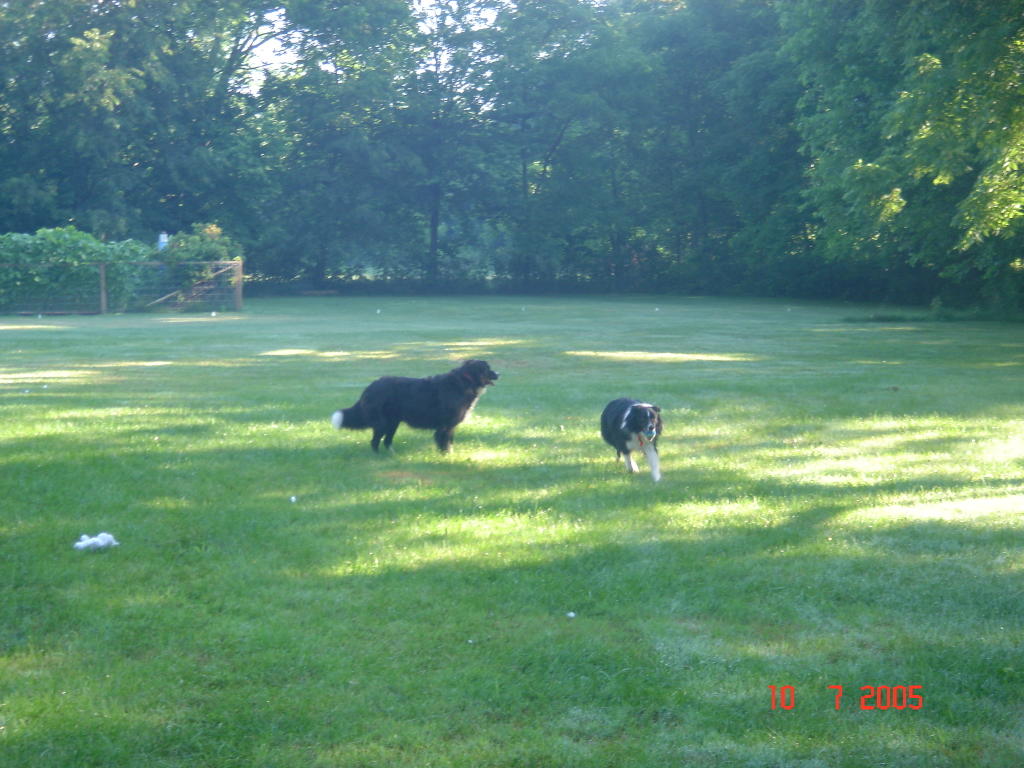
My husband and I have two dogs and I got it in my head that we needed a third. Our older dog is somewhere between 8 and 10 and she's big so likely won't get to be a 20 year old dog. She's a rescue border collie/whatever and smarter than many people I know so I wanted her to train any new dogs we got. Our second dog was a pound dog and is a 3 year old mutt with a sweeter disposition than anybody I know.

Cruising around the web looking at dogs that need new homes is dangerous...I know this because yesterday we introduced the 3rd dog to the household (4 cats, 45 fish). Photo is dog 1 (left) and dog 3 (right).

So, there you go. A post that has nothing at all to do with libraries, environmental scans, content consumption habits...nada. Not even any links. This is my real life.

Thursday, July 07, 2005

The Fourth Literacy

If you had time to read the newspaper this morning, you might have seen an Associated Press item reporting on the big kahuna of testing organizations Educational Testing Service work to create a test to evaluate what ETS is calling the "fourth literacy", which is Internet intelligence, measuring whether students can locate and verify reliable online information and whether they know how to properly use and credit the material.

I'd think that any librarian teaching information literacy will want to take a look at the test as it looks like the competencies/literacies being evaluated are among the ones librarians teach. Perhaps the good news is that the efforts of teaching librarians will receive more institutional support as a result.

The ETS announcement references Connected to the Future, a study from the Corporation for Public Broadcasting, that was underwritten by ETS, Bell South, and Kodak (an interesting group of underwriters).

Posts to IAG might be sparse for a week or so because both George and Alice are off with limited access to the Internet.

Tuesday, July 05, 2005

Dodgy Stuff

I am with Alice.....I did not like Chris Dodge's Utne Reader article at all. I didn't disagree with all his points but I definitely did not like how it was written.

It's all well and good to revere Sandy Berman and the work he did at Hennepin County Library (and continues to do on his own) but to use that as an optic for a supposedly big picture article on the future of public libraries is a bit much--and disingenuous.

Ordinary people do not search subject headings, Berman or LCSH. They search key words. Using Dodge's example of "menstrual cramps" (whaa-aa? Couldn't he think of a better phrase than this?) as a bound phrase in the keyword index of WorldCat, I got 29 records, not the one German-language item Chris's subject search revealed. Using the "libraries" limiters on Yahoo! and Google I still found 10 items (Yahoo!) and 18 (Google) served up through Open WorldCat.

So, I say Chris Dodge should have done his homework instead of indulging in low-level scaremongering. Mind you, Utne lost my respect and my subscription back in the late 90s when they published a booklet on how to survive Y2K that was full of the silliest, most uninformed drivel about the "potentially enormous and unknown global challenge ."

I am much fonder of this vision of the future of libraries which includes "Die Bibliothèque d'amis: an intimate public library for friends, which provides space for a good conversation about literature."

Addendum @8:35pm EDT: My husband--bless his pragmatist soul--pointed out that few ordinary people would be searching for whole books on menstrual cramps. A researcher or scientist would use the formal term and those of us who might suffer would be looking for much more immediate information than could be found in books.

Utne not me

Just was forwarded and read an article from Chris Dodge in the Utne Reader with which I disagree completely. On just about every level.

It appears gilded with half-truths and Nicholson Baker quotes, calculated to make the average American reader think that libraries and librarians should remain firmly rooted in the 1950's. Rrrr.

Whatever. Read the article for yourself and let me know if my nose is out of joint unnecessarily.

Knowledge for Sale?

Friday, July 01, 2005

Hasta la vista, Bloggers!

Like Lili Von Shtupp in Blazing Saddles, I'm tired. Just not for the same reason, unfortunately. (BTW, that link is rated PG-13.)

Therefore, I'm off for a week of R & R, visiting my folks in the neighborhood where I grew up in Buffalo, the Shaw Festival in Niagara on the Lake, Ontario, and Toronto. I'll be back to blogging the week of July 11.

For our Canadian friends, Happy Canada Day! To our US friends, to quote Margo Channing, "Fasten your seatbelts. It's going to be a bumpy night."

Love your Library license plates


One of the metalibrarians at the OCLC Information Center kindly sent this hunk of fun stuff yesterday. I guess our advocacy message is reaching presidents, provosts, mayors, city councilpeople...and DMV employees.

Here's the clip from Birdie at lisnews.com:

You've gotta love the DMV now that they've issued a sentimental "Love Your Library" license plate. The plate, which features a design consisting of various library resources to the left of the plate number and includes the words "READ - LEARN - EXPLORE," is available to anyone who has a passenger or commercial vehicle registered in New York State (and who can afford an additional $43 over the cost of a regular plate). Here's the press release from Empire Information Services.
The new license plate gives New Yorkers the chance to show their support for libraries by helping to subsidize summer reading programs.

Good stuff.
And P.S. George's birthday is this weekend, so be sure to leave him celebratory comments!

Canada Day

Formerly known as Dominion Day, July 1 is Canada Day. Think you know anything about Canada? You can take a quiz here. Don't feel bad if you don't get the answer to this question correct--only 8% of Canadians taking the quiz were correct.

Who is Canada's head of state?* No it's not him. And it's not her.

Perhaps because I had to study for my citizenship exam 20 years ago, I found myself in the top category for correct answers and as a result I "have qualified for the John A. Macdonald Chair for Advanced Historical Drinking at the Dominion Institute. Please show up at our offices Monday morning for a plate of leftover Haggis and some 138-year-old single malts!"

Happy Canada Day to Canadians everywhere.

* The correct answer is here.